Hershey's 5 cent bar and the cannabis sector's race to the bottom
As Hershey's revives its 5 cent bar, the cannabis sector scrambles for its own nostalgic discount offerings, hoping a blast from the past will revive penny stock dreams.
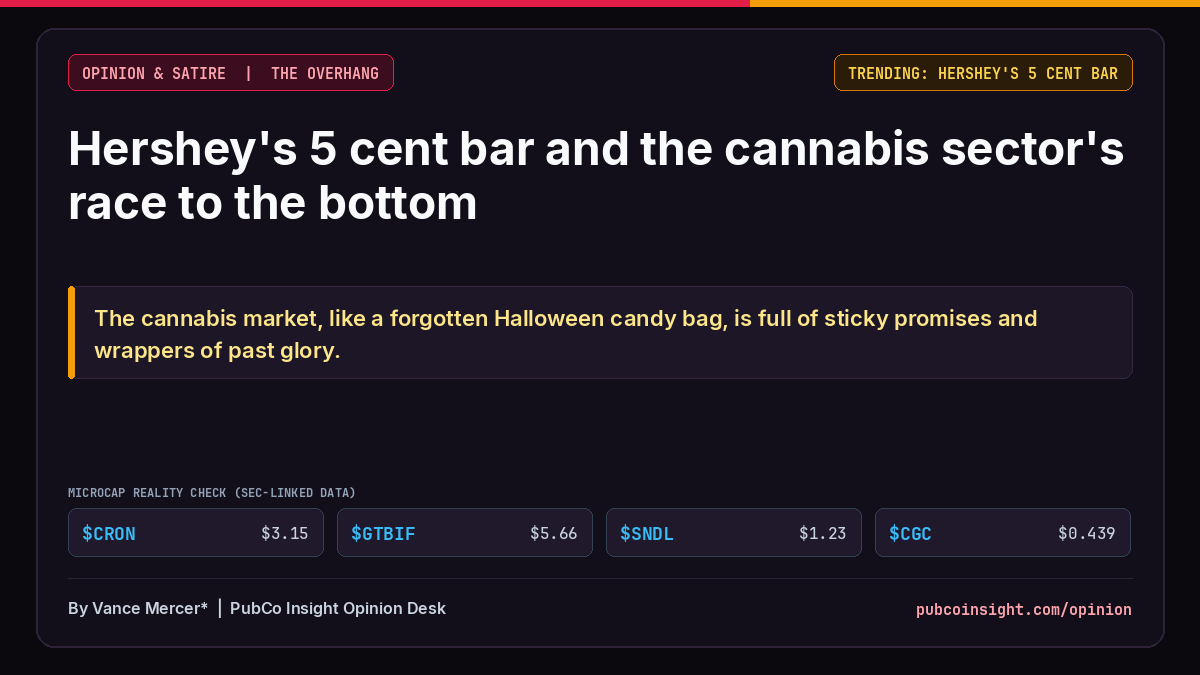
The sweet scent of nostalgia is wafting through the air, thanks to Hershey’s 5 cent bar making a limited-time comeback. For a brief, glorious moment, consumers can pretend it’s 1960 again, when a nickel could buy you a chocolatey escape. It's a marketing stunt, of course, a clever way to generate buzz and remind everyone of simpler times. But for those of us watching the small-cap cannabis market, the return of the 5 cent bar feels less like a delightful throwback and more like a grim premonition.
Because while Hershey’s is selling a dream of affordability, the cannabis sector is living a nightmare of it. These companies aren't offering 5 cent products as a promotional gimmick; they're seeing their stock prices approach that level as a matter of course. The entire industry, once touted as the next gold rush, now looks more like a yard sale where everything must go, and the price tags keep getting smaller.
The initial promise of cannabis legalization was intoxicating. Investors, high on hopium, poured billions into companies with grand visions of national empires and endless growth. The narrative was simple: weed would be everywhere, everyone would buy it, and early investors would be swimming in green. Fast forward a few years, and the reality is far more sobering. Regulatory hurdles, market saturation, and a relentless race to the bottom on pricing have turned many a cannabis dream into a penny stock nightmare.
The Penny Stock Paradox: Nostalgia vs. Reality
The irony is rich. While Hershey's leverages nostalgia for a five-cent treat, cannabis companies would kill for their stock to trade consistently above a nickel. Take Canopy Growth Corporation (CGC), for instance. Once a darling, it closed recently at $0.439, with a 30-day average dollar volume of $1.7M. Its latest 8-K filing on November 6, 2026, probably didn't announce a 5-cent joint promotion, but perhaps it should have. At this rate, they might need one just to get some retail investor attention.
Then there's SNDL Inc. (SNDL), trading at $1.23, with a 30-day average dollar volume of $1.6M. Their latest 6-K filing, dated November 23, 2026, likely detailed some strategic pivot or another, but the market's response suggests investors are more interested in what can be bought for pocket change. Even Cronos Group Inc. (CRON), a Nasdaq-listed player, is at $3.15 with a $3.9M average dollar volume, its latest 4 filing from November 12, 2026, probably outlining some executive compensation that feels wildly out of sync with shareholder returns.
These aren't just numbers; they're tombstones for shattered expectations. The "green rush" has become a "red ink" bath for many. The market is awash in product, competition is fierce, and the path to profitability remains as hazy as a smoke-filled room. Investors who jumped in early, envisioning a future where their shares would be worth more than a small country's GDP, are now left holding bags heavier than a sack of bricks.
The Dilution Dilemma and Promotion Pitfalls
One of the silent killers in the cannabis sector, and indeed many small-cap markets, is dilution. Companies, perpetually strapped for cash in a capital-intensive industry, often resort to issuing more shares to stay afloat. This constant influx of new paper dilutes existing shareholders, pushing prices down further. It's a vicious cycle: low stock price means more shares need to be issued to raise the same amount of capital, which in turn lowers the stock price even more. You can track some of these trends with tools like the Dilution Risk Tracker.
And let's not forget the endless parade of promotional efforts. From celebrity endorsements that fizzle to optimistic press releases about future growth, the cannabis sector has mastered the art of hype. But when the underlying fundamentals don't support the narrative, even the most aggressive promotion falls flat. Investors, once eager to believe the next big announcement, are now rightly skeptical. The ghost of past promises haunts every new disclosure.
Even companies like Green Thumb Industries Inc. (GTBIF), trading on the OTCQX at $5.66 with a $3.1M average dollar volume, and a 10-Q filed on November 4, 2026, face an uphill battle. While they might be considered a relative success story in this landscape, the broader market sentiment weighs heavily on all players. The dream of uplisting to a major exchange, once a common refrain, now seems like a distant fantasy for many, especially when their stock price barely registers on the Nasdaq screen.
What's Next for the Cannabis Penny Stocks?
So, as Hershey's offers a taste of the past with its 5 cent bar, what's the cannabis sector offering? Perhaps a harsh lesson in market realities. The initial euphoria has worn off, replaced by a grind for survival. The companies that emerge from this shakeout will likely be lean, efficient, and, crucially, profitable. But for many, the path ahead looks more like a desert than a garden of green.
The hope for a "blast from the past" to revive penny stock dreams is a potent one, but it's a fantasy. Unlike a nostalgic chocolate bar, the market doesn't operate on sentiment alone. It operates on revenue, profit, and a clear path to sustainable growth. Until the cannabis sector can consistently deliver on those fronts, investors might find themselves wishing they had just bought a 5 cent Hershey bar instead.
Small-Cap & Microcap Companies Mentioned
| Ticker | Company | Last Close | 30d Avg Vol | Recent Filing |
|---|---|---|---|---|
| CGC | Canopy Growth Corporation | $0.439 | $1.7M | 8-K (2026-11-06) |
| CRON | Cronos Group Inc. | $3.15 | $3.9M | 4 (2026-11-12) |
| GTBIF | Green Thumb Industries Inc. | $5.66 | $3.1M | 10-Q (2026-11-04) |
| SNDL | SNDL Inc. | $1.23 | $1.6M | 6-K (2026-11-23) |
Listed alphabetically as of 2026-11-25. None of the companies named in this column are clients of PubCo Insight or Pulse IR, and no compensation was received in connection with this article.
See the dilution and promotion flags before you see the pitch.
Each week: the micro and small-caps now showing dilution or paid-promotion signals, with the SEC filing behind every flag. No recommendations, no price targets.
News & SEC EDGAR sources (5)
- 5 cent hershey bar (google_trends | Wed, 25 Nov 2026)
- Cronos Group Inc. (CRON) SEC Filing & Hub (PubCo / SEC EDGAR | 2026-11-25)
- Green Thumb Industries Inc. (GTBIF) SEC Filing & Hub (PubCo / SEC EDGAR | 2026-11-25)
- SNDL Inc. (SNDL) SEC Filing & Hub (PubCo / SEC EDGAR | 2026-11-25)
- Canopy Growth Corporation (CGC) SEC Filing & Hub (PubCo / SEC EDGAR | 2026-11-25)