Can't sell your OTC stock? Find out why.
When SEC Rule 15c2-11 tightened, more than 2,000 companies lost their quotes and were pushed to the Expert Market, where most people can no longer buy or sell. If your broker shows a position you cannot trade, this is often the reason. Check your ticker below.
Check my stock
What happened to your shares
Rule 15c2-11 requires a broker-dealer to review current, public information about a company before it can publish a quote. When a company stops filing with the SEC, that information goes stale, market makers pull their quotes, and the security drops to the Expert Market or the Grey Market. Buyers effectively disappear. The company is usually insolvent or dormant, so it has little reason to spend money restoring eligibility, and the shares can stay stuck indefinitely.
Your real options
We will be honest: for a non-reporting, insolvent company, the shares often cannot realistically trade again. That does not mean you have nothing to do. In order of usefulness for most people: document a worthless-securities tax loss if the position qualifies, confirm your holdings with the transfer agent, check whether your shares were escheated to your state as unclaimed property, and understand clearly whether a path back exists. Each of these is a concrete step, and none of it requires hoping the stock comes back.
You cannot sell the shares. You can still document the loss.
For a non-reporting or insolvent company, getting the shares to trade again usually is not realistic. What is left is not a trading problem, it is a paperwork problem. Under IRS Section 165(g), a security that becomes wholly worthless can generally be treated as a capital loss, and that loss can offset capital gains. Whether your position qualifies, and in which tax year, are questions only a qualified tax professional can answer. What this toolkit does is get your evidence file in order before you ask them.
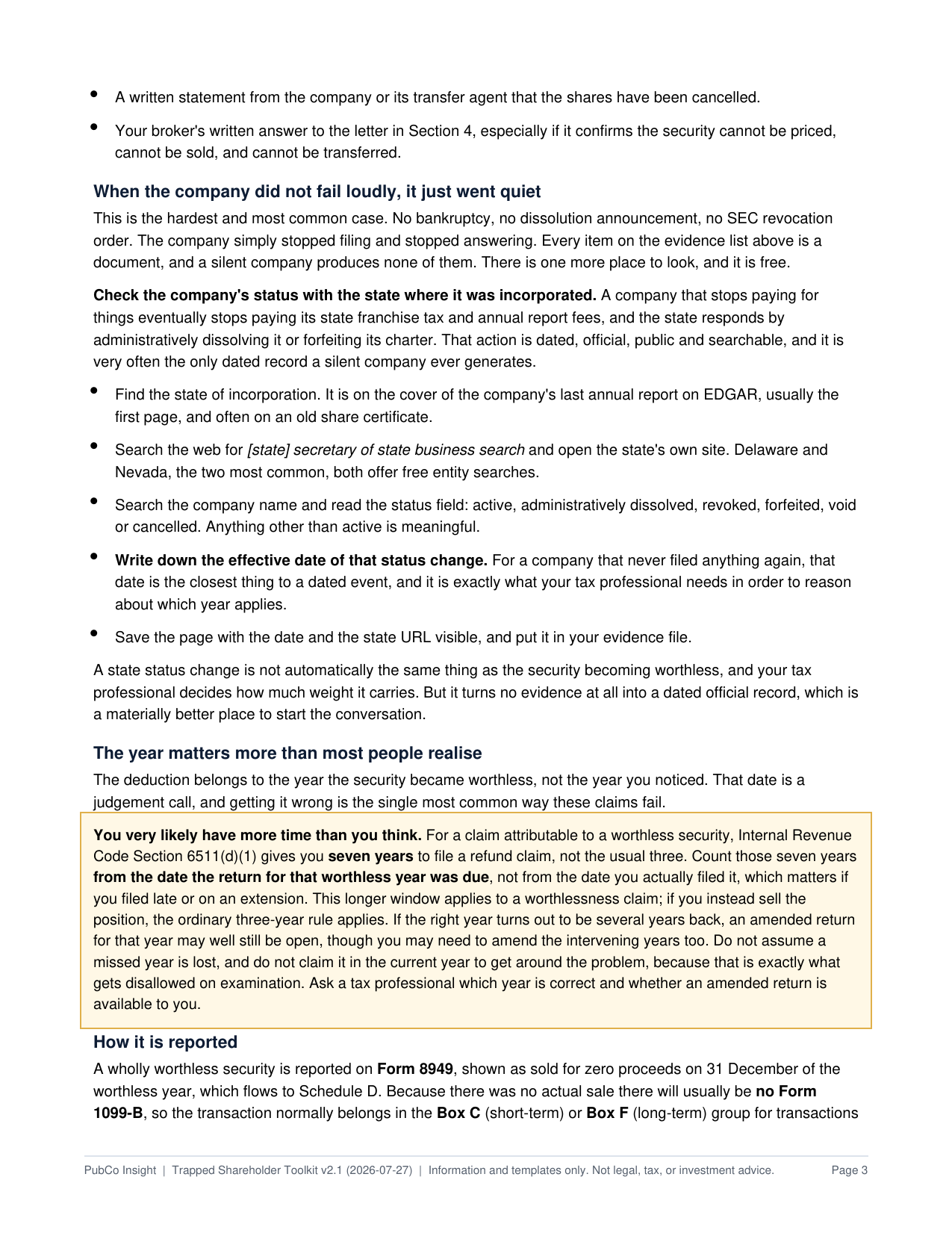
What is inside. Eight pages, nine sections, three ready-to-send letters. The page numbers are the real pages of the PDF, so you know exactly what you are buying:
- The worthless-securities tax-loss section. · pages 2 to 4 What "wholly worthless" actually requires, why the tax year matters more than most people realise, how it is reported on Form 8949 and Schedule D, and the exact evidence list to assemble.
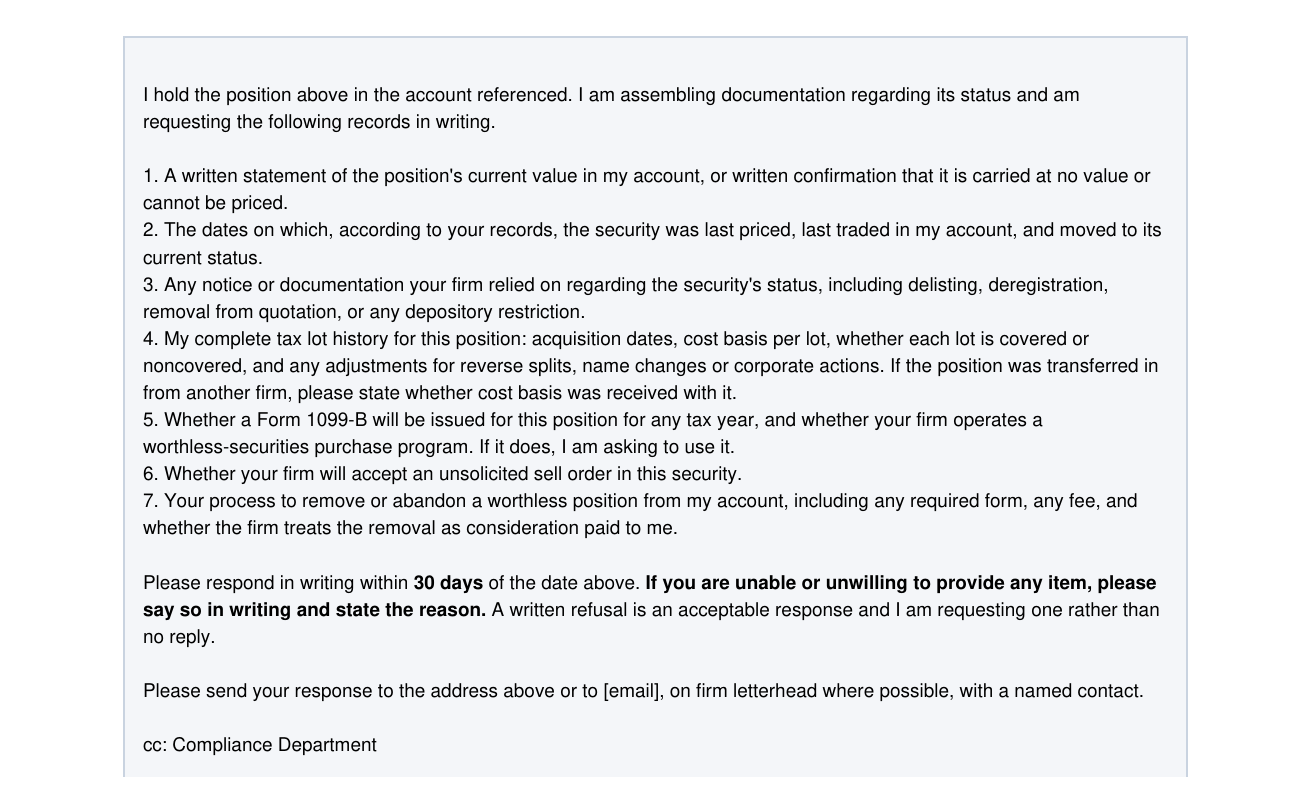
- A broker letter · pages 4 to 5 that requests seven specific named records instead of asking an open question a service rep can deflect, with a 30-day deadline and a copy to Compliance.
- A transfer agent records request · pages 5 to 6 to confirm in writing what you actually own, plus what the lost-certificate route costs and when it is not worth it.
- The escheatment section. · pages 6 to 7 Your shares may already be sitting with your state as unclaimed property. How to search it yourself for free, in every state you have lived in, and why you should never pay a finder who contacts you first.
- An unclaimed-property claim cover note · page 7 listing the documents states typically ask for.
- A decision tree · page 7 that tells you honestly whether a path back exists for your specific situation, and when to stop trying.
Why $29.99 is the easy part of this decision. The people who lose most here lose twice: once on the position, and again by never documenting it properly, or by paying a recovery finder a percentage of their own money. On a dead position of a few thousand dollars or more, whether an organised evidence file is worth doing is not a hard question. We are not your tax professional and we will not pretend to be. We just make sure you walk in with the right file.
Who this is not for: if you think the company is coming back and want someone to agree, this is not that. If your stock is thin but you can still get a fill, you are illiquid, not trapped, and you do not need this.
Eight-page PDF, updated July 2026. Templates and information only, not legal, tax, or investment advice.
Frequently asked questions
What is the Expert Market?
A restricted tier where broker-dealers cannot publish public quotes because the company lacks current information under Rule 15c2-11. Most retail investors and many brokers cannot buy or sell securities there.
Can my trapped shares ever trade again?
Sometimes, if the company resumes current SEC reporting and a market maker restores a quote. But most affected issuers are insolvent or dormant with no incentive to do so, so for many holders the realistic answer is no.
Is the checker free?
Yes. The Check My Stock tool and the guidance on this page are free. The optional document toolkit is a paid product.
See the dilution and promotion flags before you see the pitch.
Each week: the micro and small-caps now showing dilution or paid-promotion signals, with the SEC filing behind every flag. No recommendations, no price targets.