Nvidia Reportedly Eyes Reflection AI, Shifting the Autonomous Security Landscape
A potential acquisition by Nvidia of Reflection AI could reshape the competitive dynamics for small and micro-cap players in autonomous security robotics, especially those focused on AI-driven sensing and decision-making.
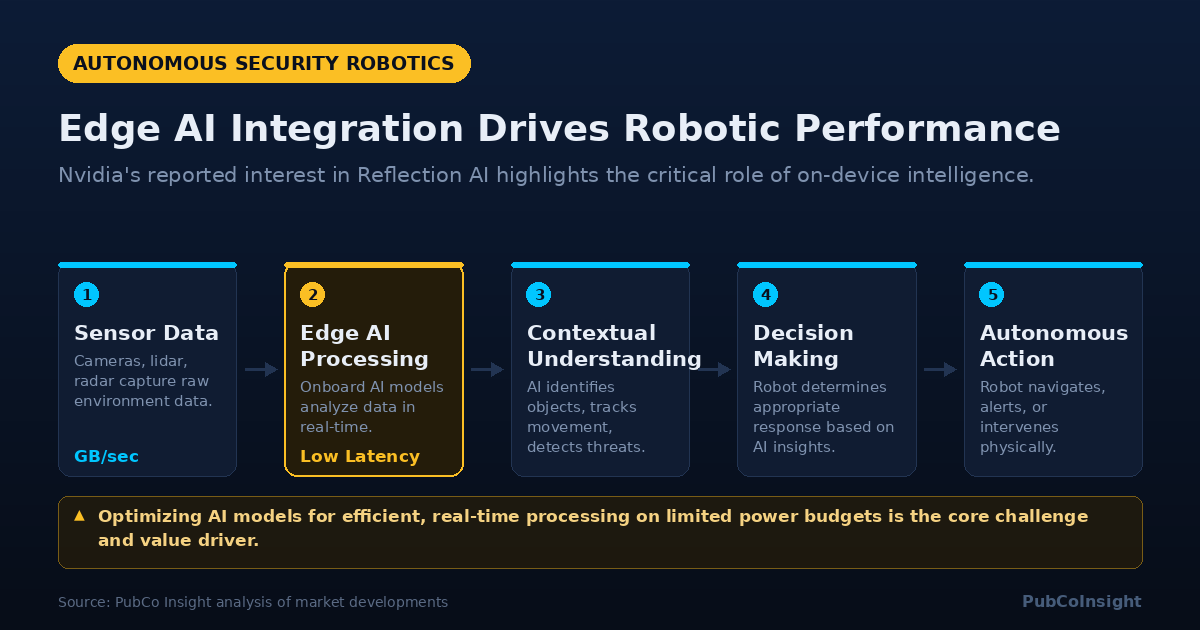
On October 12, 2026, MT Newswires reported that Nvidia is considering an acquisition of Reflection AI. This is more than just market chatter for those of us tracking the autonomous security and physical AI space. Nvidia’s interest signals a potential move to integrate advanced AI capabilities directly into hardware platforms, a strategy that could profoundly impact the value chain for smaller robotics firms. The implications stretch from sensor fusion to on-device inference, touching every company building intelligent machines for guarding services.
Reflection AI specializes in edge AI for real-time environmental understanding and predictive analytics, critical components for autonomous robotic navigation and threat assessment. A move by Nvidia into this specific niche suggests a desire to own more of the intelligent decision-making layer, rather than just supplying the underlying compute power. This could either create new opportunities for hardware partners or intensify competition for those developing proprietary AI stacks.
The Mechanism of AI Integration in Physical Security
Autonomous security robotics relies on a complex interplay of hardware, software, and AI. At its core, a robot needs to perceive its environment, understand what it sees, make decisions, and then act. Perception starts with sensors: cameras, lidar, radar, thermal imagers. These generate raw data, often gigabytes per second, which must be processed at the edge, on the robot itself, to enable real-time responses. This is where edge AI comes in. Instead of sending all data to a central cloud for analysis, the robot’s onboard processors, often Nvidia GPUs or similar accelerators, run AI models to identify objects, track movement, and detect anomalies.
Reflection AI’s reported expertise lies in refining these edge AI models for specific security contexts. This means teaching a robot to distinguish a package delivery from an intrusion, or a stray animal from a human trespasser, with high accuracy and low latency. The difficulty lies in optimizing these complex neural networks to run efficiently on limited power budgets, often in varied environmental conditions, while maintaining robust performance. It is a constant trade-off between model size, computational demand, and accuracy. If Nvidia acquires Reflection AI, it gains not only the intellectual property but also the specialized talent that understands these optimization challenges. This integration could lead to a highly optimized, vertically integrated AI stack, from chip to application, potentially setting a new performance benchmark for autonomous security platforms. The direct impact would be on the cost and performance of the AI component, which is a major driver of both CapEx and OpEx for security robot deployments.
Companies Operating in Autonomous Security Robotics
The autonomous security robotics sector is a diverse field, with companies focusing on various aspects of the technology stack and market applications. Some, like Arbe Robotics Ltd. (ARBE), specialize in specific sensor technologies. Arbe, for instance, focuses on 4D imaging radar solutions, critical for all-weather perception in autonomous systems. Their radar technology aims to provide high-resolution sensing that complements traditional camera and lidar systems, particularly in challenging conditions like fog or heavy rain. This foundational data layer is essential for any advanced AI system.
Other companies are building the physical robots themselves and integrating various AI components. Serve Robotics Inc. (SERV) develops autonomous sidewalk delivery robots, which share many underlying AI and navigation challenges with security robots, including obstacle avoidance and safe urban operation. Their focus is on last-mile logistics, but the core robotic intelligence is transferable. Similarly, Unusual Machines, Inc. (UMAC) designs and manufactures specialized drones and robotic systems, often for industrial and defense applications. Their work in robust, field-deployable autonomous platforms speaks to the hardware engineering required for reliable security operations.
Ondas Inc. (ONDS) operates in the drone and industrial IoT space, with its Ondas Networks subsidiary providing wireless data platforms for mission-critical applications. Their American Robotics subsidiary develops autonomous drone systems for industrial inspection and security. Ondas recently added $165 million in new orders, boosting 2027 revenue visibility, demonstrating traction in deploying autonomous platforms for enterprise clients. Red Cat Holdings, Inc. (RCAT) also focuses on drone technology, including hardware and software for various applications, from defense to commercial inspection, often leveraging AI for image analysis and autonomous flight.
On the AI and software side, BigBear.ai Holdings, Inc. (BBAI) provides AI-powered analytics and decision intelligence solutions, primarily for government and defense clients. Their expertise lies in processing vast datasets to derive actionable insights, a capability that is increasingly vital for comprehensive security monitoring. Lantronix, Inc. (LTRX) offers intelligent edge computing and connectivity solutions, enabling devices to communicate and process data at the network edge. Their platforms are crucial for integrating diverse sensors and robotic systems into a cohesive security network.
Sensor and display technologies are also key. MicroVision, Inc. (MVIS) develops lidar sensors for automotive safety and advanced driver-assistance systems, technology with direct application in autonomous navigation for security robots. Kopin Corporation (KOPN) specializes in microdisplays and display sub-systems, including augmented reality and virtual reality components. Kopin recently secured an additional $18.6 million US Army contract for color MicroLED technology, indicating their role in advanced visualization for human-machine interfaces, which could be relevant for remote operation and monitoring of security robots.
Artificial Intelligence Technology Solutions, Inc.
Artificial Intelligence Technology Solutions, Inc. (AITX) trades on the OTCID tier under the symbol AITX. The company builds and leases autonomous security robots and remote monitoring systems. Its business model centers on a recurring monthly subscription for these services, rather than one-off hardware sales. AITX operates through several subsidiaries: Robotic Assistance Devices, Inc. (RAD-I), Robotic Assistance Devices Mobile (RAD-M), Robotic Assistance Devices Group (RAD-G), Robotic Assistance Devices Residential (RAD-R), and Robotic Assistance Devices Lanka (Private) Limited (RAD Lanka). The company’s primary subsidiary, RAD-I, targets the security and guarding services industry, which it estimates as a $50 billion market in the United States. AITX states its solutions aim to deliver cost savings between 35% and 80% compared to traditional manned security.
The company’s offerings include a suite of stationary and mobile devices, supported by its proprietary software and monitoring platforms. RAD-I focuses on stationary security devices. RAD-M develops mobile autonomous platforms, with early commercial deployment of its ROAMEO mobile security unit commencing in May 2026. RAD-G is responsible for the SARA agentic artificial intelligence platform, which AITX intends to license for substantial revenue. RAD Lanka, a wholly owned subsidiary in Sri Lanka operating under Port City Colombo status, provides software development, AI initiatives, and technical operations support across the company. AITX refers to its long-term vision as "RAD Town," an integrated autonomous-security deployment across a campus, community, or jurisdiction.
For the fiscal year ended February 28, 2026, AITX reported revenue of $7,745,336, a 26% increase year-over-year. Gross profit rose 48% to $5,533,700, expanding gross margin to approximately 71% from 61%. Operating expenses remained flat at approximately $17,477,097, and the loss from operations improved by approximately $2.0 million to $(11,943,397). The company reported a net loss of approximately $14.5 million for the fiscal year ended February 28, 2026, with an accumulated deficit of approximately $171 million as of that date. The public record does not yet establish consistent positive cash flow from operations. For the year ended February 28, 2026, AITX had negative cash flow from operating activities of $9,344,534. As of February 28, 2026, the company had negative working capital of $17,017,745. Management does not anticipate having positive cash flow from operations in the near term. Recent 8-K filings from October 7 and October 6, 2026, indicate a substantial property management relationship developed from small orders and a third ROAMEO order from a global logistics client, respectively.
What to watch
The reported Nvidia interest in Reflection AI creates a specific set of items to monitor. First, watch for any official confirmation or denial of the acquisition by Nvidia or Reflection AI. A definitive announcement would clarify Nvidia’s strategic intent. Second, observe how other major chip manufacturers and AI developers respond. Competitors may accelerate their own edge AI development or seek similar acquisitions to maintain parity. Third, track the product roadmaps of autonomous security robotics firms. Any new partnerships or integrations with Nvidia’s AI platforms, or conversely, a shift away from Nvidia hardware, would indicate market adjustments. Specifically, look for announcements of new AI model releases or hardware integrations that leverage advanced edge processing capabilities. Finally, watch for any changes in the competitive landscape for AI software licensing in the autonomous security space, as a consolidated Nvidia-Reflection AI could alter pricing or availability for third-party developers.
, { "label": "Edge AI Processing", "note": "Onboard AI models analyze data in real-time.", "metric": "Low Latency" }, { "label": "Contextual Understanding", "note": "AI identifies objects, tracks movement, detects threats." }, { "label": "Decision Making", "note": "Robot determines appropriate response based on AI insights." }, { "label": "Autonomous Action", "note": "Robot navigates, alerts, or intervenes physically." } ], "highlight": 1, "highlight_note": "Optimizing AI models for efficient, real-time processing on limited power budgets is the core challenge and value driver.", "footnote": "Source: PubCo Insight analysis of market developments" }Companies mentioned
| Ticker | Company | Price |
|---|---|---|
| AITX client | Artificial Intelligence Technology Solutions Inc | $0.0022 |
| ARBE | Arbe Robotics Ltd. | $0.55 |
| BBAI | BigBear.ai Holdings, Inc. | $2.39 |
| KOPN | Kopin Corporation | $4.46 |
| LTRX | Lantronix, Inc. | $6.85 |
| MVIS | MicroVision, Inc. | $1.2 |
| ONDS | Ondas Inc. | $6.73 |
| RCAT | Red Cat Holdings, Inc. | $5.77 |
| SERV | Serve Robotics Inc. | $4.35 |
| UMAC | Unusual Machines, Inc. | $20.83 |
Listed alphabetically, not ranked. Prices as of 2026-10-12 and they move. Check a live quote before relying on any of this.
How we chose the companies in this article
We cover a fixed universe of companies working in autonomous security robotics, physical AI and the guarding services market they are aimed at. Every one of them that had usable market data on 2026-10-12 appears in this article. We do not pick which ones to mention based on what we think of them, and we do not order them by size, price or trading volume, because an ordered list is a verdict and that is not ours to hand down. Companies left out, and why: none. American Lithium Minerals and Artificial Intelligence Technology Solutions pay us, which is disclosed in full at the foot of every article they appear in.
See the dilution and promotion flags before you see the pitch.
Each week: the micro and small-caps now showing dilution or paid-promotion signals, with the SEC filing behind every flag. No recommendations, no price targets.
Sources used in this article
- Vanguard's S&P 500 Fund Has Raised Its Payout 71% Since 2016. Its Yield Has Nearly Halved. Motley Fool · 2026-10-12
- What the Fed Warning Means for Stock Market Investors Based on Historical Trends Motley Fool · 2026-10-12
- Prediction: IonQ Stock Will Double by the End of 2027 Motley Fool · 2026-10-12
- Bloom Energy Stock Has Fallen 20% or More 5 Times Since September 2025. It Recovered From 4 Within Weeks. Motley Fool · 2026-10-12
- Most Tokenized Stock Trading Happens Outside U.S. Market Hours, IMF Finds Unchained · 2026-10-12
- Mark My Words: ASML Stock Is the Most Overlooked Way to Play the AI Infrastructure Boom Motley Fool · 2026-10-12
- These 2 AI Stocks Have Stumbled. Now They May Soar Nearly 75%, According to Wall Street. Motley Fool · 2026-10-12
- Market Chatter: Nvidia Considering Acquisition of Reflection AI MT Newswires · 2026-10-12
- Heed Warren Buffett's Advice: The Time to Be Fearful When Others Are Greedy Has Officially Arrived Motley Fool · 2026-10-12
- I'm Not Selling Bloom Energy Before Earnings. Here's the 1 Number I'm Watching. Motley Fool · 2026-10-12
- Axon Enterprise vs. Turning Point Brands: Which Slumping Stock Is a Better Rebound Candidate Right Now? Motley Fool · 2026-10-11
- Axon’s CFO Expects Q4 to Be Its Fastest-Growing Quarter of 2026. Here’s Where the Stock Could Go by 2030 TIKR · 2026-10-11
Disclosure required by Section 17(b) of the Securities Act of 1933
Artificial Intelligence Technology Solutions, Inc., a Nevada corporation (OTCID: AITX). Artificial Intelligence Technology Solutions, Inc. pays Strategic Innovations First, Inc., a Wyoming corporation doing business as PulseIR. Compensation received: USD 5,000.00 per month for months 1-3 (August, September, October 2026); USD 10,000.00 per month for months 4-6 (November, December 2026, January 2027) contingent on the 90-day review. Minimum committed USD 15,000.00; USD 45,000.00 if the second-period rate triggers.. Form of payment: cash only, invoiced monthly in advance; no stock, options or warrants received or payable. Services: investor relations services under an Investor Relations Services Agreement effective 2026-08-01. Period: six month term, 2026-08-01 through 2027-01-31; 90-day review on or about 2026-10-30. No stock, options or warrants held by PubCo Insight, Pulse IR, Strategic Innovations First, Inc., or Brad Listermann. Confirmed by the executed agreement and by board record recKwdq39X2caPSX7 (POSITIONS HELD: none).
This is information, not investment, financial, legal or tax advice. It is not a recommendation or solicitation to buy, sell or hold any security and it contains no price target. Nothing here is independently verified by us. Confirm every figure against primary filings on SEC EDGAR before you act. Micro-cap and over-the-counter securities are speculative and illiquid and can lose all of their value. The companies named without a disclosure above pay us nothing and have no relationship with us; they are named because a published, mechanical screen selected them. Full disclosure policy.