Ondas acquires Aran Defense, pushing autonomous robotics into sovereign security
The $33 million acquisition of Aran Defense by Ondas on August 18, 2026, signals a strategic pivot for autonomous security robotics from commercial guarding to national defense, particularly in the Israeli market.
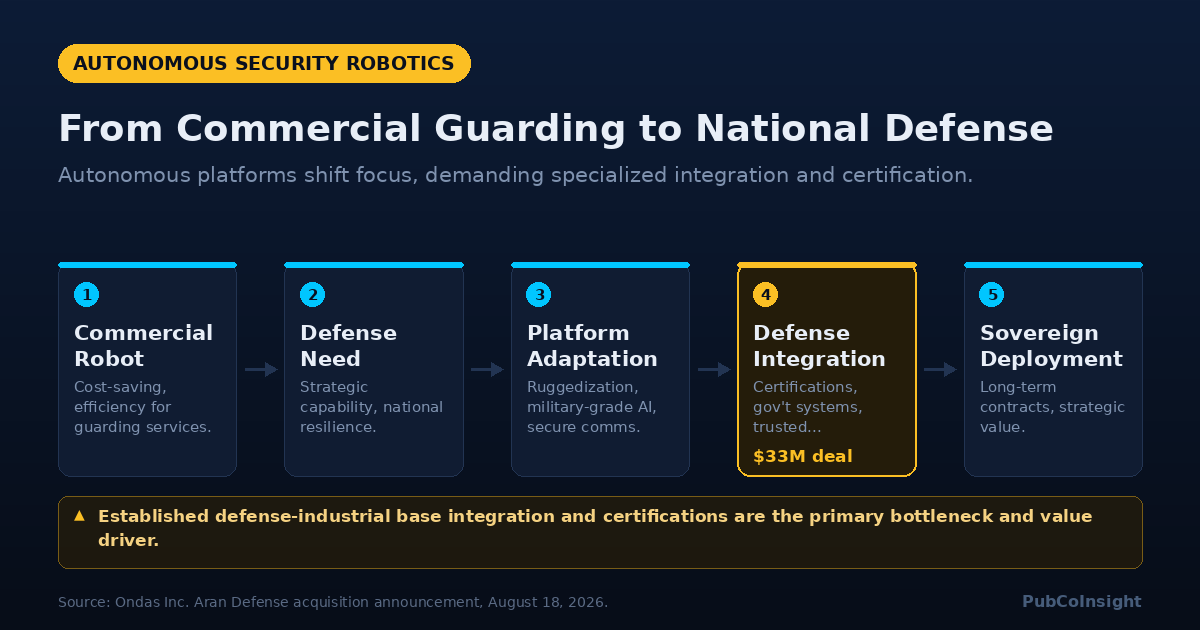
The Mechanism of Defense Integration
Integrating autonomous security robotics into a national defense framework involves several distinct stages, each with its own technical and commercial challenges. First, the core robotic platform must demonstrate ruggedness and reliability beyond typical commercial requirements. This includes operation in extreme weather, varied terrain, and potentially contested environments. Second, the AI and sensor suites need to be adaptable for military-specific applications, such as advanced threat detection, target identification, and secure communication protocols. This often means specialized payloads, encrypted data links, and robust anti-jamming capabilities. Third, and critically, is the regulatory and certification pathway. Defense contracts are not won through simple tenders. They require adherence to national defense standards, often involving multi-year testing and validation cycles. For a company like Ondas, acquiring Aran Defense provides a shortcut to this established trust and expertise within the Israeli defense sector. Aran Defense likely brings existing certifications, a track record of successful deployments, and relationships with key defense stakeholders. Without this, a commercial robotics firm faces a steep climb to penetrate sovereign markets, requiring significant investment in compliance, lobbying, and bespoke development. The value sits in the pre-existing defense-industrial base integration, not just the hardware. This integration would be disproven if Aran Defense's existing defense contracts or certifications prove non-transferable or insufficient for future strategic projects.Companies Operating in This Sector
The autonomous security robotics market includes a range of players, from those focused on commercial guarding to those with dual-use or defense-specific applications. Ondas (ONDS), with its recent acquisition of Aran Defense, is making a clear move into the latter. Ondas has historically developed and marketed autonomous drone and data solutions, including its SkyKnight platform, which can provide aerial surveillance and data collection. The Aran Defense acquisition, reported on August 18, 2026, positions Ondas to leverage this technology for military and national security purposes within Israel, a market known for its advanced defense industry. Ondas closed at $9.06. Other companies operate across various segments of this market. Serve Robotics Inc. (SERV), trading at $4.55, focuses on last-mile autonomous delivery, recently expanding its network with Grubhub and Wonder, and rolling out Moxi 2.0 through its Diligent Robotics subsidiary. While primarily commercial, the underlying autonomous navigation and object recognition technologies share common ground with security applications. Red Cat Holdings, Inc. (RCAT), priced at $10.205, specializes in drone technology, including its Teal Drones subsidiary which has supplied drones to the U.S. Department of Defense. This demonstrates an existing pathway for commercial drone technology into defense applications. In the sensor and AI component space, companies like MicroVision, Inc. (MVIS), at $1.795, develop LiDAR and micro-display solutions critical for autonomous navigation and perception. Kopin Corporation (KOPN), trading at $5.04, recently formed a joint steering committee with Fabric.AI, led by Kopin CEO Michael Murray, to expand engagement for its Neural I/o™ technology. Kopin's focus on high-performance micro-displays and neural processing units is foundational for advanced AI vision systems in any autonomous platform. Arbe Robotics Ltd. (ARBE), priced at $0.814, designs radar perception chipsets that enhance autonomous vehicle safety and navigation. These component providers are crucial enablers for both commercial and defense robotics. Further up the stack, companies like BigBear.ai Holdings, Inc. (BBAI), at $3.12, provide AI-powered analytics and decision intelligence, often for government and defense clients. Lantronix, Inc. (LTRX), at $6.28, offers secure data access and management solutions, essential for the reliable operation and data integrity of autonomous systems. Unusual Machines, Inc. (UMAC), trading at $30.58, is a micro-cap participant in the broader robotics and automation sector, recently participating in Sidoti's August Micro-Cap Virtual Conference. These companies demonstrate the diverse ecosystem of hardware, software, and services that underpin the autonomous security robotics market, with varying degrees of exposure to defense applications.Artificial Intelligence Technology Solutions, Inc.
Artificial Intelligence Technology Solutions, Inc. (AITX), trading on the OTCID tier at $0.0053, develops and leases autonomous security robots and remote monitoring systems. The company operates through a "Solutions-as-a-Service" model, generating recurring monthly subscription revenue. Its primary subsidiary, Robotic Assistance Devices, Inc. (RAD-I), targets the commercial security and guarding services market, which the company estimates to be a $50 billion market in the United States. AITX states its solutions aim for 35% to 80% cost savings compared to traditional manned security. AITX's operations are structured around three main pillars. First, stationary security devices through RAD-I, which include units like the ROSA platform. The company recently secured a third ROSA order from a property management client, expanding an existing deployment. Second, mobile autonomous platforms through Robotic Assistance Devices Mobile (RAD-M), which includes the ROAMEO mobile security unit. Early commercial deployments of ROAMEO began in May 2026. Third, the SARA agentic artificial intelligence platform through Robotic Assistance Devices Group (RAD-G), which the company intends to license for substantial revenue. RAD Lanka, a wholly-owned subsidiary in Sri Lanka, supports software development and AI initiatives. The company refers to its long-term vision as "RAD Town," an integrated autonomous-security deployment across a campus or jurisdiction. For the fiscal year ended February 28, 2026, AITX reported revenue of $7,745,336, a 26% increase over the prior year. Gross profit rose 48% to $5,533,700, and gross margin expanded to approximately 71%. Operating expenses remained flat at around $17,477,097, leading to an improved loss from operations of $(11,943,397). The company reported a net loss of approximately $14.5 million for the fiscal year and had an accumulated deficit of approximately $171 million as of that date. The public record does not yet establish a clear path to sustained positive cash flow from operations, as the company reported negative cash flow from operating activities of $9,344,534 for the year ended February 28, 2026. AITX's filings indicate management does not anticipate positive cash flow from operations in the near term. The company's strategy hinges on continued pricing acceptance, stable input costs, and manufacturing scale to achieve projected gross margins for its subscription and outright sales.What to watch
Investors should monitor the integration timeline for Ondas's acquisition of Aran Defense. Specific announcements regarding new defense contract awards or expanded deployments of Aran Defense's technology, particularly within the Israeli defense sector, will be key. Look for details on how Ondas plans to leverage its existing drone and data solutions with Aran Defense's established defense capabilities. For Serve Robotics, watch for further expansion announcements beyond the Grubhub and Wonder partnerships. The rollout of Moxi 2.0 by Diligent Robotics, a Serve Robotics company, will indicate operational scaling. For Artificial Intelligence Technology Solutions, Inc., observe the growth in subscription counts and recurring monthly revenue figures in upcoming quarterly reports. Specific deployments of ROAMEO units and any announced licensing agreements for the SARA platform will be important. Also, monitor the company's progress towards reducing its accumulated deficit and achieving positive cash flow from operations, as these are critical for long-term financial stability., { "label": "Defense Need", "note": "Strategic capability, national resilience." }, { "label": "Platform Adaptation", "note": "Ruggedization, military-grade AI, secure comms." }, { "label": "Defense Integration", "note": "Certifications, gov't systems, trusted relationships.", "metric": "$33M deal" }, { "label": "Sovereign Deployment", "note": "Long-term contracts, strategic value." } ], "highlight": 3, "highlight_note": "Established defense-industrial base integration and certifications are the primary bottleneck and value driver.", "footnote": "Source: Ondas Inc. Aran Defense acquisition announcement, August 18, 2026." }Companies mentioned
| Ticker | Company | Price |
|---|---|---|
| AITX client | Artificial Intelligence Technology Solutions Inc | $0.0053 |
| ARBE | Arbe Robotics Ltd. | $0.814 |
| BBAI | BigBear.ai Holdings, Inc. | $3.12 |
| KOPN | Kopin Corporation | $5.04 |
| LTRX | Lantronix, Inc. | $6.28 |
| MVIS | MicroVision, Inc. | $1.795 |
| ONDS | Ondas Inc. | $9.06 |
| RCAT | Red Cat Holdings, Inc. | $10.205 |
| SERV | Serve Robotics Inc. | $4.55 |
| UMAC | Unusual Machines, Inc. | $30.58 |
Listed alphabetically, not ranked. Prices as of 2026-08-19 and they move. Check a live quote before relying on any of this.
How we chose the companies in this article
We cover a fixed universe of companies working in autonomous security robotics, physical AI and the guarding services market they are aimed at. Every one of them that had usable market data on 2026-08-19 appears in this article. We do not pick which ones to mention based on what we think of them, and we do not order them by size, price or trading volume, because an ordered list is a verdict and that is not ours to hand down. Companies left out, and why: none. American Lithium Minerals and Artificial Intelligence Technology Solutions pay us, which is disclosed in full at the foot of every article they appear in.
See the dilution and promotion flags before you see the pitch.
Each week: the micro and small-caps now showing dilution or paid-promotion signals, with the SEC filing behind every flag. No recommendations, no price targets.
Sources used in this article
- David Tepper Just Made a $107 Million Bet on Top AI Stock. George Soros Is Holding Puts Against It. 24/7 Wall St. · 2026-08-19
- Dow, S&P 500, Nasdaq Futures Slip As Global Bond Rout Catches Up With Markets: LUNR, MSTR, WYFI, AMLX Stocks In Focus Stocktwits · 2026-08-19
- Elon Musk's SpaceX Stock Just Closed Above Its $135 IPO Price for the First Time in Weeks. Is the Rebound a Buy Signal? Motley Fool · 2026-08-19
- Nuclear Stocks Plunge Tuesday: Oklo Down 5%, Constellation Energy Down 4%, NuScale Down 5% 24/7 Wall St. · 2026-08-19
- Satya Nadella Said Microsoft's Own AI Chips Are Driving Up to 40% Efficiency Gains Over Reliance on OpenAI. Here's Why That Matters for Investors. Motley Fool · 2026-08-19
- Sandisk Is Up More Than 35-Fold in a Year and Sits Nearly a Third Below Its Peak. History Says What Comes Next. Motley Fool · 2026-08-19
- Apple Shares Jump Tuesday While the Nasdaq Plummets: Here’s Why It Led Magnificent 7 Stocks 24/7 Wall St. · 2026-08-19
- Bank of America doubles down on Nvidia stock despite big risk TheStreet · 2026-08-19
- Fed Chair Kevin Warsh Testified to Congress That the Fed Has "Only a Target, and It's 2%," Rejecting Any Soft Inflation Goal. What Does That Mean for Rate-Sensitive Stocks? Motley Fool · 2026-08-19
- Why Duolingo Stock Popped Today Motley Fool · 2026-08-19
- Drone Stocks See Limited Losses Tuesday During Nasdaq Sell-Off: Red Cat, Ondas Flat While AeroVironment Tumbles 24/7 Wall St. · 2026-08-19
- Strength in Software & Services Unit Drives AXON: Can the Momentum Sustain? Zacks · 2026-08-18
Disclosure required by Section 17(b) of the Securities Act of 1933
Artificial Intelligence Technology Solutions, Inc., a Nevada corporation (OTCID: AITX). Artificial Intelligence Technology Solutions, Inc. pays Strategic Innovations First, Inc., a Wyoming corporation doing business as PulseIR. Compensation received: USD 5,000.00 per month for months 1-3 (August, September, October 2026); USD 10,000.00 per month for months 4-6 (November, December 2026, January 2027) contingent on the 90-day review. Minimum committed USD 15,000.00; USD 45,000.00 if the second-period rate triggers.. Form of payment: cash only, invoiced monthly in advance; no stock, options or warrants received or payable. Services: investor relations services under an Investor Relations Services Agreement effective 2026-08-01. Period: six month term, 2026-08-01 through 2027-01-31; 90-day review on or about 2026-10-30. No stock, options or warrants held by PubCo Insight, Pulse IR, Strategic Innovations First, Inc., or Brad Listermann. Confirmed by the executed agreement and by board record recKwdq39X2caPSX7 (POSITIONS HELD: none).
This is information, not investment, financial, legal or tax advice. It is not a recommendation or solicitation to buy, sell or hold any security and it contains no price target. Nothing here is independently verified by us. Confirm every figure against primary filings on SEC EDGAR before you act. Micro-cap and over-the-counter securities are speculative and illiquid and can lose all of their value. The companies named without a disclosure above pay us nothing and have no relationship with us; they are named because a published, mechanical screen selected them. Full disclosure policy.