ADT's $15.3 Billion Take-Private Deal Reshapes Security Services Landscape
The acquisition of ADT by Thrive Holdings signals a strategic shift in the guarding services market, with potential implications for autonomous security robotics and physical AI adoption.
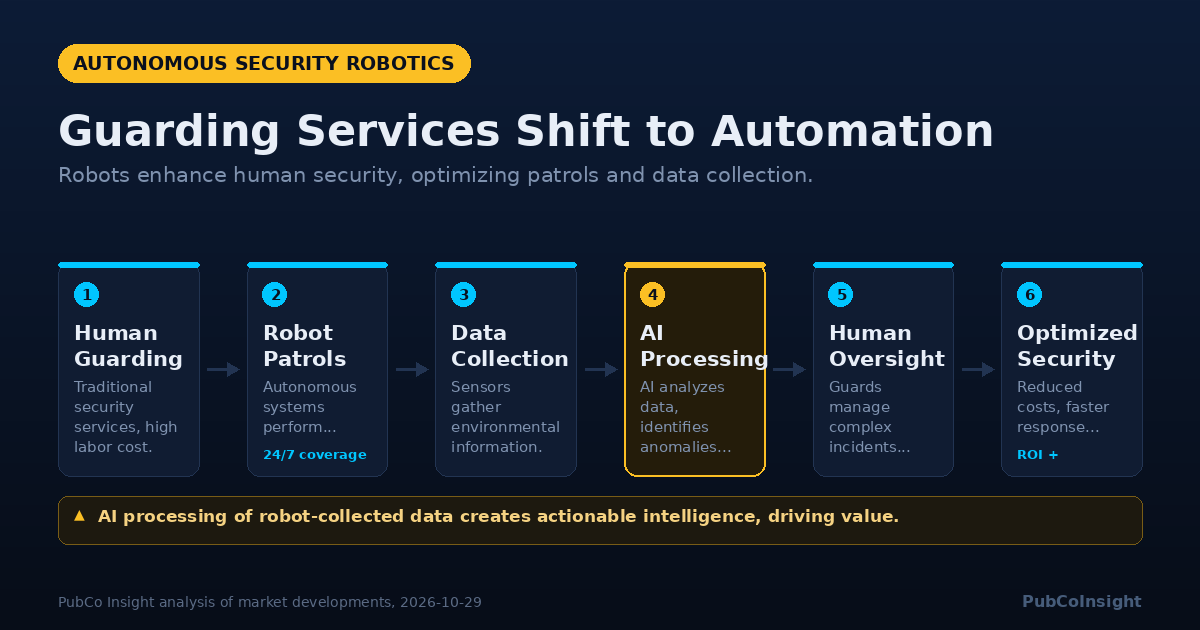
The Mechanism of Disruption in Guarding Services
The traditional guarding services market operates on a labor-intensive model. Human guards patrol properties, monitor surveillance feeds, and respond to incidents. This model faces increasing pressure from rising labor costs, staffing shortages, and the inherent limitations of human vigilance. Autonomous security robots and physical AI systems directly address these pain points. These systems deploy a combination of sensors, cameras, and AI-driven analytics to perform tasks traditionally assigned to human guards. A robot patrolling a warehouse perimeter, for example, can detect anomalies, identify intruders, and alert a remote monitoring center with greater consistency and lower ongoing cost than a human counterpart. The core mechanism of disruption lies in the unit economics: capital expenditure for a robot versus recurring operational expenditure for human labor. The bottleneck for broader adoption often sits not in the technology's capability, but in the integration with existing security infrastructure and the regulatory frameworks governing autonomous operation. Proving the reliability and cost-effectiveness of these systems in real-world scenarios, across diverse environments like corporate campuses, industrial facilities, and logistics hubs, is the critical hurdle. A failure to demonstrate clear ROI or seamless integration would slow market penetration.Operators in the Autonomous Security Sector
Several companies are actively developing and deploying autonomous security solutions, each with a distinct approach. Serve Robotics Inc. (SERV), for instance, focuses on sidewalk delivery robots, a related but distinct segment of physical AI. While not directly in security, their work in autonomous navigation and public interaction informs the broader physical AI landscape. In the drone space, Ondas Inc. (ONDS) develops mission-critical wireless networks and drone solutions. Their subsidiary, American Robotics, focuses on automated drone systems for industrial applications, including surveillance and inspection, which can augment traditional security operations. Similarly, Red Cat Holdings, Inc. (RCAT) provides drone hardware and software, with offerings that extend into defense and public safety, where autonomous aerial surveillance plays a growing role. Companies like Arbe Robotics Ltd. (ARBE) are developing high-resolution radar technology, crucial for advanced perception in autonomous systems. Their radar solutions enhance the ability of robots and vehicles to "see" in adverse conditions, a vital capability for reliable outdoor security patrols. MicroVision, Inc. (MVIS) focuses on lidar technology, another key sensor for autonomous navigation and object detection, essential for robots operating in complex environments. Kopin Corporation (KOPN) manufactures micro-displays and optical components, often used in augmented and virtual reality systems, but also critical for the sophisticated human-machine interfaces and remote viewing capabilities required for advanced robot control and monitoring. Lantronix, Inc. (LTRX) provides secure data access and management solutions, enabling the robust connectivity and data processing necessary for fleets of autonomous security devices. BigBear.ai Holdings, Inc. (BBAI) offers AI-powered analytics and decision intelligence. While not directly building robots, their platforms can process the vast amounts of data generated by autonomous security systems, providing actionable insights for security personnel and enhancing predictive capabilities. Unusual Machines, Inc. (UMAC), a newer entrant, is also operating in the broader robotics and AI sector, though specific details on their security-focused offerings are still emerging.Artificial Intelligence Technology Solutions, Inc.
Artificial Intelligence Technology Solutions, Inc. (AITX) operates through its subsidiaries, focusing on the design, assembly, and leasing of autonomous security robots and remote monitoring systems. The company generates revenue primarily through recurring monthly subscriptions for its deployed devices and associated services. AITX's approach centers on providing a Robotic Assistance Devices (RAD) platform, which integrates hardware and software for a comprehensive security solution. The company's recent filings, including the 10-Q for the six months ended August 31, 2026, indicate a focus on expanding its revenue-earning device base. As of August 31, 2026, AITX reported $4,677,987 in revenue-earning devices, net of accumulated depreciation. Their financial statements show current assets of $3,012,097 and total assets of $8,856,123 at that date. The company has an accumulated deficit of $184,084,880 and negative working capital of $55,894,870 as of August 31, 2026. AITX is actively pursuing funding, with an equity financing agreement in place to purchase up to $10,000,000 of common stock over a three-year period, with approximately $9.8 million remaining under this arrangement. The company's strategy involves growing revenues, utilizing equity proceeds, and issuing debt to support operations. The public record does not yet establish a clear path to sustained positive cash flow from operations. AITX continues to manage a complex debt structure, with numerous promissory notes detailed in its filings, some maturing as early as October 31, 2026. The company's stated plan is to continue its funding methods, including growing revenues and securing additional capital.What to watch
The ADT acquisition by Thrive Holdings is projected to close in the first quarter of 2027. Watch for any public statements from Thrive Holdings regarding ADT's technology roadmap, particularly its stance on autonomous security integration. Any announcements about new pilot programs, increased investment in robotics, or shifts in R&D focus for ADT's security offerings will be significant. For AITX, the upcoming financial reports will be crucial. The company's 10-Q filing for the quarter ending November 30, 2026, is anticipated in early 2027. Investors should monitor the cash flow from operating activities, the accumulated deficit, and any updates on the utilization of the $10 million equity financing agreement. Specifically, look for changes in the number of revenue-earning devices deployed and any progress on debt restructuring, particularly for notes maturing in late 2026 and early 2027. For Ondas, the third quarter 2026 financial results are scheduled for release on November 12, 2026. This will offer insight into their drone and network segment performance. Similarly, Arbe Robotics is set to announce its third quarter 2026 financial results on November 19, 2026, which will provide updates on their radar technology deployments and partnerships., { "label": "Autonomous Robots", "note": "Sensors, AI, consistent monitoring, lower OpEx." }, { "label": "ADT Acquisition", "note": "Thrive Holdings takes ADT private, $15.3 billion deal. Oct 29, 2026." }, { "label": "Strategic Shift", "note": "Private ADT re-evaluates tech adoption and integration." }, { "label": "Market Penetration", "note": "Increased demand for proven robot-as-a-service models." } ], "highlight": 2, "highlight_note": "ADT's new private ownership removes public market pressures, potentially speeding up tech integration decisions.", "footnote": "Source: ADT acquisition announcement, Oct 29, 2026" }Companies mentioned
| Ticker | Company | Price |
|---|---|---|
| AITX client | Artificial Intelligence Technology Solutions Inc | $0.0008 |
| ARBE | Arbe Robotics Ltd. | $0.433 |
| BBAI | BigBear.ai Holdings, Inc. | $2.67 |
| KOPN | Kopin Corporation | $4.03 |
| LTRX | Lantronix, Inc. | $6.38 |
| MVIS | MicroVision, Inc. | $1.44 |
| ONDS | Ondas Inc. | $6.88 |
| RCAT | Red Cat Holdings, Inc. | $5.05 |
| SERV | Serve Robotics Inc. | $2.84 |
| UMAC | Unusual Machines, Inc. | $17.28 |
Listed alphabetically, not ranked. Prices as of 2026-10-30 and they move. Check a live quote before relying on any of this.
How we chose the companies in this article
We cover a fixed universe of companies working in autonomous security robotics, physical AI and the guarding services market they are aimed at. Every one of them that had usable market data on 2026-10-30 appears in this article. We do not pick which ones to mention based on what we think of them, and we do not order them by size, price or trading volume, because an ordered list is a verdict and that is not ours to hand down. Companies left out, and why: none. American Lithium Minerals and Artificial Intelligence Technology Solutions pay us, which is disclosed in full at the foot of every article they appear in.
See the dilution and promotion flags before you see the pitch.
Each week: the micro and small-caps now showing dilution or paid-promotion signals, with the SEC filing behind every flag. No recommendations, no price targets.
Sources used in this article
- Can Axon Stock Jump 50%? Trefis · 2026-10-30
- Is Nu Holdings Stock a Buy Before Its First-Ever Investor Day on Dec. 8? Motley Fool · 2026-10-30
- 'Worrisome': Jim Cramer warns chip stocks have gone 'parabolic' — here are the defensive moves he's making now Moneywise · 2026-10-30
- Jim Cramer sees more pain for beaten-down AI stocks: ‘I think it’s too soon to say the coast is clear’ Moneywise · 2026-10-30
- AMD vs. SpaceX: Here's The Stock I'd Buy Now Motley Fool · 2026-10-30
- US Stock Futures Fall As AMZN, INTC Earnings Trigger Tech Sell-Off: NVDA, RDDT, RIVN, SFM In Focus Stocktwits · 2026-10-30
- Joby Is Buying a Defense Company. Archer Plans to Buy 3 From Boeing. Here's Which Pivot Makes More Sense. Motley Fool · 2026-10-30
- 3 Growth Stocks That Can Outperform Micron in 2027 Motley Fool · 2026-10-30
- Is CoreWeave Stock Increasing Your Market Risk? Trefis · 2026-10-30
- If a Stock Market Correction Is Coming, History Says This 1 Move Has Always Paid Off Big Time Motley Fool · 2026-10-30
- Annaly Pays 75 Cents a Share Each Quarter. 4,000 Shares Would Pay You $1,000 a Month. Motley Fool · 2026-10-30
- Axon Enterprise (AXON) Reports Next Week: Wall Street Expects Earnings Growth Zacks · 2026-10-29
Disclosure required by Section 17(b) of the Securities Act of 1933
Artificial Intelligence Technology Solutions, Inc., a Nevada corporation (OTCID: AITX). Artificial Intelligence Technology Solutions, Inc. pays Strategic Innovations First, Inc., a Wyoming corporation doing business as PulseIR. Compensation received: USD 5,000.00 per month for months 1-3 (August, September, October 2026); USD 10,000.00 per month for months 4-6 (November, December 2026, January 2027) contingent on the 90-day review. Minimum committed USD 15,000.00; USD 45,000.00 if the second-period rate triggers.. Form of payment: cash only, invoiced monthly in advance; no stock, options or warrants received or payable. Services: investor relations services under an Investor Relations Services Agreement effective 2026-08-01. Period: six month term, 2026-08-01 through 2027-01-31; 90-day review on or about 2026-10-30. No stock, options or warrants held by PubCo Insight, Pulse IR, Strategic Innovations First, Inc., or Brad Listermann. Confirmed by the executed agreement and by board record recKwdq39X2caPSX7 (POSITIONS HELD: none).
This is information, not investment, financial, legal or tax advice. It is not a recommendation or solicitation to buy, sell or hold any security and it contains no price target. Nothing here is independently verified by us. Confirm every figure against primary filings on SEC EDGAR before you act. Micro-cap and over-the-counter securities are speculative and illiquid and can lose all of their value. The companies named without a disclosure above pay us nothing and have no relationship with us; they are named because a published, mechanical screen selected them. Full disclosure policy.