Guarding Services Valuations Face Scrutiny After ADT Buyout
The recent ADT acquisition by Thrive Holdings at a contested valuation highlights a growing disconnect in how markets assess traditional guarding services against the emerging autonomous security robotics sector.
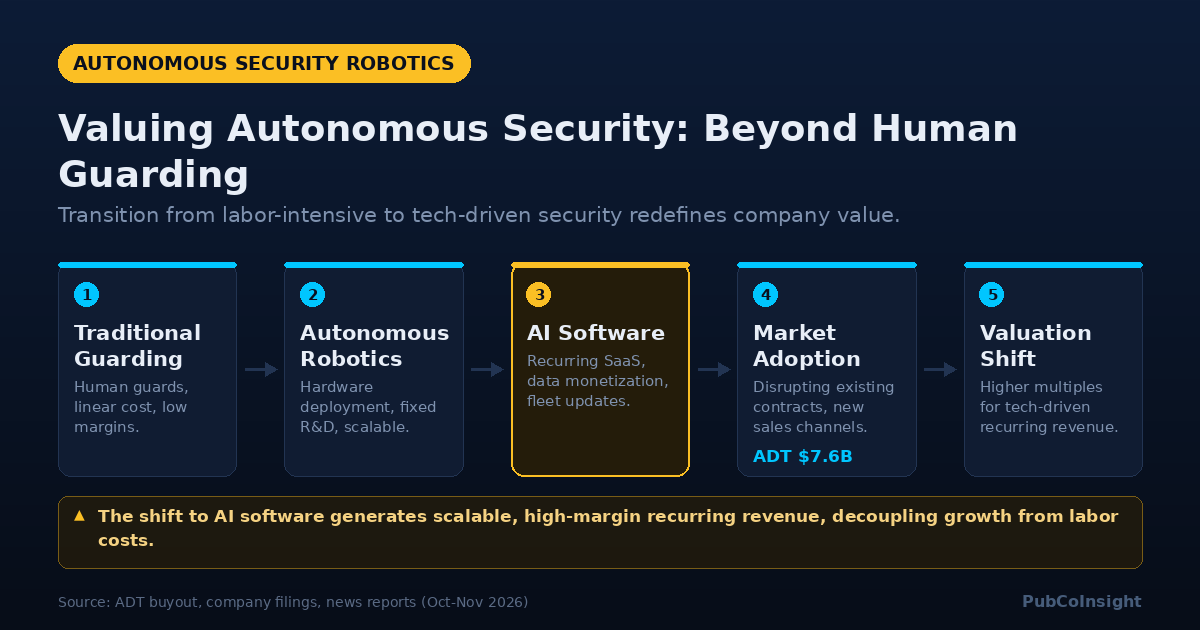
The Mechanism of Value Shift
The shift from traditional guarding to autonomous security fundamentally changes a service provider's cost structure and scalability. A human guard service scales linearly: more contracts mean more guards, more training, more payroll, and more overhead. Profit margins are typically thin, tied directly to labor costs, which are rising. Autonomous security robots, however, operate on a different curve. Once developed, the marginal cost of deploying an additional unit is significantly lower than hiring and training a human. Software updates improve performance across an entire fleet, not just one employee. The value here is in the intellectual property, the recurring software-as-a-service (SaaS) revenue, and the data collected, which can be monetized or used to further enhance the AI. This asset-light model, focused on subscription fees for hardware and software, commands higher multiples in other sectors. For this transition to matter, a company needs a robust, field-proven robotic platform, a clear path to manufacturing scale, and a sales channel capable of disrupting established guarding contracts. The proof will be in the sustained growth of recurring revenue from autonomous deployments, not just pilot programs. Without this, the valuation remains tied to the old, labor-intensive model.Operators in the Autonomous Security Sector
Several companies are navigating this space, each with distinct approaches to the autonomous security market. Ondas Inc. (ONDS), trading at $5.75, announced on October 30 that it is positioning its aerial security portfolio to support the $250 million FEMA Counter-Drone Grant Program. This highlights a focus on government contracts and specialized drone applications, moving beyond ground-based security. Red Cat Holdings, Inc. (RCAT), priced at $4.45, also operates in the drone space, with its shares seeing volatility on October 30 alongside Unusual Machines, Inc. (UMAC), which trades at $14.27. These companies are generally focused on aerial systems, which offer different capabilities and face different regulatory hurdles than ground-based robots. Serve Robotics Inc. (SERV), at $2.51, focuses on last-mile delivery robots, a related but distinct segment of physical AI. While not directly in guarding, its operational model for autonomous ground vehicles shares many underlying technological challenges and opportunities with security robotics. Arbe Robotics Ltd. (ARBE), trading at $0.42, and MicroVision, Inc. (MVIS), at $1.26, are primarily sensor technology providers. Arbe focuses on imaging radar, while MicroVision develops lidar solutions. These components are critical for autonomous navigation and perception, making them key suppliers to the broader robotics market, including security applications. Kopin Corporation (KOPN), at $3.44, develops micro-displays and optical systems, crucial for augmented reality and heads-up displays that might be integrated into advanced robotic control systems or human-robot interfaces. Lantronix, Inc. (LTRX), priced at $5.79, provides secure data access and management solutions, essential for connecting and managing fleets of autonomous robots. BigBear.ai Holdings, Inc. (BBAI), at $2.58, offers AI-powered analytics and decision intelligence, which could be applied to processing the vast amounts of data generated by security robots for threat detection and response.Artificial Intelligence Technology Solutions, Inc.
Artificial Intelligence Technology Solutions, Inc. (AITX), trading at $0.0007, operates through subsidiaries to build and lease autonomous security robots and remote monitoring systems. The company structures its sales as recurring monthly subscriptions. On November 2, AITX's RAD subsidiary launched a campaign to expand the adoption of its SARA AI security platform, positioning its agentic AI security professional as "OpenToWork." Earlier, on October 30, AITX's RAD also targeted the $1.49 billion mobile surveillance tower market with its RAIA platform. The company's most recent substantive filing, a 10-Q for the period ending August 31, 2026, details its financial position. As of August 31, 2026, AITX reported cash of $220,275, accounts receivable of $947,146, and device parts inventory of $1,261,080. Its revenue-earning devices, net of accumulated depreciation, stood at $4,677,987. The filing indicates current liabilities of $58,906,967, including significant current portions of loans payable and accrued interest. AITX had negative cash flow from operating activities of $4,820,842 for the six months ended August 31, 2026, and an accumulated deficit of $184,084,880. Management states a commitment to raising funds, pointing to an equity financing agreement from June 23, 2026, for up to $10,000,000 over three years, with approximately $9.8 million remaining. The public record does not yet establish a clear trajectory for AITX to achieve consistent positive operating cash flow. The company aims to continue operations by growing revenues, utilizing equity proceeds, and issuing debt. Its strategy focuses on placing its autonomous security solutions, such as the SARA AI platform and RAIA mobile surveillance towers, into new market segments.What to watch
Investors should monitor several concrete developments. For ADT, the close of the Thrive Holdings buyout on October 29 means the valuation debate shifts from "if" to "how well" Thrive integrates the acquisition. Watch for any further public statements or filings from ADT or Thrive that clarify the strategic rationale behind the $7.6 billion figure, especially concerning their plans for autonomous security integration. For Axon Enterprise (AXON), Axon's Q3 results, due November 3, and its November 5 earnings report will be critical, as TIKR noted on November 1 that the company needs "really attractive growth" to justify its current valuation. Specifically, listen for details on the impact of its body camera launch, which Simply Wall St. on October 31 called a "game changer." For Ondas (ONDS), its Q3 2026 financial results, scheduled for November 12, will provide an update on its defense platform and backlog growth, particularly its engagement with the FEMA Counter-Drone Grant Program. For Artificial Intelligence Technology Solutions (AITX), look for updates on the expansion of its SARA AI security platform adoption and any new contracts for its RAIA mobile surveillance towers, particularly details on recurring revenue growth in its upcoming filings., { "label": "Autonomous Robotics", "note": "Hardware deployment, fixed R&D, scalable." }, { "label": "AI Software", "note": "Recurring SaaS, data monetization, fleet updates." }, { "label": "Market Adoption", "note": "Disrupting existing contracts, new sales channels.", "metric": "ADT $7.6B" }, { "label": "Valuation Shift", "note": "Higher multiples for tech-driven recurring revenue." } ], "highlight": 2, "highlight_note": "The shift to AI software generates scalable, high-margin recurring revenue, decoupling growth from labor costs.", "footnote": "Source: ADT buyout, company filings, news reports (Oct-Nov 2026)" }Companies mentioned
| Ticker | Company | Price |
|---|---|---|
| AITX client | Artificial Intelligence Technology Solutions Inc | $0.0007 |
| ARBE | Arbe Robotics Ltd. | $0.42 |
| BBAI | BigBear.ai Holdings, Inc. | $2.58 |
| KOPN | Kopin Corporation | $3.44 |
| LTRX | Lantronix, Inc. | $5.79 |
| MVIS | MicroVision, Inc. | $1.26 |
| ONDS | Ondas Inc. | $5.75 |
| RCAT | Red Cat Holdings, Inc. | $4.45 |
| SERV | Serve Robotics Inc. | $2.51 |
| UMAC | Unusual Machines, Inc. | $14.27 |
Listed alphabetically, not ranked. Prices as of 2026-11-03 and they move. Check a live quote before relying on any of this.
How we chose the companies in this article
We cover a fixed universe of companies working in autonomous security robotics, physical AI and the guarding services market they are aimed at. Every one of them that had usable market data on 2026-11-03 appears in this article. We do not pick which ones to mention based on what we think of them, and we do not order them by size, price or trading volume, because an ordered list is a verdict and that is not ours to hand down. Companies left out, and why: none. American Lithium Minerals and Artificial Intelligence Technology Solutions pay us, which is disclosed in full at the foot of every article they appear in.
See the dilution and promotion flags before you see the pitch.
Each week: the micro and small-caps now showing dilution or paid-promotion signals, with the SEC filing behind every flag. No recommendations, no price targets.
Sources used in this article
- Kimberly-Clark Acquires Kenvue. Here’s What Investors Need to Know Ahead of Its Nov. 5 Earnings Report. Motley Fool · 2026-11-03
- 2 Unstoppable Quantum Computing Stocks to Buy Hand Over Fist Before the Next Rally Motley Fool · 2026-11-03
- Michael Burry’s Substack Turns One: He Says A Year Is ‘Useless’ For Judging Skill — Here’s How His Stock Picks Have Fared Stocktwits · 2026-11-03
- PATEO Advances In-Vehicle AI with NVIDIA Nemotron and ByteDance Doubao on its AI Box built on NVIDIA DRIVE AGX Thor PR Newswire · 2026-11-03
- Why Arm Holdings Stock Lost 29% Last Month Motley Fool · 2026-11-03
- Why Rivian Stock Popped Today Motley Fool · 2026-11-03
- 3 AI Stocks With Earnings Growth Over 27% Simply Wall St. · 2026-11-03
- Why Amplitude Stock Jumped 23% in October Motley Fool · 2026-11-03
- Nvidia Stock And 2 US Growth Stocks Facing A Treasury Yield Reset Simply Wall St. · 2026-11-03
- Axon Enterprise vs. Monday.com: Which Industrials Stock Is a Better Buy for 2027? Motley Fool · 2026-11-02
- Unlocking Q3 Potential of Axon (AXON): Exploring Wall Street Estimates for Key Metrics Zacks · 2026-11-02
- Apollo Flexes Underwriting Power With $9.6 Billion ADT Debt Deal Bloomberg · 2026-11-02
Disclosure required by Section 17(b) of the Securities Act of 1933
Artificial Intelligence Technology Solutions, Inc., a Nevada corporation (OTCID: AITX). Artificial Intelligence Technology Solutions, Inc. pays Strategic Innovations First, Inc., a Wyoming corporation doing business as PulseIR. Compensation received: USD 5,000.00 per month for months 1-3 (August, September, October 2026); USD 10,000.00 per month for months 4-6 (November, December 2026, January 2027) contingent on the 90-day review. Minimum committed USD 15,000.00; USD 45,000.00 if the second-period rate triggers.. Form of payment: cash only, invoiced monthly in advance; no stock, options or warrants received or payable. Services: investor relations services under an Investor Relations Services Agreement effective 2026-08-01. Period: six month term, 2026-08-01 through 2027-01-31; 90-day review on or about 2026-10-30. No stock, options or warrants held by PubCo Insight, Pulse IR, Strategic Innovations First, Inc., or Brad Listermann. Confirmed by the executed agreement and by board record recKwdq39X2caPSX7 (POSITIONS HELD: none).
This is information, not investment, financial, legal or tax advice. It is not a recommendation or solicitation to buy, sell or hold any security and it contains no price target. Nothing here is independently verified by us. Confirm every figure against primary filings on SEC EDGAR before you act. Micro-cap and over-the-counter securities are speculative and illiquid and can lose all of their value. The companies named without a disclosure above pay us nothing and have no relationship with us; they are named because a published, mechanical screen selected them. Full disclosure policy.