ADT Buyout Sparks Valuation Rift, Highlighting Guarding Services Transition
The proposed $10 per share acquisition of ADT by Thrive Holdings has ignited a sharp debate among analysts, revealing differing views on physical security's future and its impact on autonomous robotics firms.
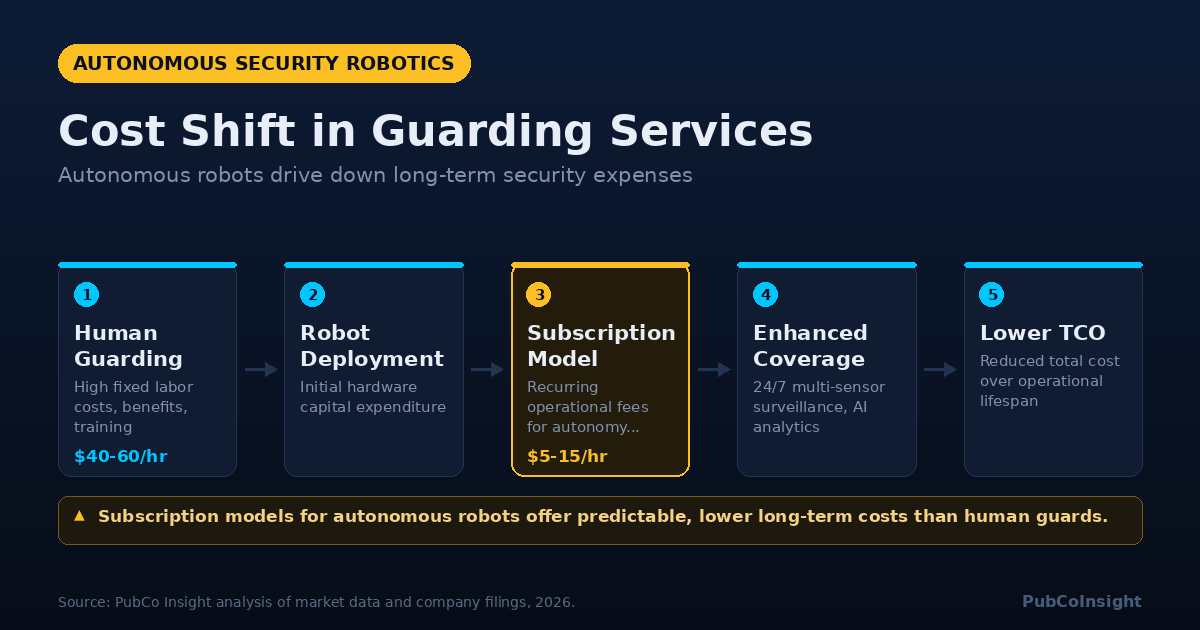
The Mechanism of Disruption: Cost and Capability
The core of the debate centers on the cost structure and operational capabilities of guarding services versus autonomous security robotics. Traditional guarding relies heavily on human labor, which involves wages, benefits, training, supervision, and the inherent limitations of human vigilance. A single human guard provides localized, intermittent surveillance, susceptible to fatigue and error. Scaling this model means linear cost increases. Autonomous security robots, conversely, offer persistent, multi-sensor surveillance across wider areas for a fixed, often subscription-based, operational cost. These robots can integrate thermal imaging, lidar, high-definition cameras, and AI-driven analytics, performing tasks like perimeter patrols, access control, and anomaly detection with consistent precision. The capital expenditure for the robot is amortized over its operational life, typically leading to significantly lower total cost of ownership compared to human guards over several years. The value proposition for autonomous systems is not just about replacing a human, but about augmenting or exceeding human capabilities in specific, repetitive, or hazardous environments, creating a new standard for security effectiveness at a different price point. This shift challenges the valuation models of legacy security providers, particularly those with high labor costs and limited automation integration.Operators in the Autonomous Security Space
Several companies are actively building out the autonomous security and physical AI ecosystem. Arbe Robotics Ltd. (ARBE), trading at $0.392, focuses on high-resolution 4D imaging radar technology. While primarily targeting automotive applications, the precision and range of their radar systems are critical for advanced autonomous navigation and object detection in complex security environments, enabling robots to operate effectively in adverse weather or low-light conditions where cameras struggle. BigBear.ai Holdings, Inc. (BBAI), at $2.6, specializes in AI-powered analytics and data fusion. Their expertise in processing vast datasets from various sensors, including those deployed on autonomous platforms, allows for predictive intelligence and enhanced situational awareness. This capability is vital for turning raw robotic sensor data into actionable security insights, moving beyond simple detection to threat anticipation. Kopin Corporation (KOPN), priced at $3.79, develops micro-displays and optical solutions. These components are essential for advanced human-machine interfaces, particularly in remote operation centers for autonomous robots or for augmented reality applications that provide security personnel with enhanced views from robotic platforms. Lantronix, Inc. (LTRX), trading at $6.01, provides secure data access and management solutions for IoT devices. Their technology enables the secure communication pathways critical for autonomous robots to transmit data, receive commands, and integrate into existing security networks without compromising data integrity or system vulnerability. MicroVision, Inc. (MVIS), at $1.35, is known for its lidar technology. Similar to Arbe, MicroVision's lidar units provide detailed 3D mapping and object detection, crucial for autonomous navigation, collision avoidance, and precise environmental understanding for security robots operating in dynamic, unstructured spaces. Ondas Inc. (ONDS), currently at $6.32, operates in the industrial drone and autonomous data solutions space. Ondas announced on October 30, 2026, its positioning of a field-proven aerial security portfolio to support the $250 million FEMA Counter-Drone Grant Program. This highlights their focus on aerial autonomous platforms for security, particularly in counter-drone measures and broader surveillance applications, expanding the definition of "physical AI" beyond ground-based robots. Red Cat Holdings, Inc. (RCAT), at $4.63, also operates in the drone sector, focusing on enterprise and defense applications. Their work in drone hardware and software platforms contributes to the aerial component of autonomous security, offering solutions for large-area surveillance, rapid response, and infrastructure inspection. Serve Robotics Inc. (SERV), priced at $2.6, develops autonomous robots for last-mile delivery. While their primary market is logistics, the underlying autonomous navigation, obstacle avoidance, and operational management technologies are directly transferable to security patrol applications, particularly in campus environments or controlled industrial settings. Unusual Machines, Inc. (UMAC), trading at $15.53, is another player in the drone market. The company's focus on innovative drone designs and operational capabilities contributes to the broader ecosystem of aerial autonomous systems that can be adapted for security, surveillance, and rapid deployment in various scenarios.Artificial Intelligence Technology Solutions, Inc.
Artificial Intelligence Technology Solutions, Inc. (AITX), trading over the counter at $0.0007, operates through its subsidiaries, focusing on building and leasing autonomous security robots and remote monitoring systems. The company generates revenue through recurring monthly subscriptions for these services, moving away from one-off hardware sales. Its subsidiary, RAD, is treated as the accounting acquirer in its financial statements, reflecting RAD's stockholders' control post-acquisition. The company's most recent substantive filing, the Form 10-Q for the six months ended August 31, 2026, indicates negative cash flow from operating activities of $4,820,842 and an accumulated deficit of $184,084,880. As of August 31, 2026, AITX reported total current assets of $3,012,097 against total current liabilities of $58,906,967, resulting in negative working capital of $55,894,870. The company does not anticipate positive cash flow from operations in the near future and acknowledges these factors raise substantial doubt about its ability to continue as a going concern for the twelve months following the issuance of the financial statements. Management states a commitment to raising funds, including an equity financing agreement from June 23, 2026, for up to $10,000,000, with approximately $9.8 million remaining to be issued under this arrangement. The company plans to address its financial situation through growing revenues, equity proceeds, and issuing debt. The public record does not yet establish a clear timeline for achieving sustained positive cash flow from operations. AITX's assets include revenue-earning devices, net of accumulated depreciation, valued at $4,677,987 as of August 31, 2026, and device parts inventory of $1,261,080. The company also lists various loans payable, with significant portions maturing in March 2027 and October 2026, carrying interest rates ranging from 12% to 22%. The company's strategy hinges on expanding its subscription base for its autonomous security solutions to offset its current burn rate and address its substantial debt obligations.What to watch
Monitor ADT's (ADT) acquisition by Thrive Holdings for any further developments or revised analyst opinions, particularly as the $10 buyout approaches completion. The market's final consensus on ADT's valuation post-acquisition will offer a clearer signal on how traditional security services are being priced against a backdrop of increasing automation. Look for Ondas (ONDS) to report its third-quarter 2026 financial results on November 12, 2026, at 8:30 AM ET; this will provide an update on its backlog growth and progress in the defense and counter-drone sectors, especially following its announcement regarding the FEMA grant program. For Artificial Intelligence Technology Solutions (AITX), watch for further updates on its capital raising efforts and any reported increases in its recurring monthly subscription revenue, which management has identified as a key component of its plan to address its financial position. Specifically, observe the utilization of the remaining $9.8 million under the equity financing agreement from June 23, 2026., { "label": "Robot Deployment", "note": "Initial hardware capital expenditure" }, { "label": "Subscription Model", "note": "Recurring operational fees for autonomy, data, maintenance", "metric": "$5-15/hr" }, { "label": "Enhanced Coverage", "note": "24/7 multi-sensor surveillance, AI analytics" }, { "label": "Lower TCO", "note": "Reduced total cost over operational lifespan" } ], "highlight": 2, "highlight_note": "Subscription models for autonomous robots offer predictable, lower long-term costs than human guards.", "footnote": "Source: PubCo Insight analysis of market data and company filings, 2026." }Companies mentioned
| Ticker | Company | Price |
|---|---|---|
| AITX client | Artificial Intelligence Technology Solutions Inc | $0.0007 |
| ARBE | Arbe Robotics Ltd. | $0.392 |
| BBAI | BigBear.ai Holdings, Inc. | $2.6 |
| KOPN | Kopin Corporation | $3.79 |
| LTRX | Lantronix, Inc. | $6.01 |
| MVIS | MicroVision, Inc. | $1.35 |
| ONDS | Ondas Inc. | $6.32 |
| RCAT | Red Cat Holdings, Inc. | $4.63 |
| SERV | Serve Robotics Inc. | $2.6 |
| UMAC | Unusual Machines, Inc. | $15.53 |
Listed alphabetically, not ranked. Prices as of 2026-11-02 and they move. Check a live quote before relying on any of this.
How we chose the companies in this article
We cover a fixed universe of companies working in autonomous security robotics, physical AI and the guarding services market they are aimed at. Every one of them that had usable market data on 2026-11-02 appears in this article. We do not pick which ones to mention based on what we think of them, and we do not order them by size, price or trading volume, because an ordered list is a verdict and that is not ours to hand down. Companies left out, and why: none. American Lithium Minerals and Artificial Intelligence Technology Solutions pay us, which is disclosed in full at the foot of every article they appear in.
See the dilution and promotion flags before you see the pitch.
Each week: the micro and small-caps now showing dilution or paid-promotion signals, with the SEC filing behind every flag. No recommendations, no price targets.
Sources used in this article
- If I Could Only Buy and Hold 1 "Magnificent Seven" Stock Through 2030, It Would Be This One Motley Fool · 2026-11-02
- SK Hynix Sees the Memory Shortage Lasting Through 2030. 2 Memory Stocks to Buy and Hold Until Then. Motley Fool · 2026-11-01
- Should You Buy PayPal Stock at About 10 Times Its Expected 2026 Earnings? Motley Fool · 2026-11-01
- Netflix Stock Is Trading at a Historically Low Valuation. Is This a Generational Buying Opportunity? Motley Fool · 2026-11-01
- Stocks Are Entering Their Historically Strongest Stretch -- But There May Be a Catch This Year Motley Fool · 2026-11-01
- Stellantis Stock Is Soaring. Europe Is Crashing the Party. Motley Fool · 2026-11-01
- MPLX Reports Earnings on Nov. 3, 2026. Here's What Investors Should Be Watching. Motley Fool · 2026-11-01
- The Big Money Poll Shows Investors as Divided as America Barrons.com · 2026-11-01
- Starlink's Subscriber Growth Is Explosive. Could SpaceX Unlock a Second Growth Engine? Motley Fool · 2026-11-01
- Barclays Says a SpaceX Merger Is Now "a Key Part" of the Tesla Bull Case. Here's Who Actually Wins if It Happens -- and Who Pays. Motley Fool · 2026-11-01
- ADT (ADT) Stock Sees Fair Value Lift After Thrive Deal Sparks Analyst Debate Simply Wall St. · 2026-11-01
- ADT (ADT) Has A 20% Overvaluation View As Its $10 Buyout Nears Simply Wall St. · 2026-11-01
Disclosure required by Section 17(b) of the Securities Act of 1933
Artificial Intelligence Technology Solutions, Inc., a Nevada corporation (OTCID: AITX). Artificial Intelligence Technology Solutions, Inc. pays Strategic Innovations First, Inc., a Wyoming corporation doing business as PulseIR. Compensation received: USD 5,000.00 per month for months 1-3 (August, September, October 2026); USD 10,000.00 per month for months 4-6 (November, December 2026, January 2027) contingent on the 90-day review. Minimum committed USD 15,000.00; USD 45,000.00 if the second-period rate triggers.. Form of payment: cash only, invoiced monthly in advance; no stock, options or warrants received or payable. Services: investor relations services under an Investor Relations Services Agreement effective 2026-08-01. Period: six month term, 2026-08-01 through 2027-01-31; 90-day review on or about 2026-10-30. No stock, options or warrants held by PubCo Insight, Pulse IR, Strategic Innovations First, Inc., or Brad Listermann. Confirmed by the executed agreement and by board record recKwdq39X2caPSX7 (POSITIONS HELD: none).
This is information, not investment, financial, legal or tax advice. It is not a recommendation or solicitation to buy, sell or hold any security and it contains no price target. Nothing here is independently verified by us. Confirm every figure against primary filings on SEC EDGAR before you act. Micro-cap and over-the-counter securities are speculative and illiquid and can lose all of their value. The companies named without a disclosure above pay us nothing and have no relationship with us; they are named because a published, mechanical screen selected them. Full disclosure policy.