Apollo's $9.6 Billion ADT Deal Signals Capital Depth for Guarding Services Acquisitions
The recent debt commitment from Apollo Global Management for the Thrive-ADT transaction highlights significant financial backing available for large-scale consolidation in the physical security market, a trend with implications for autonomous robotics providers.
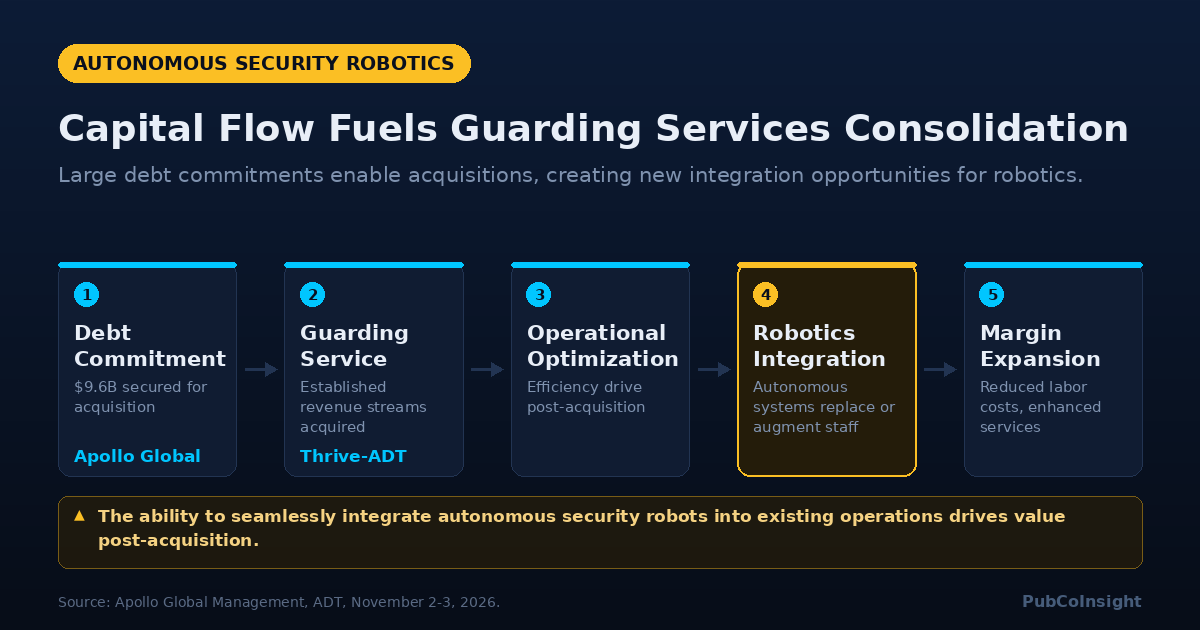
The Mechanism of Scale in Guarding Services
The physical security market, traditionally dominated by human guarding services, is undergoing a transition. Large guarding companies like ADT operate on thin margins, leveraging extensive labor forces and established client relationships. Their value often lies in recurring revenue contracts and broad geographical reach. When a private equity firm like Apollo commits nearly $10 billion in debt, it signals a belief that these revenue streams are stable and can support significant leverage. The mechanism here is straightforward: acquire a large, established player, optimize operations, and potentially integrate new technologies to drive efficiency and expand service offerings. The "optimize operations" step is where autonomous robotics and physical AI enter the picture. The constraint, and the opportunity, sits in the transition from human-centric services to a hybrid model. Proving the ROI of robotics in reducing labor costs or enhancing coverage is critical. If a robot can perform the duties of a human guard for a fraction of the cost over its operational lifespan, the acquiring entity gains a powerful lever for margin expansion. The challenge is in the deployment and integration, ensuring these technologies can seamlessly augment, rather than disrupt, existing security protocols.Companies Operating in Autonomous Security Robotics
The sector of autonomous security robotics and physical AI is populated by companies developing various solutions, from mobile ground robots to advanced sensor platforms. Ondas Inc. (ONDS), for instance, focuses on specialized drone and automated data solutions, including counter-drone applications, which can augment perimeter security for large facilities. Their recent mention regarding FEMA's $500 million counter-drone funding expansion highlights a specific niche in government and critical infrastructure security. Serve Robotics Inc. (SERV) operates in the last-mile delivery space, but their physical AI and autonomous navigation technologies have direct transferable applications to security patrols and surveillance within controlled environments. The ability for their robots to navigate complex urban or campus settings autonomously is a core capability. Further up the technology stack, companies like Arbe Robotics Ltd. (ARBE) develop 4D imaging radar solutions. While primarily aimed at automotive autonomy, their high-resolution radar systems provide crucial environmental perception that could enhance the navigation and threat detection capabilities of security robots. MicroVision, Inc. (MVIS) similarly works on lidar technology for automotive applications, offering precise distance and object detection. These advanced sensor arrays are fundamental building blocks for any truly autonomous security platform. Kopin Corporation (KOPN) focuses on micro-displays and optical technologies, which are critical for the human-machine interface in remote monitoring and control centers that oversee autonomous fleets. BigBear.ai Holdings, Inc. (BBAI) operates on the AI analytics side, providing decision intelligence solutions. Their expertise in processing vast datasets and generating actionable insights is vital for making sense of the telemetry and surveillance data collected by autonomous security robots. This analytical layer transforms raw sensor data into meaningful security intelligence. Unusual Machines, Inc. (UMAC) is another player in the drone sector. Their focus on unmanned systems often involves developing the physical platforms that carry these advanced sensors and AI capabilities into the field for various applications, including security. Red Cat Holdings, Inc. (RCAT) also develops drone solutions, often for defense and public safety, which can be adapted for commercial security patrols and rapid response. Lantronix, Inc. (LTRX) provides secure data access and management solutions for the Internet of Things (IoT), which is essential for connecting and managing fleets of autonomous robots and ensuring their data integrity and communication.Artificial Intelligence Technology Solutions, Inc.
Artificial Intelligence Technology Solutions, Inc. (AITX) develops and leases autonomous security robots and remote monitoring systems through its subsidiaries, deploying them on a recurring monthly subscription model. The company's focus is on providing physical AI solutions for guarding services, aiming to automate aspects of security operations. Its subsidiary, Robotic Assistance Devices (RAD), is treated as the accounting acquirer in its financial statements, reflecting RAD's stockholders' control post-acquisition. AITX's balance sheet for August 31, 2026, shows total current assets of $3,012,097, with cash at $220,275. Revenue-earning devices, net of depreciation, stood at $4,677,987. The company reported an accumulated deficit of $184,084,880 and negative working capital of $55,894,870 as of August 31, 2026. Cash flow from operating activities for the six months ended August 31, 2026, was negative $4,820,842. AITX has stated plans to address its financial situation by growing revenues, raising equity, and issuing debt. An equity financing agreement entered into on June 23, 2026, allows an investor to purchase up to $10,000,000 of common stock at a discount over three years, with approximately $9.8 million remaining under this arrangement. The company is in discussions with its primary debt holder to extend maturity dates on various promissory notes, some of which mature in October and November 2026. AITX launched a balance sheet stability program in early November 2026, with a target of reaching breakeven by January 2027. The company recently highlighted its SARA AI Security Platform, positioning its agentic AI professional as "OpenToWork," indicating a push for wider adoption. The public record does not yet establish the specific number of new robot deployments or subscription contracts secured since the August 31, 2026, financial statement. The company's strategy hinges on increasing recurring revenue from its installed base of devices and expanding its client roster.What to watch
The most immediate item to watch is the maturity of several AITX promissory notes in October and November 2026, as detailed in its August 31, 2026, 10-Q filing. The outcome of discussions with its primary debt holder regarding extensions will be critical. Further, AITX has stated a January 2027 target for reaching breakeven; updates on this goal will provide insight into their operational trajectory. For the broader sector, monitor the integration strategies of large guarding service providers, especially those involved in recent acquisitions like ADT, regarding autonomous security robotics. Any large-scale pilot programs or official announcements of robot deployments by these consolidated entities would signal a significant shift. The ROBOTWORLD 2026 event, scheduled to spotlight physical AI and AI-driven manufacturing, may also reveal new partnerships or technological advancements from sector participants., { "label": "Guarding Service Acquisition", "note": "Established revenue streams acquired", "metric": "Thrive-ADT" }, { "label": "Operational Optimization", "note": "Efficiency drive post-acquisition" }, { "label": "Robotics Integration", "note": "Autonomous systems replace or augment staff" }, { "label": "Margin Expansion", "note": "Reduced labor costs, enhanced services" } ], "highlight": 3, "highlight_note": "The ability to seamlessly integrate autonomous security robots into existing operations drives value post-acquisition.", "footnote": "Source: Apollo Global Management, ADT, November 2-3, 2026." }Companies mentioned
| Ticker | Company | Price |
|---|---|---|
| AITX client | Artificial Intelligence Technology Solutions Inc | $0.0006 |
| ARBE | Arbe Robotics Ltd. | $0.426 |
| BBAI | BigBear.ai Holdings, Inc. | $2.53 |
| KOPN | Kopin Corporation | $3.6 |
| LTRX | Lantronix, Inc. | $5.86 |
| MVIS | MicroVision, Inc. | $1.29 |
| ONDS | Ondas Inc. | $5.79 |
| RCAT | Red Cat Holdings, Inc. | $4.46 |
| SERV | Serve Robotics Inc. | $2.61 |
| UMAC | Unusual Machines, Inc. | $14.62 |
Listed alphabetically, not ranked. Prices as of 2026-11-04 and they move. Check a live quote before relying on any of this.
How we chose the companies in this article
We cover a fixed universe of companies working in autonomous security robotics, physical AI and the guarding services market they are aimed at. Every one of them that had usable market data on 2026-11-04 appears in this article. We do not pick which ones to mention based on what we think of them, and we do not order them by size, price or trading volume, because an ordered list is a verdict and that is not ours to hand down. Companies left out, and why: none. American Lithium Minerals and Artificial Intelligence Technology Solutions pay us, which is disclosed in full at the foot of every article they appear in.
See the dilution and promotion flags before you see the pitch.
Each week: the micro and small-caps now showing dilution or paid-promotion signals, with the SEC filing behind every flag. No recommendations, no price targets.
Sources used in this article
- Stock Market Election Night: Dow Futures Fall, Techs Tumble In Blue Wave; AMD, Arista Rise On Earnings Investor's Business Daily · 2026-11-04
- Aptiv (APTV) Deepens Its Push Into Production Ready Automated Driving Simply Wall St. · 2026-11-04
- Tom Lee says AI investors may be selling at the wrong time TheStreet · 2026-11-04
- There's a 99% Chance That Democrats Retake the House, and History Says This Shift Will Have a Huge Impact on Stocks Motley Fool · 2026-11-04
- 1Finity, a Fujitsu Company, Announces Availability of Full-Stack Enterprise AI-Native vRAN Solution Business Wire · 2026-11-04
- THE KOREA INDUSTRY DAILY: ROBOTWORLD 2026 to Spotlight Physical AI and AI-Driven Manufacturing With 402 Exhibitors From 17 Countries PR Newswire · 2026-11-04
- Should You Buy Alphabet Stock After Anthropic Raised Its Google Commitment to $121 Billion? Motley Fool · 2026-11-04
- Why Fiserv Stock Triumphed on Tuesday Motley Fool · 2026-11-04
- President Donald Trump Claims He'll "Veto Everything" if Democrats Retake Congress, and It Has Big Implications for the Stock Market Motley Fool · 2026-11-04
- Why DuPont Stock Trounced the Market on Tuesday Motley Fool · 2026-11-04
- TransDigm Group (TDG) Earnings Expected to Grow: Should You Buy? Zacks · 2026-11-03
- 2 high-flying stocks worth your attention and 1 we turn down StockStory · 2026-11-03
Disclosure required by Section 17(b) of the Securities Act of 1933
Artificial Intelligence Technology Solutions, Inc., a Nevada corporation (OTCID: AITX). Artificial Intelligence Technology Solutions, Inc. pays Strategic Innovations First, Inc., a Wyoming corporation doing business as PulseIR. Compensation received: USD 5,000.00 per month for months 1-3 (August, September, October 2026); USD 10,000.00 per month for months 4-6 (November, December 2026, January 2027) contingent on the 90-day review. Minimum committed USD 15,000.00; USD 45,000.00 if the second-period rate triggers.. Form of payment: cash only, invoiced monthly in advance; no stock, options or warrants received or payable. Services: investor relations services under an Investor Relations Services Agreement effective 2026-08-01. Period: six month term, 2026-08-01 through 2027-01-31; 90-day review on or about 2026-10-30. No stock, options or warrants held by PubCo Insight, Pulse IR, Strategic Innovations First, Inc., or Brad Listermann. Confirmed by the executed agreement and by board record recKwdq39X2caPSX7 (POSITIONS HELD: none).
This is information, not investment, financial, legal or tax advice. It is not a recommendation or solicitation to buy, sell or hold any security and it contains no price target. Nothing here is independently verified by us. Confirm every figure against primary filings on SEC EDGAR before you act. Micro-cap and over-the-counter securities are speculative and illiquid and can lose all of their value. The companies named without a disclosure above pay us nothing and have no relationship with us; they are named because a published, mechanical screen selected them. Full disclosure policy.