ADT partners with Oracle for AI, signaling a shift in security services
A major traditional guarding services provider integrating advanced AI capabilities suggests a new competitive dynamic for autonomous security robotics and physical AI.
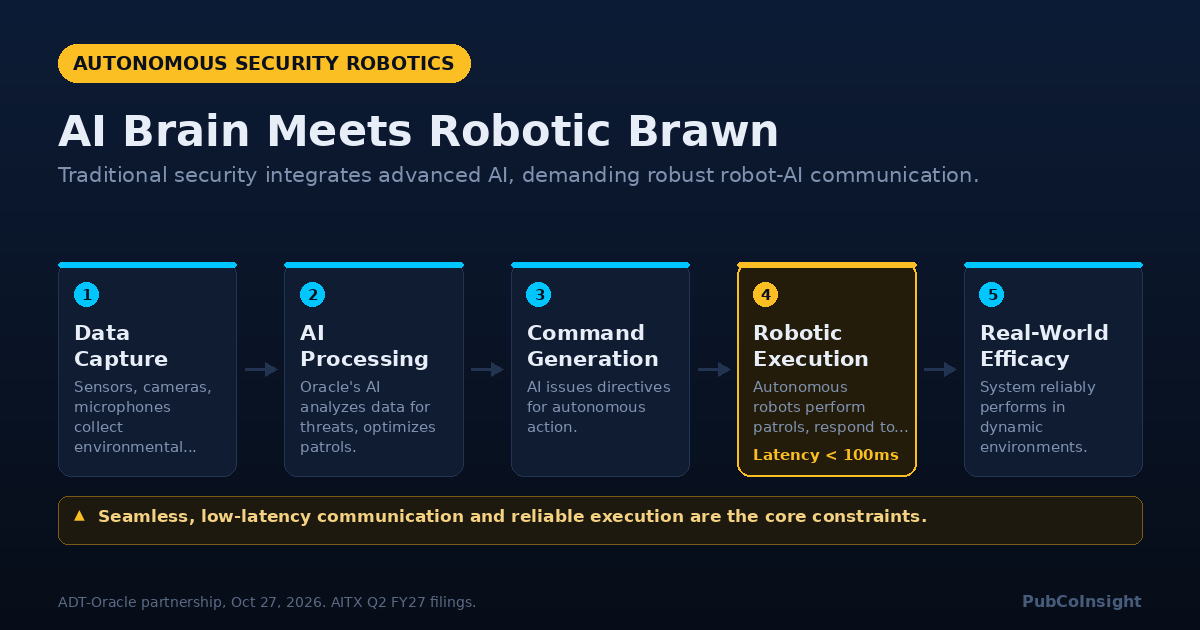
The Mechanism of AI Integration in Guarding
The integration of AI into traditional guarding services shifts the value proposition from purely human presence to augmented intelligence and automated response. This mechanism typically involves several layers. First, data capture: sensors, cameras, and microphones collect environmental data. Second, real-time processing: edge AI devices or cloud-based platforms analyze this data for anomalies, patterns, and threats. This is where the partnership between ADT and Oracle becomes critical. Oracle's cloud infrastructure and AI capabilities provide the backbone for processing vast amounts of security data, enabling sophisticated analytics that go beyond simple motion detection. This allows for predictive threat assessment, automated patrol path optimization for robotic systems, and intelligent incident reporting. The physical AI component, such as autonomous robots, acts as the front-line executor of these AI-driven directives. These robots can perform routine patrols, monitor specific zones, and respond to alerts with pre-programmed actions, like activating alarms or initiating two-way communication. The key challenge, and where the value sits, is the seamless, low-latency communication and decision-making loop between the AI brain and the robotic body. If the AI cannot process data fast enough, or the robot cannot execute commands reliably in real-world, dynamic environments, the entire system falters. This requires robust network infrastructure and highly optimized AI models. The current constraint for widespread adoption often lies in the cost-effectiveness and reliability of these integrated systems compared to human guards, particularly in complex or rapidly changing environments.Companies Operating in Autonomous Security Robotics
Several companies are actively developing the components and full systems that make up this evolving market. Arbe Robotics Ltd. (ARBE) focuses on high-resolution 4D imaging radar solutions, which are crucial for autonomous systems to perceive their environment accurately in all weather conditions. Their technology provides critical data for navigation and object detection, essential for robots operating in varied outdoor settings. Kopin Corporation (KOPN) develops micro-displays and optical modules, components vital for advanced visual systems in drones and augmented reality applications, which can enhance situational awareness for remote human operators overseeing robotic fleets. Lantronix, Inc. (LTRX) provides secure data access and management solutions, enabling the robust connectivity and remote control necessary for distributed networks of autonomous devices. Their embedded solutions are key for ensuring that AI-driven robots can communicate effectively with central command systems and each other. MicroVision, Inc. (MVIS) is known for its lidar technology, offering another critical sensor input for autonomous navigation and mapping, complementing radar in creating a comprehensive environmental understanding. In the realm of drone technology, Ondas Inc. (ONDS) develops autonomous drone systems and proprietary wireless networks. Their American-made drone components, as evidenced by a $16.9 million order from Powerus, highlight a focus on domestic supply chains for critical hardware. Ondas's network technology aims to provide reliable, secure communication for drone operations, a bottleneck for many aerial autonomous systems. Red Cat Holdings, Inc. (RCAT) also operates in the drone sector, providing hardware and software solutions for defense, enterprise, and consumer markets. Their offerings contribute to the expanding ecosystem of aerial autonomous surveillance and inspection. For ground-based autonomy, Serve Robotics Inc. (SERV) develops self-driving robots for last-mile delivery. While their primary market is logistics, the underlying autonomous navigation and obstacle avoidance technologies are directly transferable to security patrol applications, demonstrating the broader utility of physical AI. Unusual Machines, Inc. (UMAC) also focuses on drone components, securing a $16.9 million order from Powerus for American-made drone parts. Their emphasis on manufacturing within the U.S. addresses supply chain resilience, a growing concern in the sector. BigBear.ai Holdings, Inc. (BBAI) offers AI-powered analytics and decision intelligence software, which can be integrated into security platforms to enhance threat detection and response strategies, providing the 'brain' for complex autonomous operations.Artificial Intelligence Technology Solutions, Inc.
Artificial Intelligence Technology Solutions, Inc. (AITX) operates in the autonomous security robotics sector, trading on the OTCID tier. The company, through its subsidiaries, designs, builds, and leases autonomous security robots and remote monitoring systems. AITX's business model centers on recurring monthly subscriptions for its deployed devices, rather than one-off hardware sales. This approach aims to provide predictable revenue streams. The company's product lines include various robotic autonomous guarding systems such as RAD, SARA, and ROAMEO. These devices are intended to perform functions like perimeter monitoring, access control, and threat detection. AITX's most recent substantive filing, the Form 10-Q for the six months ended August 31, 2026, indicated negative cash flow from operating activities of $4,820,842. The company reported an accumulated deficit of $184,084,880 and negative working capital of $55,894,870 as of August 31, 2026. Management has stated its commitment to raising funds through growing revenues, equity proceeds, and issuing debt, including an equity financing agreement for up to $10,000,000, with approximately $9.8 million remaining to be issued under this arrangement. The public record does not yet establish a clear path to sustained positive operating cash flow for AITX. AITX's reported assets as of August 31, 2026, included $220,275 in cash, $947,146 in accounts receivable, and $1,261,080 in device parts inventory. Revenue-earning devices, net of accumulated depreciation, stood at $4,677,987. The company's liabilities included $58,906,967 in total current liabilities, with a significant portion attributed to current loans payable, net of discount, at $32,779,837, and accrued interest payable of $12,811,856. AITX has also engaged security industry veteran Tom Reilly to drive strategy for new integrator and distribution channels, aiming to expand its market reach. The company projects monthly operating cash breakeven in January 2027, tied to revenue ramp-up from its RAIA, SARA, and ROAMEO product lines.What to watch
Investors should monitor the specific deployments of ADT's Oracle-powered AI solutions. Look for announcements detailing the types of AI capabilities being integrated, the scale of deployment, and the specific security services being augmented or replaced. Any public statements from ADT regarding cost savings or efficiency gains from this partnership will be key. For Ondas Inc. (ONDS) and Unusual Machines, Inc. (UMAC), watch for further details on their drone component orders, specifically the timelines for delivery and any subsequent revenue recognition. Continued orders from entities like Powerus will indicate sustained demand for domestic drone manufacturing. Serve Robotics Inc. (SERV) will report its third-quarter 2026 financial results on November 5th. This will provide an update on their operational performance and cash position, offering insights into the broader commercial viability of autonomous ground robots. For Artificial Intelligence Technology Solutions, Inc. (AITX), the company's projected monthly operating cash breakeven in January 2027 is a critical milestone to watch. Subsequent financial filings will confirm if this target is met and how revenue from RAIA, SARA, and ROAMEO product lines contributes to it. Also, look for updates on the utilization of the remaining $9.8 million from their equity financing agreement., { "label": "AI Processing", "note": "Oracle's AI analyzes data for threats, optimizes patrols." }, { "label": "Command Generation", "note": "AI issues directives for autonomous action." }, { "label": "Robotic Execution", "note": "Autonomous robots perform patrols, respond to alerts.", "metric": "Latency < 100ms" }, { "label": "Real-World Efficacy", "note": "System reliably performs in dynamic environments." } ], "highlight": 3, "highlight_note": "Seamless, low-latency communication and reliable execution are the core constraints.", "footnote": "ADT-Oracle partnership, Oct 27, 2026. AITX Q2 FY27 filings." }Companies mentioned
| Ticker | Company | Price |
|---|---|---|
| AITX client | Artificial Intelligence Technology Solutions Inc | $0.0008 |
| ARBE | Arbe Robotics Ltd. | $0.458 |
| BBAI | BigBear.ai Holdings, Inc. | $2.35 |
| KOPN | Kopin Corporation | $3.76 |
| LTRX | Lantronix, Inc. | $6.24 |
| MVIS | MicroVision, Inc. | $1.24 |
| ONDS | Ondas Inc. | $6.65 |
| RCAT | Red Cat Holdings, Inc. | $4.87 |
| SERV | Serve Robotics Inc. | $2.94 |
| UMAC | Unusual Machines, Inc. | $17.87 |
Listed alphabetically, not ranked. Prices as of 2026-10-28 and they move. Check a live quote before relying on any of this.
How we chose the companies in this article
We cover a fixed universe of companies working in autonomous security robotics, physical AI and the guarding services market they are aimed at. Every one of them that had usable market data on 2026-10-28 appears in this article. We do not pick which ones to mention based on what we think of them, and we do not order them by size, price or trading volume, because an ordered list is a verdict and that is not ours to hand down. Companies left out, and why: none. American Lithium Minerals and Artificial Intelligence Technology Solutions pay us, which is disclosed in full at the foot of every article they appear in.
See the dilution and promotion flags before you see the pitch.
Each week: the micro and small-caps now showing dilution or paid-promotion signals, with the SEC filing behind every flag. No recommendations, no price targets.
Sources used in this article
- Ranking 4 AI Power Stocks By Balance Sheet After the Sell-off: Vertiv, GE Vernova, Bloom Energy, and Plug Power. Motley Fool · 2026-10-28
- /C O R R E C T I O N - Lektra, Inc./ PR Newswire · 2026-10-28
- Why SoFi Stock Popped Today Motley Fool · 2026-10-28
- Here's How Many Shares of Procter & Gamble It Would Take to Fund an Annual $3,000 Vacation From Dividends Motley Fool · 2026-10-28
- SK Hynix Shares Spike in Seoul as Q3 Profit Jumps More Than 7-Fold: Memory Giant Plans $75 Billion in Shareholder Returns Benzinga · 2026-10-28
- Does Super Micro Computer (SMCI) Have A Bigger AI Infrastructure Story Now? Simply Wall St. · 2026-10-28
- Anthropic Held More Cash Than Nvidia and Apple Combined Ahead of IPO BeInCrypto · 2026-10-28
- RBC Says SpaceX Stock Has 50% Upside. S&P Global Just Warned About Its Hidden AI Debt. Here's Who I Think Is Right. Motley Fool · 2026-10-28
- British Growth Stocks To Watch In October 2026 Simply Wall St. · 2026-10-28
- Why Hawkins Stock Crushed the Market on Tuesday Motley Fool · 2026-10-28
- Why Axon Enterprise Fell Even As Sales Rose Simply Wall St. · 2026-10-27
- Axon Enterprise (AXON) Unveils Body 5 As AI Policing Hype Meets Valuation Question Simply Wall St. · 2026-10-27
Disclosure required by Section 17(b) of the Securities Act of 1933
Artificial Intelligence Technology Solutions, Inc., a Nevada corporation (OTCID: AITX). Artificial Intelligence Technology Solutions, Inc. pays Strategic Innovations First, Inc., a Wyoming corporation doing business as PulseIR. Compensation received: USD 5,000.00 per month for months 1-3 (August, September, October 2026); USD 10,000.00 per month for months 4-6 (November, December 2026, January 2027) contingent on the 90-day review. Minimum committed USD 15,000.00; USD 45,000.00 if the second-period rate triggers.. Form of payment: cash only, invoiced monthly in advance; no stock, options or warrants received or payable. Services: investor relations services under an Investor Relations Services Agreement effective 2026-08-01. Period: six month term, 2026-08-01 through 2027-01-31; 90-day review on or about 2026-10-30. No stock, options or warrants held by PubCo Insight, Pulse IR, Strategic Innovations First, Inc., or Brad Listermann. Confirmed by the executed agreement and by board record recKwdq39X2caPSX7 (POSITIONS HELD: none).
This is information, not investment, financial, legal or tax advice. It is not a recommendation or solicitation to buy, sell or hold any security and it contains no price target. Nothing here is independently verified by us. Confirm every figure against primary filings on SEC EDGAR before you act. Micro-cap and over-the-counter securities are speculative and illiquid and can lose all of their value. The companies named without a disclosure above pay us nothing and have no relationship with us; they are named because a published, mechanical screen selected them. Full disclosure policy.