AI Agents Drive Unexpected Surge in GPU Demand, Pressuring Autonomous Security Robotics
Nvidia CEO Jensen Huang's recent comments on AI agent-fueled GPU demand highlight a critical bottleneck for firms building physical AI systems, impacting development and deployment schedules across the sector.
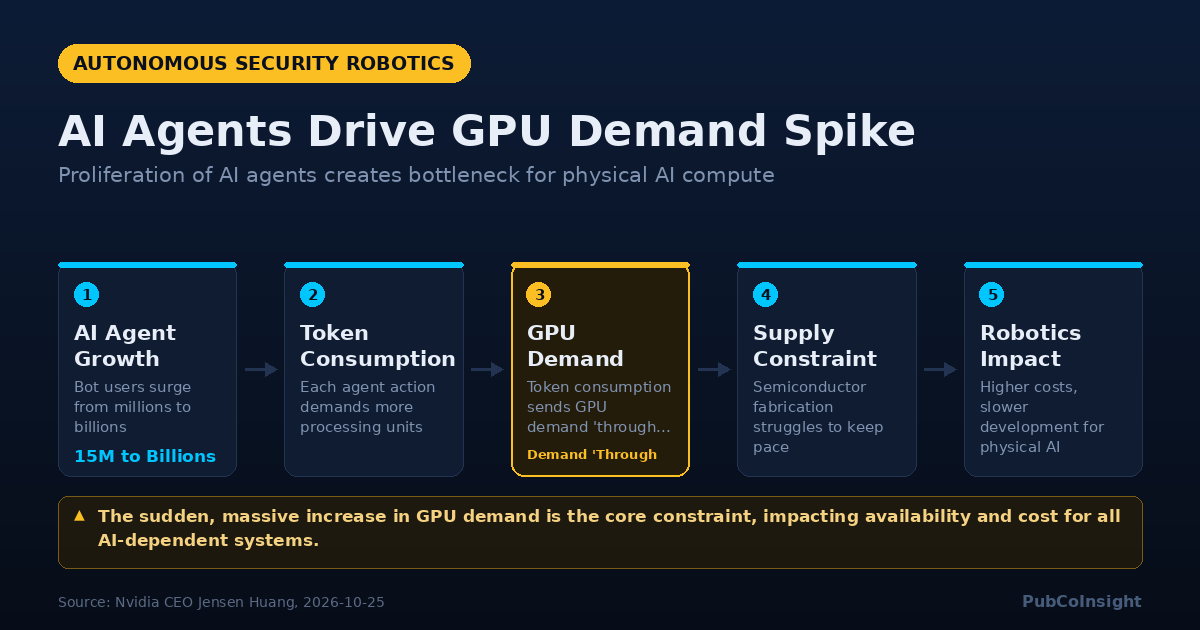
The Mechanism of Constraint
Autonomous security robots operate through a complex interplay of sensors, local processing, and cloud-based AI. A robot patrolling a perimeter, for instance, collects video, audio, and lidar data. This raw data is initially processed on the device to identify immediate threats or anomalies. However, for more sophisticated analysis, pattern recognition, and adaptive learning, the data often streams to a central AI platform. These platforms, whether proprietary or third-party, run on GPU-accelerated servers. The "tokens" Huang mentioned refer to the fundamental units of information processed by large language models and other generative AI systems. Each decision an AI agent makes, each perception it processes, consumes tokens and, by extension, GPU cycles. The more AI agents deployed, the more tokens are consumed, and the greater the demand for GPUs to crunch those tokens. This creates a direct pipeline from the proliferation of AI agents in general computing to the operational costs and hardware availability for physical AI systems like security robots. If the supply of high-end GPUs cannot keep pace, or if their cost escalates dramatically, it directly impacts the ability of robotics companies to scale their AI capabilities, refine their algorithms, and ultimately deploy more advanced units. This bottleneck is physical, rooted in semiconductor fabrication capacity and the specialized architectures of AI processors. It would be proven wrong if GPU manufacturing capacity rapidly expanded beyond current projections, or if new, highly efficient AI architectures emerged that dramatically reduced token consumption per task.Operators in the Autonomous Security Sector
The companies building autonomous security robotics and related physical AI systems face this evolving landscape. Some, like Arbe Robotics Ltd. (ARBE), focus on critical perception components. Arbe, trading at $0.432, recently introduced the Gryphon Radar System, designed to provide reliable perception for unmanned ground vehicles, particularly on rough terrain. This kind of specialized sensor technology is crucial for autonomous operation, feeding data into the AI processing pipeline. Others, such as Ondas Inc. (ONDS), at $6.20, are developing autonomous systems for industrial and defense applications. Ondas's recent EASA certification for its IronBot drone suggests progress in regulatory approval for its airborne platforms, which also rely on sophisticated AI for navigation and data analysis. The company's focus on airborne defense prospects implies a need for robust, real-time AI processing. Serve Robotics Inc. (SERV), trading at $2.78, operates in the last-mile delivery space with its sidewalk robots. These robots navigate complex urban environments, requiring constant AI processing for obstacle avoidance, route optimization, and interaction with pedestrians. The scalability of their deployments is directly tied to the efficiency and availability of the underlying AI compute. In the broader AI infrastructure space, companies like Kopin Corporation (KOPN), at $3.38, are exploring solutions to the data bottleneck. Kopin's analysis suggests optical interconnect architecture could address the "copper wall" in data centers, potentially increasing GPU utilization by up to 60% in a Neural I/o™-Powered Data Center. While not directly building robots, such advancements in data center efficiency could indirectly alleviate some pressure on GPU demand by making existing hardware more effective. BigBear.ai Holdings, Inc. (BBAI), trading at $2.14, provides AI-powered analytics and decision intelligence. While their focus is more on software and data analysis, their ability to deliver advanced AI solutions is also dependent on the availability and cost of high-performance computing resources. Lantronix, Inc. (LTRX), at $5.75, offers secure data access and management solutions for IoT and IT assets. Their technology is foundational for connecting and managing autonomous devices, ensuring the data flows efficiently to and from AI processing centers. MicroVision, Inc. (MVIS), at $1.18, develops lidar solutions for autonomous vehicles and other applications. Lidar generates massive datasets, which then require significant AI processing to interpret and use for navigation and perception. Red Cat Holdings, Inc. (RCAT), at $4.43, operates in the drone sector, including defense and consumer applications. Their drone systems, particularly those used for reconnaissance or inspection, incorporate AI for image processing, target recognition, and autonomous flight. Unusual Machines, Inc. (UMAC), trading at $17.02, recently received a $16.9 million order from Powerus for American-made drone components and completed the acquisition of Upgrade Energy, expanding its U.S. drone battery manufacturing. This indicates a focus on hardware and supply chain for drone production, where the integration of AI components will be a key factor in their product's capabilities and market adoption.Artificial Intelligence Technology Solutions, Inc.
Artificial Intelligence Technology Solutions, Inc. (AITX), trading over the counter at $0.0013, operates through its subsidiaries to build and lease autonomous security robots and remote monitoring systems. The company structures its sales as recurring monthly subscriptions, shifting from a one-off hardware model. This subscription model means AITX retains ownership and responsibility for the ongoing operation and maintenance of its deployed robots, including their AI capabilities. The company's recent filings, including its 10-Q for the six months ended August 31, 2026, show negative cash flow from operating activities of $4,820,842 and an accumulated deficit of $184,084,880. AITX reported negative working capital of $55,894,870 as of August 31, 2026. Management has stated plans to address its financial situation through continued funding methods, including growing revenues, equity proceeds, and issuing debt. An equity financing agreement signed on June 23, 2026, allows an investor to purchase up to $10,000,000 of common stock over three years, with approximately $9.8 million remaining under this arrangement. AITX's balance sheet as of August 31, 2026, shows cash of $220,275, accounts receivable of $947,146, and revenue-earning devices, net of depreciation, at $4,677,987. The company's current liabilities include accounts payable and accrued expenses of $2,920,634 and a significant current portion of loans payable, net of discount, totaling $32,779,837. AITX's RAD subsidiary is treated as the accounting acquirer, meaning the financial statements reflect RAD's historical operations. The company has no deferred development costs, meaning R&D expenses are recognized as incurred. The public record does not yet establish a clear path to sustained positive operating cash flow for AITX. However, the company continues to secure orders across its three product lines, as reported on October 22, 2026, and projects monthly operating cash breakeven in January 2027, ahead of anticipated revenue ramps for its RAIA, SARA, and ROAMEO product lines. AITX also engaged security industry veteran Tom Reilly on October 19, 2026, to drive strategy for new integrator and distribution channels, aiming to expand its market reach for its autonomous security solutions.What to watch
Monitor Nvidia's earnings calls and public statements for any updates on GPU supply, pricing, and demand forecasts. Any indication of easing supply or significant price increases will directly impact the cost structure of autonomous robotics companies. Watch for Q3 2026 earnings reports from companies in the sector, such as Axon (AXON) on November 5, and Serve Robotics (SERV) on November 5, for insights into their operational costs and any commentary on AI infrastructure expenses. Look for specific announcements from robotics firms regarding new partnerships with cloud AI providers or investments in their own compute infrastructure. Any changes in the maturity dates of AITX's various promissory notes, particularly those due October 31, 2026, and November 15, 2026, will be detailed in future filings. Observe the progress of AITX's stated plan to achieve monthly operating cash breakeven by January 2027, which will be reflected in subsequent financial reports., { "label": "Token Consumption", "note": "Each agent action demands more processing units" }, { "label": "GPU Demand", "note": "Token consumption sends GPU demand 'through the roof'", "metric": "Demand 'Through Roof'" }, { "label": "Supply Constraint", "note": "Semiconductor fabrication struggles to keep pace" }, { "label": "Robotics Impact", "note": "Higher costs, slower development for physical AI" } ], "highlight": 2, "highlight_note": "The sudden, massive increase in GPU demand is the core constraint, impacting availability and cost for all AI-dependent systems.", "footnote": "Source: Nvidia CEO Jensen Huang, 2026-10-25" }Companies mentioned
| Ticker | Company | Price |
|---|---|---|
| AITX client | Artificial Intelligence Technology Solutions Inc | $0.0013 |
| ARBE | Arbe Robotics Ltd. | $0.432 |
| BBAI | BigBear.ai Holdings, Inc. | $2.14 |
| KOPN | Kopin Corporation | $3.38 |
| LTRX | Lantronix, Inc. | $5.75 |
| MVIS | MicroVision, Inc. | $1.18 |
| ONDS | Ondas Inc. | $6.2 |
| RCAT | Red Cat Holdings, Inc. | $4.43 |
| SERV | Serve Robotics Inc. | $2.78 |
| UMAC | Unusual Machines, Inc. | $17.02 |
Listed alphabetically, not ranked. Prices as of 2026-10-25 and they move. Check a live quote before relying on any of this.
How we chose the companies in this article
We cover a fixed universe of companies working in autonomous security robotics, physical AI and the guarding services market they are aimed at. Every one of them that had usable market data on 2026-10-25 appears in this article. We do not pick which ones to mention based on what we think of them, and we do not order them by size, price or trading volume, because an ordered list is a verdict and that is not ours to hand down. Companies left out, and why: none. American Lithium Minerals and Artificial Intelligence Technology Solutions pay us, which is disclosed in full at the foot of every article they appear in.
See the dilution and promotion flags before you see the pitch.
Each week: the micro and small-caps now showing dilution or paid-promotion signals, with the SEC filing behind every flag. No recommendations, no price targets.
Sources used in this article
- Should Investors Buy the Meta Platforms Dip? Motley Fool · 2026-10-25
- Prediction: The Stock Market Will Soar After Midterm Elections Motley Fool · 2026-10-25
- Constellation, Vistra, and GE Vernova Ranked From Worst to First for the AI Power Boom Motley Fool · 2026-10-25
- Rocket Lab Just Postponed Its Neutron Launch. Again. Motley Fool · 2026-10-25
- Nvidia’s Jensen Huang Says AI Agents Have Sent Token, GPU Demand ‘Through the Roof’: Gene Munster Sees 15 Million Bot Users Soaring to Billions Benzinga · 2026-10-25
- Is Now a Good Time to Buy Lockheed Martin? Motley Fool · 2026-10-25
- The Earnings Boom Is Heavily Reliant on Just a Handful of Stocks The Wall Street Journal · 2026-10-25
- 1 Red Flag That Keeps Me From Buying AMD Stock Motley Fool · 2026-10-25
- Is the AI Bubble About to Burst? Plus, Apple Bets on Doorbells. Motley Fool · 2026-10-25
- SpaceX’s $1 Trillion Revenue Ambition: Can Elon Musk Deliver? Motley Fool · 2026-10-25
- Axon Announces Body 5: Next-Generation Camera Built for the AI Era PR Newswire · 2026-10-24
- Axon Stock Rebounded After a Sharp Selloff. Raymond James Still Sees 61% Upside TIKR · 2026-10-24
Disclosure required by Section 17(b) of the Securities Act of 1933
Artificial Intelligence Technology Solutions, Inc., a Nevada corporation (OTCID: AITX). Artificial Intelligence Technology Solutions, Inc. pays Strategic Innovations First, Inc., a Wyoming corporation doing business as PulseIR. Compensation received: USD 5,000.00 per month for months 1-3 (August, September, October 2026); USD 10,000.00 per month for months 4-6 (November, December 2026, January 2027) contingent on the 90-day review. Minimum committed USD 15,000.00; USD 45,000.00 if the second-period rate triggers.. Form of payment: cash only, invoiced monthly in advance; no stock, options or warrants received or payable. Services: investor relations services under an Investor Relations Services Agreement effective 2026-08-01. Period: six month term, 2026-08-01 through 2027-01-31; 90-day review on or about 2026-10-30. No stock, options or warrants held by PubCo Insight, Pulse IR, Strategic Innovations First, Inc., or Brad Listermann. Confirmed by the executed agreement and by board record recKwdq39X2caPSX7 (POSITIONS HELD: none).
This is information, not investment, financial, legal or tax advice. It is not a recommendation or solicitation to buy, sell or hold any security and it contains no price target. Nothing here is independently verified by us. Confirm every figure against primary filings on SEC EDGAR before you act. Micro-cap and over-the-counter securities are speculative and illiquid and can lose all of their value. The companies named without a disclosure above pay us nothing and have no relationship with us; they are named because a published, mechanical screen selected them. Full disclosure policy.