Axon's Body 5 Camera Signals AI-First Hardware Shift in Autonomous Security
The October 24, 2026, launch of Axon's Body 5 camera, designed specifically for advanced AI integration, highlights a critical inflection point for autonomous security robotics and the guarding services market.
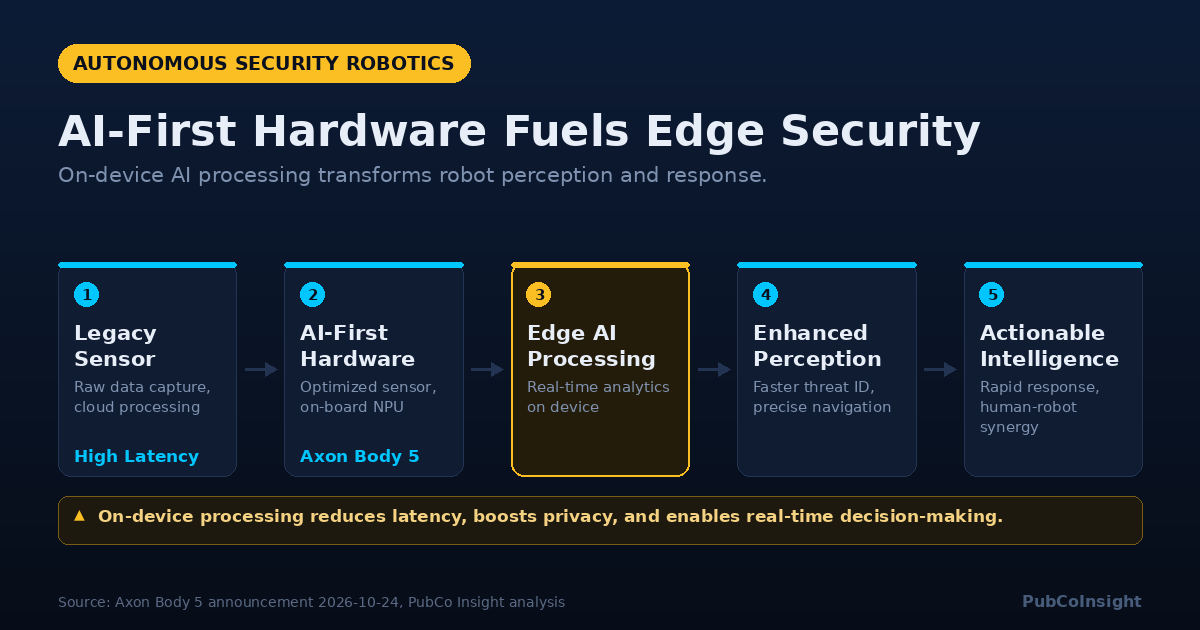
The Mechanism of AI-First Hardware
The core mechanism behind "AI-first" hardware like Axon's Body 5 involves a tightly integrated sensor-compute architecture designed to handle complex machine learning models at the edge. Traditional cameras capture raw video data, which then requires significant bandwidth to transmit to a central server or cloud for processing. This creates latency and limits real-time decision-making. An AI-first camera, conversely, incorporates specialized processing units, often neural processing units (NPUs) or powerful GPUs, directly into the device. These units are optimized for parallel computation, allowing them to execute AI algorithms, such as object detection, facial recognition, and anomaly detection, on the device itself. This on-device processing reduces data transfer requirements, enhancing privacy by minimizing raw data exposure, and critically, cuts down response times. For autonomous security robots, this means faster identification of threats, more precise navigation, and quicker communication with human operators. The challenge lies in balancing processing power with energy efficiency and thermal management within a compact form factor. A robust AI-first system needs high-quality optics, advanced image stabilization, and often multi-spectral sensing to feed clean, rich data to its on-board AI. If the sensor input is poor, even the most powerful NPU will struggle to deliver reliable results. The proof of its efficacy will be in demonstrable improvements in detection accuracy and reduced false positives in real-world deployments.Companies Operating in This Sector
The shift towards AI-first hardware impacts a range of companies developing and deploying autonomous security solutions. Operators like Serve Robotics Inc. (SERV), with its focus on last-mile autonomous delivery, will find that enhanced on-device perception capabilities directly improve navigation and obstacle avoidance in complex urban environments. While their robots primarily handle logistics, the underlying AI and sensor technology shares common ground with security applications, especially in object identification and situational awareness. In the broader robotics space, Unusual Machines, Inc. (UMAC) recently secured a $16.9 million order from Powerus for American-made drone components and completed the acquisition of Upgrade Energy, expanding its U.S. drone battery manufacturing. This highlights a focus on the foundational hardware elements, including power systems, that will be critical for sustaining more powerful, AI-driven aerial security platforms. Similarly, Red Cat Holdings, Inc. (RCAT) operates in the drone sector, providing various solutions that could integrate advanced AI vision systems for surveillance and monitoring. Their success often hinges on the quality of their sensor payloads and the processing capabilities they can support. Sensor technology specialists are also key players. Arbe Robotics Ltd. (ARBE) recently introduced the Gryphon Radar System, designed for reliable perception in unmanned ground vehicles on rough terrain. This type of advanced radar, capable of operating in adverse conditions where optical sensors might struggle, provides crucial data streams for AI models, enabling robust autonomous operation regardless of environmental factors. MicroVision, Inc. (MVIS) develops LiDAR technology, another critical sensor for autonomous systems, offering precise depth mapping that complements camera-based AI. The integration of such diverse sensor inputs is essential for comprehensive AI understanding of a security environment. Companies like Kopin Corporation (KOPN), which is exploring optical interconnect architecture to address data center bottlenecks, are working on the underlying data transfer and processing infrastructure that ultimately supports complex AI applications, even if not directly in robotics. Their work on high-speed data pathways could enable faster training and deployment of the sophisticated AI models these new cameras are designed to leverage. Lantronix, Inc. (LTRX) provides secure data access and management solutions for IoT devices, which will become increasingly vital as more AI-enabled security hardware generates and processes sensitive data at the edge. Meanwhile, software and analytics firms such as BigBear.ai Holdings, Inc. (BBAI) focus on AI-powered analytics and decision support. Their platforms will need to seamlessly ingest and interpret the richer, pre-processed data streams coming from AI-first cameras and robots, translating raw perception into actionable intelligence for security personnel. Ondas Inc. (ONDS) is involved in critical infrastructure and mission-critical IoT, including drone solutions. Their ability to deliver secure and reliable communication networks is paramount for coordinating fleets of AI-enabled security robots and ensuring their data reaches command centers efficiently.Artificial Intelligence Technology Solutions, Inc.
Artificial Intelligence Technology Solutions, Inc. (AITX) trades on the OTCID tier under the ticker AITX. The company, through its subsidiary Robotic Assistance Devices (RAD), designs and leases autonomous security robots and remote monitoring systems. Their business model centers on recurring monthly subscription revenue rather than one-off hardware sales. RAD's product portfolio includes stationary security robots like the Stationary Autonomous Remote Device (SARA) and mobile units such as the Robotic Observation and Detection (ROAMEO) and Response and Alert Device (RAD) series. These devices are deployed across various sectors, including corporate campuses, logistics centers, and public spaces, aiming to augment or replace traditional human guarding services. AITX's financial filings, including the 10-Q for the six months ended August 31, 2026, show negative cash flow from operating activities of $4,820,842 and an accumulated deficit of $184,084,880. The company also reports negative working capital of $55,894,870 as of August 31, 2026. Management has stated plans to address its financial situation through growing revenues, equity proceeds, and issuing debt. Specifically, an equity financing agreement from June 23, 2026, allows for the purchase of up to $10,000,000 of common stock over three years, with approximately $9.8 million remaining under this arrangement. The company is in discussions with its primary debt holder to extend maturity dates on various promissory notes, many of which carry 12% to 15% interest rates and some of which mature in late 2026 and early 2027. The public record does not yet establish a clear path to sustained positive operating cash flow for AITX. However, the company continues to report operational developments. On October 22, 2026, AITX's RAD secured orders across three product lines, and on October 21, 2026, the company reported Q2 FY2027 revenue, excluding its largest customer, up 61% year-over-year, and overall revenue up 8% sequentially. On October 19, 2026, AITX announced the engagement of Tom Reilly, a security industry veteran, to drive strategy for new integrator and distribution channels, indicating a focus on expanding market reach. The company also projected monthly operating cash breakeven in January 2027, ahead of anticipated revenue ramps from its RAIA, SARA, and ROAMEO product lines. Its balance sheet shows $220,275 in cash as of August 31, 2026, and revenue-earning devices, net of depreciation, valued at $4,677,987.What to watch
Investors should watch for specific, dated developments. Axon (AXON) is set to release its Third Quarter 2026 Earnings on November 5, 2026. This report will offer insights into their strategic direction following the Body 5 camera announcement, particularly any commentary on early adoption or market reception. Serve Robotics (SERV) will also report its Third Quarter 2026 Financial Results on November 5, providing an update on its operational performance and any pivots in its technology roadmap. ADT (ADT) is scheduled to release its Third Quarter 2026 results on November 3, which could provide a broader view of the guarding services market's demand for advanced security solutions. For Unusual Machines (UMAC), look for further details on the $16.9 million Powerus order for drone parts and the integration of Upgrade Energy's battery manufacturing capabilities. These developments will indicate how quickly they can scale production and deliver on larger contracts. For AITX, watch for the January 2027 timeframe regarding their projected monthly operating cash breakeven. Subsequent filings will show whether this target is met and if revenue growth accelerates as anticipated from their RAIA, SARA, and ROAMEO deployments. Pay close attention to the maturity dates of AITX's promissory notes in late 2026 and early 2027, and any announcements regarding extensions or refinancing., { "label": "AI-First Hardware", "note": "Optimized sensor, on-board NPU", "metric": "Axon Body 5" }, { "label": "Edge AI Processing", "note": "Real-time analytics on device" }, { "label": "Enhanced Perception", "note": "Faster threat ID, precise navigation" }, { "label": "Actionable Intelligence", "note": "Rapid response, human-robot synergy" } ], "highlight": 2, "highlight_note": "On-device processing reduces latency, boosts privacy, and enables real-time decision-making.", "footnote": "Source: Axon Body 5 announcement 2026-10-24, PubCo Insight analysis" }Companies mentioned
| Ticker | Company | Price |
|---|---|---|
| AITX client | Artificial Intelligence Technology Solutions Inc | $0.0013 |
| ARBE | Arbe Robotics Ltd. | $0.432 |
| BBAI | BigBear.ai Holdings, Inc. | $2.14 |
| KOPN | Kopin Corporation | $3.38 |
| LTRX | Lantronix, Inc. | $5.75 |
| MVIS | MicroVision, Inc. | $1.18 |
| ONDS | Ondas Inc. | $6.2 |
| RCAT | Red Cat Holdings, Inc. | $4.43 |
| SERV | Serve Robotics Inc. | $2.78 |
| UMAC | Unusual Machines, Inc. | $17.02 |
Listed alphabetically, not ranked. Prices as of 2026-10-26 and they move. Check a live quote before relying on any of this.
How we chose the companies in this article
We cover a fixed universe of companies working in autonomous security robotics, physical AI and the guarding services market they are aimed at. Every one of them that had usable market data on 2026-10-26 appears in this article. We do not pick which ones to mention based on what we think of them, and we do not order them by size, price or trading volume, because an ordered list is a verdict and that is not ours to hand down. Companies left out, and why: none. American Lithium Minerals and Artificial Intelligence Technology Solutions pay us, which is disclosed in full at the foot of every article they appear in.
See the dilution and promotion flags before you see the pitch.
Each week: the micro and small-caps now showing dilution or paid-promotion signals, with the SEC filing behind every flag. No recommendations, no price targets.
Sources used in this article
- Wall Street Thinks Archer Aviation Is a Buy. Here's Why I Don't. Motley Fool · 2026-10-26
- AI Stocks Surge, Then Plunge: Which of 4 Sectors Is Worth Buying? 24/7 Wall St. · 2026-10-26
- Microsoft, Alphabet, and Amazon Make Up About 15% of the S&P 500. All 3 Report Earnings Within 2 Days. Motley Fool · 2026-10-26
- 3 Growth Stocks With Up To 66% Earnings Growth Simply Wall St. · 2026-10-26
- Vanguard S&P 500 ETF Long-Term Outlook: What Historical Trends Suggest for Patient Investors Motley Fool · 2026-10-25
- Prediction: 2 Stocks That Will Be Worth More Than AMD 5 Years From Now Motley Fool · 2026-10-25
- Can Bitcoin Double in Value During the Next Crypto Bull Market? Motley Fool · 2026-10-25
- Corning Stock Has Lost Half Its Value Since June. Is It a Buy Before Its Next Report? Motley Fool · 2026-10-25
- Elon Musk Says 200+ AI Cloud Firms Face Wipeout: Will CoreWeave Survive? BeInCrypto · 2026-10-25
- Stock-Split Watch: Is Sandisk Next? Motley Fool · 2026-10-25
- Axon Announces Body 5: Next-Generation Camera Built for the AI Era PR Newswire · 2026-10-24
- Axon Stock Rebounded After a Sharp Selloff. Raymond James Still Sees 61% Upside TIKR · 2026-10-24
Disclosure required by Section 17(b) of the Securities Act of 1933
Artificial Intelligence Technology Solutions, Inc., a Nevada corporation (OTCID: AITX). Artificial Intelligence Technology Solutions, Inc. pays Strategic Innovations First, Inc., a Wyoming corporation doing business as PulseIR. Compensation received: USD 5,000.00 per month for months 1-3 (August, September, October 2026); USD 10,000.00 per month for months 4-6 (November, December 2026, January 2027) contingent on the 90-day review. Minimum committed USD 15,000.00; USD 45,000.00 if the second-period rate triggers.. Form of payment: cash only, invoiced monthly in advance; no stock, options or warrants received or payable. Services: investor relations services under an Investor Relations Services Agreement effective 2026-08-01. Period: six month term, 2026-08-01 through 2027-01-31; 90-day review on or about 2026-10-30. No stock, options or warrants held by PubCo Insight, Pulse IR, Strategic Innovations First, Inc., or Brad Listermann. Confirmed by the executed agreement and by board record recKwdq39X2caPSX7 (POSITIONS HELD: none).
This is information, not investment, financial, legal or tax advice. It is not a recommendation or solicitation to buy, sell or hold any security and it contains no price target. Nothing here is independently verified by us. Confirm every figure against primary filings on SEC EDGAR before you act. Micro-cap and over-the-counter securities are speculative and illiquid and can lose all of their value. The companies named without a disclosure above pay us nothing and have no relationship with us; they are named because a published, mechanical screen selected them. Full disclosure policy.