Nvidia Price Hikes Signal Rising AI Component Costs for Autonomous Security Robotics
Nvidia customers received notice on August 22, 2026, of price increases exceeding 15% for AI server components, a direct consequence of escalating memory costs, which will ripple through the autonomous security robotics sector.
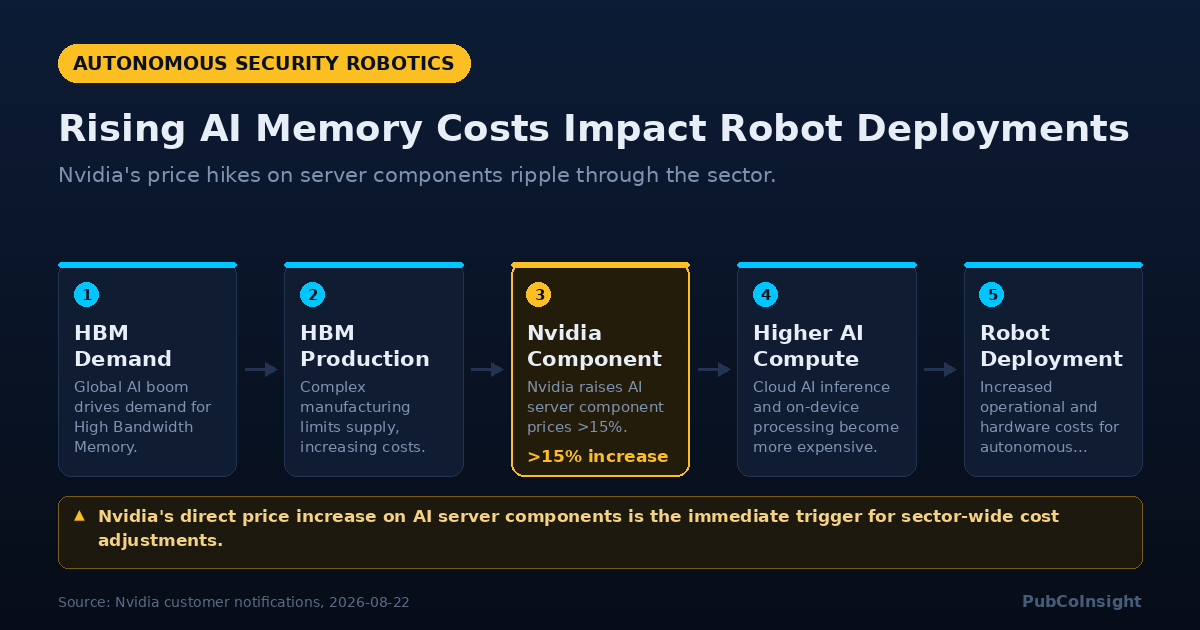
The Mechanism of AI Cost Escalation
The core of this price increase lies in the memory market. Modern AI, particularly the deep learning models used in autonomous navigation, object recognition, and behavioral analysis for security robots, demands immense memory bandwidth. Graphics Processing Units, or GPUs, are the workhorses for this, but their performance is bottlenecked by the speed at which they can access data. High Bandwidth Memory, or HBM, is the solution. HBM stacks multiple memory dies vertically, connecting them with tiny, high-speed interconnects called through-silicon vias, or TSVs. This architecture dramatically increases memory bandwidth compared to traditional DDR memory. Manufacturing HBM is complex. It involves advanced packaging techniques, precise die stacking, and sophisticated thermal management. Yields for these advanced memory chips are lower than for standard DRAM, making them inherently more expensive. Furthermore, the global demand for AI compute, driven by large language models and data center expansion, has outstripped HBM supply. Memory manufacturers, facing high demand and constrained production capacity, can command higher prices. Nvidia, as a primary consumer of HBM for its AI accelerators, passes these increased costs onto its customers. This directly impacts the cost of running AI inference and training workloads in the cloud, which many autonomous security robot deployments depend on for complex tasks like fleet management, anomaly detection, and real-time threat assessment. A sustained increase in these foundational AI costs could force a re-evaluation of deployment economics, favoring more localized, efficient AI or models that require less intensive cloud processing.Companies Navigating the AI Cost Landscape
The autonomous security robotics sector includes a range of companies, each with different exposures to these AI component cost shifts. Firms focused on hardware manufacturing with integrated AI often face direct bill-of-materials impacts. Others, providing "robotics-as-a-service" and relying on cloud AI, will see higher operational expenses. Arbe Robotics Ltd. (ARBE, price $0.715) develops high-resolution 4D imaging radar solutions. Their technology focuses on perception for autonomous systems, which is foundational to security robotics. While their core radar sensor is hardware-based, the processing of the vast datasets generated by 4D radar often leverages advanced AI. Increases in AI compute costs could impact the total system cost for integrators using Arbe's radar alongside AI perception stacks. BigBear.ai Holdings, Inc. (BBAI, price $3.22) operates in the broader AI and data analytics space, primarily serving government and defense clients. Their involvement in autonomous systems typically centers on the software and analytical layers, providing predictive insights and decision support. As a pure-play AI software provider, BigBear.ai's direct exposure to hardware component costs is less pronounced, but their clients' overall AI budgets, influenced by rising infrastructure costs, could see adjustments. Kopin Corporation (KOPN, price $5.04) specializes in micro-displays and optical solutions for augmented reality, virtual reality, and defense applications. These components are crucial for human-robot interaction and advanced vision systems in some autonomous platforms. While not directly an AI chip manufacturer, their products are often integrated into systems that rely heavily on AI for processing visual data, meaning their customers could face higher overall system costs. Lantronix, Inc. (LTRX, price $5.98) provides secure data access and management solutions for the Internet of Things (IoT) and IT infrastructure. Their offerings are critical for connecting and managing fleets of autonomous robots, ensuring secure communication and data transfer. Increased AI costs for managing large robot deployments could affect the overall budget for connectivity solutions, though Lantronix's direct exposure to AI chip pricing is limited. MicroVision, Inc. (MVIS, price $1.66) develops MEMS-based laser beam scanning technology, including lidar sensors for automotive safety and autonomous driving. Lidar is a key perception technology for many outdoor autonomous security robots. Like Arbe, the raw data from lidar requires significant AI processing, and higher AI compute costs could influence the overall cost structure for systems integrating MicroVision's sensors. Ondas Inc. (ONDS, price $8.71) focuses on mission-critical wireless networks and autonomous drone solutions. Ondas has been expanding its defense drone capabilities, including launching a drone operations center in Springfield, Ohio. Their recent Q2 2026 earnings call transcript highlighted a record backlog and raised 2026 guidance. The company's acquisition of Aran Defense suggests a sovereign defense strategy. For drone platforms, on-board AI for navigation, object detection, and payload management is crucial. Rising AI component costs could impact the manufacturing cost of their autonomous drones and the operational costs of their network for AI-driven analytics. Red Cat Holdings, Inc. (RCAT, price $9.62) provides drone hardware and software, including its Teal Drones subsidiary, which focuses on defense and public safety. Red Cat’s emphasis on U.S.-made, NDAA-compliant drones positions them in a strategic market. The AI embedded in these drones for autonomy and data processing is a significant factor. Higher AI component costs could affect their bill-of-materials and pricing strategies for new drone models. Serve Robotics Inc. (SERV, price $4.98) deploys autonomous sidewalk delivery robots. The company recently secured a deal with Grubhub, following a previous Uber Eats deal. Serve Robotics' Q2 revenue grew 400%, but guidance was cut. These robots rely heavily on edge AI for navigation, obstacle avoidance, and interaction with the environment. The cost of the AI processors and memory within each robot, and the cloud infrastructure supporting their fleet management, will be directly affected by the Nvidia price hikes. Unusual Machines, Inc. (UMAC, price $27.43) is ramping up U.S. drone component output, driven by defense demand. Their NDAA-compliant expansion and battery deals point to a focus on domestic manufacturing and supply chain resilience. Unusual Machines' specific exposure to AI component cost increases would depend on the degree of AI processing performed on their components versus in the final integrated drone system. However, any increase in the overall cost of AI for drones will eventually filter down to component demand and pricing.Artificial Intelligence Technology Solutions, Inc.
Artificial Intelligence Technology Solutions, Inc. (AITX, price $0.0047) operates through several subsidiaries, including Robotic Assistance Devices, Inc. (RAD-I), Robotic Assistance Devices Mobile (RAD-M), Robotic Assistance Devices Group (RAD-G), Robotic Assistance Devices Residential (RAD-R), and RAD Lanka. The company's business model centers on developing and leasing AI-driven security robots and remote monitoring systems through a "Solutions-as-a-Service" model. This approach means recurring monthly subscriptions rather than one-off hardware sales. AITX's solutions aim to deliver significant cost savings, estimated between 35% and 80%, compared to traditional manned security. They achieve this using a suite of stationary and mobile devices integrated with their software and monitoring platforms. The company's primary subsidiary, RAD-I, targets the security and guarding services industry, which AITX estimates as a $50 billion market in the United States. The company's operations are structured around three main pillars: stationary security devices (RAD-I), mobile autonomous platforms (RAD-M), and the SARA agentic artificial intelligence platform (RAD-G). RAD-M includes the ROAMEO mobile security unit, which began early commercial deployment in May 2026. RAD Lanka, a wholly owned subsidiary in Sri Lanka, supports software development, AI initiatives, and technical operations. AITX refers to its long-term strategy as "RAD Town," envisioning integrated autonomous security deployments across campuses, communities, or jurisdictions. For the fiscal year ended February 28, 2026, AITX reported revenue of $7,745,336, a 26% increase over the prior year. Gross profit rose 48% to $5,533,700, with gross margin expanding to approximately 71% from 61%. Operating expenses remained stable at about $17,477,097, leading to an improved loss from operations of $(11,943,397). The net loss for the year was approximately $14.5 million, with an accumulated deficit of about $171 million as of that date. The company had negative cash flow from operating activities of $9,344,534 for the same period. AITX's independent registered public accounting firm has noted substantial doubt about its ability to continue as a going concern. The company's most recent 8-K filing on August 18, 2026, reported a third ROSA order, indicating expansion with an existing property management client. The public record does not yet establish a clear path to sustained positive cash flow from operations. The company intends for RAD-I's recurring revenue to support positive cash flow, and for RAD-M to eventually surpass RAD-I's monthly recurring revenue. Subscription gross margins are projected to exceed 75%, and outright-sale gross margins to exceed 50%, based on current input costs and market pricing.What to watch
The immediate impact of Nvidia's price hikes will manifest in Q3 and Q4 2026 financial reports for companies with significant AI compute expenses. Look for specific mentions of increased "cost of goods sold" or "cloud computing expenses" related to AI. Any shifts in product pricing from hardware manufacturers like Red Cat Holdings or Unusual Machines, Inc. could signal direct pass-throughs of higher component costs. Serve Robotics' ability to maintain its reported 400% Q2 revenue growth while navigating rising AI costs will be a key indicator, especially given their recent guidance cut. For AITX, watch for updates on subscription gross margins and any commentary regarding input costs for their autonomous units, particularly as ROAMEO deployments scale. The company's ability to maintain its stated target gross margins of over 75% for subscriptions and over 50% for outright sales will be critical in a rising cost environment., { "label": "HBM Production Constraint", "note": "Complex manufacturing limits supply, increasing costs." }, { "label": "Nvidia Component Hike", "note": "Nvidia raises AI server component prices >15%.", "metric": ">15% increase" }, { "label": "Higher AI Compute Costs", "note": "Cloud AI inference and on-device processing become more expensive." }, { "label": "Robot Deployment Impact", "note": "Increased operational and hardware costs for autonomous security robots." } ], "highlight": 2, "highlight_note": "Nvidia's direct price increase on AI server components is the immediate trigger for sector-wide cost adjustments.", "footnote": "Source: Nvidia customer notifications, 2026-08-22" }Companies mentioned
| Ticker | Company | Price |
|---|---|---|
| AITX client | Artificial Intelligence Technology Solutions Inc | $0.0047 |
| ARBE | Arbe Robotics Ltd. | $0.715 |
| BBAI | BigBear.ai Holdings, Inc. | $3.22 |
| KOPN | Kopin Corporation | $5.04 |
| LTRX | Lantronix, Inc. | $5.98 |
| MVIS | MicroVision, Inc. | $1.66 |
| ONDS | Ondas Inc. | $8.71 |
| RCAT | Red Cat Holdings, Inc. | $9.62 |
| SERV | Serve Robotics Inc. | $4.98 |
| UMAC | Unusual Machines, Inc. | $27.43 |
Listed alphabetically, not ranked. Prices as of 2026-08-22 and they move. Check a live quote before relying on any of this.
How we chose the companies in this article
We cover a fixed universe of companies working in autonomous security robotics, physical AI and the guarding services market they are aimed at. Every one of them that had usable market data on 2026-08-22 appears in this article. We do not pick which ones to mention based on what we think of them, and we do not order them by size, price or trading volume, because an ordered list is a verdict and that is not ours to hand down. Companies left out, and why: none. American Lithium Minerals and Artificial Intelligence Technology Solutions pay us, which is disclosed in full at the foot of every article they appear in.
See the dilution and promotion flags before you see the pitch.
Each week: the micro and small-caps now showing dilution or paid-promotion signals, with the SEC filing behind every flag. No recommendations, no price targets.
Sources used in this article
- Nvidia customers face over 15% server price hikes as memory costs soar - report Investing.com · 2026-08-22
- Active ETFs Now Take 42% of Every Dollar Flowing Into ETFs, Up From 26% in 2024 Motley Fool · 2026-08-22
- Ross Stores Grew Comparable Sales 10%. TJX Grew 4%. Only One Stock Went Up. Motley Fool · 2026-08-22
- Billionaire Stanley Druckenmiller Just Sold Some Sandisk Stock and Bought These 3 Unstoppable Artificial Intelligence (AI) Stocks Motley Fool · 2026-08-22
- Apple vs. Meta Platforms: Which "Magnificent Seven" Giant Has the Stronger Artificial Intelligence (AI) Growth Engine? Motley Fool · 2026-08-22
- Does Greg Abel Know Something Wall Street Doesn't? New Berkshire Hathaway CEO Doubles Down On a Legacy Department Store Stock With a 3.3% Dividend Yield Motley Fool · 2026-08-22
- Can This 6.3% Yield Survive if Oil Crashes Again? Motley Fool · 2026-08-22
- My 3 Favorite High-Yield Dividend Stocks to Buy Right Now Motley Fool · 2026-08-22
- Nvidia customers notified about AI-related price hikes above 15%, Bloomberg News reports Reuters · 2026-08-22
- TSMC's $100 Billion Arizona Expansion Shows The Stock Is a No-Brainer Buy Motley Fool · 2026-08-22
- Is Unusual Machines’ (UMAC) NDAA-Compliant Expansion Redefining Its Long-Term Defense Drone Investment Profile? Simply Wall St. · 2026-08-22
- Is Unusual Machines (UMAC) Overvalued Following Its Manufacturing Expansion And Battery Deal? Simply Wall St. · 2026-08-22
Disclosure required by Section 17(b) of the Securities Act of 1933
Artificial Intelligence Technology Solutions, Inc., a Nevada corporation (OTCID: AITX). Artificial Intelligence Technology Solutions, Inc. pays Strategic Innovations First, Inc., a Wyoming corporation doing business as PulseIR. Compensation received: USD 5,000.00 per month for months 1-3 (August, September, October 2026); USD 10,000.00 per month for months 4-6 (November, December 2026, January 2027) contingent on the 90-day review. Minimum committed USD 15,000.00; USD 45,000.00 if the second-period rate triggers.. Form of payment: cash only, invoiced monthly in advance; no stock, options or warrants received or payable. Services: investor relations services under an Investor Relations Services Agreement effective 2026-08-01. Period: six month term, 2026-08-01 through 2027-01-31; 90-day review on or about 2026-10-30. No stock, options or warrants held by PubCo Insight, Pulse IR, Strategic Innovations First, Inc., or Brad Listermann. Confirmed by the executed agreement and by board record recKwdq39X2caPSX7 (POSITIONS HELD: none).
This is information, not investment, financial, legal or tax advice. It is not a recommendation or solicitation to buy, sell or hold any security and it contains no price target. Nothing here is independently verified by us. Confirm every figure against primary filings on SEC EDGAR before you act. Micro-cap and over-the-counter securities are speculative and illiquid and can lose all of their value. The companies named without a disclosure above pay us nothing and have no relationship with us; they are named because a published, mechanical screen selected them. Full disclosure policy.