The AI Buildout Has a Guarding Problem, and It Is Showing Up in Small-Cap Robotics
Data centres are enormous, remote and lightly staffed. That is why security robotics revenue is arriving now, and why the economics turn on triage rather than patrol.
On August 3, 2026, security and robotics equities moved together. Serve Robotics (SERV) rose about 13 percent, Ouster climbed 6 percent and Symbotic gained 4 percent in a session that reporters filed under a robotics rally. The same day, Ondas (ONDS) announced that David Barnea, the former director of Israel's Mossad, had joined the company. Also that day, Artificial Intelligence Technology Solutions (AITX) said it had adopted a cost reduction plan aimed at improving cash flow from operations, four days after its RAD subsidiary reported the largest data center construction order in its history.
Those three items look unrelated. They are not. Each one is a response to the same development: the artificial intelligence buildout has stopped being an abstraction on a balance sheet and started being buildings. Very large buildings, full of very expensive hardware, in places nobody used to need to guard.
A hyperscale data center is an unusually awkward security problem. It is physically enormous, often on the edge of a metropolitan area or well outside one, lightly staffed by design, and it contains concentrated capital value per square foot that has no real precedent outside a vault. Guarding it the traditional way means paying humans to walk a perimeter through the night, at a wage that has risen faster than almost any other operating input, for a job that is mostly uneventful and therefore mostly done badly.
The economics that actually decide this
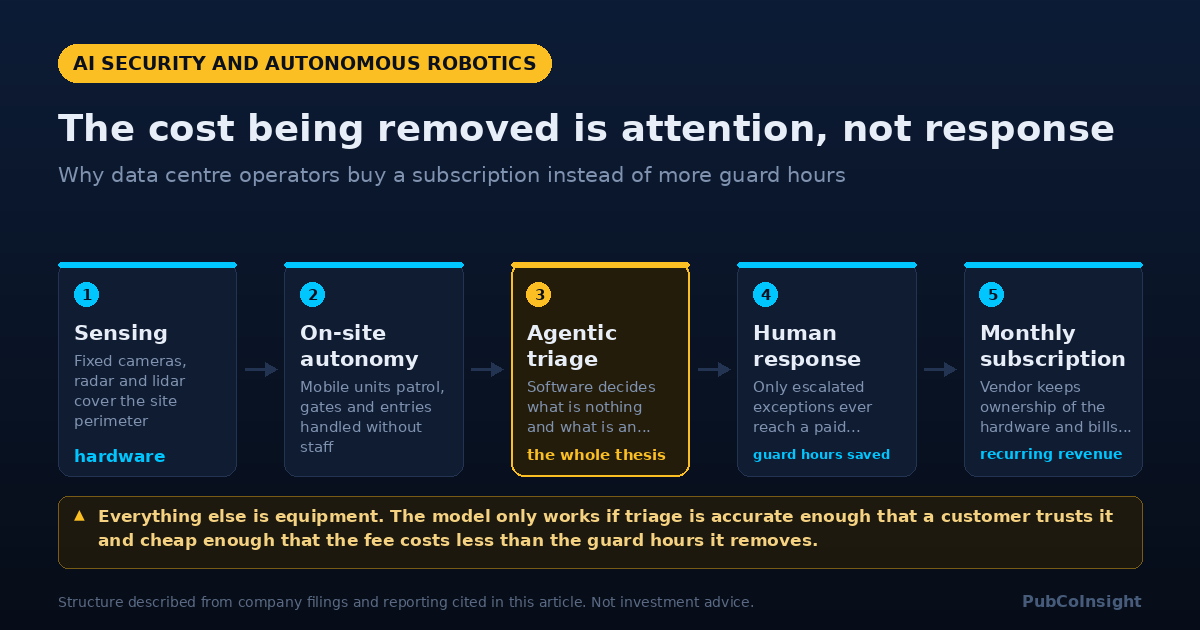
The thesis behind autonomous security is not that a robot patrols better than a person. It is narrower and more testable than that. It is that most of the cost in physical security is not response, it is attention: the hours spent watching a place where nothing is happening. If a machine can hold attention at a materially lower cost per hour and hand a human only the exceptions, the customer's guard-hour count falls and a monthly fee smaller than the wages saved becomes an obvious purchase.
That argument only closes if three conditions hold at once, and each one is checkable.
- The triage has to be good enough to trust. A system that escalates too often recreates the labour cost it was sold to remove. One that escalates too rarely fails on the night it matters. The whole proposition sits on the false positive rate, and that number is not something an outside investor can read off a filing.
- The unit has to survive contact with a real site. Weather, dust, loading docks, contractors, wildlife. Hardware deployed outdoors degrades in ways that lab demonstrations do not surface, and the vendor absorbs that cost under a subscription model.
- The customer has to renew. Recurring revenue is only recurring while the contract is. A twelve month initial term is a commitment for twelve months and an option after that.
What would falsify the thesis is straightforward to describe: subscription counts that plateau while the sales headcount keeps growing, renewal rates that quietly drop, or gross margins that fail to improve as deployments scale. None of those would announce themselves in a press release.
Who is actually building in this part of the market
The small and micro-cap end of physical AI is not one industry. It is several, sold to overlapping buyers, and the companies in it are attacking different layers of the same stack.
Ondas Inc. (ONDS, $8.86) sits closest to the defence and critical-infrastructure buyer, which is the context for the Barnea appointment, and pairs autonomous drone systems with private wireless networking. Red Cat Holdings (RCAT, $8.86) and Unusual Machines (UMAC, $26.67) approach the same customer through drones and drone components, with Unusual Machines concentrated on the supply chain question of who makes the parts domestically. Serve Robotics (SERV, $5.69) works the opposite end of the market, running autonomous delivery on public sidewalks, which is a harder navigation problem in a more forgiving liability environment.
A second group sells the senses rather than the machine. Arbe Robotics (ARBE, $0.7286) develops high resolution imaging radar, the sensing layer that lets a system distinguish a person from a post in conditions where cameras struggle. MicroVision (MVIS, $3.655) builds lidar toward similar ends. Kopin Corporation (KOPN, $4.15) makes microdisplays and, with Fabric.AI, published joint work on MicroLED optical interconnect for next generation systems. Lantronix (LTRX, $6.10) supplies the edge compute and connectivity that has to sit between a sensor and any decision made from it.
BigBear.ai Holdings (BBAI, $3.15) occupies a different position again, selling decision intelligence software into government and defence programmes without the hardware exposure the others carry.
Artificial Intelligence Technology Solutions, Inc. (OTCID: AITX)
AITX trades over the counter at $0.0073 and files with the SEC under CIK 1498148 as a Nevada corporation. It operates through a family of subsidiaries built around Robotic Assistance Devices: RAD-I for enterprise, RAD-M for mobile, RAD-G for the software platform, RAD-R for residential, and RAD Lanka for offshore engineering.
The product line is unusually legible for a company this size. ROAMEO is an outdoor mobile unit that conducts patrol. AVA manages vehicle access at gates and perimeters. TOM handles credentialed pedestrian access at building entries. ROSA, RIO and RAM are fixed-position units covering high-value zones, and RADCam addresses residential and small-business endpoints. Above all of them sits SARA, which the company describes as an agentic layer that orchestrates the devices and escalates to human responders only when necessary. In the company's own framing, the design target is a fully covered site rather than any single product, which it refers to as RAD Town.
The commercial model matters more than the hardware list. Substantially all revenue comes from recurring monthly subscription contracts with minimum twelve month initial terms, under a Solutions-as-a-Service arrangement in which the company keeps ownership of the deployed hardware rather than selling it. A limited number of legacy enterprise customers still buy units outright. The company states it expects gross margin over the deployment life of a subscribed unit to exceed 75 percent, and margin on outright sales to exceed 50 percent, based on bill of materials costs and pricing it says the market has appeared to accept. Those are the company's expectations, not results.
For the three months ended May 31, 2026, total revenue was $1,831,202, a decrease of $23,635 or about 1 percent against $1,854,837 in the same period a year earlier. The company attributed the decline to reduced spending by one major customer running its own cost cutting programme, a customer that had represented roughly 48 percent of revenue in the prior-year quarter. On July 30, 2026 RAD reported its largest data center construction order to date. On August 3, 2026 the company announced a cost reduction plan targeting improved cash flow from operations.
What the filings do not establish is when, or whether, operating costs fall below gross profit. The company states plainly in its S-1 that operating expenses have consistently exceeded gross profit, that interest expense on its debt is a further recurring charge, and that no assurance can be given as to whether or when it will achieve profitability. Customer concentration at that level is the other open question, and the most recent quarter is the first visible read on what happens when a large customer pulls back.
What to watch
- The next quarterly filing. AITX filed a 10-Q on July 14, 2026 and amended both its 10-Q and 10-K on July 17. The next one shows whether the customer concentration effect was a single quarter or the start of a trend.
- Whether the data center order repeats. One large order is a sale. A second from a different operator is a segment. RAD announced the first on July 30, 2026.
- The S-1 filed July 17, 2026 and the EFFECT notice dated July 24, 2026. A registration statement going effective tells you a company intends to be able to raise. The terms and the pace of any subsequent sales are on EDGAR and are worth reading directly.
- Whether the cost reduction plan shows up in the numbers. Announced August 3, 2026. The test is operating expense in the next two filings, not the announcement.
- Peer signals on institutional appetite. Ondas adding a former national intelligence director, and Serve Robotics reporting Q2 results, both indicate how seriously larger buyers and capital are treating this category.
Companies mentioned
| Ticker | Company | Price |
|---|---|---|
| AITX client | Artificial Intelligence Technology Solutions Inc | $0.0073 |
| ARBE | Arbe Robotics Ltd. | $0.7286 |
| BBAI | BigBear.ai Holdings, Inc. | $3.15 |
| KOPN | Kopin Corporation | $4.15 |
| LTRX | Lantronix, Inc. | $6.1 |
| MVIS | MicroVision, Inc. | $3.655 |
| ONDS | Ondas Inc. | $8.86 |
| RCAT | Red Cat Holdings, Inc. | $8.86 |
| SERV | Serve Robotics Inc. | $5.69 |
| UMAC | Unusual Machines, Inc. | $26.67 |
Listed alphabetically, not ranked. Prices as of 2026-08-05 and they move. Check a live quote before relying on any of this.
How we chose the companies in this article
We cover a fixed universe of companies working in autonomous security robotics, physical AI and the guarding services market they are aimed at. Every one of them with usable market data on 2026-08-05 appears in this article. We do not choose which to mention based on what we think of them and we do not order them by size, price or trading volume, because an ordered list is a verdict and that is not ours to hand down. No company was left out. Artificial Intelligence Technology Solutions has a paid investor relations agreement with us, disclosed in full at the foot of this article.
See the dilution and promotion flags before you see the pitch.
Each week: the micro and small-caps now showing dilution or paid-promotion signals, with the SEC filing behind every flag. No recommendations, no price targets.
Disclosure required by Section 17(b) of the Securities Act of 1933
Artificial Intelligence Technology Solutions, Inc., a Nevada corporation (OTCID: AITX). Artificial Intelligence Technology Solutions, Inc. pays Strategic Innovations First, Inc., a Wyoming corporation doing business as PulseIR. Compensation received: USD 5,000.00 per month for months 1-3 (August, September, October 2026); USD 10,000.00 per month for months 4-6 (November, December 2026, January 2027) contingent on the 90-day review. Minimum committed USD 15,000.00; USD 45,000.00 if the second-period rate triggers.. Form of payment: cash only, invoiced monthly in advance; no stock, options or warrants received or payable. Services: investor relations services under an Investor Relations Services Agreement effective 2026-08-01. Period: six month term, 2026-08-01 through 2027-01-31; 90-day review on or about 2026-10-30. No stock, options or warrants held by PubCo Insight, Pulse IR, Strategic Innovations First, Inc., or Brad Listermann. Confirmed by the executed agreement and by board record recKwdq39X2caPSX7 (POSITIONS HELD: none).
This is information, not investment, financial, legal or tax advice. It is not a recommendation or solicitation to buy, sell or hold any security and it contains no price target. Nothing here is independently verified by us. Confirm every figure against primary filings on SEC EDGAR before you act. Micro-cap and over-the-counter securities are speculative and illiquid and can lose all of their value. The companies named without a disclosure above pay us nothing and have no relationship with us; they are named because a published, mechanical screen selected them. Full disclosure policy.