AI Debt Concerns Ripple Through Autonomous Security Robotics
The recent CoreWeave stock drop, despite Nvidia's backing, highlights growing investor scrutiny of AI-related debt structures and their impact on early-stage robotics and guarding services firms.
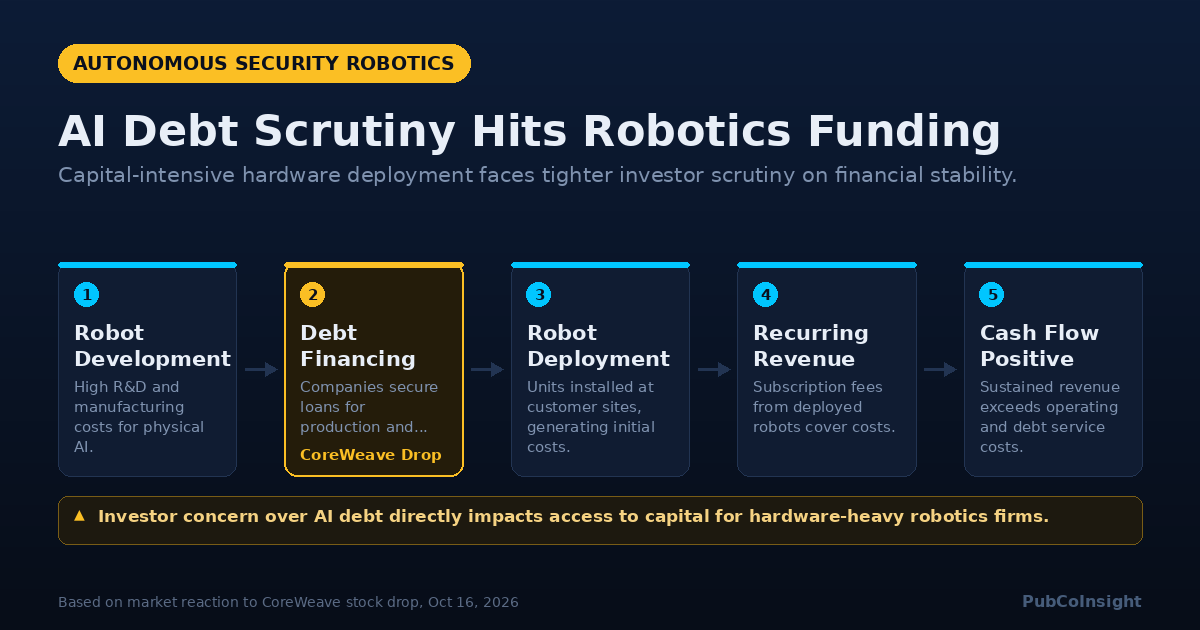
The Mechanism of AI Debt Scrutiny
The core of this market shift lies in the capital intensity of physical AI deployment. Developing an autonomous security robot, from R&D to prototyping, manufacturing, and then deploying units for a customer, requires significant capital. This is not just software development, which can scale with relatively lower fixed costs. A robot needs components, assembly lines, and field support. Many early-stage robotics companies finance this through a combination of equity raises and debt. The debt often comes with covenants tied to future performance, or it is secured against assets that might not yet be fully revenue-generating. When a company like CoreWeave, which provides cloud infrastructure for AI, faces investor skepticism over its financial health, it casts a shadow on the broader AI ecosystem. Investors begin to ask harder questions about the debt-to-equity ratios, cash burn rates, and pathways to profitability for all AI-dependent businesses. For autonomous security robotics, this means a sharper focus on recurring revenue models, such as Robotics-as-a-Service (RaaS), which aim to smooth out revenue and demonstrate a clear path to covering operational costs and servicing debt. A company that can show consistent, growing subscription revenue for its deployed units will fare better than one relying on large, infrequent hardware sales or speculative future contracts. The key metric that proves or disproves financial stability in this environment is the demonstrable, recurring revenue generated per deployed unit, and the margin on that revenue. If the cost of acquiring and deploying a robot cannot be covered by its subscription income within a reasonable timeframe, the debt financing that enabled that deployment becomes a liability.Companies Operating in Autonomous Security Robotics
Several companies are navigating this environment, each with distinct approaches to technology and market penetration. Arbe Robotics Ltd. (ARBE), trading at $0.487, focuses on high-resolution 4D imaging radar solutions. While not directly building security robots, its technology is crucial for autonomous navigation and perception in such systems. Arbe's radar provides detailed environmental sensing, essential for robots operating in complex or low-visibility conditions. The company's strategy hinges on widespread adoption of its radar as a core component in autonomous platforms, including security robots. BigBear.ai Holdings, Inc. (BBAI), priced at $2.33, operates in the broader AI and data analytics space, with applications spanning defense, intelligence, and commercial sectors. Its AI-driven insights can enhance the operational intelligence of autonomous security systems, providing predictive analytics for threat detection or patrol optimization. BigBear.ai's value proposition is less about physical robotics and more about the AI brain behind the operations, which can be licensed or integrated into existing security platforms. Kopin Corporation (KOPN), trading at $3.81, develops micro-displays and optical systems. These components are vital for augmented reality (AR) and virtual reality (VR) applications, and increasingly for sophisticated human-machine interfaces in robotics. For autonomous security, Kopin's technology could be integrated into operator control stations or even directly into robot vision systems, enhancing situational awareness for remote human oversight. On October 8, Kopin secured an additional $18.6 million U.S. Army contract for color MicroLED technology, indicating continued government interest in advanced display solutions. Lantronix, Inc. (LTRX), at $5.85, provides secure data access and management solutions for the Internet of Things (IoT) and IT infrastructure. For autonomous security robots, Lantronix's technology could ensure secure communication between robots, central command, and cloud platforms, addressing critical data integrity and cybersecurity concerns in deployed systems. MicroVision, Inc. (MVIS), with a price of $1.23, is known for its lidar technology, another key sensing component for autonomous navigation. Lidar provides precise 3D mapping of environments, crucial for robots to understand their surroundings, avoid obstacles, and perform complex tasks. Like Arbe, MicroVision's success in the security robotics sector depends on its technology becoming a standard for perception systems. Ondas Inc. (ONDS), trading at $6.35, is active in autonomous drone and data solutions. While primarily focused on drones, the underlying technologies for autonomous navigation, data collection, and AI-driven analysis are highly transferable to ground-based security robots. Ondas's October 12 partnership with Palantir to launch Regna AI, focused on defense missions, highlights the strategic importance of integrated AI for autonomous systems. The company also announced EASA certification for an advanced missile protection system on the Bombardier Global 7500 on October 13, expanding its airborne defense capabilities. Red Cat Holdings, Inc. (RCAT), at $4.9, specializes in drone technology and related software. Its expertise in drone operations, including surveillance and reconnaissance, can inform the development and deployment strategies for autonomous ground security robots, particularly in areas requiring wide-area monitoring or rapid response. Serve Robotics Inc. (SERV), priced at $3.49, focuses on last-mile autonomous delivery robots. While a different application, Serve Robotics' experience in deploying and operating fleets of autonomous ground vehicles in urban environments offers valuable insights into regulatory challenges, public acceptance, and the practicalities of maintaining such fleets. The reported departure of Uber autonomous head Maredia on October 13 suggests ongoing leadership shifts in the broader autonomous vehicle space, which could impact talent pools and strategic direction. Unusual Machines, Inc. (UMAC), at $17.83, is involved in advanced manufacturing and robotics. The appointment of CEO Dr. Allan Evans to XTI Aerospace's board on October 14 indicates a cross-pollination of expertise in advanced autonomous systems. Unusual Machines' capabilities in designing and producing specialized robotic components or platforms could be critical for the development of next-generation security robots.Artificial Intelligence Technology Solutions, Inc.
Artificial Intelligence Technology Solutions, Inc. (AITX) operates through subsidiaries including Robotic Assistance Devices, Inc. (RAD-I), Robotic Assistance Devices Mobile (RAD-M), and Robotic Assistance Devices Group (RAD-G). The company focuses on developing and deploying AI-driven security and productivity solutions, primarily through a "Solutions-as-a-Service" model to the security and guarding services industry. This model aims to deliver cost savings of 35% to 80% compared to traditional manned security. RAD-I is the primary subsidiary, marketing stationary security devices. AITX's filings describe a strategy where RAD-I's recurring revenue and gross margin could, on a standalone basis, support positive cash flow operations. The company states that subscription gross margin is expected to exceed 75% and outright-sale gross margin to exceed 50%, based on average bill of materials costs and market-accepted pricing. These figures are dependent on assumptions about continued pricing acceptance, stable input costs, and manufacturing scale. RAD-M focuses on mobile autonomous platforms, including the ROAMEO mobile security unit, which began early commercial deployment in May 2026. AITX anticipates RAD-M will eventually surpass RAD-I's monthly recurring revenue contribution. Recent news from October 6 and October 14 indicates AITX's RAD secured a third ROAMEO order from a global logistics client and added another municipal customer with a seven-unit ROSA order, respectively. ROSA is a stationary solution. RAD-G is responsible for the SARA agentic artificial intelligence platform, which AITX expects to generate substantial revenue through platform licensing. The company also maintains Robotic Assistance Devices Lanka (Private) Limited, a wholly owned subsidiary in Sri Lanka, supporting software development, AI initiatives, and technical operations. The long-term vision for this integrated strategy is referred to internally as "RAD Town," aiming for comprehensive autonomous security deployments across campuses or communities. For the fiscal year ended February 28, 2026, AITX reported revenue of $7,745,336, a 26% increase over the prior fiscal year. Gross profit rose 48% to $5,533,700, with gross margin expanding to approximately 71%. Operating expenses remained largely flat at $17,477,097. The company reported a net loss of approximately $14.5 million for the fiscal year and had an accumulated deficit of approximately $171 million as of that date. The public record does not yet establish consistent positive cash flow from operations. As of February 28, 2026, the company had negative cash flow from operating activities of $9,344,534 and negative working capital of $17,017,745. Management does not anticipate having positive cash flow from operations in the near term.What to watch
Investors should monitor several key indicators for companies in this sector. For AITX, watch for the next quarterly filing (NT 10-Q was filed October 15) for updates on recurring revenue growth, gross margin trends, and cash flow from operations. Specific announcements regarding new deployments of ROAMEO units or significant licensing agreements for the SARA platform will provide concrete evidence of commercial traction. The company's ability to demonstrate continued expansion of its municipal customer base, as seen with the recent ROSA order, will be important. For Ondas, the progress of its Regna AI partnership with Palantir, particularly any announced contracts or deployments, will be a critical data point. For Arbe Robotics and MicroVision, watch for announcements of design wins or commercial partnerships with major autonomous system integrators, which would validate their core technology adoption. Broader sentiment around AI debt will continue to influence this sector, making any shifts in lending terms or investor appetite for capital-intensive AI ventures a critical watch item., { "label": "Debt Financing", "note": "Companies secure loans for production and deployment.", "metric": "CoreWeave Drop" }, { "label": "Robot Deployment", "note": "Units installed at customer sites, generating initial costs." }, { "label": "Recurring Revenue", "note": "Subscription fees from deployed robots cover costs." }, { "label": "Cash Flow Positive", "note": "Sustained revenue exceeds operating and debt service costs." } ], "highlight": 1, "highlight_note": "Investor concern over AI debt directly impacts access to capital for hardware-heavy robotics firms.", "footnote": "Based on market reaction to CoreWeave stock drop, Oct 16, 2026" }Companies mentioned
| Ticker | Company | Price |
|---|---|---|
| AITX client | Artificial Intelligence Technology Solutions Inc | $0.0015 |
| ARBE | Arbe Robotics Ltd. | $0.487 |
| BBAI | BigBear.ai Holdings, Inc. | $2.33 |
| KOPN | Kopin Corporation | $3.81 |
| LTRX | Lantronix, Inc. | $5.85 |
| MVIS | MicroVision, Inc. | $1.23 |
| ONDS | Ondas Inc. | $6.35 |
| RCAT | Red Cat Holdings, Inc. | $4.9 |
| SERV | Serve Robotics Inc. | $3.49 |
| UMAC | Unusual Machines, Inc. | $17.83 |
Listed alphabetically, not ranked. Prices as of 2026-10-16 and they move. Check a live quote before relying on any of this.
How we chose the companies in this article
We cover a fixed universe of companies working in autonomous security robotics, physical AI and the guarding services market they are aimed at. Every one of them that had usable market data on 2026-10-16 appears in this article. We do not pick which ones to mention based on what we think of them, and we do not order them by size, price or trading volume, because an ordered list is a verdict and that is not ours to hand down. Companies left out, and why: none. American Lithium Minerals and Artificial Intelligence Technology Solutions pay us, which is disclosed in full at the foot of every article they appear in.
See the dilution and promotion flags before you see the pitch.
Each week: the micro and small-caps now showing dilution or paid-promotion signals, with the SEC filing behind every flag. No recommendations, no price targets.
Sources used in this article
- History Says a Stock Market Sell-Off Is Coming Eventually. Here's the Smartest ETF to Buy Right Now. Motley Fool · 2026-10-16
- Investors — and Elon Musk — crashed CoreWeave stock. But many analysts don't see the problem. Yahoo Finance · 2026-10-16
- Nvidia CEO Jensen Huang addresses CoreWeave stock plunge: 'I'm optimistic' Yahoo Finance · 2026-10-16
- Nvidia-Backed AI Biotech Iambic Up 16% After $150 Million IPO Bloomberg · 2026-10-16
- Why Nvidia Stock Is Rising While the Broader Chip Sector Keeps Falling Barrons.com · 2026-10-16
- 6 Blue Chip Stocks Trading Well Below Their Highs Motley Fool · 2026-10-16
- Billionaires Are Selling These 6 Artificial Intelligence (AI) Stocks. Should You Follow? Motley Fool · 2026-10-16
- Prediction: A $10,000 Investment in This Artificial Intelligence (AI) Hardware Stock Will At Least Double by 2030 (Hint: It’s Not Nvidia or Micron) Motley Fool · 2026-10-16
- SpaceX Has Climbed 15% From Its IPO Price. Here’s Where History Says It Will Be After 1 Year. Motley Fool · 2026-10-16
- CoreWeave Stock Drops. Why AI Debt Fears Aren’t Over Despite Nvidia’s Confidence. Barrons.com · 2026-10-16
- ONDS Stock Heads For Third Red Week, But Retail Stands Firm On Drone Defense Opportunity — ‘Will Be Epic Like GameStop' Stocktwits · 2026-10-16
- Axon Reports Significant Momentum Across Federal Sector as U.S. Government Fiscal Year Closes PR Newswire · 2026-10-15
Disclosure required by Section 17(b) of the Securities Act of 1933
Artificial Intelligence Technology Solutions, Inc., a Nevada corporation (OTCID: AITX). Artificial Intelligence Technology Solutions, Inc. pays Strategic Innovations First, Inc., a Wyoming corporation doing business as PulseIR. Compensation received: USD 5,000.00 per month for months 1-3 (August, September, October 2026); USD 10,000.00 per month for months 4-6 (November, December 2026, January 2027) contingent on the 90-day review. Minimum committed USD 15,000.00; USD 45,000.00 if the second-period rate triggers.. Form of payment: cash only, invoiced monthly in advance; no stock, options or warrants received or payable. Services: investor relations services under an Investor Relations Services Agreement effective 2026-08-01. Period: six month term, 2026-08-01 through 2027-01-31; 90-day review on or about 2026-10-30. No stock, options or warrants held by PubCo Insight, Pulse IR, Strategic Innovations First, Inc., or Brad Listermann. Confirmed by the executed agreement and by board record recKwdq39X2caPSX7 (POSITIONS HELD: none).
This is information, not investment, financial, legal or tax advice. It is not a recommendation or solicitation to buy, sell or hold any security and it contains no price target. Nothing here is independently verified by us. Confirm every figure against primary filings on SEC EDGAR before you act. Micro-cap and over-the-counter securities are speculative and illiquid and can lose all of their value. The companies named without a disclosure above pay us nothing and have no relationship with us; they are named because a published, mechanical screen selected them. Full disclosure policy.