AI Infrastructure Financing Evolves as Nvidia Proposes Chip-Backed Securities
Nvidia CEO Jensen Huang’s recent $500 billion proposal for chip-backed securities signals a potential shift in how large-scale AI infrastructure is financed, drawing both interest and skepticism from market observers.
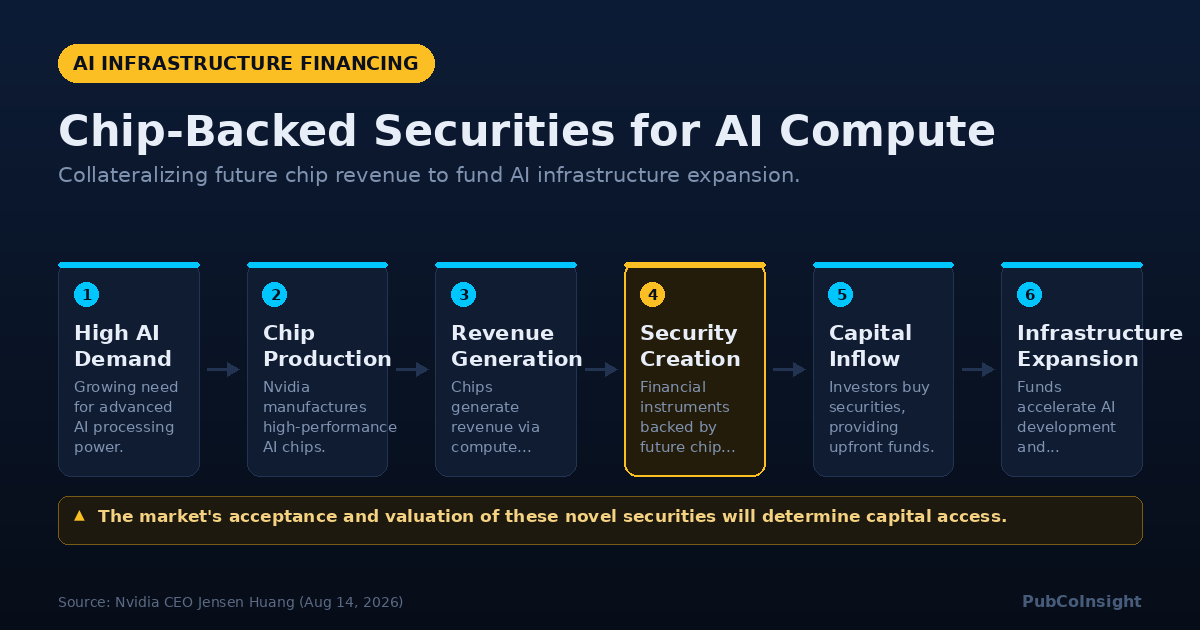
The Mechanism of Chip-Backed Securities
The idea behind chip-backed securities is to collateralize future revenue streams generated by high-demand AI chips or the computing power they provide. Imagine a data center filled with Nvidia’s latest GPUs. These GPUs generate revenue through computational services, cloud access, or direct sales. A financial instrument, a security, would be created, backed by these predictable revenue streams. Investors would purchase these securities, providing upfront capital to Nvidia or its partners, who would then use that capital to fund further chip production, R&D, or data center expansion. This is not a simple bond. Unlike a traditional corporate bond backed by the overall health of a company, or a mortgage-backed security tied to a pool of home loans, chip-backed securities would be linked directly to the performance and utilization of specific hardware assets. The value of these securities would depend on sustained demand for AI processing, the longevity and efficiency of the chips, and the operational effectiveness of the data centers housing them. A key risk lies in technological obsolescence. If a new generation of chips renders the collateralized hardware significantly less competitive, the underlying revenue stream could diminish, impacting the security's value. Proving the long-term, stable demand for specific chip generations, and establishing robust valuation models for future compute power, will be critical for these instruments to gain widespread acceptance and liquidity. Without clear, consistent demand and a reliable method to forecast chip utility over time, the market for such securities would remain niche.Companies Operating in Autonomous Security Robotics
The autonomous security robotics sector relies heavily on advanced AI, from perception and navigation to decision-making algorithms. This makes the broader AI infrastructure financing landscape relevant to their operational runway and scaling potential. Companies like Arbe Robotics Ltd. (ARBE) focus on radar technology, essential for autonomous navigation and object detection in robotic systems. Their 4D imaging radar chips provide high-resolution data crucial for robots operating in complex environments. MicroVision, Inc. (MVIS) develops LiDAR technology, another critical sensor for autonomous platforms, offering precise 3D mapping and obstacle avoidance. Both ARBE and MVIS supply foundational perception components that enable the "eyes" of autonomous security robots. In the realm of AI processing and data, BigBear.ai Holdings, Inc. (BBAI) provides AI-powered analytics and decision intelligence solutions. Their work often involves processing vast datasets to derive actionable insights, which can be applied to enhance the intelligence of autonomous security systems, such as predictive threat analysis or optimized patrol routes. Kopin Corporation (KOPN) focuses on micro-displays and optical solutions, including those used in augmented reality and virtual reality applications, which can be integrated into advanced human-robot interfaces or remote operation systems for security robots. Kopin recently announced an expansion of its Neural I/o™ program with new Non-Disclosure Agreements across the AI interconnect ecosystem, signaling deeper engagement in AI hardware development. The drone sector, a close cousin to ground-based autonomous robotics, also leverages significant AI. Ondas Inc. (ONDS) reported record revenue in Q2 2026, driven by strategic expansion, including an Israeli defense drone contract. Despite widening losses, their focus on mission-critical wireless networks and drone solutions positions them in a market demanding robust AI. Red Cat Holdings, Inc. (RCAT) operates in the drone industry, developing integrated hardware and software solutions for defense and public safety. Their success hinges on efficient AI processing for real-time data analysis and autonomous flight. Unusual Machines, Inc. (UMAC) also operates in the drone space, with Piper Sandler initiating coverage with an Overweight rating and a $38 price target on August 12, 2026. This indicates growing investor interest in drone technology, which inherently requires advanced AI for autonomy. In the delivery and service robotics segment, Serve Robotics Inc. (SERV) develops autonomous sidewalk delivery robots. Uber fully exited its stake in Serve Robotics on August 11, 2026, a move that highlights the ongoing capital considerations and strategic shifts within the robotics market. This divestment suggests that even established players are re-evaluating their investments in specific robotics ventures, potentially seeking more direct exposure to core AI infrastructure or software. Lantronix, Inc. (LTRX) provides secure data access and management solutions for the Internet of Things (IoT) and intelligent edge applications, which are fundamental for connecting and managing fleets of autonomous robots securely and efficiently.Artificial Intelligence Technology Solutions, Inc.
Artificial Intelligence Technology Solutions, Inc. (AITX) trades on the OTC Markets under the symbol AITX, with a recent price of $0.0068. The company operates through several subsidiaries, including Robotic Assistance Devices, Inc. (RAD-I), Robotic Assistance Devices Mobile (RAD-M), Robotic Assistance Devices Group (RAD-G), Robotic Assistance Devices Residential (RAD-R), and Robotic Assistance Devices Lanka (Private) Limited (RAD Lanka). AITX focuses on developing and leasing AI-driven security robots and remote monitoring systems. The business model is centered on a recurring monthly subscription for its solutions, rather than one-off hardware sales. RAD-I, the primary subsidiary, targets the security and guarding services industry, which AITX estimates as a $50 billion market in the United States. The company states its solutions aim to deliver cost savings between 35% and 80% compared to traditional manned security. These solutions comprise a suite of stationary and mobile devices integrated with AITX's proprietary software and monitoring platforms. RAD Lanka, based in Sri Lanka, supports software development, AI initiatives, and technical operations across the subsidiaries. AITX's operations are structured around three main pillars: stationary security devices (RAD-I), mobile autonomous platforms (RAD-M), and the SARA agentic artificial intelligence platform (RAD-G). Commercial deployment of the ROAMEO mobile security unit, under RAD-M, began in May 2026. The company's long-term vision, referred to as "RAD Town," involves integrated autonomous-security deployments across campuses, communities, or jurisdictions. For the fiscal year ended February 28, 2026, AITX reported revenue of $7,745,336, a 26% increase year-over-year. Gross profit rose 48% to $5,533,700, expanding the gross margin to approximately 71% from 61%. Operating expenses remained relatively flat at $17,477,097, leading to an improved loss from operations of $(11,943,397), a $2.0 million improvement. The net loss for the fiscal year was approximately $14.5 million, with an accumulated deficit of $171 million as of that date. The company had negative cash flow from operating activities of $9,344,534 for the same period. As of February 28, 2026, AITX had negative working capital of $17,017,745. The public record does not yet establish a clear path to sustained positive cash flow from operations, as the independent registered public accounting firm has included an explanatory paragraph in its report expressing substantial doubt about the company's ability to continue as a going concern. AITX's filings indicate management does not anticipate positive cash flow from operations in the near term. The company's S-1 filing from July 16, 2026, details an Equity Purchase Agreement with Trillium, under which AITX will receive proceeds from the sale of Put Shares.What to watch
The development of Nvidia's chip-backed securities will unfold with several key indicators. Watch for the formal filing of any such security instruments with the SEC. Specific details on the collateral, revenue projections, and risk disclosures will be critical. Any initial pilot programs or partnerships announced by Nvidia or its affiliates, detailing the first issuance of these securities, will provide concrete data points. The market's reception of these initial offerings, including pricing and investor uptake, will indicate viability. Also, monitor statements from major financial institutions regarding their willingness to underwrite or invest in such novel instruments. For the autonomous security robotics sector, watch for announcements from companies like AITX, ARBE, and MVIS regarding their direct or indirect engagement with these new financing channels, or any shifts in their capital expenditure plans that could be attributed to improved access to AI infrastructure., { "label": "Chip Production", "note": "Nvidia manufactures high-performance AI chips." }, { "label": "Revenue Generation", "note": "Chips generate revenue via compute services or sales." }, { "label": "Security Creation", "note": "Financial instruments backed by future chip revenue." }, { "label": "Capital Inflow", "note": "Investors buy securities, providing upfront funds." }, { "label": "Infrastructure Expansion", "note": "Funds accelerate AI development and deployment." } ], "highlight": 3, "highlight_note": "The market's acceptance and valuation of these novel securities will determine capital access.", "footnote": "Source: Nvidia CEO Jensen Huang (Aug 14, 2026)" }Companies mentioned
| Ticker | Company | Price |
|---|---|---|
| AITX client | Artificial Intelligence Technology Solutions Inc | $0.0068 |
| ARBE | Arbe Robotics Ltd. | $0.768 |
| BBAI | BigBear.ai Holdings, Inc. | $3.34 |
| KOPN | Kopin Corporation | $4.83 |
| LTRX | Lantronix, Inc. | $6.09 |
| MVIS | MicroVision, Inc. | $3.77 |
| ONDS | Ondas Inc. | $8.91 |
| RCAT | Red Cat Holdings, Inc. | $10.23 |
| SERV | Serve Robotics Inc. | $4.94 |
| UMAC | Unusual Machines, Inc. | $27.24 |
Listed alphabetically, not ranked. Prices as of 2026-08-14 and they move. Check a live quote before relying on any of this.
How we chose the companies in this article
We cover a fixed universe of companies working in autonomous security robotics, physical AI and the guarding services market they are aimed at. Every one of them that had usable market data on 2026-08-14 appears in this article. We do not pick which ones to mention based on what we think of them, and we do not order them by size, price or trading volume, because an ordered list is a verdict and that is not ours to hand down. Companies left out, and why: none. American Lithium Minerals and Artificial Intelligence Technology Solutions pay us, which is disclosed in full at the foot of every article they appear in.
See the dilution and promotion flags before you see the pitch.
Each week: the micro and small-caps now showing dilution or paid-promotion signals, with the SEC filing behind every flag. No recommendations, no price targets.
Sources used in this article
- The Stock Market Just Made a Move That Warren Buffett Has Warned About. History Says Investors Should Make This 1 Move. Motley Fool · 2026-08-14
- How Investors May Respond To Walmart (WMT) Earnings Countdown And New Exclusive Family-Focused Offerings Simply Wall St. · 2026-08-14
- Chuck Robbins Says AI Is Fueling a "Networking Supercycle." Cisco's Guide Puts a $7.5 Billion Number on It. Motley Fool · 2026-08-14
- Is the Reported $400 Billion AstraZeneca-Bristol Myers Squibb Megamerger a Slam Dunk -- or a Disaster Waiting to Happen? Motley Fool · 2026-08-14
- Why Savers Value Village Stock Was Wilting This Week Motley Fool · 2026-08-14
- Nvidia CEO Jensen Huang Just Introduced a Bold $500 Billion Plan to Potentially Create Chip-Backed Securities. What Could Go Wrong? Motley Fool · 2026-08-14
- Why Airbnb Stock Keeps Going Up Motley Fool · 2026-08-14
- Michael Burry Calls Nvidia’s $500 Billion AI Financing Push a ‘Wall Street Stunt’: ‘Meet the New Boss…' Benzinga · 2026-08-14
- At 64, He Moved His 401(k) Away From Stocks. Wall Street May Bring AI Risk Back Through the Bond Side. 24/7 Wall St. · 2026-08-14
- You Can't Invest In Trader Joe's, But This Mexican Grocery Stock With the Same Business Model Might Be Even Better Motley Fool · 2026-08-14
- UMAC, RCAT, ONDS, AVAV, KTOS Stocks Rise Overnight: Trump Takes Aim At Foreign Drones With New Tariffs Stocktwits · 2026-08-14
- Stock Market Today, Aug. 13: Cellebrite Shares Plummet 29% After Missing Earnings, Cutting 2026 Revenue Guidance Motley Fool · 2026-08-13
Disclosure required by Section 17(b) of the Securities Act of 1933
Artificial Intelligence Technology Solutions, Inc., a Nevada corporation (OTCID: AITX). Artificial Intelligence Technology Solutions, Inc. pays Strategic Innovations First, Inc., a Wyoming corporation doing business as PulseIR. Compensation received: USD 5,000.00 per month for months 1-3 (August, September, October 2026); USD 10,000.00 per month for months 4-6 (November, December 2026, January 2027) contingent on the 90-day review. Minimum committed USD 15,000.00; USD 45,000.00 if the second-period rate triggers.. Form of payment: cash only, invoiced monthly in advance; no stock, options or warrants received or payable. Services: investor relations services under an Investor Relations Services Agreement effective 2026-08-01. Period: six month term, 2026-08-01 through 2027-01-31; 90-day review on or about 2026-10-30. No stock, options or warrants held by PubCo Insight, Pulse IR, Strategic Innovations First, Inc., or Brad Listermann. Confirmed by the executed agreement and by board record recKwdq39X2caPSX7 (POSITIONS HELD: none).
This is information, not investment, financial, legal or tax advice. It is not a recommendation or solicitation to buy, sell or hold any security and it contains no price target. Nothing here is independently verified by us. Confirm every figure against primary filings on SEC EDGAR before you act. Micro-cap and over-the-counter securities are speculative and illiquid and can lose all of their value. The companies named without a disclosure above pay us nothing and have no relationship with us; they are named because a published, mechanical screen selected them. Full disclosure policy.