Humanoid Robotics Push into Commercial Security with Audi Pilot
The launch of Agile Robots' Agile ONE SN Humanoid and its pilot with Audi on October 27, 2026, signals a critical shift in how physical AI could reshape the guarding services market.
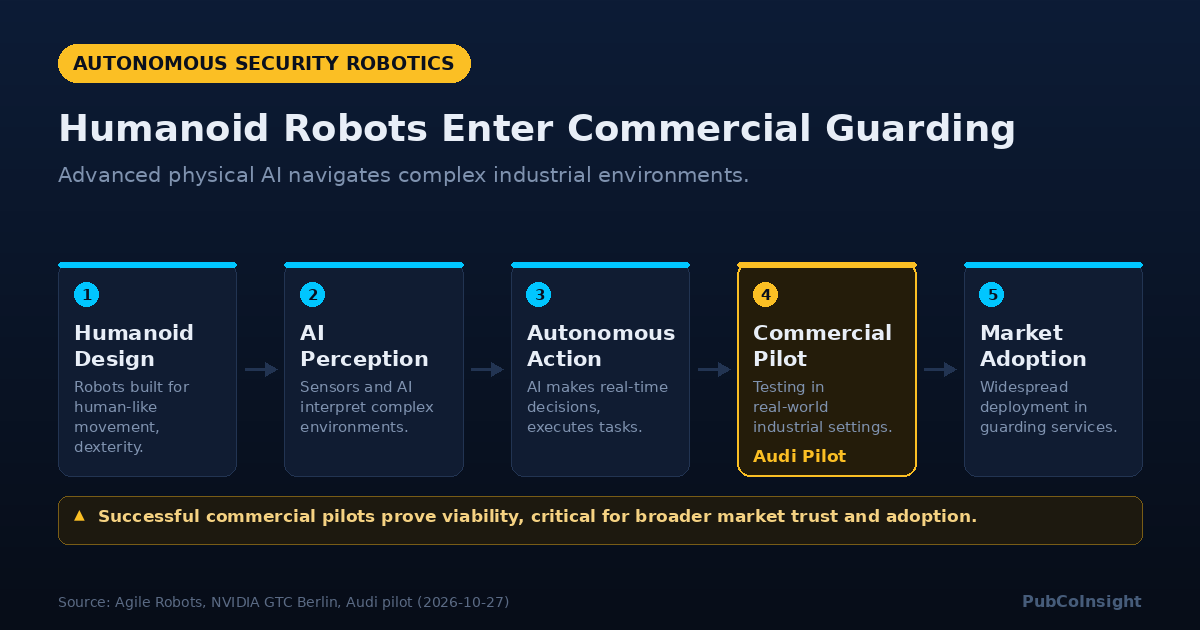
The Mechanism of Humanoid Integration
The core mechanism enabling this shift lies in the convergence of advanced locomotion, dexterous manipulation, and sophisticated AI perception. Humanoids like the Agile ONE SN are designed to navigate complex, unstructured environments that wheeled or tracked robots struggle with. They can climb stairs, open doors, and interact with tools designed for human hands. This physical adaptability is crucial for tasks in industrial facilities, warehouses, and eventually, security patrols where obstacles are common and dynamic. The "physical AI" component refers to the robot's ability to interpret sensory data - vision, lidar, haptics - to understand its surroundings, make real-time decisions, and execute actions with precision. For a humanoid to be commercially viable, it must demonstrate reliable performance in varied lighting, noise, and human traffic conditions. The pilot with Audi, a company known for stringent operational standards, suggests a level of robustness in the Agile ONE SN's current iteration. The value sits not just in the robot's hardware, but in its software stack, particularly the AI models that enable autonomous decision-making and human-like interaction. Proving this wrong would involve consistent failures in navigation, object identification, or task completion in real-world scenarios, or a prohibitive cost structure that prevents widespread adoption.Companies Operating in This Sector
Several companies are navigating the evolving landscape of autonomous security robotics and physical AI. Serve Robotics Inc. (SERV), for instance, focuses on last-mile delivery robots, demonstrating autonomous navigation in urban environments. While not humanoids, their operational experience with autonomous ground vehicles provides insights into deployment challenges and regulatory pathways. Ondas Inc. (ONDS) operates in the drone space, with its American Robotics subsidiary specializing in automated drone systems for industrial inspection and monitoring. Their work with fully autonomous aerial systems, including the recent EASA certification for airborne defense, highlights the regulatory hurdles and technical demands of truly unattended operations. In the perception and component layer, companies like MicroVision, Inc. (MVIS) and Arbe Robotics Ltd. (ARBE) are critical. MicroVision develops lidar solutions, essential for environmental mapping and obstacle detection in autonomous systems. Arbe Robotics focuses on high-resolution 4D imaging radar, providing robust perception in adverse weather conditions where optical sensors might fail. These technologies are foundational for any advanced autonomous robot, including humanoids, to operate safely and effectively. Kopin Corporation (KOPN) contributes with its display and optical solutions, which are vital for human-robot interaction interfaces and potentially for advanced vision systems. Their work on optical interconnect architecture for data centers also speaks to the underlying infrastructure required for processing the massive data streams generated by physical AI. Lantronix, Inc. (LTRX) provides secure data access and management solutions for the Internet of Things (IoT) and embedded computing. Their technology is crucial for connecting autonomous robots to central command systems, ensuring secure data transmission and remote management capabilities. Red Cat Holdings, Inc. (RCAT) is involved in drone technology, including enterprise-grade drone solutions and drone racing. Their focus on drone software and hardware development contributes to the broader ecosystem of autonomous aerial vehicles that share many AI and navigation challenges with ground-based robotics. Unusual Machines, Inc. (UMAC) recently received a $16.9 million purchase order from Powerus for American-made drone components and completed the acquisition of Upgrade Energy, expanding its U.S. drone battery manufacturing. This highlights the ongoing demand for specialized components and the strategic importance of domestic supply chains in the autonomous systems market. BigBear.ai Holdings, Inc. (BBAI) provides AI-powered analytics and decision intelligence solutions, primarily for government and defense clients. While not directly building robots, their expertise in applying AI to complex data sets is indicative of the advanced intelligence layers that will eventually drive sophisticated humanoid decision-making.Artificial Intelligence Technology Solutions, Inc.
Artificial Intelligence Technology Solutions, Inc. (AITX) operates in the autonomous security robotics sector, trading on the OTCID tier. The company, through its subsidiaries, focuses on building and leasing autonomous security robots and remote monitoring systems. AITX employs a recurring monthly subscription model for its offerings, rather than one-off hardware sales. This approach aligns with a broader industry trend towards "robotics-as-a-service," aiming to provide predictable revenue streams and lower upfront costs for customers. The company's recent filings, including the 8-K on October 26, 2026, and the 10-Q on October 20, 2026, detail its financial position. As of August 31, 2026, AITX reported cash of $220,275 and accounts receivable of $947,146. The company also holds $1,261,080 in device parts inventory and $4,677,987 in revenue-earning devices, net of depreciation. The 10-Q filing indicates an accumulated deficit of $184,084,880 and negative working capital of $55,894,870 as of August 31, 2026. Management has stated plans to address its financial situation through continued funding methods, including growing revenues, equity proceeds, and issuing debt. On June 23, 2026, AITX entered an equity financing agreement for up to $10,000,000 of common stock purchases over three years, with approximately $9.8 million remaining under this arrangement. The company projects monthly operating cash breakeven in January 2027, ahead of anticipated revenue ramps from its RAIA, SARA, and ROAMEO product lines. What the public record does not yet establish for AITX is a clear, consistent path to sustained positive operating cash flow. The company continues to expand its security distribution strategy, as evidenced by the engagement of industry veteran Tom Reilly on October 19, 2026, to drive new integrator and distribution channels. AITX's RAD subsidiary has also secured orders across three product lines, as reported on October 22, 2026.What to watch
The coming months hold several specific developments to track. Keep an eye on the progress of Agile Robots' pilot with Audi, particularly any public statements or reports detailing performance metrics or expanded deployment plans. This will provide concrete evidence of humanoid capabilities in a commercial setting. For Axon Enterprise (AXON), the release of third-quarter 2026 earnings on November 5, 2026, will offer insight into their AI push, especially after the October 24, 2026, announcement of Body 5, their next-generation camera built for the AI era. Serve Robotics Inc. (SERV) is also set to report its third-quarter 2026 financial results on November 5, providing an update on its last-mile delivery operations. ADT (ADT) will release its third-quarter 2026 results on November 3, which could include commentary on their integration of advanced security technologies. For Artificial Intelligence Technology Solutions, Inc. (AITX), the declared goal of achieving monthly operating cash breakeven in January 2027 is a key milestone. This will require close attention to their subsequent financial filings to verify progress against this target. Any further details on new integrator and distribution channels, following the appointment of Tom Reilly, will also indicate the company's market penetration strategy., { "label": "AI Perception", "note": "Sensors and AI interpret complex environments." }, { "label": "Autonomous Action", "note": "AI makes real-time decisions, executes tasks." }, { "label": "Commercial Pilot", "note": "Testing in real-world industrial settings.", "metric": "Audi Pilot" }, { "label": "Market Adoption", "note": "Widespread deployment in guarding services." } ], "highlight": 3, "highlight_note": "Successful commercial pilots prove viability, critical for broader market trust and adoption.", "footnote": "Source: Agile Robots, NVIDIA GTC Berlin, Audi pilot (2026-10-27)" }Companies mentioned
| Ticker | Company | Price |
|---|---|---|
| AITX client | Artificial Intelligence Technology Solutions Inc | $0.001 |
| ARBE | Arbe Robotics Ltd. | $0.42 |
| BBAI | BigBear.ai Holdings, Inc. | $2.12 |
| KOPN | Kopin Corporation | $3.4 |
| LTRX | Lantronix, Inc. | $5.83 |
| MVIS | MicroVision, Inc. | $1.26 |
| ONDS | Ondas Inc. | $6.16 |
| RCAT | Red Cat Holdings, Inc. | $4.4 |
| SERV | Serve Robotics Inc. | $2.64 |
| UMAC | Unusual Machines, Inc. | $16.62 |
Listed alphabetically, not ranked. Prices as of 2026-10-27 and they move. Check a live quote before relying on any of this.
How we chose the companies in this article
We cover a fixed universe of companies working in autonomous security robotics, physical AI and the guarding services market they are aimed at. Every one of them that had usable market data on 2026-10-27 appears in this article. We do not pick which ones to mention based on what we think of them, and we do not order them by size, price or trading volume, because an ordered list is a verdict and that is not ours to hand down. Companies left out, and why: none. American Lithium Minerals and Artificial Intelligence Technology Solutions pay us, which is disclosed in full at the foot of every article they appear in.
See the dilution and promotion flags before you see the pitch.
Each week: the micro and small-caps now showing dilution or paid-promotion signals, with the SEC filing behind every flag. No recommendations, no price targets.
Sources used in this article
- What Does Axon Enterprise (AXON) Body 5 Mean For Its AI Push? Simply Wall St. · 2026-10-27
- Nvidia to invest $3 bln in Meta share offering as part of bigger AI partnership Investing.com · 2026-10-27
- Bristol Myers Squibb’s Cancer Drug Just Doubled Survival Time Without Progression — Here’s Why It Matters Motley Fool · 2026-10-27
- Agile Robots Launches Agile ONE SN Humanoid at NVIDIA GTC Berlin and Pilots Humanoids with Audi PR Newswire · 2026-10-27
- Warren Buffett Says Buy an S&P 500 Index Fund. Here's What $500 a Month Is Worth in 20 Years at 3 Different Return Rates. Motley Fool · 2026-10-27
- NVIDIA and Meta to Expand Collaboration on Muse and Muse Family of Models Amid Robust Growth GlobeNewswire · 2026-10-27
- Investors: Oct. 28 Will Be an Important Day for the Stock Market. Here's Why. Motley Fool · 2026-10-27
- Is a Stock Market Crash Coming? What History Says a $10,000 Investment in an S&P 500 ETF Could Be Worth at the End of 2027. Motley Fool · 2026-10-27
- Amkor Technology (AMKR) Stock May Be Undervalued Despite Its $3b AI Packaging Deal Simply Wall St. · 2026-10-27
- Nvidia, Chipmakers Face Higher Costs? TSMC Reportedly Plans Up To 20% Price Hike For Advanced Chip Packaging Stocktwits · 2026-10-27
- Elon Musk Predicts a Wave of Failures Among AI Cloud Companies. Is SpaceX Stock a Sell? Motley Fool · 2026-10-27
- Axon Enterprise vs. CrowdStrike: Which Security Stock Is a Better Buy? Motley Fool · 2026-10-26
Disclosure required by Section 17(b) of the Securities Act of 1933
Artificial Intelligence Technology Solutions, Inc., a Nevada corporation (OTCID: AITX). Artificial Intelligence Technology Solutions, Inc. pays Strategic Innovations First, Inc., a Wyoming corporation doing business as PulseIR. Compensation received: USD 5,000.00 per month for months 1-3 (August, September, October 2026); USD 10,000.00 per month for months 4-6 (November, December 2026, January 2027) contingent on the 90-day review. Minimum committed USD 15,000.00; USD 45,000.00 if the second-period rate triggers.. Form of payment: cash only, invoiced monthly in advance; no stock, options or warrants received or payable. Services: investor relations services under an Investor Relations Services Agreement effective 2026-08-01. Period: six month term, 2026-08-01 through 2027-01-31; 90-day review on or about 2026-10-30. No stock, options or warrants held by PubCo Insight, Pulse IR, Strategic Innovations First, Inc., or Brad Listermann. Confirmed by the executed agreement and by board record recKwdq39X2caPSX7 (POSITIONS HELD: none).
This is information, not investment, financial, legal or tax advice. It is not a recommendation or solicitation to buy, sell or hold any security and it contains no price target. Nothing here is independently verified by us. Confirm every figure against primary filings on SEC EDGAR before you act. Micro-cap and over-the-counter securities are speculative and illiquid and can lose all of their value. The companies named without a disclosure above pay us nothing and have no relationship with us; they are named because a published, mechanical screen selected them. Full disclosure policy.