Optical Interconnects Target Data Center Bottlenecks, Boosting AI for Robotics
Kopin and Fabric.AI are pushing optical interconnects to unlock GPU capacity, a development that could reshape the underlying infrastructure for autonomous security robotics and physical AI.
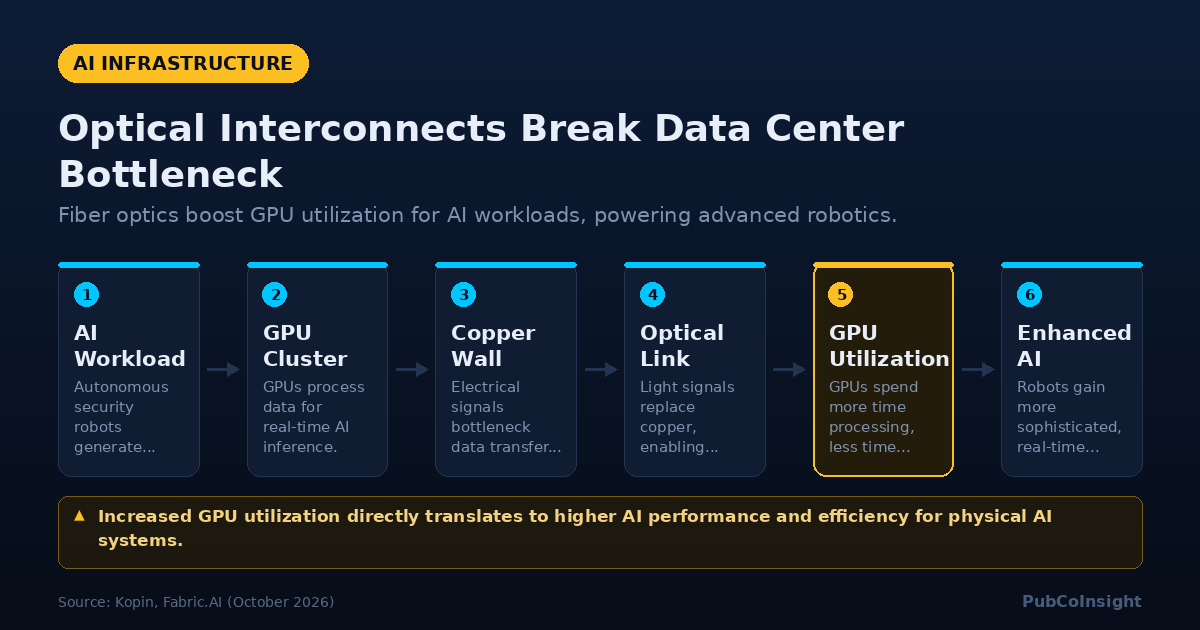
The Mechanism: Breaking the Copper Wall
High-performance computing, especially for AI, stacks Graphics Processing Units (GPUs) into dense clusters. These GPUs need to exchange vast amounts of data quickly. Traditionally, copper cables carry these electrical signals. The problem is that electrical signals degrade over distance and at higher frequencies. They also generate heat, which is a major concern in data centers. As data rates climb and GPU density increases, the copper cables become a bottleneck. They limit the effective distance between GPUs, force slower communication speeds, and consume significant power for signal conditioning. Optical interconnects replace electrical signals with light. Data is converted from electrical to optical, sent over fiber optic cables, and then converted back to electrical at the receiving end. Light signals travel further, faster, and with less power loss than electrical signals. They also generate less heat. Kopin's role, as a microLED display specialist, is in the optical components. Fabric.AI focuses on the architecture that integrates these optical links into the data center fabric, specifically for AI workloads. Their analysis suggests that by removing the copper bottleneck, GPUs can spend more time processing data and less time waiting for data transfer, leading to the reported utilization gains. Proving this wrong would involve demonstrating that the overhead of electrical-to-optical conversion, or the cost and complexity of deploying optical fabric, outweighs the gains in GPU utilization and power efficiency.Companies Navigating the AI Infrastructure Shift
The race for efficient AI processing touches every company building or deploying physical AI. On the hardware side, companies like Kopin Corporation (KOPN), trading at $3.43, are directly involved in the foundational technology for these optical interconnects. Their expertise in microLEDs and high-speed optoelectronics positions them as a key enabler for next-generation data center architectures. Other companies are focused on the AI models and systems that benefit from this improved infrastructure. BigBear.ai Holdings, Inc. (BBAI), priced at $2.17, develops AI-powered analytics and decision intelligence software, often for government and defense applications. Their solutions require robust computing backends. Similarly, Lantronix, Inc. (LTRX), at $5.82, provides secure data access and management solutions for the Internet of Things (IoT) and edge computing, where AI processing is increasingly moving. Efficient data transfer is critical for their connected devices. In the autonomous robotics space, companies like Arbe Robotics Ltd. (ARBE), trading at $0.465, develop high-resolution radar perception for autonomous vehicles and ground robots. Their Gryphon radar system, introduced recently, provides reliable perception on rough terrain. Processing this rich sensor data in real-time demands significant AI compute. MicroVision, Inc. (MVIS), at $1.16, focuses on lidar technology for similar applications, where point cloud processing is a core AI task. Drone and mobile robotics companies also stand to benefit. Ondas Inc. (ONDS), priced at $6.10, is active in autonomous drone systems for critical infrastructure and defense, recently launching Regna AI with Palantir. This partnership aims to expand sovereign AI capabilities, which will depend on scalable, high-performance AI infrastructure. Red Cat Holdings, Inc. (RCAT), at $4.52, develops drone hardware and software, including for defense applications. Unusual Machines, Inc. (UMAC), at $16.38, recently acquired Upgrade Energy to expand U.S. drone battery manufacturing, indicating a focus on the operational aspects of drone deployment. Their "Swarm Economics" approach, as noted in recent news, relies on scalable AI robotics. Finally, companies like Serve Robotics Inc. (SERV), trading at $3.05, deploy autonomous delivery robots. These robots operate in complex, dynamic environments, requiring constant AI processing for navigation, object recognition, and decision-making. The efficiency of their backend AI infrastructure directly impacts their ability to scale and operate economically.Artificial Intelligence Technology Solutions, Inc.
Artificial Intelligence Technology Solutions, Inc. (AITX), trading over the counter at $0.0024, operates through several subsidiaries to build and lease autonomous security robots and remote monitoring systems. The company employs a "Solutions-as-a-Service" model, generating recurring monthly subscription revenue rather than one-off hardware sales. AITX estimates the U.S. security and guarding services market, which it targets, to be approximately $50 billion. The company states its solutions can deliver cost savings of 35% to 80% compared to traditional manned security. AITX's operations are structured around three pillars. Robotic Assistance Devices, Inc. (RAD-I) focuses on stationary security devices. Robotic Assistance Devices Mobile (RAD-M) develops mobile autonomous platforms, including the ROAMEO mobile security unit, which began early commercial deployment in May 2026. The company's SARA agentic artificial intelligence platform is managed under Robotic Assistance Devices Group (RAD-G). A wholly owned subsidiary, RAD Lanka, in Sri Lanka, supports software development, AI initiatives, and technical operations. The company refers to its long-term vision as "RAD Town," aiming for integrated autonomous security deployments across campuses or communities. For the fiscal year ended February 28, 2026, AITX reported revenue of $7,745,336, a 26% increase year-over-year. Gross profit rose 48% to $5,533,700, with gross margin expanding to approximately 71% from 61%. Operating expenses remained largely flat at about $17,477,097, and the loss from operations improved by approximately $2.0 million to $(11,943,397). The company reported a net loss of approximately $14.5 million for the fiscal year and had an accumulated deficit of approximately $171 million as of February 28, 2026. Cash flow from operating activities for the year was negative $9,344,534. As of February 28, 2026, the company had negative working capital of $17,017,745. The public record does not yet establish positive operating cash flow for the company. Management has stated in filings that it projects monthly operating cash breakeven in January 2027, ahead of a revenue ramp for RAIA, SARA, and ROAMEO. AITX recently expanded its security distribution strategy with the appointment of industry veteran Tom Reilly on October 19, aiming to drive new integrator and distribution channels.What to watch
Watch for further announcements from Kopin (KOPN) and Fabric.AI regarding pilot deployments or commercialization timelines for their optical interconnect architecture. Specific data center operators adopting the technology would be a key indicator. On October 20, Artificial Intelligence Technology Solutions (AITX) filed a 10-Q and an 8-K. The 10-Q will contain updated financial figures and operational details. The company has stated a projection for monthly operating cash breakeven in January 2027; subsequent filings will show progress toward that goal. For Ondas (ONDS), monitor the development and adoption of their Regna AI platform, especially regarding any specific project wins or expanded partnerships beyond Palantir. Axon Enterprise (AXON) is scheduled to release third-quarter 2026 results on Tuesday, November 3rd, which will provide insight into their federal sector momentum and overall financial performance., { "label": "GPU Cluster", "note": "GPUs process data for real-time AI inference." }, { "label": "Copper Wall", "note": "Electrical signals bottleneck data transfer between GPUs." }, { "label": "Optical Link", "note": "Light signals replace copper, enabling faster data flow." }, { "label": "GPU Utilization", "note": "GPUs spend more time processing, less time waiting." }, { "label": "Enhanced AI", "note": "Robots gain more sophisticated, real-time intelligence." } ], "highlight": 4, "highlight_note": "Increased GPU utilization directly translates to higher AI performance and efficiency for physical AI systems.", "footnote": "Source: Kopin, Fabric.AI (October 2026)" }Companies mentioned
| Ticker | Company | Price |
|---|---|---|
| AITX client | Artificial Intelligence Technology Solutions Inc | $0.0024 |
| ARBE | Arbe Robotics Ltd. | $0.465 |
| BBAI | BigBear.ai Holdings, Inc. | $2.17 |
| KOPN | Kopin Corporation | $3.43 |
| LTRX | Lantronix, Inc. | $5.82 |
| MVIS | MicroVision, Inc. | $1.16 |
| ONDS | Ondas Inc. | $6.1 |
| RCAT | Red Cat Holdings, Inc. | $4.52 |
| SERV | Serve Robotics Inc. | $3.05 |
| UMAC | Unusual Machines, Inc. | $16.38 |
Listed alphabetically, not ranked. Prices as of 2026-10-21 and they move. Check a live quote before relying on any of this.
How we chose the companies in this article
We cover a fixed universe of companies working in autonomous security robotics, physical AI and the guarding services market they are aimed at. Every one of them that had usable market data on 2026-10-21 appears in this article. We do not pick which ones to mention based on what we think of them, and we do not order them by size, price or trading volume, because an ordered list is a verdict and that is not ours to hand down. Companies left out, and why: none. American Lithium Minerals and Artificial Intelligence Technology Solutions pay us, which is disclosed in full at the foot of every article they appear in.
See the dilution and promotion flags before you see the pitch.
Each week: the micro and small-caps now showing dilution or paid-promotion signals, with the SEC filing behind every flag. No recommendations, no price targets.
Sources used in this article
- Arista Networks vs. Axon Enterprise: Which Tech Stock Is a Better Buy in 2026? Motley Fool · 2026-10-21
- CRWV, NBIS, NVDA Jump Overnight: Musk Says SpaceX Could Rent Compute ‘Several Times Over,’ Analyst Dismisses Glut Fears Stocktwits · 2026-10-21
- What Is The Case For Waiting On CoreWeave Stock? Trefis · 2026-10-21
- How Long Could You Wait for the S&P 500 to Recover From a 10% Drop? Motley Fool · 2026-10-21
- Nvidia Stock Pops After Hours As Elon Musk Says SpaceX Is Adding 200,000 Chips a Month — Daniel Newman Says NVDA Is 'Ripping' Benzinga · 2026-10-21
- Oracle Calls Force Majeure Already? Motley Fool · 2026-10-21
- Why Northrop Grumman Stock Rallied Today Motley Fool · 2026-10-21
- Anthropic Is Targeting an IPO as Soon as Mid-November Motley Fool · 2026-10-21
- Axon Enterprise (AXON) Laps the Stock Market: Here's Why Zacks · 2026-10-20
- Has Buying Axon Stock's Dips Paid Off? Trefis · 2026-10-20
- Can Micron Stock Keep Climbing After a 10-Fold Run? Here's What Its Past Booms Say. Motley Fool · 2026-10-20
- SMCI Stock Surges 16% As Preliminary Q1 Sales Smash Estimates Amid AI Boom Stocktwits · 2026-10-20
Disclosure required by Section 17(b) of the Securities Act of 1933
Artificial Intelligence Technology Solutions, Inc., a Nevada corporation (OTCID: AITX). Artificial Intelligence Technology Solutions, Inc. pays Strategic Innovations First, Inc., a Wyoming corporation doing business as PulseIR. Compensation received: USD 5,000.00 per month for months 1-3 (August, September, October 2026); USD 10,000.00 per month for months 4-6 (November, December 2026, January 2027) contingent on the 90-day review. Minimum committed USD 15,000.00; USD 45,000.00 if the second-period rate triggers.. Form of payment: cash only, invoiced monthly in advance; no stock, options or warrants received or payable. Services: investor relations services under an Investor Relations Services Agreement effective 2026-08-01. Period: six month term, 2026-08-01 through 2027-01-31; 90-day review on or about 2026-10-30. No stock, options or warrants held by PubCo Insight, Pulse IR, Strategic Innovations First, Inc., or Brad Listermann. Confirmed by the executed agreement and by board record recKwdq39X2caPSX7 (POSITIONS HELD: none).
This is information, not investment, financial, legal or tax advice. It is not a recommendation or solicitation to buy, sell or hold any security and it contains no price target. Nothing here is independently verified by us. Confirm every figure against primary filings on SEC EDGAR before you act. Micro-cap and over-the-counter securities are speculative and illiquid and can lose all of their value. The companies named without a disclosure above pay us nothing and have no relationship with us; they are named because a published, mechanical screen selected them. Full disclosure policy.