Nvidia's $5 Billion AI Infrastructure Bet Reshapes Autonomous Security Robotics
Nvidia’s recent $5 billion commitment to AI infrastructure signals a critical shift, intensifying the race for integrated hardware and software solutions that power the next generation of autonomous security robots.
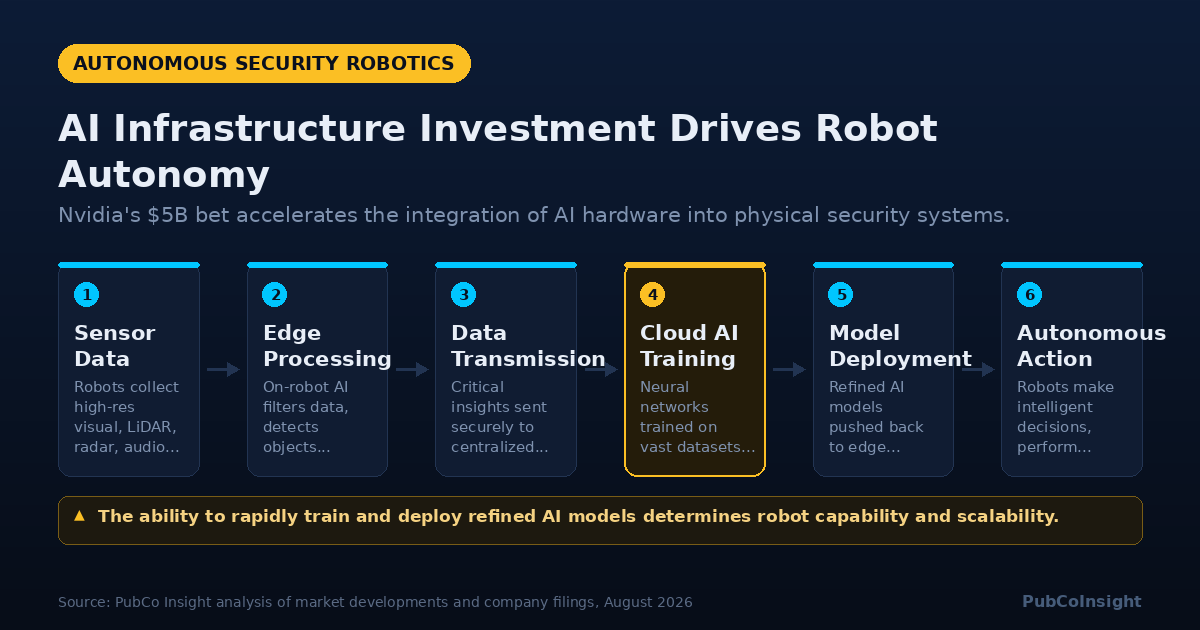
The AI Infrastructure Mechanism
Autonomous security robots, whether stationary sentinels or mobile patrols, rely on a complex interplay of sensors, processors, and AI models to perceive, understand, and react to their environment. This mechanism begins with data capture: high-resolution cameras, LiDAR, radar, and acoustic sensors continuously stream information. This raw data, often gigabytes per second, must be processed in real-time. Edge computing units on the robots themselves perform initial filtering and object detection, reducing the data load before transmitting critical insights. The real heavy lifting, however, often happens further up the chain, in centralized data centers or specialized cloud environments. Here, sophisticated neural networks are trained on vast datasets, learning to distinguish between a stray animal and an intruder, or to identify suspicious patterns of behavior. This training requires immense computational power, often provided by GPU clusters. Once trained, these models are then deployed back to the edge devices, allowing the robots to make increasingly intelligent decisions autonomously. The bottleneck sits in the continuous feedback loop: data from deployment refines models, models are pushed to devices, and the cycle repeats. Nvidia’s $5 billion investment targets this entire pipeline, from the specialized silicon at the edge to the server farms powering the training. If the integration of these layers fails, or if the data flow is inefficient, even the most advanced robot becomes a simple sensor platform. Conversely, seamless integration allows for rapid iteration and deployment of more capable, adaptable AI agents.Companies Building This Future
Several companies are navigating this evolving landscape, each with distinct approaches to integrating AI into physical security. Arbe Robotics Ltd. (ARBE), with its focus on high-resolution 4D imaging radar, addresses a critical sensing component. Their technology aims to provide robust perception in challenging conditions, a foundational requirement for autonomous navigation and threat detection in security robots. This radar data feeds directly into the AI processing pipeline, making the quality of their sensor output directly relevant to the performance of the overall AI system. MicroVision, Inc. (MVIS) also operates in the sensing layer, specializing in LiDAR technology. Their solutions provide precise depth perception, crucial for obstacle avoidance and detailed environmental mapping, particularly for mobile autonomous platforms. The accuracy of their point clouds directly influences the efficiency and reliability of the AI algorithms that interpret the physical world. Moving up the stack, Kopin Corporation (KOPN) develops micro-displays and optical modules. While not directly building security robots, their technology is vital for the human-machine interface, particularly for remote operators or augmented reality applications that overlay AI-generated data onto a human's view. Clear, low-latency visual feedback is essential for effective human oversight and intervention in autonomous operations. Lantronix, Inc. (LTRX) provides secure data access and management solutions for IoT and industrial devices. In the context of autonomous security, their technology ensures that the vast amounts of sensor data and AI model updates can be transmitted reliably and securely between robots, edge processors, and cloud infrastructure. This connectivity is the circulatory system for the AI brain. On the software and analytics side, BigBear.ai Holdings, Inc. (BBAI) offers AI-powered analytics and decision intelligence. Their platforms can ingest data from various sources, including security robots, to provide predictive insights and enhance situational awareness. Their strength lies in making sense of complex data streams, translating raw robot observations into actionable intelligence for security personnel. Ondas Inc. (ONDS), through its American Robotics subsidiary, focuses on autonomous drone solutions, including those for security and surveillance. Their recent U.S. Army order for over $50 million and the contract to provide counter-drone protection for Jacksonville Jaguars NFL games highlight a growing demand for aerial autonomous security. Ondas’s approach integrates hardware, software, and regulatory compliance for fully autonomous drone operations, showcasing a vertically integrated model for a specific segment of the market. Red Cat Holdings, Inc. (RCAT) also operates in the drone space, providing hardware and software for tactical small drones. Their solutions are often deployed for immediate reconnaissance and threat assessment, complementing ground-based autonomous security systems. The real-time data from their drones feeds into the broader AI infrastructure for rapid analysis and response. Finally, Serve Robotics Inc. (SERV) focuses on last-mile autonomous delivery robots. While their primary market is logistics, the underlying technology for autonomous navigation, object detection, and safe human interaction is directly transferable to security applications. Their Q2 earnings call highlighted continued revenue growth, demonstrating progress in commercial deployment of physical AI in real-world environments. Unusual Machines, Inc. (UMAC), despite reporting Q2 losses, is a player in the broader robotics and automation sector. Their focus on advanced manufacturing and machine intelligence suggests an interest in the foundational technologies that enable complex autonomous systems, including those used in security. The company's Q2 earnings call highlights indicate ongoing development in this area.Artificial Intelligence Technology Solutions, Inc.
Artificial Intelligence Technology Solutions, Inc. (AITX) operates on the OTCID tier, focusing on building and leasing autonomous security robots and remote monitoring systems. The company structures its offerings as a recurring monthly subscription service, moving away from one-off hardware sales. This model aims to provide predictable revenue streams from its deployed units. AITX organizes its operations around three main pillars. The first, Robotic Assistance Devices, Inc. (RAD-I), markets stationary security devices. These units are designed to deliver cost savings for guarding services, with the company estimating between 35% and 80% reduction compared to traditional manned security. The second pillar, Robotic Assistance Devices Mobile (RAD-M), develops mobile autonomous platforms. This includes the ROAMEO mobile security unit, which began early commercial deployment in May 2026. The company views RAD-M as having a higher revenue ceiling than its stationary solutions. The third pillar, Robotic Assistance Devices Group (RAD-G), focuses on the SARA agentic artificial intelligence platform, which AITX intends to license to generate substantial revenue. Supporting these efforts is RAD Lanka, a wholly-owned subsidiary in Sri Lanka operating under Port City Colombo status, which handles software development, AI initiatives, and technical operations. AITX's long-term vision, referred to internally as "RAD Town," involves integrated autonomous security deployments across entire campuses, communities, or jurisdictions. For the fiscal year ended February 28, 2026, AITX reported revenue of $7,745,336, a 26% increase over the prior fiscal year. Gross profit rose 48% to $5,533,700, with gross margin expanding to approximately 71% from 61%. Operating expenses remained largely flat at $17,477,097, leading to an improved loss from operations of $(11,943,397). The company reported a net loss of approximately $14.5 million for the fiscal year and an accumulated deficit of approximately $171 million as of that date. The public record does not yet establish the specific number of RAD-M ROAMEO units currently deployed or the exact revenue contribution from these mobile platforms. The company's filings indicate negative cash flow from operating activities of $9,344,534 for the year ended February 28, 2026, and negative working capital of $17,017,745. AITX's management does not anticipate positive cash flow from operations in the near term. The company's common stock was quoted at $0.0086 per share on July 15, 2026.What to watch
The Nvidia investment signals a critical period for companies in autonomous security robotics. Watch for specific announcements regarding collaborations between chip manufacturers and robotics firms. Any new partnerships that integrate advanced AI hardware directly into robot designs will be significant. Monitor the quarterly filings for companies like Serve Robotics (SERV), Unusual Machines (UMAC), and Ondas (ONDS). Look for detailed breakdowns of their R&D spending on AI integration and any increases in their compute infrastructure investments. Specific contract wins that detail the AI capabilities required, such as Ondas's recent U.S. Army order or the Jacksonville Jaguars counter-drone contract, will provide concrete evidence of market adoption for advanced autonomous systems. For AITX, track the progress of its RAD-M ROAMEO deployments. The company's filings indicate early commercial deployment began in May 2026. Specific updates on the number of units deployed, customer feedback, and any revenue generated from these mobile platforms will be key. Also, watch for further details on the commercialization of the SARA agentic artificial intelligence platform under RAD-G, particularly any licensing agreements or pilot programs. Finally, observe the broader trends in AI model development. If large language models and other generative AI technologies begin to be explicitly adapted for physical AI applications, it will indicate a new phase of development that could further accelerate the capabilities of autonomous security robots., { "label": "Edge Processing", "note": "On-robot AI filters data, detects objects, reduces bandwidth." }, { "label": "Data Transmission", "note": "Critical insights sent securely to centralized compute." }, { "label": "Cloud AI Training", "note": "Neural networks trained on vast datasets, refine models." }, { "label": "Model Deployment", "note": "Refined AI models pushed back to edge devices." }, { "label": "Autonomous Action", "note": "Robots make intelligent decisions, perform security tasks." } ], "highlight": 3, "highlight_note": "The ability to rapidly train and deploy refined AI models determines robot capability and scalability.", "footnote": "Source: PubCo Insight analysis of market developments and company filings, August 2026" }Companies mentioned
| Ticker | Company | Price |
|---|---|---|
| AITX client | Artificial Intelligence Technology Solutions Inc | $0.0069 |
| ARBE | Arbe Robotics Ltd. | $0.768 |
| BBAI | BigBear.ai Holdings, Inc. | $3.27 |
| KOPN | Kopin Corporation | $4.27 |
| LTRX | Lantronix, Inc. | $5.97 |
| MVIS | MicroVision, Inc. | $3.39 |
| ONDS | Ondas Inc. | $9.11 |
| RCAT | Red Cat Holdings, Inc. | $9.21 |
| SERV | Serve Robotics Inc. | $5.085 |
| UMAC | Unusual Machines, Inc. | $26.11 |
Listed alphabetically, not ranked. Prices as of 2026-08-10 and they move. Check a live quote before relying on any of this.
How we chose the companies in this article
We cover a fixed universe of companies working in autonomous security robotics, physical AI and the guarding services market they are aimed at. Every one of them that had usable market data on 2026-08-10 appears in this article. We do not pick which ones to mention based on what we think of them, and we do not order them by size, price or trading volume, because an ordered list is a verdict and that is not ours to hand down. Companies left out, and why: none. American Lithium Minerals and Artificial Intelligence Technology Solutions pay us, which is disclosed in full at the foot of every article they appear in.
See the dilution and promotion flags before you see the pitch.
Each week: the micro and small-caps now showing dilution or paid-promotion signals, with the SEC filing behind every flag. No recommendations, no price targets.
Sources used in this article
- Chip Stocks Face a Long Climb Back to Their Peak Despite Recent Rally The Wall Street Journal · 2026-08-10
- Sandisk Can Now Buy Back $15.5 Billion of Its Own Stock. That's 8.6% of the Company. Motley Fool · 2026-08-10
- Why Rocket Lab Stock Plummeted 36.1% Last Month But Is Soaring in August Motley Fool · 2026-08-10
- Disney's Valuation Is at Multiyear Lows, and Buybacks Are at a 9-Year High. Is Disney a No-Brainer Value Stock to Buy Now? Motley Fool · 2026-08-10
- I've Been Writing About Procter & Gamble Stock for Years. Here's Why My Conviction Has Never Been Higher. Motley Fool · 2026-08-10
- Warren Buffett's Successor, Greg Abel, Just Bought $4.5 Billion of the Oracle of Omaha's Favorite Stock (No, Not Alphabet!) Motley Fool · 2026-08-10
- SpaceX Stock Is Down 34% From Its Post-IPO Peak. A $10,000 Investment Today Could Be Worth This Much by the End of 2027. (NASDAQ: SPCX) Motley Fool · 2026-08-10
- Anthropic Locks In $10B European Compute Bet With a Seven-Month-Old Startup Forkast News · 2026-08-10
- Micron Trades at 6 Times Next Year's Earnings. The $38 Billion of Capacity That Ends This Cycle Doesn't Open Until 2028. Motley Fool · 2026-08-10
- Nvidia (NVDA) Commits $5 Billion To Take A Bigger Role In AI Infrastructure Simply Wall St. · 2026-08-10
- 1 Nasdaq 100 Stock for Long-Term Investors and 2 We Question StockStory · 2026-08-09
- Unusual Machines Q2 Earnings Call Highlights MarketBeat · 2026-08-09
Disclosure required by Section 17(b) of the Securities Act of 1933
Artificial Intelligence Technology Solutions, Inc., a Nevada corporation (OTCID: AITX). Artificial Intelligence Technology Solutions, Inc. pays Strategic Innovations First, Inc., a Wyoming corporation doing business as PulseIR. Compensation received: USD 5,000.00 per month for months 1-3 (August, September, October 2026); USD 10,000.00 per month for months 4-6 (November, December 2026, January 2027) contingent on the 90-day review. Minimum committed USD 15,000.00; USD 45,000.00 if the second-period rate triggers.. Form of payment: cash only, invoiced monthly in advance; no stock, options or warrants received or payable. Services: investor relations services under an Investor Relations Services Agreement effective 2026-08-01. Period: six month term, 2026-08-01 through 2027-01-31; 90-day review on or about 2026-10-30. No stock, options or warrants held by PubCo Insight, Pulse IR, Strategic Innovations First, Inc., or Brad Listermann. Confirmed by the executed agreement and by board record recKwdq39X2caPSX7 (POSITIONS HELD: none).
This is information, not investment, financial, legal or tax advice. It is not a recommendation or solicitation to buy, sell or hold any security and it contains no price target. Nothing here is independently verified by us. Confirm every figure against primary filings on SEC EDGAR before you act. Micro-cap and over-the-counter securities are speculative and illiquid and can lose all of their value. The companies named without a disclosure above pay us nothing and have no relationship with us; they are named because a published, mechanical screen selected them. Full disclosure policy.