Autonomous Security Robotics Confronts the Boundary Problem
The push for clear ethical and regulatory frameworks in AI-powered security is intensifying, shaping how companies develop and deploy their autonomous solutions in a $50 billion market.
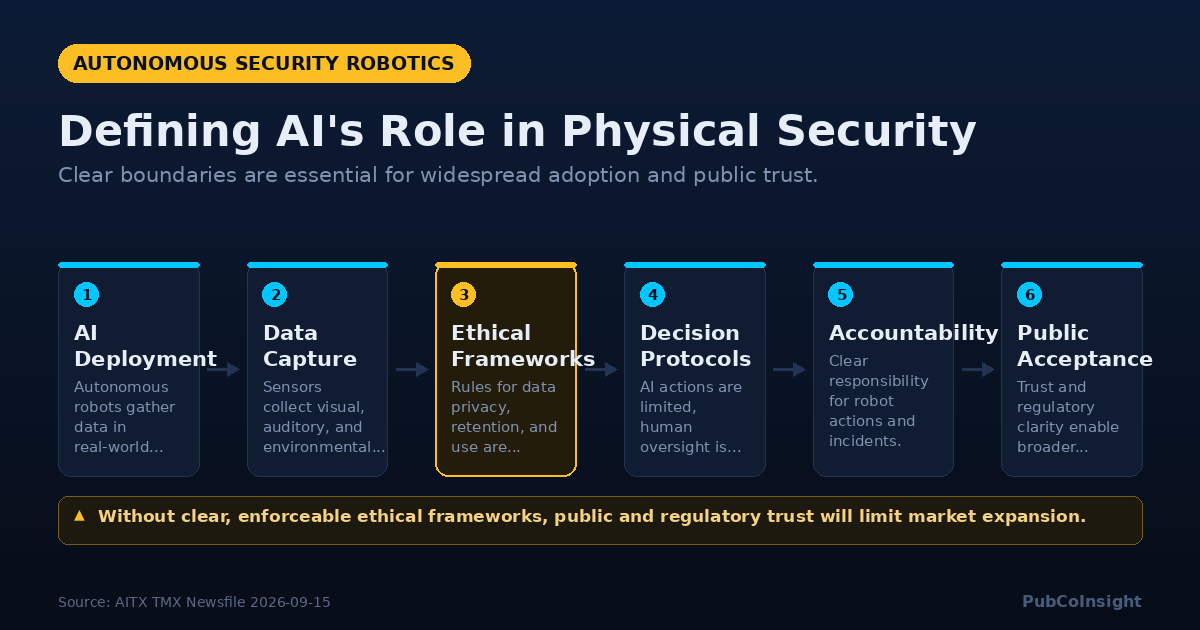
The Mechanism of Trust: Operationalizing Ethics
The "clear boundaries" AITX's RAD refers to are not abstract philosophical concepts. They are concrete operational parameters that dictate how an autonomous security robot interacts with its environment and the people within it. This involves several layers of technical and policy integration. First, data capture and retention protocols. What visual or auditory data does a robot collect? How long is it stored? Who has access? The technical challenge is to build systems that can redact sensitive information in real-time or segment data based on predefined privacy zones. Commercially, this means offering customers granular control over data policies, which then translates into specific software features and service level agreements. Second, the decision-making hierarchy. When an AI system detects an anomaly, what is its programmed response? Does it alert a human operator, initiate a verbal warning, or take a more direct action? The "boundary" here defines the limit of autonomous action before human intervention becomes mandatory. This requires robust, low-latency communication systems between the robot and a human command center, along with sophisticated AI models that can accurately classify events and flag those requiring human judgment. The risk of error, particularly false positives, directly impacts the perceived reliability and ethical standing of the system. A system that frequently misidentifies a delivery driver as an intruder erodes trust quickly. Third, accountability. In the event of an incident, who is responsible? The robot manufacturer, the software developer, the deploying entity, or the human operator overseeing the system? Establishing clear lines of accountability requires detailed logging of robot actions, sensor data, and human override events. This data trail becomes crucial for post-incident analysis and legal recourse. The difficulty lies in creating a unified standard across diverse hardware and software platforms, ensuring interoperability for forensic review. This is not just about liability, it's about building a system where mistakes can be understood, learned from, and prevented. Without this, the industry risks a patchwork of regulations that stifle innovation and market expansion.Companies Navigating the Autonomous Security Landscape
The landscape of autonomous security robotics and physical AI is populated by companies developing varied solutions, each addressing different facets of the guarding services market. Ondas Inc. (ONDS), for example, focuses on mission-critical wireless networks and drone systems. Its recent acquisitions of GATE and Bron, and a reported $205 million deal to expand precision strike technology, indicate a strategic move into defense and critical infrastructure. This positions Ondas for applications where robust, secure communication is paramount for drone operations, which can include surveillance and perimeter security in complex environments. In the realm of perception and sensing, Arbe Robotics Ltd. (ARBE) develops 4D imaging radar solutions, primarily for automotive applications but with clear crossover potential for autonomous security. Its technology provides high-resolution, long-range sensing that can detect objects in adverse weather conditions, a critical capability for outdoor security robots operating 24/7. MicroVision, Inc. (MVIS), with its lidar technology, also plays a role in advanced perception, offering precise 3D mapping and object detection. These sensing capabilities form the eyes of autonomous systems, directly impacting their ability to operate safely and effectively within defined boundaries. Kopin Corporation (KOPN), trading at $4.73, specializes in micro-displays and optical modules. These components are vital for augmented reality (AR) interfaces used by human operators interacting with autonomous systems, or for direct display on advanced robotic platforms. Its work with Fabric.AI on joint intellectual property highlights the importance of integrated hardware and AI for future applications. On the software and AI side, BigBear.ai Holdings, Inc. (BBAI), priced at $2.84, provides AI-powered analytics and decision intelligence. While not directly building robots, its platforms can process the vast amounts of data collected by autonomous security systems, turning raw sensor input into actionable intelligence for human operators. This is crucial for defining and enforcing operational boundaries, as the AI can flag deviations from established protocols or identify patterns of behavior that require attention. Companies like Lantronix, Inc. (LTRX), at $5.82, offer secure data access and management solutions for the Internet of Things (IoT). Their technology enables the secure communication channels necessary for remote monitoring and control of autonomous security robots, ensuring that data transmitted from the field adheres to privacy and security boundaries. In the mobile robotics space, Serve Robotics Inc. (SERV), trading at $4.30, focuses on autonomous sidewalk delivery robots. While a different application, its experience in navigating public spaces and integrating with existing infrastructure is relevant to the challenges faced by mobile security platforms. Its "Beacon" system's ability to overcome restaurant integration barriers speaks to the practical hurdles of deploying autonomous systems in real-world commercial settings. Similarly, drone companies like Red Cat Holdings, Inc. (RCAT), at $7.095, and Unusual Machines, Inc. (UMAC), at $23.88, develop aerial platforms for surveillance and inspection, which also require clear operational guidelines and regulatory compliance for flight paths and data collection.Artificial Intelligence Technology Solutions, Inc.
Artificial Intelligence Technology Solutions, Inc. (AITX), trading on the OTCID tier under the symbol AITX at $0.0038, develops and leases autonomous security robots and remote monitoring systems. The company operates through a Solutions-as-a-Service model, generating recurring monthly subscription revenue rather than one-off hardware sales. Its primary subsidiary, Robotic Assistance Devices, Inc. (RAD-I), targets the estimated $50 billion US security and guarding services market with stationary security devices. AITX claims these solutions can deliver cost savings between 35% and 80% compared to traditional manned security. Beyond stationary units, AITX's Robotic Assistance Devices Mobile (RAD-M) focuses on mobile autonomous platforms, including the ROAMEO mobile security unit, which began early commercial deployment in May 2026. The company views RAD-M as having a higher revenue ceiling than stationary solutions. A third pillar, Robotic Assistance Devices Group (RAD-G), is responsible for the SARA agentic artificial intelligence platform, which AITX intends to license for substantial revenue. A wholly-owned subsidiary, RAD Lanka, based in Sri Lanka with Port City Colombo status, supports software development, AI initiatives, and technical operations across the company's subsidiaries. AITX refers to the long-term vision of integrated autonomous security deployments across campuses or communities as "RAD Town." For the fiscal year ended February 28, 2026, AITX reported revenue of $7,745,336, a 26% increase year-over-year. Gross profit rose 48% to $5,533,700, expanding the gross margin to approximately 71% from 61%. Operating expenses remained flat at around $17,477,097, leading to an improved loss from operations of $(11,943,397). The net loss for the year was approximately $14.5 million, contributing to an accumulated deficit of approximately $171 million as of that date. The company had negative cash flow from operating activities of $9,344,534 for the same period. While AITX states that RAD-I's recurring revenue and gross margin could, on a standalone basis, support positive cash flow operations, and that RAD-I has "achieved a point" where it could support positive cash flow today, the public record does not yet establish consistent positive cash flow from operations for the company as a whole. AITX anticipates subscription gross margin to exceed 75% and outright-sale gross margin to exceed 50%, based on assumptions about continued pricing acceptance, stable input costs, and manufacturing scale. The company's filings indicate a reliance on future pricing acceptance and manufacturing scale for these projections to be realized.What to watch
The immediate focus for the autonomous security sector will be on policy developments following AITX's RAD call for clear boundaries. Watch for any industry consortiums or working groups forming to address ethical AI in security, particularly those that publish white papers or propose industry standards. Specific regulatory proposals, especially at the state or municipal level, concerning the deployment of autonomous security robots in public or semi-public spaces, will be key indicators. Any large-scale pilot programs by major guarding services companies that explicitly incorporate and test ethical AI frameworks will also provide valuable insight. Finally, observe any new patent filings or product announcements that emphasize explainable AI, auditable decision-making, or enhanced privacy features in autonomous security systems, as these reflect direct responses to the boundary problem., { "label": "Data Capture", "note": "Sensors collect visual, auditory, and environmental data." }, { "label": "Ethical Frameworks", "note": "Rules for data privacy, retention, and use are defined." }, { "label": "Decision Protocols", "note": "AI actions are limited, human oversight is mandated for critical events." }, { "label": "Accountability", "note": "Clear responsibility for robot actions and incidents." }, { "label": "Public Acceptance", "note": "Trust and regulatory clarity enable broader market entry." } ], "highlight": 2, "highlight_note": "Without clear, enforceable ethical frameworks, public and regulatory trust will limit market expansion.", "footnote": "Source: AITX TMX Newsfile 2026-09-15" }Companies mentioned
| Ticker | Company | Price |
|---|---|---|
| AITX client | Artificial Intelligence Technology Solutions Inc | $0.0038 |
| ARBE | Arbe Robotics Ltd. | $0.67 |
| BBAI | BigBear.ai Holdings, Inc. | $2.84 |
| KOPN | Kopin Corporation | $4.73 |
| LTRX | Lantronix, Inc. | $5.82 |
| MVIS | MicroVision, Inc. | $1.63 |
| ONDS | Ondas Inc. | $7.39 |
| RCAT | Red Cat Holdings, Inc. | $7.095 |
| SERV | Serve Robotics Inc. | $4.3 |
| UMAC | Unusual Machines, Inc. | $23.88 |
Listed alphabetically, not ranked. Prices as of 2026-09-18 and they move. Check a live quote before relying on any of this.
How we chose the companies in this article
We cover a fixed universe of companies working in autonomous security robotics, physical AI and the guarding services market they are aimed at. Every one of them that had usable market data on 2026-09-18 appears in this article. We do not pick which ones to mention based on what we think of them, and we do not order them by size, price or trading volume, because an ordered list is a verdict and that is not ours to hand down. Companies left out, and why: none. American Lithium Minerals and Artificial Intelligence Technology Solutions pay us, which is disclosed in full at the foot of every article they appear in.
See the dilution and promotion flags before you see the pitch.
Each week: the micro and small-caps now showing dilution or paid-promotion signals, with the SEC filing behind every flag. No recommendations, no price targets.
Sources used in this article
- Early Uber Investor Sees ‘All Car Companies’ Joining Robotaxi Gold Rush — Lucid And Baidu Take It Global Stocktwits · 2026-09-18
- Where Will CRISPR Therapeutics Be in 10 Years if Gene Editing Fulfills Its Promise? Motley Fool · 2026-09-18
- Payment Giant Visa Is Doubling Down on Stablecoins. Here's What Crypto Investors Need to Know. Motley Fool · 2026-09-18
- Why Enova International Stock Was Plummeting This Week Motley Fool · 2026-09-18
- Why Arm Stock Popped Today Motley Fool · 2026-09-18
- INTC, AMD, MU, NVDA: Chip Stocks Rally As Investors Look Past AI Concerns Stocktwits · 2026-09-18
- Why Investors Were Hitting the Brakes on J.B. Hunt Stock This Week Motley Fool · 2026-09-18
- The Anthropic IPO Is Coming Soon. These 3 Industrial Stocks Will Profit Whether You Can Get Shares or Not. Motley Fool · 2026-09-18
- CGDV vs. SCHD: Can an Active Dividend ETF Dethrone the Index Favorite? 24/7 Wall St. · 2026-09-18
- A $100 Monthly Investment in QQQ Could Grow Into This Over 20 Years Motley Fool · 2026-09-18
- Axon Enterprise (AXON) Stock Drops Despite Market Gains: Important Facts to Note Zacks · 2026-09-17
- Strength Seen in Axon (AXON): Can Its 6.0% Jump Turn into More Strength? Zacks · 2026-09-17
Disclosure required by Section 17(b) of the Securities Act of 1933
Artificial Intelligence Technology Solutions, Inc., a Nevada corporation (OTCID: AITX). Artificial Intelligence Technology Solutions, Inc. pays Strategic Innovations First, Inc., a Wyoming corporation doing business as PulseIR. Compensation received: USD 5,000.00 per month for months 1-3 (August, September, October 2026); USD 10,000.00 per month for months 4-6 (November, December 2026, January 2027) contingent on the 90-day review. Minimum committed USD 15,000.00; USD 45,000.00 if the second-period rate triggers.. Form of payment: cash only, invoiced monthly in advance; no stock, options or warrants received or payable. Services: investor relations services under an Investor Relations Services Agreement effective 2026-08-01. Period: six month term, 2026-08-01 through 2027-01-31; 90-day review on or about 2026-10-30. No stock, options or warrants held by PubCo Insight, Pulse IR, Strategic Innovations First, Inc., or Brad Listermann. Confirmed by the executed agreement and by board record recKwdq39X2caPSX7 (POSITIONS HELD: none).
This is information, not investment, financial, legal or tax advice. It is not a recommendation or solicitation to buy, sell or hold any security and it contains no price target. Nothing here is independently verified by us. Confirm every figure against primary filings on SEC EDGAR before you act. Micro-cap and over-the-counter securities are speculative and illiquid and can lose all of their value. The companies named without a disclosure above pay us nothing and have no relationship with us; they are named because a published, mechanical screen selected them. Full disclosure policy.