Autonomous Security Robotics Face Market Headwinds as Axon Drops
A recent fund move capitalizing on an "AI-related selloff" in Axon Enterprise shares highlights a broader market sentiment impacting autonomous security robotics and physical AI, despite ongoing sector innovation.
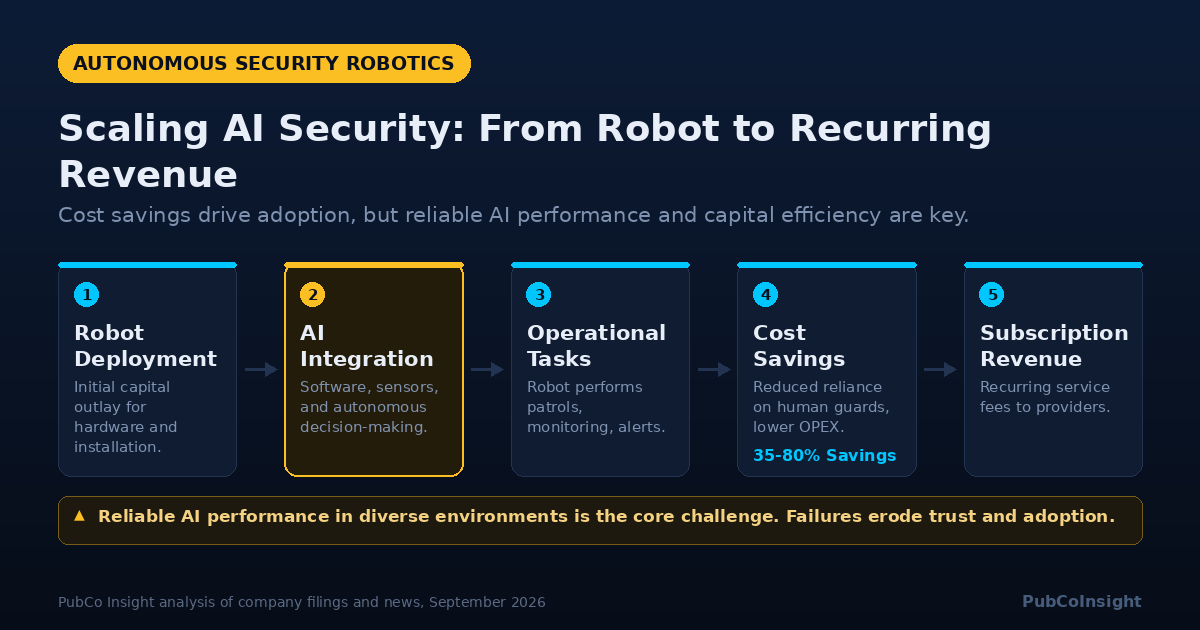
The Mechanism of Value in Autonomous Security
Autonomous security robotics fundamentally shifts the cost structure of guarding services. Traditional manned security involves significant labor costs, including wages, benefits, training, and supervision. These costs are largely fixed per guard, per shift. Robotic solutions, however, introduce a high upfront capital expenditure for the robot itself, followed by recurring software, maintenance, and monitoring fees. The value proposition hinges on the robot's ability to perform tasks previously handled by human guards, but at a lower long-term operational cost. For this model to deliver, three conditions must hold. First, the robot must reliably execute its assigned tasks, whether that is patrolling a perimeter, monitoring specific zones, or responding to anomalies. This demands robust hardware, advanced sensor integration, and sophisticated AI for perception, navigation, and decision-making. Second, the cost savings must be substantial enough to offset the initial investment and ongoing operational expenses. Companies often cite reductions in the 35% to 80% range compared to traditional manned security. This is where the recurring "Solutions-as-a-Service" model gains traction; it spreads the capital cost over time, making it more palatable for customers and creating predictable revenue streams for providers. Third, the regulatory and social acceptance of autonomous security must continue to expand. Permits for drone operations, local ordinances for ground robots, and public perception of AI in security all play a role. A single high-profile failure or a restrictive regulatory decision can slow adoption significantly. The bottleneck, then, is often in the sustained, reliable performance of the AI in diverse, real-world environments, coupled with the ability to scale deployments without prohibitive service costs.Companies Navigating the Autonomous Security Landscape
The small and micro-cap end of autonomous security robotics features a range of companies tackling different aspects of the market. Some focus on specific hardware, others on software platforms, and many combine both into a service offering. Ondas Inc. (ONDS), trading at $7.39, recently expanded its defense sector footprint with the acquisitions of GATE and Bron. These moves aim to integrate component ownership, potentially improving returns in its drone and precision strike technology segments. Ondas had a $205 million deal to expand its precision strike technology, as reported on September 14, 2026. This indicates a focus on specialized, high-value applications beyond traditional commercial security. In the drone space, Red Cat Holdings, Inc. (RCAT), priced at $7.095, and Unusual Machines, Inc. (UMAC), at $23.88, are both active. Unusual Machines was highlighted by Zacks for benefiting from wireless industry tailwinds. Red Cat has seen some volatility, with its stock sinking following a broader slide in speculative drone names. These companies are navigating a market where drone technology is rapidly evolving, but commercial and security applications still require significant integration and regulatory clarity. Serve Robotics Inc. (SERV), trading at $4.30, focuses on last-mile delivery robotics. Its "Beacon" platform aims to overcome restaurant integration barriers. While not directly in security, the challenges of autonomous navigation and integration into existing commercial workflows are shared. Companies like Arbe Robotics Ltd. (ARBE), at $0.67, and MicroVision, Inc. (MVIS), at $1.63, are developing core sensor technologies crucial for autonomous operation. Arbe specializes in imaging radar, critical for all-weather, all-condition perception in autonomous systems. MicroVision focuses on LiDAR technology, which provides high-resolution 3D mapping capabilities. These foundational technologies are essential for the safe and effective deployment of any autonomous robot. Kopin Corporation (KOPN), priced at $4.73, is involved in display technologies and micro-displays, often used in augmented reality and heads-up displays for various applications, including robotics and defense. Fabric.AI recently appointed counsel to support joint intellectual property with Kopin, suggesting ongoing development in critical AI-related components. Lantronix, Inc. (LTRX), at $5.82, provides secure data access and management solutions, which are vital for connecting and controlling autonomous robots in a distributed network. Their focus on IoT and embedded computing ensures that the data collected by security robots can be securely transmitted and analyzed. BigBear.ai Holdings, Inc. (BBAI), trading at $2.84, offers AI-powered analytics and data solutions. While not a robotics company itself, its expertise in processing and interpreting large datasets is critical for the "intelligence" aspect of autonomous security, enabling predictive analytics and enhanced decision-making for robotic platforms.Artificial Intelligence Technology Solutions, Inc.
Artificial Intelligence Technology Solutions, Inc. (AITX), trading over the counter at $0.0038, operates through subsidiaries like Robotic Assistance Devices, Inc. (RAD-I), Robotic Assistance Devices Mobile (RAD-M), and Robotic Assistance Devices Group (RAD-G). The company focuses on building and leasing autonomous security robots and remote monitoring systems. Its business model centers on a recurring monthly subscription, rather than outright hardware sales. This "Solutions-as-a-Service" approach targets the security and guarding services industry, which AITX estimates to be a $50 billion market in the United States. AITX's solutions aim to deliver significant cost savings, between 35% and 80%, compared to traditional manned security. This is achieved using a suite of stationary and mobile devices integrated with the company's software and monitoring platforms. The operations are structured around three pillars: stationary security devices (RAD-I), mobile autonomous platforms (RAD-M), including the ROAMEO mobile security unit which began early commercial deployment in May 2026, and the SARA agentic artificial intelligence platform (RAD-G). RAD Lanka, a wholly owned subsidiary in Sri Lanka, supports software development, AI initiatives, and technical operations. Internally, the company refers to its long-term strategy as "RAD Town," envisioning integrated autonomous security deployments across campuses, communities, or jurisdictions. For the fiscal year ended February 28, 2026, AITX reported revenue of $7,745,336, a 26% increase year-over-year. Gross profit rose 48% to $5,533,700, with gross margin expanding to approximately 71% from 61%. Operating expenses remained largely flat at about $17,477,097, and the loss from operations improved by approximately $2.0 million to $(11,943,397). The net loss for the fiscal year was approximately $14.5 million, with an accumulated deficit of approximately $171 million as of that date. The company had negative cash flow from operating activities of $9,344,534 for the year ended February 28, 2026, and negative working capital of $17,017,745. The public record does not yet establish a clear path to positive cash flow from operations. AITX's filings indicate management does not anticipate positive cash flow from operations in the near term. The company's recent 8-K filings on September 18, 16, 15, and 14, 2026, detail ongoing operational updates and corporate actions. The company states that RAD-I's recurring revenue and gross margin could, on a standalone basis, support positive cash flow operations, and that RAD-M is projected to surpass RAD-I's monthly recurring revenue contribution at some future point. These projections are dependent on assumptions about continued pricing acceptance, stable input costs, and manufacturing scale.What to watch
Investors should monitor the quarterly filings from companies in this sector for specific metrics. For AITX, watch for updates on the deployment numbers for the ROAMEO mobile security units and the adoption rate of the SARA platform. The company's future filings will detail the progression of its "RAD Town" strategy. For Ondas, the integration of GATE and Bron, and any new contracts related to its precision strike technology, will be key indicators. Pay attention to the revenue contribution from these acquisitions. In the broader drone market, look for regulatory developments regarding commercial drone operation permits, which directly impact companies like Red Cat and Unusual Machines. For sensor technology providers like Arbe Robotics and MicroVision, watch for design wins and partnerships with major robotics manufacturers. The ability of Serve Robotics to expand its "Beacon" platform beyond initial pilot programs will signal its scalability. Finally, observe the general market sentiment for AI-related stocks, as reflected by movements in larger players like Axon, which can influence capital availability for smaller, growth-focused companies., { "label": "AI Integration", "note": "Software, sensors, and autonomous decision-making." }, { "label": "Operational Tasks", "note": "Robot performs patrols, monitoring, alerts." }, { "label": "Cost Savings", "note": "Reduced reliance on human guards, lower OPEX.", "metric": "35-80% Savings" }, { "label": "Subscription Revenue", "note": "Recurring service fees to providers." } ], "highlight": 1, "highlight_note": "Reliable AI performance in diverse environments is the core challenge. Failures erode trust and adoption.", "footnote": "PubCo Insight analysis of company filings and news, September 2026" }Companies mentioned
| Ticker | Company | Price |
|---|---|---|
| AITX client | Artificial Intelligence Technology Solutions Inc | $0.0038 |
| ARBE | Arbe Robotics Ltd. | $0.67 |
| BBAI | BigBear.ai Holdings, Inc. | $2.84 |
| KOPN | Kopin Corporation | $4.73 |
| LTRX | Lantronix, Inc. | $5.82 |
| MVIS | MicroVision, Inc. | $1.63 |
| ONDS | Ondas Inc. | $7.39 |
| RCAT | Red Cat Holdings, Inc. | $7.095 |
| SERV | Serve Robotics Inc. | $4.3 |
| UMAC | Unusual Machines, Inc. | $23.88 |
Listed alphabetically, not ranked. Prices as of 2026-09-18 and they move. Check a live quote before relying on any of this.
How we chose the companies in this article
We cover a fixed universe of companies working in autonomous security robotics, physical AI and the guarding services market they are aimed at. Every one of them that had usable market data on 2026-09-18 appears in this article. We do not pick which ones to mention based on what we think of them, and we do not order them by size, price or trading volume, because an ordered list is a verdict and that is not ours to hand down. Companies left out, and why: none. American Lithium Minerals and Artificial Intelligence Technology Solutions pay us, which is disclosed in full at the foot of every article they appear in.
See the dilution and promotion flags before you see the pitch.
Each week: the micro and small-caps now showing dilution or paid-promotion signals, with the SEC filing behind every flag. No recommendations, no price targets.
Sources used in this article
- Fed Chair Kevin Warsh Raises Interest Rates for the First Time in Over 3 Years. These AI Stocks Will Benefit Motley Fool · 2026-09-18
- The Anthropic IPO Could Be Bigger Than SpaceX. Here's What That Means for Vistra, Bloom Energy, and Oklo. Motley Fool · 2026-09-18
- Zacks Investment Ideas feature highlights: NVIDIA, Advanced Micro Devices, Tempus, Moderna, Super Micro Computer and Aya Gold & Silver Zacks · 2026-09-18
- Apple Just Announced a Groundbreaking iPhone, but It Has Alienated a Key Market Motley Fool · 2026-09-18
- Micron Is Still 22% Below Its All-Time High Heading Into Earnings -- Buying Opportunity or Warning Sign? Motley Fool · 2026-09-18
- 3 Financial Stocks Berkshire Hathaway Owns That I'd Buy Before Buying Berkshire Itself Motley Fool · 2026-09-18
- 3 High-Yield Dividend Stocks I'd Buy in September With No Hesitation Motley Fool · 2026-09-18
- 3 Stocks to Buy as an Analyst Sees Semiconductor Spending Surging 88% Motley Fool · 2026-09-18
- Why Salesforce CEO Marc Benioff thinks AI chip king Nvidia is 'exquisite' Yahoo Finance · 2026-09-18
- Tesla Gets 50% Tax Break for $10 Billion Texas Solar Factory. Here's Why That Benefits Tesla's Robotaxi Growth Motley Fool · 2026-09-18
- Zacks Industry Outlook Ubiquiti, InterDigital and Unusual Machines Zacks · 2026-09-18
- Axon Enterprise (AXON) Stock Drops Despite Market Gains: Important Facts to Note Zacks · 2026-09-17
Disclosure required by Section 17(b) of the Securities Act of 1933
Artificial Intelligence Technology Solutions, Inc., a Nevada corporation (OTCID: AITX). Artificial Intelligence Technology Solutions, Inc. pays Strategic Innovations First, Inc., a Wyoming corporation doing business as PulseIR. Compensation received: USD 5,000.00 per month for months 1-3 (August, September, October 2026); USD 10,000.00 per month for months 4-6 (November, December 2026, January 2027) contingent on the 90-day review. Minimum committed USD 15,000.00; USD 45,000.00 if the second-period rate triggers.. Form of payment: cash only, invoiced monthly in advance; no stock, options or warrants received or payable. Services: investor relations services under an Investor Relations Services Agreement effective 2026-08-01. Period: six month term, 2026-08-01 through 2027-01-31; 90-day review on or about 2026-10-30. No stock, options or warrants held by PubCo Insight, Pulse IR, Strategic Innovations First, Inc., or Brad Listermann. Confirmed by the executed agreement and by board record recKwdq39X2caPSX7 (POSITIONS HELD: none).
This is information, not investment, financial, legal or tax advice. It is not a recommendation or solicitation to buy, sell or hold any security and it contains no price target. Nothing here is independently verified by us. Confirm every figure against primary filings on SEC EDGAR before you act. Micro-cap and over-the-counter securities are speculative and illiquid and can lose all of their value. The companies named without a disclosure above pay us nothing and have no relationship with us; they are named because a published, mechanical screen selected them. Full disclosure policy.