Rising Costs Squeeze Autonomous Security Robot Hardware
Autonomous security robot developers face increasing materials, compute, and transportation costs, challenging the economic model for physical AI deployments.
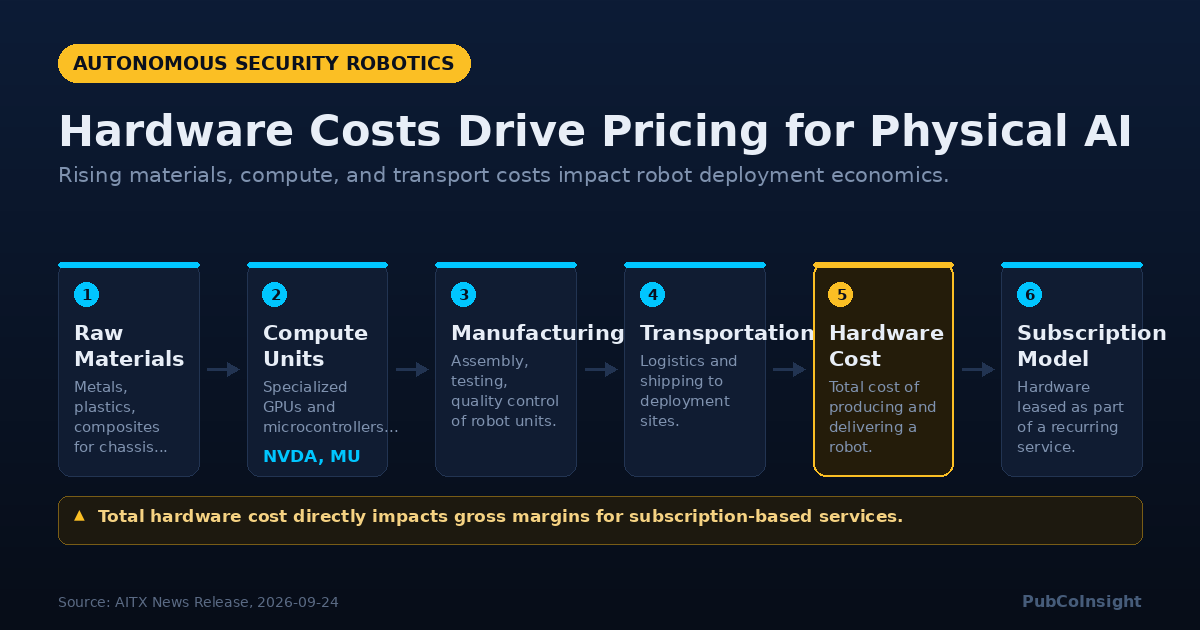
On September 24, 2026, Artificial Intelligence Technology Solutions, Inc. (AITX) announced a price update for its Robotic Assistance Devices (RAD) hardware. The company cited rising costs across materials, compute components, and transportation as the drivers behind this adjustment. This is not an isolated event. It highlights a critical, sector-wide challenge: the economic friction of bringing advanced autonomous security robotics to scale.
The promise of physical AI in guarding services hinges on delivering substantial cost savings compared to human patrols. When the underlying hardware costs climb, that core value proposition gets tested. For companies operating on subscription models, where hardware is leased or provided as part of a service, managing these input costs directly impacts gross margins and the long-term viability of their deployments.
The Mechanism of Cost Pressure
Autonomous security robots are complex machines. They integrate advanced sensors, high-performance computing units, and durable mechanical components. Each of these elements carries its own supply chain vulnerabilities. For instance, the specialized microcontrollers and GPUs required for on-device AI processing are often sourced from a concentrated pool of manufacturers. NVIDIA (NVDA) remains a dominant player in this space, and demand from diverse sectors, from data centers to automotive, creates bottlenecks. When a new generation of chips is released or demand from a competing industry surges, prices for these critical compute units can rise rapidly. This is not just about the silicon itself; it extends to the packaging, cooling solutions, and power delivery systems that enable these chips to function reliably in a rugged outdoor environment.
Materials also play a significant role. The chassis of a mobile autonomous unit, for example, requires specific alloys for strength, weather resistance, and often, electromagnetic shielding. These metals, along with specialized plastics and composites, are subject to global commodity price fluctuations and regional supply chain disruptions. Furthermore, the logistics of moving these heavy, often bulky robots from manufacturing facilities to deployment sites adds another layer of cost. Fuel prices, labor availability for specialized transport, and even port congestion can inflate delivery expenses. The cumulative effect of these pressures means that the bill of materials for a single robot is not static. It can shift significantly over a fiscal quarter, directly impacting the profitability of each unit deployed, especially for companies operating on fixed-price subscription contracts.
Companies Navigating the Landscape
The small and micro-cap companies in this sector are taking different approaches to these cost pressures. Some focus on specialized components, others on complete integrated solutions, and still others on the software layer. Kopin Corporation (KOPN), for example, is a key supplier of micro-displays and optical components. Their recent collaboration with Fabric.AI on fiber-coupled and connector-free MicroLED optical interconnects highlights the ongoing innovation in critical sensor technology. These advancements can improve performance, but often come with initial development and manufacturing costs that need to be absorbed.
In the drone and mobile robotics space, companies like Ondas Inc. (ONDS), Red Cat Holdings, Inc. (RCAT), and Unusual Machines, Inc. (UMAC) are integrating various hardware and software stacks. Ondas recently acquired three defense technology firms for $56 million, aiming to build an integrated autonomous defense systems platform. This strategy could allow for greater control over component sourcing and potentially mitigate some external cost pressures through vertical integration. Red Cat Holdings focuses on drone technology, including its FPV (First Person View) drones, which also rely on specialized components and high-performance computing for real-time video processing and control. Unusual Machines, which saw a 6% jump in September as drone names bounced together, operates in a similar vein, developing and deploying advanced drone systems. Serve Robotics Inc. (SERV) is focused on last-mile delivery robots, a distinct segment but one that shares many underlying hardware cost challenges with security robotics, particularly around battery technology, navigation sensors, and robust chassis design.
Beyond the hardware, the AI software layer is crucial. BigBear.ai Holdings, Inc. (BBAI) specializes in AI-powered analytics and decision intelligence, often for government and defense applications. While not directly manufacturing physical robots, their software underpins the intelligence that drives many autonomous systems. Similarly, Lantronix, Inc. (LTRX) provides secure data access and management solutions for the Internet of Things (IoT) and embedded computing, which are essential for connecting and managing fleets of autonomous robots. MicroVision, Inc. (MVIS) and Arbe Robotics Ltd. (ARBE) are focused on LiDAR and radar technology, respectively. These are critical sensor inputs for autonomous navigation and perception. The performance and cost of these sensor arrays directly impact the overall system's capabilities and economic viability.
Artificial Intelligence Technology Solutions, Inc.
Artificial Intelligence Technology Solutions, Inc. (AITX), trading as AITX on the OTCID tier, develops and leases autonomous security robots and remote monitoring systems. The company operates through several subsidiaries: Robotic Assistance Devices, Inc. (RAD-I) for stationary security devices, Robotic Assistance Devices Mobile (RAD-M) for mobile autonomous platforms like the ROAMEO unit, and Robotic Assistance Devices Group (RAD-G) for its SARA agentic AI platform. RAD-M began early commercial deployment of its ROAMEO mobile security unit in May 2026. AITX also has a subsidiary, RAD Lanka, in Sri Lanka, which supports software development, AI initiatives, and technical operations. The company's strategy, which it refers to internally as "RAD Town," aims for integrated autonomous-security deployments across large areas like campuses or communities.
AITX emphasizes a "Solutions-as-a-Service" model, where customers subscribe to the service rather than purchasing hardware outright. This model aims to deliver cost savings of 35% to 80% compared to traditional manned security. For the fiscal year ended February 28, 2026, AITX reported revenue of $7,745,336, a 26% increase year-over-year. Gross profit rose 48% to $5,533,700, with gross margin expanding to approximately 71% from 61%. Operating expenses remained flat at approximately $17,477,097, and the loss from operations improved by approximately $2.0 million to $(11,943,397). The company reported a net loss of approximately $14.5 million for the fiscal year ended February 28, 2026, and had an accumulated deficit of approximately $171 million as of that date. The public record does not yet establish that the company has achieved positive cash flow from operations, which was negative $9,344,534 for the year ended February 28, 2026. AITX's filings state that its RAD-I subsidiary's recurring revenue and gross margin could, on a standalone basis, support positive cash flow operations, and that management believes RAD-I has "achieved a point" where it could support positive cash flow operations today. The company also projects subscription gross margin to exceed 75% and outright-sale gross margin to exceed 50%, based on average bill of materials costs and market-accepted pricing. AITX’s plan includes the introduction of additional stationary solutions and the expectation that RAD-M will eventually surpass RAD-I’s monthly recurring revenue contribution.
What to watch
Investors should monitor several specific indicators. The pricing actions taken by AITX on September 24, 2026, are a direct response to input costs. Watch for similar announcements from other hardware-centric players in the sector. Any subsequent revisions, either up or down, will signal shifts in supply chain stability or component availability. Pay attention to the gross margin figures reported in upcoming quarterly filings for all companies involved in hardware manufacturing. A sustained decline in gross margins, especially for subscription-based models, would indicate that rising costs are eroding profitability. Look for specific announcements regarding new supplier contracts or manufacturing partnerships. These could indicate efforts to diversify supply chains or achieve economies of scale. Finally, observe any shifts in product development focus. If companies begin to emphasize software-only solutions or higher-margin services over new hardware deployments, it could signal a strategic adaptation to persistent hardware cost pressures.
, { "label": "Compute Units", "note": "Specialized GPUs and microcontrollers for AI processing.", "metric": "NVDA, MU" }, { "label": "Manufacturing", "note": "Assembly, testing, quality control of robot units." }, { "label": "Transportation", "note": "Logistics and shipping to deployment sites." }, { "label": "Hardware Cost", "note": "Total cost of producing and delivering a robot." }, { "label": "Subscription Model", "note": "Hardware leased as part of a recurring service." } ], "highlight": 4, "highlight_note": "Total hardware cost directly impacts gross margins for subscription-based services.", "footnote": "Source: AITX News Release, 2026-09-24" }Companies mentioned
| Ticker | Company | Price |
|---|---|---|
| AITX client | Artificial Intelligence Technology Solutions Inc | $0.0033 |
| ARBE | Arbe Robotics Ltd. | $0.674 |
| BBAI | BigBear.ai Holdings, Inc. | $2.8 |
| KOPN | Kopin Corporation | $4.87 |
| LTRX | Lantronix, Inc. | $6.6 |
| MVIS | MicroVision, Inc. | $1.62 |
| ONDS | Ondas Inc. | $7.6 |
| RCAT | Red Cat Holdings, Inc. | $6.8 |
| SERV | Serve Robotics Inc. | $4.51 |
| UMAC | Unusual Machines, Inc. | $23.93 |
Listed alphabetically, not ranked. Prices as of 2026-09-25 and they move. Check a live quote before relying on any of this.
How we chose the companies in this article
We cover a fixed universe of companies working in autonomous security robotics, physical AI and the guarding services market they are aimed at. Every one of them that had usable market data on 2026-09-25 appears in this article. We do not pick which ones to mention based on what we think of them, and we do not order them by size, price or trading volume, because an ordered list is a verdict and that is not ours to hand down. Companies left out, and why: none. American Lithium Minerals and Artificial Intelligence Technology Solutions pay us, which is disclosed in full at the foot of every article they appear in.
See the dilution and promotion flags before you see the pitch.
Each week: the micro and small-caps now showing dilution or paid-promotion signals, with the SEC filing behind every flag. No recommendations, no price targets.
Sources used in this article
- Sterling, Axon, Herc, Nextpower, and FTAI Aviation Shares Plummet, What You Need To Know StockStory · 2026-09-25
- Is VOO or VTI the Better Long-Term Investment? Here's What History Suggests. Motley Fool · 2026-09-25
- Why Fervo Energy Stock Is Up Today Motley Fool · 2026-09-25
- Prediction: The S&P 500 Finishes 2027 Above 9,000. Here's the Earnings Math. Motley Fool · 2026-09-25
- Is Micron (MU) Quietly Recasting Its AI Memory Strategy With New Leadership and 512GB DDR5? Simply Wall St. · 2026-09-25
- Nebius Group (NBIS) to Hike Prices Next Week, Shares Rocket Insider Monkey · 2026-09-25
- 2 Soaring Stocks to Hold for the Next 7 Years Motley Fool · 2026-09-25
- Bloom Energy's Backlog Is 5 Times This Year's Expected Revenue. Here's How Fast It Can Actually Build. Motley Fool · 2026-09-25
- Prediction: Here's What a $10,000 Investment in Archer Aviation Will Be Worth in 5 Years Motley Fool · 2026-09-25
- Titans of Tech Attend State Dinner Honoring China’s Xi The Wall Street Journal · 2026-09-25
- How IonQ’s On‑Prem Quantum System At NVIDIA (NVDA) Has Changed Its Investment Story Simply Wall St. · 2026-09-25
- Unusual Machines Jumps 6% as Drone Names Bounce Together; Ondas Climbs 4%, Red Cat Rises 3% 24/7 Wall St. · 2026-09-24
Disclosure required by Section 17(b) of the Securities Act of 1933
Artificial Intelligence Technology Solutions, Inc., a Nevada corporation (OTCID: AITX). Artificial Intelligence Technology Solutions, Inc. pays Strategic Innovations First, Inc., a Wyoming corporation doing business as PulseIR. Compensation received: USD 5,000.00 per month for months 1-3 (August, September, October 2026); USD 10,000.00 per month for months 4-6 (November, December 2026, January 2027) contingent on the 90-day review. Minimum committed USD 15,000.00; USD 45,000.00 if the second-period rate triggers.. Form of payment: cash only, invoiced monthly in advance; no stock, options or warrants received or payable. Services: investor relations services under an Investor Relations Services Agreement effective 2026-08-01. Period: six month term, 2026-08-01 through 2027-01-31; 90-day review on or about 2026-10-30. No stock, options or warrants held by PubCo Insight, Pulse IR, Strategic Innovations First, Inc., or Brad Listermann. Confirmed by the executed agreement and by board record recKwdq39X2caPSX7 (POSITIONS HELD: none).
This is information, not investment, financial, legal or tax advice. It is not a recommendation or solicitation to buy, sell or hold any security and it contains no price target. Nothing here is independently verified by us. Confirm every figure against primary filings on SEC EDGAR before you act. Micro-cap and over-the-counter securities are speculative and illiquid and can lose all of their value. The companies named without a disclosure above pay us nothing and have no relationship with us; they are named because a published, mechanical screen selected them. Full disclosure policy.