Market Pulse: Macro & Small-Cap Liquidity
AI Rout Crushes Nasdaq, S&P 500: Small Caps Face Liquidity Drain, Balance Sheet Pressure
The AI selloff pushed the Nasdaq 100 to its worst week since 2020, erasing 2026 gains, forcing small caps to navigate tighter credit and shifting retail order flow.
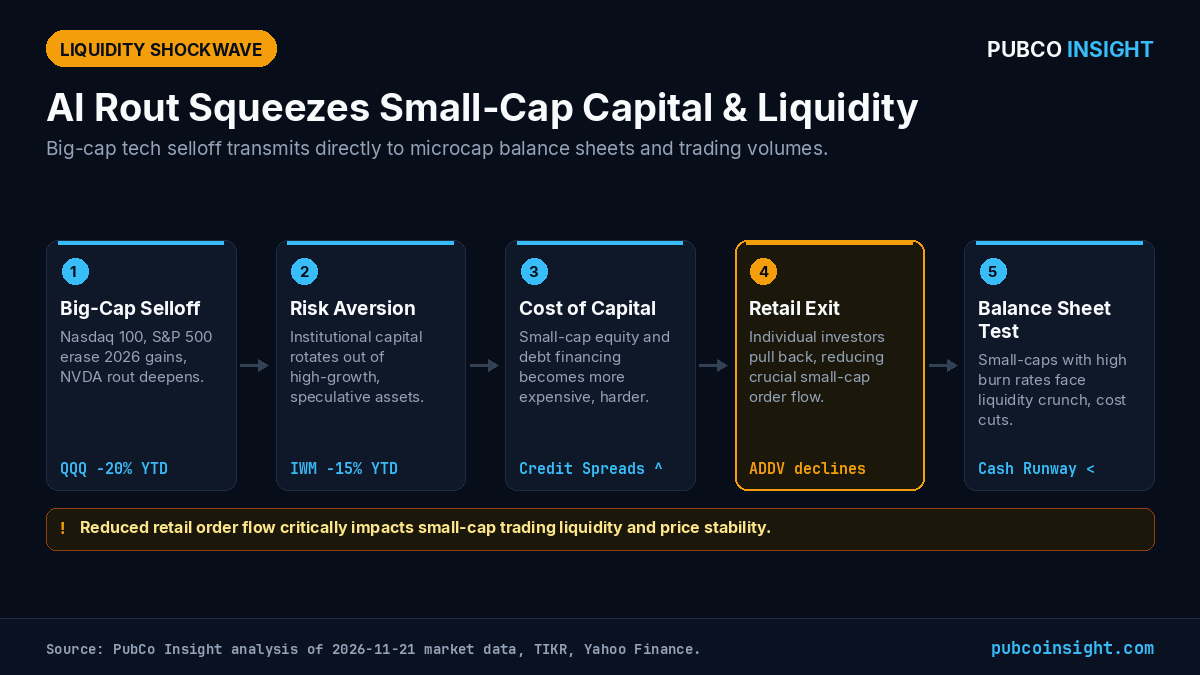
The market just delivered a brutal reality check. The Nasdaq 100 closed its worst week since 2020, with the S&P 500 officially in correction territory. The AI rout, anchored by giants like Nvidia (NVDA), has soured sentiment across the board, wiping out all 2026 gains for major indices. This isn't just a big-cap story; the seismic shift in sentiment and capital allocation at the top immediately transmits down the cap spectrum, directly impacting small-cap, microcap, and OTC balance sheets and trading liquidity.
When the titans bleed, the ripple effect is swift and painful for smaller players. Nvidia, a key sole supplier to CoreWeave and its $6.3 billion backstop, is facing an SEC probe reportedly investigating its accounting, extending its $2.7 trillion rout. AMD, a direct stakeholder in Anthropic with up to $5 billion riding on its IPO, is also feeling the heat. This isn't theoretical; it's a direct capital flow constraint. As institutional money flees high-growth AI names, it doesn't just sit on the sidelines; it rotates, often out of the entire risk spectrum, leaving smaller, less liquid names vulnerable.
The Market Transmission Mechanism: From AI Rout to Small-Cap Squeeze
The AI selloff isn't merely a repricing of future growth; it's a fundamental shift in market liquidity and risk appetite that directly impacts small-cap and microcap companies. First, the cost of capital tightens. When major indices like the Nasdaq 100 (QQQ) and S&P 500 (SPY) erase 2026 gains, the perceived risk of equity investments rises across the board. This makes it harder and more expensive for small-cap companies, many of which are not yet profitable, to raise capital through equity offerings or debt. Lenders and investors demand higher returns for perceived higher risk, impacting everything from working capital lines to expansion plans. Second, retail order flow, a crucial component for many small-cap and microcap stocks, shifts dramatically. When headlines scream "AI Rout Sours Sentiment," individual investors, who often drive significant volume in the lower-cap segments, pull back or reallocate to safer assets. This reduction in demand can exacerbate price declines and widen bid-ask spreads, making it harder for existing shareholders to exit positions without significant slippage. The Russell 2000 (IWM), which saw names like Glaukos lead its Wednesday sell list, is a prime example of this liquidity drain. For companies reliant on consistent access to capital markets for growth, this environment presents a severe challenge to their balance sheets and operational runway.
The weekly Flags Watchlist: small-caps now showing dilution or promotion signals, each linked to the SEC filing behind the flag.
How the Small-Cap and Microcap Cohort Positions Around This Trend
The current market environment forces a stark reevaluation for small-cap and microcap companies, particularly those with exposure to AI or high-growth narratives. **IonQ, Inc.** (IONQ), a quantum computing firm, is trading at $20.72 with a 30-day average daily dollar volume of $747.8 million. While quantum computing is distinct from traditional AI, its high-growth, speculative nature often places it in a similar risk bucket for investors. The question for IonQ is whether it can differentiate its long-term technological promise from the broader tech downturn, especially as comparisons to Alphabet (GOOGL) surface. **Ondas Inc.** (ONDS), trading at $3.76 with a $275.0 million 30-day average daily dollar volume, operates in mission-critical wireless networks and automated drone systems. While not a pure AI play, its technology-driven solutions for industrial and government clients could offer some insulation from the speculative AI collapse if its revenue streams are less tied to venture capital funding cycles. However, any broad risk-off sentiment could still impact its ability to secure new contracts or raise follow-on capital. **SoundHound AI, Inc.** (SOUN) has felt the direct impact, sinking 44% in a month to $2.61, with a 30-day average daily dollar volume of $73.1 million. The company is now facing the imperative to land its $120 million of cost cuts. This is a classic small-cap response to tightening capital: aggressive cost reduction to extend runway when external funding becomes scarce or expensive. Its ability to execute these cuts while maintaining operational momentum will be critical. **BigBear.ai Holdings, Inc.** (BBAI), trading at $1.58 with a $46.2 million 30-day average daily dollar volume, provides AI-powered analytics and decision intelligence. As a direct AI beneficiary, BigBear.ai faces increased scrutiny on its revenue growth and path to profitability in a post-AI bubble market. Its government contracts might offer some stability, but commercial AI adoption could slow. **Red Cat Holdings, Inc.** (RCAT), at $1.795 with a $30.7 million 30-day average daily dollar volume, focuses on drone technology and software. Similar to Ondas, its niche in unmanned systems could offer some resilience. However, the broader tech selloff could still dampen investor enthusiasm, making capital raises more challenging if needed for expansion or R&D. In the critical minerals sector, **American Battery Technology Company** (ABAT), trading at $0.79 with a $4.2 million 30-day average daily dollar volume, and **Standard Lithium Ltd.** (SLI), at $1.01 with a $2.4 million 30-day average daily dollar volume, face a different set of challenges. While not directly exposed to the AI bust, their capital-intensive projects require consistent funding. A broad market downturn and tightening credit conditions can make it significantly harder to secure project financing or equity raises, impacting their ability to scale production and meet demand for battery materials. Their low average daily dollar volumes also highlight their sensitivity to shifts in retail or specialist fund liquidity.What Active Traders and Desks Are Watching Next
- Federal Reserve Commentary and Yields: Monitor upcoming FOMC minutes and any Fed official statements for shifts in interest rate expectations. Higher for longer rates directly impact small-cap cost of capital.
- Q4 2026 Earnings Season: Watch for Q4 earnings reports from small-cap tech and AI-exposed companies in late January and early February 2027. Pay close attention to revenue guidance, cash burn rates, and any explicit comments on capital raising plans or cost-cutting measures.
- Russell 2000 Rebalancing: Observe any further rebalancing activity in the Russell 2000 (IWM) that could indicate continued institutional rotation out of smaller, higher-risk names.
- Retail Flow Metrics: Track retail trading platform data and sentiment indicators for signs of renewed engagement or further capitulation in small-cap and microcap segments.
- Key Capital Raise Announcements: Look for any significant equity or debt financing announcements from the small-cap cohort. The terms of these deals will signal the prevailing cost of capital and investor appetite for risk.
- SEC Filings for AI Companies: Scrutinize 10-K and 10-Q filings from AI-exposed companies for details on revenue recognition, customer concentration, and any changes in accounting practices, especially in light of the Nvidia probe.
Companies mentioned
| Ticker | Company | Price |
|---|---|---|
| ABAT | American Battery Technology Company | $0.79 |
| BBAI | BigBear.ai Holdings, Inc. | $1.58 |
| IONQ | IonQ, Inc. | $20.72 |
| ONDS | Ondas Inc. | $3.76 |
| RCAT | Red Cat Holdings, Inc. | $1.795 |
| SLI | Standard Lithium Ltd. | $1.01 |
| SOUN | SoundHound AI, Inc. | $2.61 |
Listed alphabetically, not ranked. Prices as of 2026-11-21 and they move. Check a live quote before relying on any of this.
How we chose the companies in this article
Candidate pool of 10 small-cap, microcap, and OTC names in Market Pulse: Macro & Small-Cap Liquidity; ranked by 30-day average daily dollar volume (Yahoo Finance) as of 2026-11-21. All compensated IR clients are excluded from this editorial lane.
PubCo Insight
See the dilution and promotion flags before you see the pitch.
Each week: the micro and small-caps now showing dilution or paid-promotion signals, with the SEC filing behind every flag. No recommendations, no price targets.
Every flag links to its EDGAR filing so you can check it yourself. Sponsored coverage disclosed under SEC 17(b). One-click unsubscribe.
Sources used in this article
- $1 Million In Cash: Buy Stocks Now Or Wait? Trefis · 2026-11-21
- Nasdaq 100 Ends Worst Week Since 2020, S&P 500 In Correction Territory As AI Rout Sours Sentiment — ANT, NVDA, TTWO, ZS, CRWD In Focus Stocktwits · 2026-11-21
- Stocks Erase 2026 Gains as AI Selloff Deepens etf.com · 2026-11-21
- Here's How Many Shares of Starbucks You’d Need to Cover $744 in Coffee Using Dividends Alone Motley Fool · 2026-11-21
- Is AMD the Stock to Buy With Nvidia in Limbo? Motley Fool · 2026-11-21
- Is This 6%-Yielding Dividend Stock a Bargain or a Trap? Its Payout Eats Up About 90% of Cash Flow. Motley Fool · 2026-11-21
- Nvidia Is CoreWeave’s “Key Sole Supplier” and $6.3 Billion Backstop. Congress Is Now Looking TIKR · 2026-11-21
- AMD Is “A Direct Stakeholder in Anthropic.” That’s Up to $5 Billion Riding on Its IPO TIKR · 2026-11-21
- Greg Abel Just Approved a Record $9.6 Billion in Stock Buybacks for Berkshire Hathaway Last Quarter, More Than Double the Pace Set in the Second Quarter. Is Berkshire Still a Buy as Shares Sit Near All-Time Highs? Motley Fool · 2026-11-21
- Nvidia stock extends $2.7 trillion rout as SEC probe reportedly investigates its accounting Yahoo Finance · 2026-11-21
- Jensen Huang's next move: Wall Street floats Intel and SpaceX, but bettors are banking on a surprise second act Yahoo Finance · 2026-11-21
- Quantum-Proof Accounts Are Coming to the XRP Blockchain by 2028. That's Not Likely to Be a Game Changer for XRP. Motley Fool · 2026-11-21
PubCo Insight publishes research on small and micro-cap companies. Nothing here is investment advice, we make no buy or sell recommendations, and we publish no price targets. Small and micro-cap shares are speculative and illiquid and you can lose everything you put into them. Check every figure against primary filings on SEC EDGAR before you act on it.