Autonomous Security Robotics Shift Focus to Cash Breakeven as Revenue Ramps
The autonomous security robotics sector sees a renewed emphasis on operational efficiency and cash flow, driven by AITX's January 2027 breakeven projection and broader industry trends in physical AI deployment.
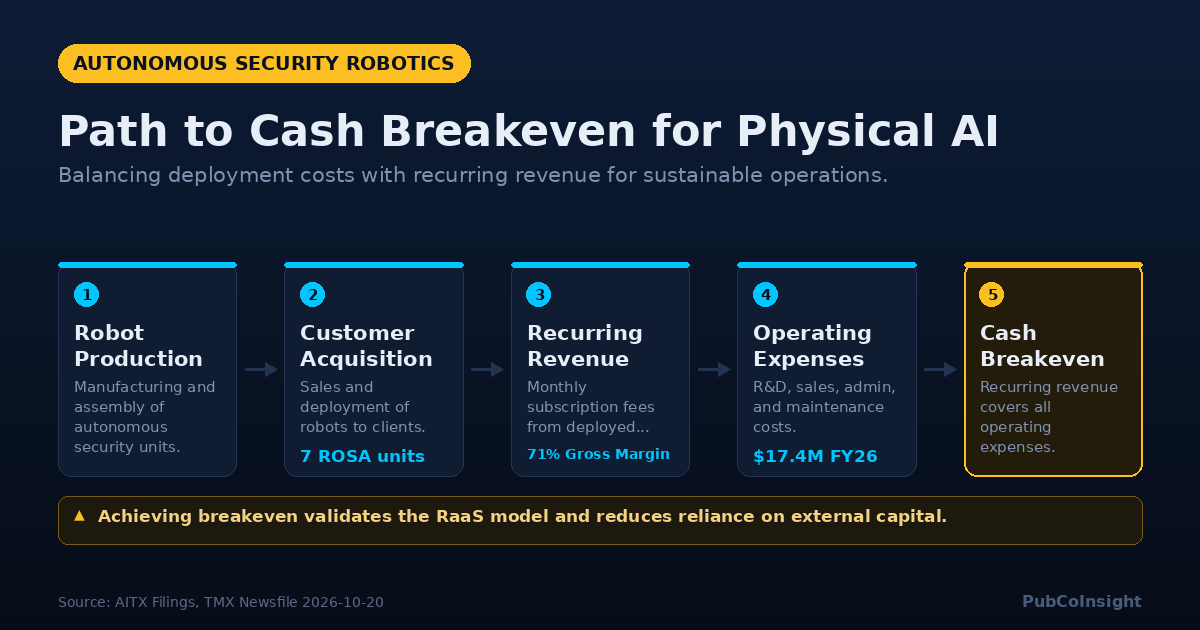
The Mechanism of Cash Breakeven in Robotics
Achieving cash breakeven in autonomous robotics is a balancing act between fixed and variable costs, driven by the installed base of deployed units. The core mechanism involves a company generating enough recurring revenue from its "Robotics-as-a-Service" (RaaS) subscriptions to offset its operating expenses. These expenses include research and development, sales and marketing, general administrative costs, and the variable costs associated with maintaining the deployed fleet. Each deployed robot generates a predictable monthly revenue stream. However, each robot also incurs costs: manufacturing, deployment, power, data transmission, and ongoing maintenance. The gross margin on these subscriptions, which AITX filings suggest can exceed 75% for subscriptions and 50% for outright sales, is crucial. This margin must be wide enough to contribute significantly to covering the fixed overhead. The breakeven point is reached when the cumulative gross profit from the recurring revenue stream, plus any outright sales, surpasses the total operating expenses. This requires consistent customer acquisition, efficient manufacturing, and a robust service infrastructure to keep robots operational and generating revenue. A breakdown in any of these areas, such as a major component shortage impacting production or a high failure rate in deployed units requiring costly field service, can delay or prevent breakeven. Conversely, increased scale in manufacturing can drive down per-unit costs, expanding gross margins and accelerating the path to cash positivity.Companies Operating in Autonomous Security
The autonomous security robotics sector features a range of companies developing physical AI solutions for guarding services. Arbe Robotics Ltd. (ARBE), trading at $0.465, provides high-resolution 4D imaging radar solutions. Their recent introduction of the Gryphon Radar System focuses on reliable perception for unmanned ground vehicles, particularly on rough terrain. This technology is foundational for the navigation and object detection capabilities of autonomous security robots, enabling them to operate effectively in diverse environments. Ondas Inc. (ONDS), with shares at $6.1, operates in the drone and autonomous systems space. Their EASA certification indicates progress in airborne defense, and their partnership with Palantir to launch Regna AI focuses on sovereign AI capabilities. While primarily focused on drones, the underlying AI and autonomous navigation technologies developed by Ondas have clear applications in ground-based security robotics, particularly for large-area surveillance and perimeter control. Serve Robotics Inc. (SERV), priced at $3.05, focuses on last-mile delivery robots. While a different end-market, their experience in deploying autonomous robots in urban environments, navigating public spaces, and managing a fleet offers valuable lessons for security robotics. The challenges of public acceptance, regulatory navigation, and robust autonomous operation are shared across these physical AI applications. Unusual Machines, Inc. (UMAC), trading at $16.38, recently completed the acquisition of Upgrade Energy, expanding its U.S. drone battery manufacturing. Battery technology and power management are critical bottlenecks for any autonomous system, directly impacting operational endurance and deployment flexibility. Improvements in this area can significantly enhance the viability and utility of security robots. Other companies like BigBear.ai Holdings, Inc. (BBAI) at $2.17, Kopin Corporation (KOPN) at $3.43, Lantronix, Inc. (LTRX) at $5.82, MicroVision, Inc. (MVIS) at $1.16, and Red Cat Holdings, Inc. (RCAT) at $4.52, contribute to the broader ecosystem of physical AI. BigBear.ai focuses on AI-powered analytics and decision intelligence, which can enhance the data processing and threat assessment capabilities of security platforms. Kopin, with its work on optical interconnect architecture, addresses data center bottlenecks, a critical infrastructure component for processing the vast amounts of sensor data generated by autonomous robots. Lantronix provides secure data access and management solutions, essential for remote monitoring and control of deployed units. MicroVision specializes in lidar technology, another key sensor for autonomous navigation. Red Cat Holdings focuses on drone technology, with applications in aerial surveillance that complement ground-based robotic security.Artificial Intelligence Technology Solutions, Inc.
Artificial Intelligence Technology Solutions, Inc. (AITX), trading under AITX on the OTCID tier at $0.0024, develops and leases autonomous security robots and remote monitoring systems. The company's business model centers on a recurring monthly subscription, rather than outright hardware sales. AITX operates through several subsidiaries: Robotic Assistance Devices, Inc. (RAD-I), focused on stationary security devices; Robotic Assistance Devices Mobile (RAD-M), which includes the ROAMEO mobile security unit; Robotic Assistance Devices Group (RAD-G), responsible for the SARA agentic artificial intelligence platform; and Robotic Assistance Devices Lanka (RAD Lanka), which supports software development and AI initiatives from Sri Lanka. The company aims to deliver significant cost savings, between 35% and 80%, compared to traditional manned security. Its solutions leverage a suite of stationary and mobile devices integrated with proprietary software and monitoring platforms. Early commercial deployment of the ROAMEO mobile security unit began in May 2026. AITX's filings indicate that for the fiscal year ended February 28, 2026, revenue reached $7,745,336, a 26% increase year-over-year. Gross profit grew 48% to $5,533,700, with gross margin expanding to approximately 71% from 61%. Operating expenses remained flat at approximately $17,477,097, leading to an improved loss from operations of $(11,943,397). The company reported a net loss of approximately $14.5 million for the fiscal year and had an accumulated deficit of approximately $171 million as of that date. Cash flow from operating activities was negative $9,344,534 for the same period. While AITX projects monthly operating cash breakeven in January 2027, the public record does not yet establish the specific number of deployed units or the average monthly recurring revenue per unit required to achieve this target. The company continues to expand its distribution strategy, appointing industry veteran Tom Reilly in October 2026 to drive new integrator and distribution channels. A recent municipal customer in October 2026 placed an order for seven ROSA units.What to watch
Investors should monitor AITX's upcoming filings for updates on its progress towards the January 2027 cash breakeven target. Specifically, look for quarterly reports that detail subscription revenue growth, the number of new unit deployments, and changes in operating expenses. Any acceleration in the commercial deployment of ROAMEO mobile units, as well as the RAIA and SARA platforms, will be key. The impact of the expanded distribution strategy, particularly new integrator partnerships and municipal customer acquisitions, will also be important to track. Pay attention to any announcements regarding manufacturing scale-up or supply chain efficiencies, as these directly influence gross margins and the path to profitability., { "label": "Customer Acquisition", "note": "Sales and deployment of robots to clients.", "metric": "7 ROSA units" }, { "label": "Recurring Revenue", "note": "Monthly subscription fees from deployed robots.", "metric": "71% Gross Margin" }, { "label": "Operating Expenses", "note": "R&D, sales, admin, and maintenance costs.", "metric": "$17.4M FY26" }, { "label": "Cash Breakeven", "note": "Recurring revenue covers all operating expenses." } ], "highlight": 4, "highlight_note": "Achieving breakeven validates the RaaS model and reduces reliance on external capital.", "footnote": "Source: AITX Filings, TMX Newsfile 2026-10-20" }Companies mentioned
| Ticker | Company | Price |
|---|---|---|
| AITX client | Artificial Intelligence Technology Solutions Inc | $0.0024 |
| ARBE | Arbe Robotics Ltd. | $0.465 |
| BBAI | BigBear.ai Holdings, Inc. | $2.17 |
| KOPN | Kopin Corporation | $3.43 |
| LTRX | Lantronix, Inc. | $5.82 |
| MVIS | MicroVision, Inc. | $1.16 |
| ONDS | Ondas Inc. | $6.1 |
| RCAT | Red Cat Holdings, Inc. | $4.52 |
| SERV | Serve Robotics Inc. | $3.05 |
| UMAC | Unusual Machines, Inc. | $16.38 |
Listed alphabetically, not ranked. Prices as of 2026-10-21 and they move. Check a live quote before relying on any of this.
How we chose the companies in this article
We cover a fixed universe of companies working in autonomous security robotics, physical AI and the guarding services market they are aimed at. Every one of them that had usable market data on 2026-10-21 appears in this article. We do not pick which ones to mention based on what we think of them, and we do not order them by size, price or trading volume, because an ordered list is a verdict and that is not ours to hand down. Companies left out, and why: none. American Lithium Minerals and Artificial Intelligence Technology Solutions pay us, which is disclosed in full at the foot of every article they appear in.
See the dilution and promotion flags before you see the pitch.
Each week: the micro and small-caps now showing dilution or paid-promotion signals, with the SEC filing behind every flag. No recommendations, no price targets.
Sources used in this article
- Down 54%, This Tech Stock Looks Like a Buy With or Without AI Motley Fool · 2026-10-21
- Arista Networks vs. Axon Enterprise: Which Tech Stock Is a Better Buy in 2026? Motley Fool · 2026-10-21
- Advanced Micro Devices (AMD) Stock Plummeted 13% Last Week. Should You Buy the Dip Before Nov. 3? Motley Fool · 2026-10-21
- 2 Bank Stocks to Buy That Expect Faster Interest-Income Growth in 2027 Motley Fool · 2026-10-21
- NVIDIA Advances Isaac Platform for General-Purpose Robotics With New Reference Humanoid, Frameworks, Simulation Pipelines and Data GlobeNewswire · 2026-10-21
- Is Nebius a Millionaire-Maker Stock? Motley Fool · 2026-10-21
- European Mobility Leaders Build Safe Vehicles and Robotaxi Fleets on NVIDIA Hyperion GlobeNewswire · 2026-10-21
- Healthcare and Life Sciences Leaders Build on NVIDIA to Advance Drug Discovery and Expand Patient Care GlobeNewswire · 2026-10-21
- NVIDIA, Nokia and Leading Telecom Operators Turn Networks Into Distributed Intelligence Platforms GlobeNewswire · 2026-10-21
- 2 Brilliant Stocks to Buy Now and Hold Forever Motley Fool · 2026-10-21
- NVIDIA Launches OpenShell Reference Architecture for Safe AI Agents GlobeNewswire · 2026-10-21
- Axon Enterprise (AXON) Laps the Stock Market: Here's Why Zacks · 2026-10-20
Disclosure required by Section 17(b) of the Securities Act of 1933
Artificial Intelligence Technology Solutions, Inc., a Nevada corporation (OTCID: AITX). Artificial Intelligence Technology Solutions, Inc. pays Strategic Innovations First, Inc., a Wyoming corporation doing business as PulseIR. Compensation received: USD 5,000.00 per month for months 1-3 (August, September, October 2026); USD 10,000.00 per month for months 4-6 (November, December 2026, January 2027) contingent on the 90-day review. Minimum committed USD 15,000.00; USD 45,000.00 if the second-period rate triggers.. Form of payment: cash only, invoiced monthly in advance; no stock, options or warrants received or payable. Services: investor relations services under an Investor Relations Services Agreement effective 2026-08-01. Period: six month term, 2026-08-01 through 2027-01-31; 90-day review on or about 2026-10-30. No stock, options or warrants held by PubCo Insight, Pulse IR, Strategic Innovations First, Inc., or Brad Listermann. Confirmed by the executed agreement and by board record recKwdq39X2caPSX7 (POSITIONS HELD: none).
This is information, not investment, financial, legal or tax advice. It is not a recommendation or solicitation to buy, sell or hold any security and it contains no price target. Nothing here is independently verified by us. Confirm every figure against primary filings on SEC EDGAR before you act. Micro-cap and over-the-counter securities are speculative and illiquid and can lose all of their value. The companies named without a disclosure above pay us nothing and have no relationship with us; they are named because a published, mechanical screen selected them. Full disclosure policy.