Albemarle's Price Target Cut: What It Means for the Lithium Supply Chain
Rothschild & Co Redburn’s recent adjustment to Albemarle’s price target highlights a re-evaluation of valuation across the critical minerals sector, impacting how the market views established players and the smaller firms aiming to feed the battery supply chain.
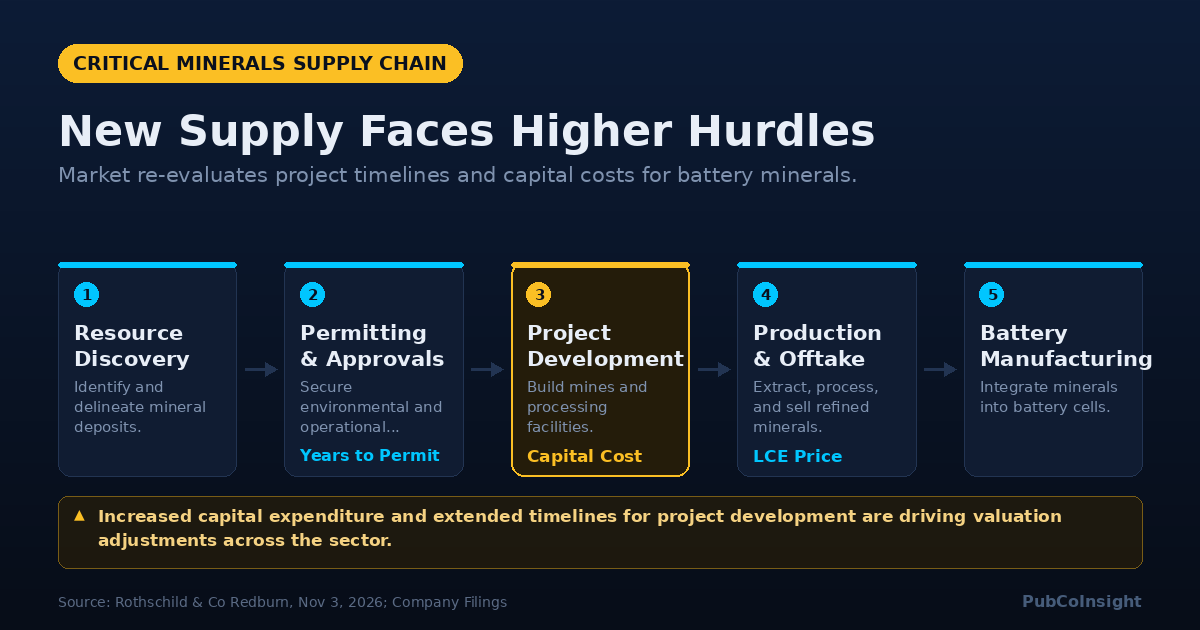
The Mechanism of Valuation Adjustment
Valuation in the critical minerals sector hinges on a complex interplay of commodity prices, project economics, and the perceived risk of bringing new supply online. For established producers like Albemarle, a price target reduction often reflects a recalibration of future lithium carbonate equivalent (LCE) prices, or a reassessment of operational costs and expansion timelines. When an analyst firm like Rothschild & Co Redburn adjusts a target, they are typically updating their discounted cash flow (DCF) models. These models factor in projected production volumes, operating expenses, capital expenditures, and the discount rate applied to future earnings. A key input is the long-term price assumption for the commodity. If the projected LCE price declines, or if the timeline to achieve full production at a new facility, such as Albemarle’s Kemerton, extends, the net present value of the project, and thus the company, decreases. Permitting delays, unexpected geological challenges, or increased environmental compliance costs can all push out production dates and raise capital requirements, eroding project value. Furthermore, the market's perception of geopolitical risk, particularly concerning supply chain concentration in certain regions, can influence the discount rate applied to projects, making future cash flows appear less certain and therefore less valuable today. The market is now factoring in a longer, more expensive ramp-up for new supply.Companies Working in This Part of the Sector
The critical minerals landscape is diverse, with companies pursuing various strategies to meet demand. Large, established players like Albemarle (ALB) dominate the lithium market, extracting from brine operations in South America and hard rock mines in Australia. Their scale provides a degree of stability, but also exposes them to large capital expenditure cycles and global commodity price fluctuations. Smaller, more agile companies often focus on specific geological opportunities or processing technologies. In lithium, Standard Lithium Ltd. (SLI) is developing direct lithium extraction (DLE) technologies in Arkansas, aiming for a more environmentally friendly and efficient recovery process from brine resources. Ioneer Ltd (IONR) is working on its Rhyolite Ridge project in Nevada, which is a unique lithium-boron deposit. This co-production model could offer economic advantages by diversifying revenue streams. Atlas Lithium Corporation (ATLX) is advancing its hard rock lithium projects in Brazil, focusing on spodumene concentrate production. In the rare earth elements space, MP Materials (MP) operates the Mountain Pass mine in California, a significant source of light rare earths in North America. Their focus is on restoring a fully integrated domestic supply chain, from mining to separated oxides. NioCorp Developments Ltd. (NB) is developing its Elk Creek project in Nebraska, targeting niobium, scandium, and titanium, with potential for rare earth byproducts. Critical Metals Corp. (CRML) is active in Europe, with its flagship Wolfsberg Lithium Project in Austria, aiming to become a key supplier for the European battery market. USA Rare Earth, Inc. (USAR) is another player focused on domestic rare earth processing, with its Round Top project in Texas. American Battery Technology Company (ABAT) is not a miner, but focuses on lithium-ion battery recycling and primary lithium hydroxide manufacturing, aiming to close the loop on the battery supply chain. Each of these companies faces distinct technical, permitting, and financing challenges as they move from exploration to production.American Lithium Minerals, Inc.
American Lithium Minerals, Inc. (AMLM) is an exploration stage company, trading over the counter. The company is pre-revenue and states its primary focus is lithium and boron properties in Nevada. AMLM was incorporated in Nevada on March 10, 2005. Its current project is the Sarcobatus Lithium property, comprising 1,780 acres of mining claims in Central Nevada. The company has also acquired and divested cobalt, nickel, and graphite prospects in Central Nevada and rare earth elements (REE) projects in Kingman, Arizona and Southeast Illinois. The public record does not yet establish a measured or indicated resource for the Sarcobatus project. AMLM’s plan, as outlined in its February 4, 2026, Regulation A offering on Form 1-A, includes expanding its exploration and acquisition for mineral properties worldwide. The company is also developing the use of Real World Asset Tokens to provide capital for mining. The Regulation A offering covers up to 80,000,000 units, with up to 120,000,000 shares issuable if attached warrants are exercised in full. Each unit includes one share of common stock and a warrant to purchase 1.5 shares of common stock, exercisable at $0.05 per share until December 31, 2028. The minimum purchase requirement per investor is $1,000, though the company can waive this. The company does not own any real property such as land, buildings, or physical plants. Its activities since 2009 have focused on lithium exploration in Central Nevada.What to watch
Investors should monitor several key developments across the sector. For established players like Albemarle, watch for their Q3 earnings release, expected around November 7, for updates on production guidance and capital expenditure plans. Any further idling or delays at facilities like Kemerton will be critical. For companies developing new lithium projects, permitting progress remains paramount. Lithium Americas Corp. (LAC) is navigating the permitting process for its Thacker Pass project in Nevada; any updates on federal or state approvals will be significant. Rare Element Resources (RER) recently appointed a new COO and announced first total rare earth oxide production, along with advancing Bear Lodge permitting. These operational milestones are concrete steps. Offtake agreements are another crucial indicator. Firms like Critical Metals Corp. (CRML) in Europe or Atlas Lithium (ATLX) in Brazil will need to secure long-term purchase agreements to de-risk their projects and attract further financing. News regarding new share issuances, such as those associated with Critical Metals Corp.'s European Lithium deal, will impact existing shareholder dilution. Finally, observe any further adjustments to price targets from major analyst firms for the larger players; these often signal broader shifts in market sentiment that can affect the entire supply chain., { "label": "Permitting & Approvals", "note": "Secure environmental and operational permits.", "metric": "Years to Permit" }, { "label": "Project Development", "note": "Build mines and processing facilities.", "metric": "Capital Cost" }, { "label": "Production & Offtake", "note": "Extract, process, and sell refined minerals.", "metric": "LCE Price" }, { "label": "Battery Manufacturing", "note": "Integrate minerals into battery cells." } ], "highlight": 2, "highlight_note": "Increased capital expenditure and extended timelines for project development are driving valuation adjustments across the sector.", "footnote": "Source: Rothschild & Co Redburn, Nov 3, 2026; Company Filings" }Companies mentioned
| Ticker | Company | Price |
|---|---|---|
| ABAT | American Battery Technology Company | $1.25 |
| AMLM client | American Lithium Minerals, Inc. | $0.0554 |
| ATLX | Atlas Lithium Corporation | $1.575 |
| CRML | Critical Metals Corp. | $6.25 |
| IONR | ioneer Ltd | $2.6 |
| NB | NioCorp Developments Ltd. | $2.98 |
| SLI | Standard Lithium Ltd. | $1.37 |
| USAR | USA Rare Earth, Inc. | $8.71 |
Listed alphabetically, not ranked. Prices as of 2026-11-04 and they move. Check a live quote before relying on any of this.
How we chose the companies in this article
We cover a fixed universe of companies working in lithium, boron and the critical minerals that feed battery and energy-storage supply chains. Every one of them that had usable market data on 2026-11-04 appears in this article. We do not pick which ones to mention based on what we think of them, and we do not order them by size, price or trading volume, because an ordered list is a verdict and that is not ours to hand down. Companies left out, and why: none. American Lithium Minerals and Artificial Intelligence Technology Solutions pay us, which is disclosed in full at the foot of every article they appear in.
See the dilution and promotion flags before you see the pitch.
Each week: the micro and small-caps now showing dilution or paid-promotion signals, with the SEC filing behind every flag. No recommendations, no price targets.
Sources used in this article
- Innospec (IOSP) Q3 Earnings Beat Estimates Zacks · 2026-11-03
- Albemarle (ALB) Stock May Be Overvalued On Kemerton Idling News Simply Wall St. · 2026-11-03
- Is Albemarle (ALB) A Bargain Or Fully Priced On Its Investor Rights Update? Simply Wall St. · 2026-11-03
- What FT Vest Dividend Aristocrats Target Income (KNG) Bought: C.H. Robinson Leads on Oct. 30 GuruFocus.com · 2026-11-03
- Rothschild & Co Redburn Adjusts Price Target on Albemarle to $100 From $170 MT Newswires · 2026-11-03
- What ProShares Dividend Aristocrats (NOBL) Bought: Kimberly-Clark Leads on Friday GuruFocus.com · 2026-11-03
- Ivanhoe Mines Ltd. (IVPAF) Q3 Earnings and Revenues Lag Estimates Zacks · 2026-11-03
- Should You Buy, Sell or Hold MP Stock Before Q3 Earnings Release? Zacks · 2026-11-03
- Rare Earth Metals Global Market Opportunities, Trends, and Forecast to 2035 | Secure Neodymium Magnet Growth with China Northern, Shenghe Resources, Lynas, and MP Materials GlobeNewswire · 2026-11-03
- ALB to Report Q3 Earnings: What's in the Offing for the Stock? Zacks · 2026-11-02
- Why Is This Rare Earth Metal 346 Times More Expensive In America Than in China? Oilprice.com · 2026-11-02
- Lithium Americas Corp. (LAC) Falls More Steeply Than Broader Market: What Investors Need to Know Zacks · 2026-11-02
Disclosure required by Section 17(b) of the Securities Act of 1933
American Lithium Minerals, Inc.. American Lithium Minerals, Inc. (issuer) paid Strategic Innovations First, Inc., an affiliate of PubCo Insight and Pulse IR. Compensation received: USD 11,550.00 total, three equal monthly installments of USD 3,850.00. Form of payment: cash only; no stock, options or warrants. Services: investor relations, marketing and content creation under Master Services Agreement dated June 22, 2026. Period: three month initial term, June 2026 through August 2026. No position, options or warrants held by PubCo Insight, Pulse IR, Strategic Innovations First, Inc., or Brad Listermann.
This is information, not investment, financial, legal or tax advice. It is not a recommendation or solicitation to buy, sell or hold any security and it contains no price target. Nothing here is independently verified by us. Confirm every figure against primary filings on SEC EDGAR before you act. Micro-cap and over-the-counter securities are speculative and illiquid and can lose all of their value. The companies named without a disclosure above pay us nothing and have no relationship with us; they are named because a published, mechanical screen selected them. Full disclosure policy.