Lithium Majors See Price Target Cuts as Supply Chain Shifts
Recent adjustments to price targets for Albemarle by Citigroup and BofA Securities highlight a critical re-evaluation of the lithium market's future, impacting how investors view the entire battery minerals supply chain.
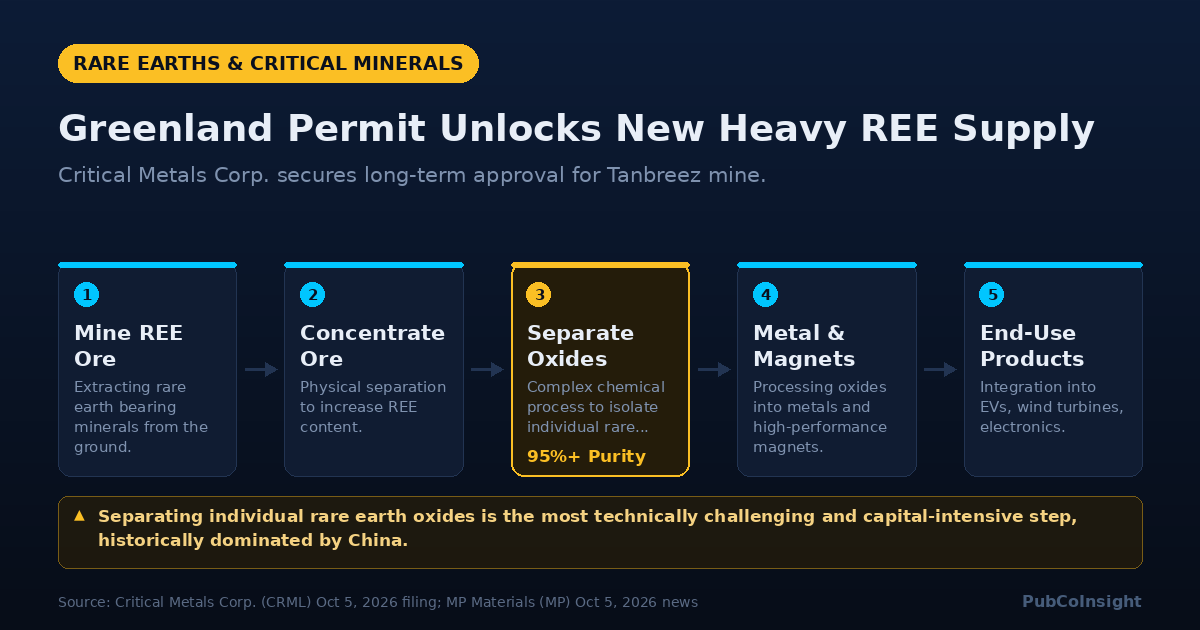
The Mechanism of Conversion and Refinement
Lithium, whether from brines or hard rock, is not directly usable in batteries. It must be processed into high-purity lithium carbonate or lithium hydroxide. Brine operations, common in South America, pump lithium-rich water to the surface, concentrating it through solar evaporation ponds. This is a low-cost method but slow, taking 12-18 months. The concentrated brine then undergoes chemical treatment to precipitate lithium carbonate. Hard rock deposits, like spodumene, require mining, crushing, and then roasting at high temperatures, often over 1000°C, to convert the mineral into a form amenable to acid leaching. This process is energy-intensive. The resulting lithium sulfate solution is then converted to lithium hydroxide or carbonate. The challenge is purity. Battery manufacturers demand extremely low impurity levels, often 99.5% or higher, for consistent cell performance and longevity. Contaminants like iron, magnesium, and calcium must be meticulously removed. This purification is where significant capital expenditure and operational expertise are required. It is not enough to have a large lithium resource. The ability to economically and sustainably produce battery-grade material determines market relevance. A project with a massive resource but an uneconomical or unproven refining pathway faces a fundamental hurdle. Conversely, advancements in direct lithium extraction (DLE) technologies, or more efficient hard rock processing, could significantly alter the cost curve and accelerate supply. The market is now scrutinizing these downstream capabilities with greater intensity.Companies Operating in the Battery Minerals Sector
The small and micro-cap sector for battery minerals is diverse, with companies pursuing various strategies across the supply chain. Some focus on traditional extraction, others on advanced processing, and a few on recycling. In the lithium space, ioneer Ltd (IONR) is developing its Rhyolite Ridge project in Nevada, which aims to produce both lithium carbonate and boron. This dual-product strategy is a key differentiator, as boron is also a critical industrial mineral. Atlas Lithium Corporation (ATLX) holds lithium properties in Brazil's Lithium Valley, focusing on hard rock spodumene deposits. Standard Lithium Ltd. (SLI) is advancing its direct lithium extraction (DLE) projects in Arkansas and recently filed a positive Preliminary Economic Assessment for its Franklin Project in East Texas, targeting 70,000 tonnes per year of lithium carbonate equivalent. American Battery Technology Company (ABAT) is working on a multi-pronged approach, including lithium extraction from Nevada claystone and battery recycling facilities in the US. Beyond lithium, NioCorp Developments Ltd. (NB) is focused on its Elk Creek project in Nebraska, targeting niobium, scandium, and titanium, all critical for advanced materials and aerospace. Critical Metals Corp. (CRML) recently saw its merger with European Lithium approved by security holders, positioning it with the Wolfsberg lithium project in Austria. USA Rare Earth, Inc. (USAR) is developing its Round Top heavy rare earth and critical minerals project in Texas, which includes a wide array of elements beyond just rare earths, such as lithium and uranium. These companies represent different stages of development and different approaches to securing critical mineral supply. Their success hinges on not just the resource, but the viability of their chosen processing pathways and their ability to navigate permitting and financing.American Lithium Minerals, Inc.
American Lithium Minerals, Inc. (AMLM) operates as an exploration stage company, focusing on lithium and boron properties in Nevada. The company trades over the counter and is pre-revenue. AMLM's primary asset is the Sarcobatus Lithium property, comprising 1,780 acres of mining claims in Central Nevada. This project is the stated focus of its current exploration activities. The company's filings indicate an intention to expand its exploration and acquisition of mineral properties globally. AMLM also states an interest in developing Real World Asset Tokens to secure capital for its mining endeavors. This represents a non-traditional approach to financing within the mining sector. The company was incorporated in Nevada in March 2005. Its activities since 2009 have centered on lithium exploration in Central Nevada. While AMLM has acquired and divested cobalt, nickel, graphite, and rare earth element prospects in the past, its current emphasis is on the Sarcobatus lithium project. The public record does not yet establish the resource size or economic viability of the Sarcobatus project. The company's Regulation A offering, qualified by the SEC on February 4, 2026, covers up to 80,000,000 units, with potential for 120,000,000 shares upon full warrant exercise. Each unit includes one share of common stock and a warrant to purchase 1.5 shares at $0.05 per share until December 31, 2028. The minimum purchase requirement per investor is $1,000, though this can be waived. AMLM's strategy centers on acquiring undervalued projects and leveraging blockchain technology for enhanced investor access and asset liquidity.What to watch
Several key developments will shape the trajectory of these companies and the broader market in the coming months. For Standard Lithium (SLI), the next step following the positive Preliminary Economic Assessment for the Franklin Project will be the progression towards a Pre-Feasibility Study (PFS) or Feasibility Study (FS), which will provide more detailed economic and technical data. Keep an eye on any updates regarding permitting timelines for their Arkansas projects. Critical Metals Corp. (CRML) has secured shareholder approval for its merger with European Lithium. The focus now shifts to the integration of the Wolfsberg project and any subsequent announcements regarding development plans, financing, or off-take agreements for the Austrian lithium asset. For American Battery Technology Company (ABAT), watch for progress on the construction and commissioning of their battery recycling facilities and any further details on the development of their Nevada claystone lithium extraction project. Specific milestones on pilot plant operations or commercial-scale production will be important. Regarding American Lithium Minerals (AMLM), look for announcements detailing exploration results from the Sarcobatus Lithium property, such as drilling assay results or initial resource estimates. Any further information on the development and implementation of their Real World Asset Token financing strategy would also be a notable event. For ioneer (IONR), updates on the permitting process for the Rhyolite Ridge project in Nevada, particularly from federal agencies, will be critical. Any news on off-take agreements for either lithium or boron from the project would also be significant. The broader market will continue to watch for major lithium producers like Albemarle (ALB) and SQM (SQM) to release their Q3 2026 earnings reports, which will provide further clarity on current market prices and production outlooks. These reports often set the tone for the entire sector., { "label": "Concentration", "note": "Brine evaporation or spodumene beneficiation.", "metric": "Spodumene 6% Li2O" }, { "label": "Chemical Conversion", "note": "Processing into lithium carbonate or hydroxide.", "metric": "99.5% purity" }, { "label": "Battery Cell Mfg", "note": "Lithium chemicals used in cathode production.", "metric": "GWh capacity" }, { "label": "EV & Storage", "note": "Final products for electric vehicles and grid storage." } ], "highlight": 2, "highlight_note": "The ability to produce high-purity, battery-grade lithium chemicals is the critical constraint, not just raw resource.", "footnote": "PubCo Insight analysis based on market news and company filings, Oct 2026" }Companies mentioned
| Ticker | Company | Price |
|---|---|---|
| ABAT | American Battery Technology Company | $1.35 |
| AMLM client | American Lithium Minerals, Inc. | $0.0615 |
| ATLX | Atlas Lithium Corporation | $1.93 |
| CRML | Critical Metals Corp. | $6.36 |
| IONR | ioneer Ltd | $2.55 |
| NB | NioCorp Developments Ltd. | $2.95 |
| SLI | Standard Lithium Ltd. | $1.43 |
| USAR | USA Rare Earth, Inc. | $9.33 |
Listed alphabetically, not ranked. Prices as of 2026-10-25 and they move. Check a live quote before relying on any of this.
How we chose the companies in this article
We cover a fixed universe of companies working in lithium, boron and the critical minerals that feed battery and energy-storage supply chains. Every one of them that had usable market data on 2026-10-25 appears in this article. We do not pick which ones to mention based on what we think of them, and we do not order them by size, price or trading volume, because an ordered list is a verdict and that is not ours to hand down. Companies left out, and why: none. American Lithium Minerals and Artificial Intelligence Technology Solutions pay us, which is disclosed in full at the foot of every article they appear in.
See the dilution and promotion flags before you see the pitch.
Each week: the micro and small-caps now showing dilution or paid-promotion signals, with the SEC filing behind every flag. No recommendations, no price targets.
Sources used in this article
- Sociedad Química y Minera De Chile (NYSE:SQM) Stock Looks Reasonable Despite Its 28% Run Simply Wall St. · 2026-10-24
- Top 3 Canadian Lithium Stocks To Watch In October 2026 Simply Wall St. · 2026-10-24
- Is MP Materials Stock a Millionaire Maker? Motley Fool · 2026-10-24
- Can Albemarle Stock Jump 50%? Trefis · 2026-10-23
- Albemarle (ALB) Gains As Market Dips: What You Should Know Zacks · 2026-10-23
- What to Expect From Albemarle's Q3 2026 Earnings Report Barchart · 2026-10-23
- Pirelli partners with BKT to manufacture car tyres in India Just Auto · 2026-10-23
- Carrier Plans $600M Fort Worth Advanced Manufacturing Hub CRE Daily · 2026-10-23
- MP vs. LYSDY: Which Rare Earth Stock Has an Edge Right Now? Zacks · 2026-10-23
- Albemarle (ALB) Suffers a Larger Drop Than the General Market: Key Insights Zacks · 2026-10-22
- Is MP Materials Stock Still a Buy After Its Recent Pullback? Motley Fool · 2026-10-22
- Critical Metals And 2 Rare Earth Stocks To Watch Simply Wall St. · 2026-10-22
Disclosure required by Section 17(b) of the Securities Act of 1933
American Lithium Minerals, Inc.. American Lithium Minerals, Inc. (issuer) paid Strategic Innovations First, Inc., an affiliate of PubCo Insight and Pulse IR. Compensation received: USD 11,550.00 total, three equal monthly installments of USD 3,850.00. Form of payment: cash only; no stock, options or warrants. Services: investor relations, marketing and content creation under Master Services Agreement dated June 22, 2026. Period: three month initial term, June 2026 through August 2026. No position, options or warrants held by PubCo Insight, Pulse IR, Strategic Innovations First, Inc., or Brad Listermann.
This is information, not investment, financial, legal or tax advice. It is not a recommendation or solicitation to buy, sell or hold any security and it contains no price target. Nothing here is independently verified by us. Confirm every figure against primary filings on SEC EDGAR before you act. Micro-cap and over-the-counter securities are speculative and illiquid and can lose all of their value. The companies named without a disclosure above pay us nothing and have no relationship with us; they are named because a published, mechanical screen selected them. Full disclosure policy.