ABAT's Reinstated DOE Grant Points to Shifting US Battery Mineral Policy
American Battery Technology Company's successful appeal for a $57 million Department of Energy grant signals a firmer US commitment to domestic critical mineral supply chains, impacting the landscape for lithium and boron developers.
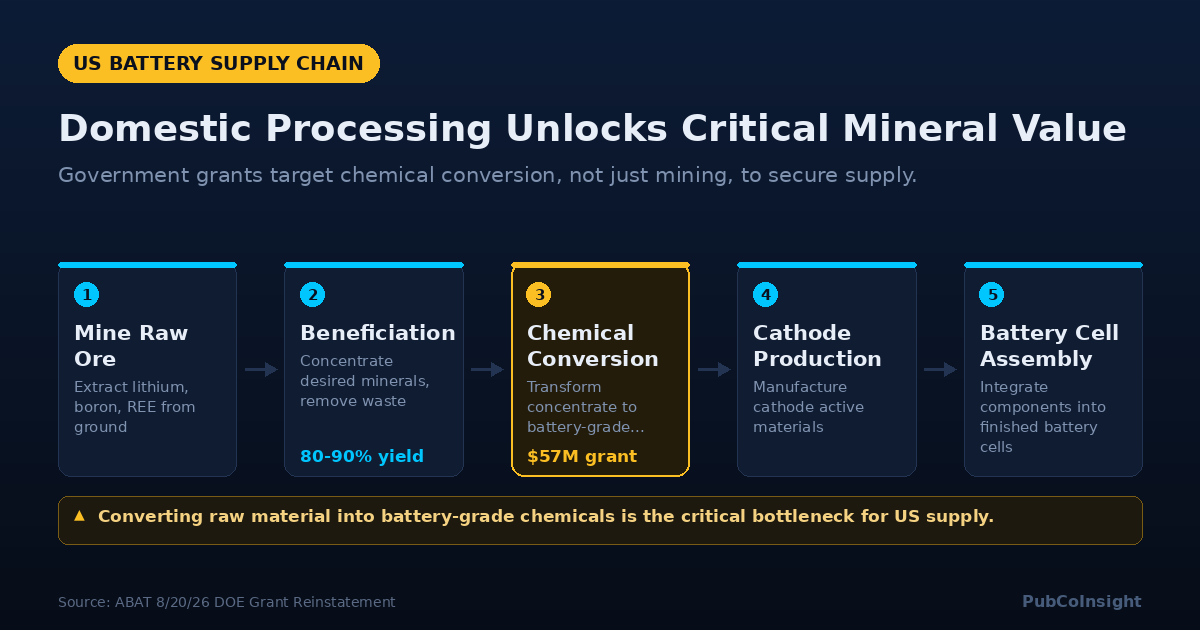
The Mechanism of Domestic Supply
The bottleneck in the US critical minerals supply chain is not solely about digging rock out of the ground. It is about converting that raw material into battery-grade chemicals. For lithium, this means transforming spodumene concentrate, brine, or clay into high-purity lithium carbonate or lithium hydroxide. These are the feedstocks for cathode manufacturing. The vast majority of this processing capacity currently resides outside the US, primarily in China. A domestic supply chain requires integrated steps: extraction, beneficiation, and then chemical conversion. Take lithium from clay, for example. The clay must be mined, then processed to leach out the lithium. This leachate then undergoes purification and crystallization to yield lithium carbonate or hydroxide. Each step demands specific chemical engineering and significant capital investment. The DOE grant to ABAT targets the lithium hydroxide manufacturing stage, a crucial link in this chain. Lithium hydroxide is particularly important for high-nickel cathodes, which offer greater energy density in EV batteries. Without domestic processing, even US-mined lithium still relies on foreign conversion, leaving the supply chain vulnerable.Companies Building US Capacity
Several companies are working to establish or expand critical mineral operations within the US, addressing various points in the supply chain. In lithium, Standard Lithium Ltd. (SLI), trading at $2.42, recently secured a 10-year offtake deal with LG Energy Solution for lithium carbonate from its Smackover project in South West Arkansas. This project, a joint venture with Equinor, aims to produce battery-grade lithium from brine using direct lithium extraction (DLE) technology. Atlas Lithium Corporation (ATLX), priced at $3.33, is advancing its Minas Gerais project in Brazil, but its strategic focus also includes potential US market supply. Albemarle Corporation (ALB), a major global player, continues to operate its Silver Peak brine operation in Nevada, one of the few active lithium mines in the US. Rare earth elements, essential for magnets in EVs and wind turbines, also see domestic development. MP Materials (MP) operates the Mountain Pass mine in California, the only integrated rare earth mining and processing site in North America. They produce rare earth concentrate and are investing in downstream processing to separate individual rare earth oxides. USA Rare Earth, Inc. (USAR), at $17.61, is developing the Round Top heavy rare earth and critical minerals project in Texas. This project targets a wide array of critical minerals including lithium, uranium, and beryllium, in addition to rare earths. Boron, a less talked about but critical component in some battery chemistries and advanced materials, is also part of the domestic supply chain conversation. Ioneer Ltd (IONR), trading at $3.14, is developing the Rhyolite Ridge lithium-boron project in Nevada. This project aims to produce lithium carbonate and boric acid from a single deposit, leveraging a unique co-production model. NioCorp Developments Ltd. (NB), priced at $4.13, is focused on its Elk Creek project in Nebraska, which targets niobium, scandium, and titanium, with potential for rare earth byproducts. Critical Metals Corp. (CRML), at $7.28, is pursuing a proposed acquisition of European Lithium, focusing on a project in Austria, but the broader move to secure critical minerals globally highlights the urgency of domestic supply.American Lithium Minerals, Inc.
American Lithium Minerals, Inc. (AMLM), trading over the counter at $0.0782, is an exploration stage company. It is pre-revenue and incorporated in Nevada in 2005. The company's stated focus is lithium and boron properties in Nevada. AMLM’s current project is the Sarcobatus Lithium property, which comprises 1,780 acres of mining claims in Central Nevada. The company has acquired mineral rights to mining properties in North America and has explored for minerals since its inception. While the company has explored for lithium in Central Nevada since 2009, and has acquired and divested cobalt, nickel, graphite, and rare earth prospects, the public record does not yet establish a measured or indicated resource for its Sarcobatus property. AMLM filed a Regulation A offering on Form 1-A on February 4, 2026, covering up to 80,000,000 units. Each unit includes one share of common stock and a warrant to purchase 1.5 shares, exercisable at $0.05 per share until December 31, 2028. The offering could result in up to 120,000,000 shares issued if all warrants are exercised. The company has stated its intent to expand its exploration and acquisition for mineral properties worldwide, and is also developing the use of Real World Asset Tokens to provide capital for mining. Its long-term vision includes creating an interoperable ecosystem where mining assets can be tokenized and traded.What to watch
The DOE's reinstatement of ABAT's $57 million grant sets a precedent. Watch for further government funding announcements for domestic processing facilities, particularly for lithium and rare earths. The Bipartisan Infrastructure Law still has capital to deploy. Specific dates to monitor include: * **Q4 2026/Q1 2027**: Progress updates from American Battery Technology Company on its Fernley, Nevada lithium hydroxide plant, especially regarding construction timelines and permitting milestones. * **Ongoing**: Offtake agreements for US-produced battery materials. Standard Lithium's recent deal with LG Energy Solution for its Smackover project is a template. More such agreements will signal market acceptance and financial viability for domestic projects. * **2027**: Permitting decisions for major US-based critical mineral projects. These include environmental impact statements and federal land use approvals, which are often multi-year processes. * **Late 2026/Early 2027**: Updates from Ioneer Ltd on its Rhyolite Ridge project, particularly regarding the permitting process and any further financing arrangements for its lithium-boron co-production. * **Ongoing**: News from MP Materials regarding the commissioning and ramp-up of its rare earth separation facility at Mountain Pass. This will be a key indicator of US capability in advanced rare earth processing., { "label": "Beneficiation", "note": "Concentrate desired minerals, remove waste", "metric": "80-90% yield" }, { "label": "Chemical Conversion", "note": "Transform concentrate to battery-grade chemicals", "metric": "$57M grant" }, { "label": "Cathode Production", "note": "Manufacture cathode active materials" }, { "label": "Battery Cell Assembly", "note": "Integrate components into finished battery cells" } ], "highlight": 2, "highlight_note": "Converting raw material into battery-grade chemicals is the critical bottleneck for US supply.", "footnote": "Source: ABAT 8/20/26 DOE Grant Reinstatement" }Companies mentioned
| Ticker | Company | Price |
|---|---|---|
| ABAT | American Battery Technology Company | $2.78 |
| AMLM client | American Lithium Minerals, Inc. | $0.0782 |
| ATLX | Atlas Lithium Corporation | $3.33 |
| CRML | Critical Metals Corp. | $7.28 |
| IONR | ioneer Ltd | $3.14 |
| NB | NioCorp Developments Ltd. | $4.13 |
| SLI | Standard Lithium Ltd. | $2.42 |
| USAR | USA Rare Earth, Inc. | $17.61 |
Listed alphabetically, not ranked. Prices as of 2026-09-08 and they move. Check a live quote before relying on any of this.
How we chose the companies in this article
We cover a fixed universe of companies working in lithium, boron and the critical minerals that feed battery and energy-storage supply chains. Every one of them that had usable market data on 2026-09-08 appears in this article. We do not pick which ones to mention based on what we think of them, and we do not order them by size, price or trading volume, because an ordered list is a verdict and that is not ours to hand down. Companies left out, and why: none. American Lithium Minerals and Artificial Intelligence Technology Solutions pay us, which is disclosed in full at the foot of every article they appear in.
See the dilution and promotion flags before you see the pitch.
Each week: the micro and small-caps now showing dilution or paid-promotion signals, with the SEC filing behind every flag. No recommendations, no price targets.
Sources used in this article
- Albemarle Corporation (ALB) Is a Trending Stock: Facts to Know Before Betting on It Zacks · 2026-09-07
- Albemarle’s Next CEO Inherits A $250 Million Swing Per Dollar Benzinga · 2026-09-05
- Critical Metals Stock And 2 Other Rare Earth Stocks To Own Simply Wall St. · 2026-09-05
- Why Is Albemarle (ALB) Up 5.4% Since Last Earnings Report? Zacks · 2026-09-04
- Jim Cramer Bullish on MP Materials (MP) But Warns Investors Not to Expect Quick Results Insider Monkey · 2026-09-04
- Energy Fuels' Q2 Loss Widens: Is a Recovery on the Horizon? Zacks · 2026-09-04
- USA Rare Earth Rises 4%, Then Coughs Up Gains as Chinese Suppliers Refuse U.S. Shipments 24/7 Wall St. · 2026-09-04
- MP Materials (MP) Stock Looks Expensive On Sales But Strong On Returns Simply Wall St. · 2026-09-04
- MP, CRML, USAR Stocks In Focus: China Reportedly Blocks Some Rare Earth Shipments To US Stocktwits · 2026-09-04
- ‘Some of These Lasers Were the Size of Buildings’: Now They Need 12 Minerals China Cut Off 24/7 Wall St. · 2026-09-04
- Albemarle Names Ragnar Udd President and CEO MT Newswires · 2026-09-03
- Albemarle Announces CEO Succession Plan PR Newswire · 2026-09-03
Disclosure required by Section 17(b) of the Securities Act of 1933
American Lithium Minerals, Inc.. American Lithium Minerals, Inc. (issuer) paid Strategic Innovations First, Inc., an affiliate of PubCo Insight and Pulse IR. Compensation received: USD 11,550.00 total, three equal monthly installments of USD 3,850.00. Form of payment: cash only; no stock, options or warrants. Services: investor relations, marketing and content creation under Master Services Agreement dated June 22, 2026. Period: three month initial term, June 2026 through August 2026. No position, options or warrants held by PubCo Insight, Pulse IR, Strategic Innovations First, Inc., or Brad Listermann.
This is information, not investment, financial, legal or tax advice. It is not a recommendation or solicitation to buy, sell or hold any security and it contains no price target. Nothing here is independently verified by us. Confirm every figure against primary filings on SEC EDGAR before you act. Micro-cap and over-the-counter securities are speculative and illiquid and can lose all of their value. The companies named without a disclosure above pay us nothing and have no relationship with us; they are named because a published, mechanical screen selected them. Full disclosure policy.