Lithium Recycling Powers American Battery Technology's Revenue Jump
American Battery Technology Company's recent financial results highlight a growing revenue stream from battery recycling, a critical process for securing domestic mineral supply and reducing reliance on mined resources.
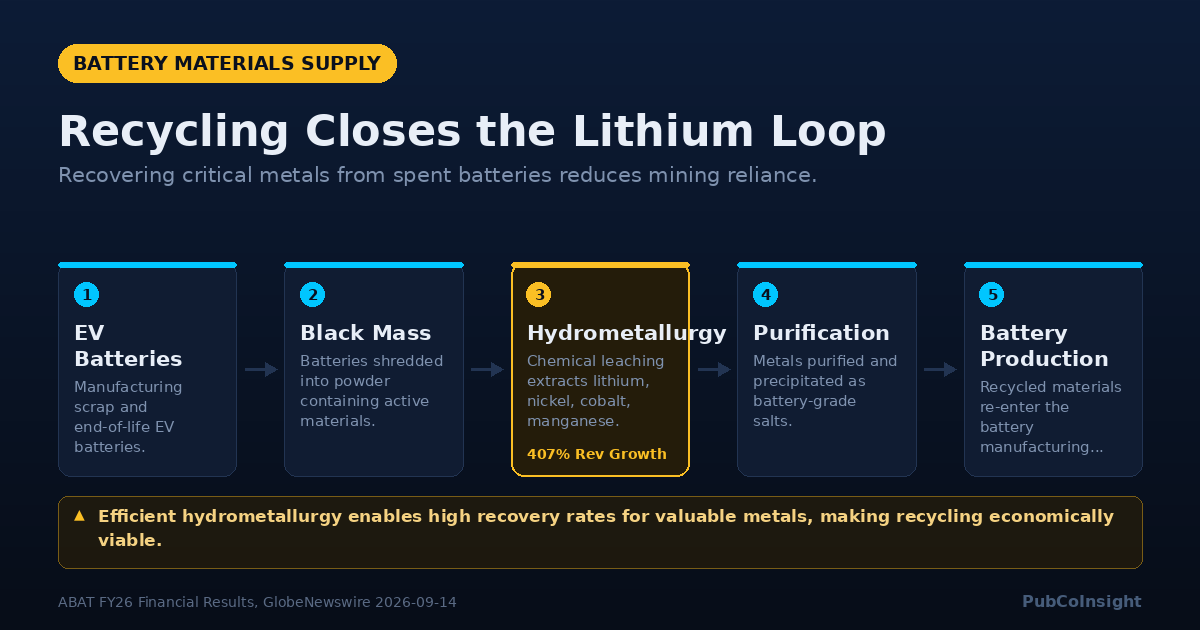
The Closed-Loop Advantage
Battery recycling is not simply about waste management. It is a re-mining operation, focused on recovering high-value metals like lithium, nickel, cobalt, and manganese from end-of-life electric vehicle batteries and manufacturing scrap. The process typically involves several stages. First, batteries are safely discharged and dismantled. Next, mechanical processes shred the battery cells into a material called "black mass," a powder containing the active cathode and anode materials. The critical step for metal recovery is the hydrometallurgical or pyrometallurgical treatment of this black mass. Hydrometallurgy uses chemical solutions to selectively leach out the valuable metals, which are then purified and precipitated as salts, like lithium carbonate or lithium hydroxide, suitable for re-entry into battery manufacturing. Pyrometallurgy, on the other hand, involves high-temperature smelting to recover metals, often in an alloy form, which then require further refining. The advantage of hydrometallurgy, when executed efficiently, is its lower energy consumption and the ability to recover a wider range of materials, including lithium, which is often lost in pyrometallurgical processes. This closed-loop approach reduces the environmental footprint of battery production and, crucially, lessens dependence on new mineral extraction, which faces permitting hurdles and long development timelines. The real challenge lies in achieving high recovery rates for all valuable metals at a cost competitive with primary mining.Operators in the Critical Minerals Space
The demand for battery metals has spurred activity across various segments, from traditional mining to advanced processing and recycling. Albemarle (ALB), a major established player, continues to operate large-scale lithium brine and hard rock mines globally. Its recent stock movements reflect broader market sentiment and the inherent volatility in commodity prices. Lithium Americas (LAC) focuses on its Thacker Pass project in Nevada, a significant clay-based lithium deposit. The company has navigated complex permitting processes and secured substantial financing to advance this project. Standard Lithium Ltd. (SLI) is developing direct lithium extraction (DLE) technologies in the Smackover Formation in Arkansas and Texas. Its Franklin Project in East Texas recently announced a positive preliminary economic assessment, with estimates up to 70,000 tonnes of annual lithium carbonate output. This DLE approach aims for lower environmental impact and faster production compared to traditional methods. In the rare earth elements sector, MP Materials (MP) operates the Mountain Pass mine in California, the only integrated rare earth mining and processing facility in North America. The company is working to expand its capabilities to include magnet production, aiming to supply critical materials for electric vehicle motors. Critical Metals Corp. (CRML) is advancing its merger with European Lithium, which holds the Wolfsberg Lithium Project in Austria. This deal, recently cleared for a shareholder vote in October, represents a move to consolidate European lithium assets. USA Rare Earth, Inc. (USAR) is developing the Round Top heavy rare earth and critical minerals project in Texas. The project aims to establish a domestic supply chain for a wide range of critical minerals, including rare earths, lithium, and uranium. Atlas Lithium Corporation (ATLX) is advancing its Neves Project in Brazil, de-risking the project by contracting 71% of its direct capital budget. ioneer Ltd (IONR) is developing the Rhyolite Ridge Lithium-Boron Project in Nevada, an integrated operation designed to produce both lithium carbonate and boric acid. NioCorp Developments Ltd. (NB) is focused on its Elk Creek project in Nebraska, which aims to produce niobium, scandium, and titanium, with potential for rare earth element co-production.American Lithium Minerals, Inc.
American Lithium Minerals, Inc. (AMLM) is an exploration stage company, trading over the counter. Its stated focus is lithium and boron properties in Nevada. The company filed a Regulation A offering on Form 1-A, qualified on February 4, 2026, which covers up to 80,000,000 units, each including one share of common stock and a warrant to purchase 1.5 shares. The warrants are exercisable at $0.05 per share until December 31, 2028. The offering could result in up to 120,000,000 additional shares if all warrants are exercised. AMLM was incorporated in Nevada on March 10, 2005. Its primary asset is the Sarcobatus Lithium property, comprising 1,780 acres of mining claims in Central Nevada. The company states its activities since 2009 have focused on lithium exploration in this region. AMLM has also acquired and divested cobalt, nickel, and graphite prospects in Central Nevada, and rare earth elements projects in Kingman, Arizona, and Southeast Illinois. The company's filings indicate it does not own real property like land or buildings. The public record does not yet establish a measured or indicated resource estimate for the Sarcobatus Lithium property. AMLM's business plan includes expanding its exploration and acquisition of mineral properties globally. It also states an intention to develop "Real World Asset Tokens" to provide capital for mining. The company has not generated significant revenues to date and is pre-revenue. Its ability to generate revenue depends on executing its business plan and expanding its client base.What to watch
Investors should monitor several specific developments across the sector. For Critical Metals Corp. (CRML), the October shareholder vote on the European Lithium merger is a key near-term event. Standard Lithium Ltd. (SLI) will likely release further engineering and permitting updates for its Smackover projects, following its positive preliminary economic assessment for the Franklin Project. Lithium Americas (LAC) will face continued scrutiny on its Thacker Pass project, particularly regarding permitting progress and construction timelines. American Battery Technology Company (ABAT) will need to demonstrate sustained positive adjusted gross profit in subsequent quarters to confirm the profitability trend in its recycling operations. For American Lithium Minerals, Inc. (AMLM), watch for any announcements regarding exploration results at its Sarcobatus Lithium property, specifically any drilling campaigns or initial resource estimates, and updates on its stated plan to acquire additional properties., { "label": "Black Mass", "note": "Batteries shredded into powder containing active materials." }, { "label": "Hydrometallurgy", "note": "Chemical leaching extracts lithium, nickel, cobalt, manganese.", "metric": "407% Rev Growth" }, { "label": "Purification", "note": "Metals purified and precipitated as battery-grade salts." }, { "label": "Battery Production", "note": "Recycled materials re-enter the battery manufacturing supply chain." } ], "highlight": 2, "highlight_note": "Efficient hydrometallurgy enables high recovery rates for valuable metals, making recycling economically viable.", "footnote": "ABAT FY26 Financial Results, GlobeNewswire 2026-09-14" }Companies mentioned
| Ticker | Company | Price |
|---|---|---|
| ABAT | American Battery Technology Company | $2.24 |
| AMLM client | American Lithium Minerals, Inc. | $0.075 |
| ATLX | Atlas Lithium Corporation | $2.96 |
| CRML | Critical Metals Corp. | $6.35 |
| IONR | ioneer Ltd | $2.91 |
| NB | NioCorp Developments Ltd. | $3.56 |
| SLI | Standard Lithium Ltd. | $2.05 |
| USAR | USA Rare Earth, Inc. | $15.4 |
Listed alphabetically, not ranked. Prices as of 2026-09-16 and they move. Check a live quote before relying on any of this.
How we chose the companies in this article
We cover a fixed universe of companies working in lithium, boron and the critical minerals that feed battery and energy-storage supply chains. Every one of them that had usable market data on 2026-09-16 appears in this article. We do not pick which ones to mention based on what we think of them, and we do not order them by size, price or trading volume, because an ordered list is a verdict and that is not ours to hand down. Companies left out, and why: none. American Lithium Minerals and Artificial Intelligence Technology Solutions pay us, which is disclosed in full at the foot of every article they appear in.
See the dilution and promotion flags before you see the pitch.
Each week: the micro and small-caps now showing dilution or paid-promotion signals, with the SEC filing behind every flag. No recommendations, no price targets.
Sources used in this article
- Should You Buy, Sell or Hold ALB Stock After a 29% Dip in 6 Months? Zacks · 2026-09-15
- Is MP Materials (MP) Cheap On Its Conference Spotlight And $75 Fair Value Narrative? Simply Wall St. · 2026-09-15
- Critical Metals Says Court Clears European Lithium Deal for October Shareholder Vote MT Newswires · 2026-09-15
- Critical Metals Corp. Merger with European Lithium Advances to Shareholder Vote Following Court Ruling GlobeNewswire · 2026-09-15
- CRML Stock In Focus: European Lithium Sets October Votes As Critical Metals Merger Clears Court Hurdle Stocktwits · 2026-09-15
- ABAT Q4 2026 Earnings Call Transcript Motley Fool · 2026-09-15
- Lithium Americas (TSX:LAC) Sells Off Again, But Is The Valuation Story Getting Harder To Call? Simply Wall St. · 2026-09-14
- Morgan Stanley raises Target Hospitality PT on accretive contract win Investing.com · 2026-09-14
- This Strategic Metals Stock Surges on $450 Million Pentagon Deal Barrons.com · 2026-09-14
- USAR, MP, UUUU, CRML Stocks Drop Overnight: Why China's Threat To Scrap Trump-Xi Summit Matters Stocktwits · 2026-09-14
- American Battery Technology Q4 Earnings Call Highlights MarketBeat · 2026-09-14
- American Battery Technology Company Reports FY 26 Financial Results, Delivering 407% Revenue Growth and Positive Adjusted Gross Profit GlobeNewswire · 2026-09-14
Disclosure required by Section 17(b) of the Securities Act of 1933
American Lithium Minerals, Inc.. American Lithium Minerals, Inc. (issuer) paid Strategic Innovations First, Inc., an affiliate of PubCo Insight and Pulse IR. Compensation received: USD 11,550.00 total, three equal monthly installments of USD 3,850.00. Form of payment: cash only; no stock, options or warrants. Services: investor relations, marketing and content creation under Master Services Agreement dated June 22, 2026. Period: three month initial term, June 2026 through August 2026. No position, options or warrants held by PubCo Insight, Pulse IR, Strategic Innovations First, Inc., or Brad Listermann.
This is information, not investment, financial, legal or tax advice. It is not a recommendation or solicitation to buy, sell or hold any security and it contains no price target. Nothing here is independently verified by us. Confirm every figure against primary filings on SEC EDGAR before you act. Micro-cap and over-the-counter securities are speculative and illiquid and can lose all of their value. The companies named without a disclosure above pay us nothing and have no relationship with us; they are named because a published, mechanical screen selected them. Full disclosure policy.