Lithium Americas’ Thacker Pass Costs Jump 31% as Albemarle Price Targets Diverge
Thacker Pass capital cost estimates rose to $3.83 billion, while analysts issued conflicting price target adjustments for Albemarle, highlighting the capital-intensive nature and market volatility in critical minerals.
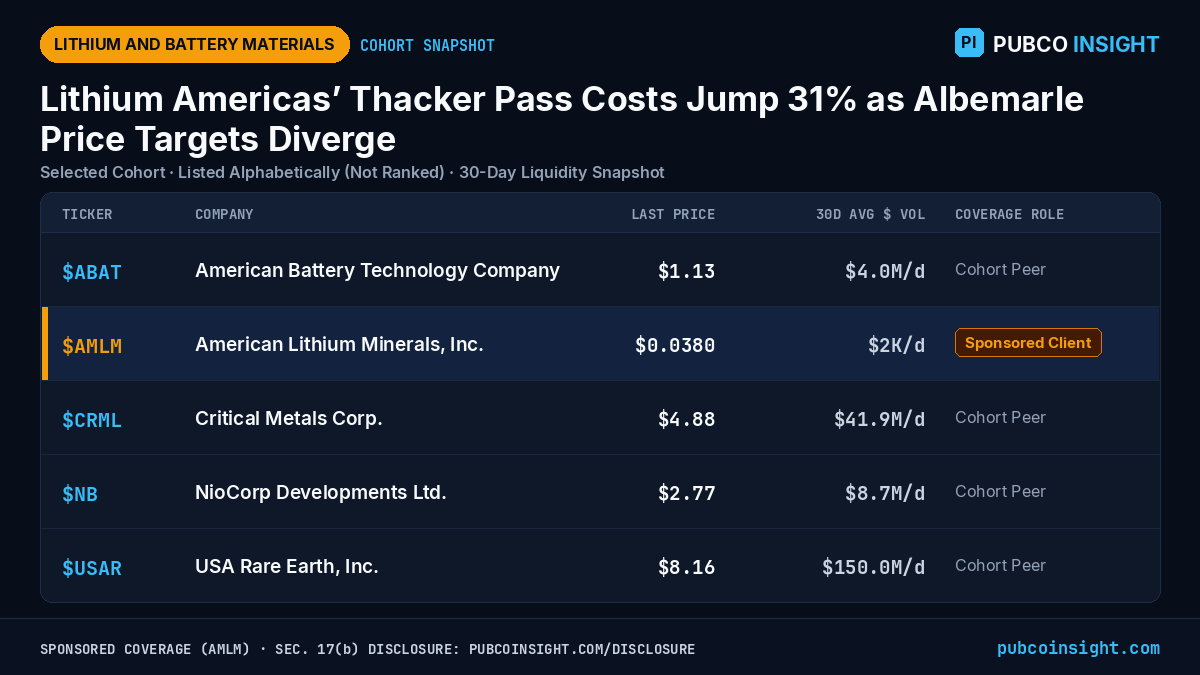
On November 11, Lithium Americas (LAC) announced a 31% increase in the estimated capital costs for Phase 1 of its Thacker Pass project, pushing the figure to $3.83 billion. This news came as analysts issued a series of conflicting price target adjustments for Albemarle (ALB). CICC raised its target to $108.58 from $83.28 on November 12, while BofA reduced its target to $120 from $131 the same day. Rothschild & Co Redburn also cut its target to $86 from $100 on November 11. These movements underscore the significant capital demands and volatile market sentiment surrounding the development of new lithium supply, even for established players.
The divergence in analyst views on Albemarle, a major lithium producer, alongside the substantial cost escalation at Thacker Pass, points to a broader tension in the critical minerals sector. The industry needs new supply to meet growing demand, but the path to production is fraught with financial and operational challenges. These recent developments highlight the inherent risks and rewards in bringing new mineral assets online.
The Mechanism of Lithium Production Cost Escalation
Developing a new lithium mine, particularly a large-scale project like Thacker Pass, involves intricate engineering, extensive permitting, and substantial upfront capital. The process begins with exploration to define the resource, followed by metallurgical testing to determine the optimal extraction method. For clay-based deposits like Thacker Pass, this often involves complex hydrometallurgical processes, which are less common than brine or hard rock extraction. These processes require specialized reagents, significant energy input, and sophisticated infrastructure. Construction of processing plants, tailings facilities, and supporting utilities drives a large portion of the capital expenditure. Labor costs, equipment procurement, and regulatory compliance also contribute significantly. Unexpected geological conditions, changes in commodity prices for construction materials, and evolving environmental regulations can all lead to cost overruns. The long lead times from discovery to commercial production, often a decade or more, expose projects to economic shifts and inflationary pressures, making initial cost estimates difficult to maintain.
Companies Navigating the Critical Minerals Landscape
Several companies are actively developing projects across the lithium, boron, and rare earth sectors, each facing unique challenges and opportunities. In lithium, Standard Lithium Ltd. (SLI) is focused on direct lithium extraction (DLE) from brine resources in Arkansas, aiming for a more environmentally friendly and efficient production method. Atlas Lithium Corporation (ATLX) is advancing its hard rock lithium project in Brazil, targeting spodumene concentrate production. ioneer Ltd (IONR) is developing the Rhyolite Ridge lithium-boron project in Nevada, which aims to produce both lithium carbonate and boric acid from a single ore body. This co-production model offers potential economic advantages by diversifying revenue streams, but also adds complexity to processing.
In the broader critical minerals space, NioCorp Developments Ltd. (NB) is working on its Elk Creek project in Nebraska, which targets niobium, scandium, and titanium, with potential for rare earth elements. American Battery Technology Company (ABAT) is focused on lithium-ion battery recycling and the development of proprietary extraction technologies for primary resources, aiming to create a circular supply chain. Their recent Q1 FY27 financial results showed 83% year-over-year revenue growth, primarily from battery recycling services.
The rare earth sector sees players like MP Materials (MP), which operates the Mountain Pass mine in California, the only integrated rare earth mining and processing site in North America. MP Materials reported a 176% jump in Q3 revenues, driven by increased demand for rare earth products. Insiders at MP Materials recently purchased shares worth $3.35 million, according to SEC filings. Critical Metals Corp. (CRML) recently announced full ownership of the Tanbreez Rare Earth Project after acquiring European Lithium, stating it has US$264.5 million in cash and 194.2 million shares outstanding. USA Rare Earth, Inc. (USAR) is also active, with its stock climbing 3% on November 13 as rare earth stocks extended a rally.
American Lithium Minerals, Inc.
American Lithium Minerals, Inc. (AMLM), trading over the counter, is an exploration stage company focused on lithium and boron properties in Nevada. The company was incorporated in Nevada on March 10, 2005. Its primary asset is the Sarcobatus Lithium property, comprising 1,780 acres of mining claims in Central Nevada. The company's activities since 2009 have centered on lithium exploration at Sarcobatus. While the company intends to expand its exploration and acquisition of mineral properties globally, and is exploring the use of Real World Asset Tokens for capital, the public record does not yet establish the economic viability or resource specifics of its Sarcobatus project. AMLM is pre-revenue and does not own any real property beyond its mineral rights. The SEC qualified a Regulation A offering on Form 1-A on February 4, 2026, for up to 80,000,000 units, with an additional 120,000,000 shares issuable upon full exercise of attached warrants. Each unit includes one share of common stock and a warrant to purchase 1.5 shares of common stock, exercisable at $0.05 per share until December 31, 2028. The maximum total offering amount is $20,000,000. The company's stated plan is to explore for lithium in Nevada and potentially expand into other critical minerals and geographies. Its filings indicate a focus on consolidating in-ground mining assets.
What to watch
- Lithium Americas (LAC): Monitor further updates on the Thacker Pass Phase 1 capital expenditure and project timeline. Any new financing arrangements or construction milestones will be key.
- Albemarle (ALB): Watch for earnings reports and management commentary that might clarify the basis for the divergent analyst price targets. Production guidance and new project developments will be important.
- MP Materials (MP): Look for continued insider buying activity and further details on the company's Q3 revenue growth drivers. Updates on their downstream processing capabilities will also be significant.
- Critical Metals Corp. (CRML): Track the company's 2027 roadmap and any specific announcements regarding the development of the Tanbreez Rare Earth Project.
- Standard Lithium (SLI): Follow progress on their DLE projects in Arkansas, particularly any pilot plant results or definitive feasibility study updates.
- American Battery Technology Company (ABAT): Keep an eye on their next financial results for continued revenue growth trends from recycling operations and progress on their primary resource extraction technologies.
- American Lithium Minerals, Inc. (AMLM): Observe any public announcements regarding exploration results at the Sarcobatus Lithium property or updates on the utilization of proceeds from their Regulation A offering.
Companies mentioned
| Ticker | Company | Price |
|---|---|---|
| ABAT | American Battery Technology Company | $1.13 |
| AMLM client | American Lithium Minerals, Inc. | $0.038 |
| ATLX | Atlas Lithium Corporation | $1.54 |
| CRML | Critical Metals Corp. | $4.88 |
| IONR | ioneer Ltd | $2.18 |
| NB | NioCorp Developments Ltd. | $2.77 |
| SLI | Standard Lithium Ltd. | $1.37 |
| USAR | USA Rare Earth, Inc. | $8.16 |
Listed alphabetically, not ranked. Prices as of 2026-11-14 and they move. Check a live quote before relying on any of this.
How we chose the companies in this article
We cover a fixed universe of companies working in lithium, boron and the critical minerals that feed battery and energy-storage supply chains. Every one of them that had usable market data on 2026-11-14 appears in this article. We do not pick which ones to mention based on what we think of them, and we do not order them by size, price or trading volume, because an ordered list is a verdict and that is not ours to hand down. Companies left out, and why: none. American Lithium Minerals and Artificial Intelligence Technology Solutions pay us, which is disclosed in full at the foot of every article they appear in.
See the dilution and promotion flags before you see the pitch.
Each week: the micro and small-caps now showing dilution or paid-promotion signals, with the SEC filing behind every flag. No recommendations, no price targets.
Sources used in this article
- Are Wall Street Analysts Predicting Albemarle Stock Will Climb or Sink? Barchart · 2026-11-13
- Are Options Traders Betting on a Big Move in Sociedad Quimica y Minera Stock? Zacks · 2026-11-13
- Deutsche Bank Lowers Price Target on Lithium Americas to $2.20 From $2.80, Keeps Hold Rating MT Newswires · 2026-11-13
- Critical Metals Rises 3% as Rare Earth Stocks Extend Rally; USA Rare Earth Climbs 3%, MP Materials Gains 2% 24/7 Wall St. · 2026-11-13
- MP's Q3 Revenues Jump 176%: Can This Growth Be Sustained? Zacks · 2026-11-13
- Wall Street Wrap: Nvidia Faces Downgrades As Jensen Huang’s Exit Rattles Analysts — AMD, MP Materials, Riot Platforms Get Bullish Calls Stocktwits · 2026-11-13
- Rare Earth Wars: U.S. General Sounds Alarm Over China's Military Leverage Oilprice.com · 2026-11-13
- American Battery Technology Company Announces First Quarter FY27 Financial Results Including 83% Year-Over-Year Revenue Growth GlobeNewswire · 2026-11-13
- BofA Adjusts Price Target on Albemarle to $120 From $131 MT Newswires · 2026-11-12
- CICC Adjusts Price Target on Albemarle to $108.58 From $83.28 MT Newswires · 2026-11-12
- Lithium Americas Q3 Loss Per Share Narrows MT Newswires · 2026-11-12
- TSX futures subdued amid reports Nvidia board preparing ouster of CEO Jensen Huang Investing.com · 2026-11-12
Disclosure required by Section 17(b) of the Securities Act of 1933
American Lithium Minerals, Inc.. American Lithium Minerals, Inc. (issuer) paid Strategic Innovations First, Inc., an affiliate of PubCo Insight and Pulse IR. Compensation received: USD 11,550.00 total, three equal monthly installments of USD 3,850.00. Form of payment: cash only; no stock, options or warrants. Services: investor relations, marketing and content creation under Master Services Agreement dated June 22, 2026. Period: three month initial term, June 2026 through August 2026. No position, options or warrants held by PubCo Insight, Pulse IR, Strategic Innovations First, Inc., or Brad Listermann.
This is information, not investment, financial, legal or tax advice. It is not a recommendation or solicitation to buy, sell or hold any security and it contains no price target. Nothing here is independently verified by us. Confirm every figure against primary filings on SEC EDGAR before you act. Micro-cap and over-the-counter securities are speculative and illiquid and can lose all of their value. The companies named without a disclosure above pay us nothing and have no relationship with us; they are named because a published, mechanical screen selected them. Full disclosure policy.