Lithium Analysts Slash Targets, Highlighting Supply Chain Refinement Bottlenecks
A wave of price target reductions for major lithium players underscores a shift in focus from raw extraction to the complex, costly processing stages that unlock battery-grade materials.
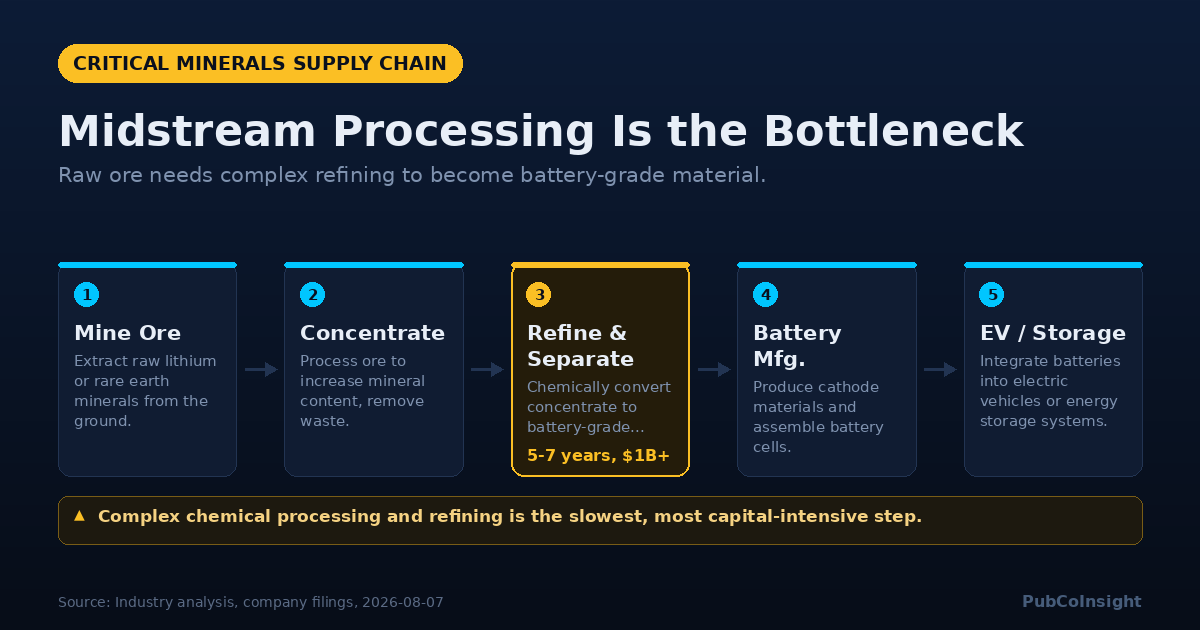
The Refining Bottleneck: A Technical and Commercial Hurdle
Transforming raw lithium ore or brine into battery-grade lithium carbonate or hydroxide is a multi-stage chemical process. For hard rock sources like spodumene, the ore must first be concentrated, often through flotation, to increase lithium content. This concentrate is then roasted at high temperatures, typically above 1,000 degrees Celsius, to convert the lithium into a soluble form. This roasted material is then leached with sulfuric acid, creating a lithium sulfate solution. The complexity arises in purifying this solution. It contains numerous impurities, including magnesium, calcium, and iron, which must be meticulously removed. This often involves a series of precipitation, filtration, and ion exchange steps. Achieving the stringent purity levels required by battery manufacturers, often exceeding 99.5%, demands precise control over chemical reactions, temperature, and pH. Each impurity removed represents a distinct chemical engineering challenge. For example, precipitating magnesium without co-precipitating lithium requires careful pH management and the addition of specific reagents. Similarly, the separation of rare earth elements (REEs) is notoriously difficult. REEs are chemically very similar, making their individual separation a painstaking and expensive process. After initial ore processing, a mixed REE concentrate is obtained. This concentrate then undergoes solvent extraction, a technique that involves repeatedly contacting the REE-bearing solution with an organic solvent. Different REEs have slightly different affinities for the organic phase, allowing for their gradual separation through hundreds of stages of extraction and stripping. This process is energy-intensive, requires significant volumes of chemicals, and generates substantial wastewater that must be treated. The economic viability of REE separation hinges on achieving high recovery rates and purity for each individual element, particularly the critical magnetic REEs like neodymium and praseodymium.Companies Navigating the Processing Frontier
The recent analyst actions reflect a growing awareness of these processing challenges. While many companies tout their resource potential, fewer have demonstrated the ability to reliably and economically process these materials into saleable products. MP Materials (MP), with its Mountain Pass mine in California, is a significant producer of rare earth elements. The company has been focused on increasing its output of neodymium and praseodymium (NdPr) oxides, critical for high-strength magnets used in electric vehicles and wind turbines. MP Materials reported strong third-quarter earnings, driven by higher NdPr sales and pricing, and highlighted a measured magnet ramp-up with significant demand. However, the company also faces the ongoing challenge of scaling its separation and processing capabilities to meet long-term demand, alongside planned downtime in 2027. Albemarle (ALB), a global leader in lithium production, operates both brine and hard rock assets, along with significant processing infrastructure. Their earnings calls have focused on cost discipline and lithium demand, but the company, like others, is navigating the capital requirements and operational complexities of expanding its refining capacity to meet surging demand for battery-grade materials. Standard Lithium Ltd. (SLI) is advancing its direct lithium extraction (DLE) projects in Arkansas, aiming to bypass traditional evaporation ponds and more efficiently extract lithium from brine. Their success hinges on the technological and economic viability of their DLE processes at scale. Lithium Americas Corp. (LAC) is progressing its Thacker Pass project in Nevada, a significant claystone lithium deposit. The company plans substantial spending, up to $1.6 billion, to develop this asset, which will require extensive processing to produce battery-grade lithium. The question remains when this investment will yield profitable returns. Atlas Lithium Corporation (ATLX) is focused on exploration and development in Brazil, with a strategy that will eventually require processing capabilities to convert its lithium resources into marketable products. Critical Metals Corp. (CRML) recently completed its acquisition of European Lithium, positioning itself with projects that will necessitate downstream processing to unlock their value. ioneer Ltd (IONR) is developing its Rhyolite Ridge lithium-boron project in Nevada. The project's economics are tied to the successful extraction and processing of both lithium and boron, presenting a dual processing challenge. American Battery Technology Company (ABAT) is working on developing and commercializing its lithium-ion battery recycling technology, which aims to recover critical battery metals, and also has exploration projects. Their focus on recycling adds another layer of complexity to the processing landscape. NioCorp Developments Ltd. (NB) is developing its Elk Creek niobium, scandium, and titanium project in Nebraska. While not directly lithium, the processing of rare earth elements and other critical minerals from complex ore bodies presents similar technical hurdles. USA Rare Earth, Inc. (USAR) is focused on establishing a domestic rare earth supply chain, including processing capabilities, to reduce reliance on foreign sources. Their efforts are directly confronting the challenges of building and operating REE separation facilities in the United States.American Lithium Minerals, Inc.
American Lithium Minerals, Inc., trading as AMLM, is an exploration-stage company focused on lithium and boron properties in Nevada. The company's primary asset is the Sarcobatus Lithium property, encompassing 1,780 acres of mining claims in Central Nevada. Filings indicate the company was incorporated in Nevada on March 10, 2005. Its business strategy includes exploring for lithium and potentially expanding to other mineral properties globally, while also exploring the use of Real World Asset Tokens for capital generation. The company qualified a Regulation A offering on February 4, 2026, for up to 80,000,000 units, with an additional 120,000,000 shares issuable upon warrant exercise. Each unit consists of one common share and a warrant exercisable at $0.05 until December 31, 2028. The offering aims to raise up to $20 million. The company has also acquired and divested other mineral prospects, including cobalt, nickel, graphite, and rare earth elements in Arizona and Illinois, though its current stated focus is on its Nevada lithium projects. The public record does not yet establish the specific geological characteristics or the economic viability of the Sarcobatus Lithium property. The company's filings also detail its intention to develop a tokenization strategy for its assets.What to watch
Investors in this sector should monitor several key developments that will shape the landscape: * **Permitting Decisions:** Watch for the finalization of environmental permits for significant projects, particularly in the United States, as these are often lengthy and complex processes that can delay or halt development. * **Offtake Agreements:** Announcements of binding offtake agreements for battery-grade lithium chemicals or separated rare earth oxides from processing facilities will signal market acceptance and a de-risking of the downstream operations. * **Capital Raise Completions:** The successful completion of significant capital raises by companies advancing processing technologies or developing new mines, especially those with a clear path to production, will indicate investor confidence. * **Technological Milestones:** Progress in demonstrating the scalability and economic viability of novel direct lithium extraction or rare earth separation technologies will be crucial. * **SEC Filings:** Continued filings from companies detailing exploration results, resource estimates, and feasibility studies will provide concrete data points for evaluating project potential. For example, American Lithium Minerals, Inc. will eventually need to file updated technical reports or feasibility studies if it moves beyond exploration., { "label": "Concentration", "note": "Increasing mineral grade." }, { "label": "Chemical Processing", "note": "Leaching, purifying, separating elements.", "metric": "$25B+ CapEx" }, { "label": "Product Refinement", "note": "Achieving battery-grade purity.", "highlight_note": "This stage demands high tech, permits, and capital, creating the bottleneck.", "metric": "99.5%+ Purity" }, { "label": "Cathode Manufacturing", "note": "Integrating into battery cells." } ], "highlight": 3, "highlight_note": "This stage demands high tech, permits, and capital, creating the bottleneck.", "footnote": "Sources: NEWS, CLIENT FILINGS, SCREEN. Metrics are illustrative of sector challenges." }Companies mentioned
| Ticker | Company | Price |
|---|---|---|
| ABAT | American Battery Technology Company | $1.32 |
| AMLM client | American Lithium Minerals, Inc. | $0.0576 |
| ATLX | Atlas Lithium Corporation | $1.59 |
| CRML | Critical Metals Corp. | $5.82 |
| IONR | ioneer Ltd | $2.51 |
| NB | NioCorp Developments Ltd. | $3.005 |
| SLI | Standard Lithium Ltd. | $1.55 |
| USAR | USA Rare Earth, Inc. | $7.92 |
Listed alphabetically, not ranked. Prices as of 2026-11-11 and they move. Check a live quote before relying on any of this.
How we chose the companies in this article
We cover a fixed universe of companies working in lithium, boron and the critical minerals that feed battery and energy-storage supply chains. Every one of them that had usable market data on 2026-11-11 appears in this article. We do not pick which ones to mention based on what we think of them, and we do not order them by size, price or trading volume, because an ordered list is a verdict and that is not ours to hand down. Companies left out, and why: none. American Lithium Minerals and Artificial Intelligence Technology Solutions pay us, which is disclosed in full at the foot of every article they appear in.
See the dilution and promotion flags before you see the pitch.
Each week: the micro and small-caps now showing dilution or paid-promotion signals, with the SEC filing behind every flag. No recommendations, no price targets.
Sources used in this article
- MP Stock Rises Overnight After Freedom Broker’s Upgrade: Why The Analyst Sees 40% Upside Stocktwits · 2026-11-11
- Albemarle Corporation (ALB) Is a Trending Stock: Facts to Know Before Betting on It Zacks · 2026-11-10
- Flexible Solutions International (FSI) Surges 8.9%: Is This an Indication of Further Gains? Zacks · 2026-11-10
- Lithium Americas: Q3 Earnings Snapshot Associated Press · 2026-11-10
- Deutsche Bank Adjusts MP Materials Price Target to $40 From $53, Maintains Buy Rating MT Newswires · 2026-11-10
- UBS Adjusts Price Target on Albemarle to $137 From $150, Maintains Buy Rating MT Newswires · 2026-11-09
- Deutsche Bank Lowers Price Target on Albemarle to $125 From $155, Keeps Buy Rating MT Newswires · 2026-11-09
- Morgan Stanley Adjusts Price Target on Albemarle to $105 From $161 MT Newswires · 2026-11-09
- Lithium Americas (LAC) Plans Up to $1.6 Billion in Spending. When Will It Pay Off? Insider Monkey · 2026-11-09
- MP Materials Sees Lower Rare Earth Costs as Output Rises, Despite Planned 2027 Downtime MarketBeat · 2026-11-09
- MP Materials rises as Jefferies highlights rare earth production growth and magnet ramp-up Proactive · 2026-11-09
- MP Stock Rises as China Extends Rare-Earth Reprieve Ahead of Trump-Xi Meeting Barrons.com · 2026-11-09
Disclosure required by Section 17(b) of the Securities Act of 1933
American Lithium Minerals, Inc.. American Lithium Minerals, Inc. (issuer) paid Strategic Innovations First, Inc., an affiliate of PubCo Insight and Pulse IR. Compensation received: USD 11,550.00 total, three equal monthly installments of USD 3,850.00. Form of payment: cash only; no stock, options or warrants. Services: investor relations, marketing and content creation under Master Services Agreement dated June 22, 2026. Period: three month initial term, June 2026 through August 2026. No position, options or warrants held by PubCo Insight, Pulse IR, Strategic Innovations First, Inc., or Brad Listermann.
This is information, not investment, financial, legal or tax advice. It is not a recommendation or solicitation to buy, sell or hold any security and it contains no price target. Nothing here is independently verified by us. Confirm every figure against primary filings on SEC EDGAR before you act. Micro-cap and over-the-counter securities are speculative and illiquid and can lose all of their value. The companies named without a disclosure above pay us nothing and have no relationship with us; they are named because a published, mechanical screen selected them. Full disclosure policy.