Albemarle Target Cuts Expose North American Brine Processing Realities
Wall Street trims price targets on the lithium leader while junior Nevada explorers push alternative clays, brines, and direct extraction flows.
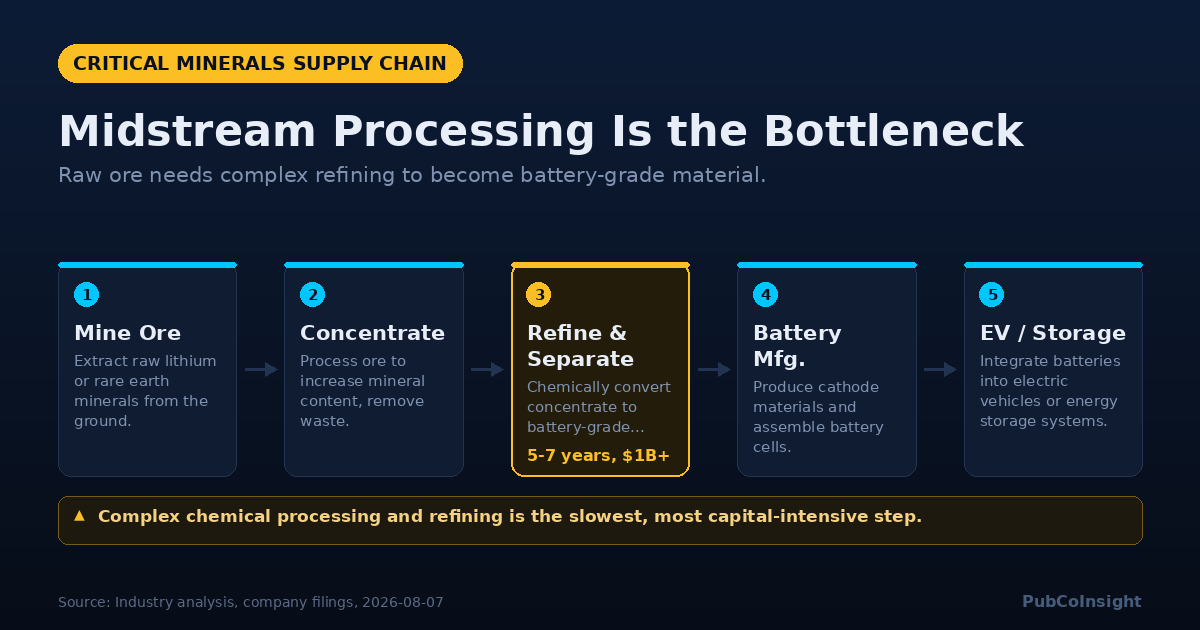
The Mechanics of Extraction and the Conversion Bottleneck
Extracting lithium from the ground is fundamentally an exercise in selective separation. In brine operations, subterranean saltwater containing concentrations of lithium, potassium, magnesium, and sodium is pumped to the surface. Traditional methods route this brine through extensive evaporation ponds over 12 to 24 months, using solar concentration to precipitate out salts until lithium concentrations reach roughly 6,000 parts per million. At that stage, soda ash precipitates lithium carbonate. Direct Lithium Extraction avoids the pond network by cycling raw brine through an engineered medium. Adsorbents, ion-exchange resins, or membranes capture lithium ions while rejecting sodium and magnesium, stripping the target mineral in hours instead of years. The concentrated eluate then enters standard chemical precipitation loops to produce lithium hydroxide or carbonate. The mechanism drastically reduces surface land use, but it introduces heavy utility and chemical consumption demands. If the brine matrix carries high total dissolved solids or complex divalent contaminants, column degradation can make continuous regeneration prohibitively expensive. Sedimentary and claystone deposits present an entirely different chemical problem. Here, lithium sits locked within smectite or illite clay lattices. Processing requires crushing the ore, followed by acid leaching or thermal calcination with sulfate salts to break the mineral structure. The resulting leach liquor carries not just lithium, but aluminum, iron, and boron. Boron removal requires specialized solvent extraction loops, because even trace quantities spoil the purity required for lithium iron phosphate or nickel-cobalt-manganese cathode chemistry. Commercial viability requires water conservation, rapid reagent recycling, and mineral recovery rates above 80 percent. The process must deliver technical-grade or battery-grade salts at a cash cost below prevailing spot conversion prices. If reagent consumption runs too high, the entire process fails economically regardless of resource grade.North American Operators Navigate Refining Hurdles
Operators across North America are taking distinct paths through the conversion matrix. In southern Arkansas, Standard Lithium Ltd. (SLI, $1.43) is scaling direct lithium extraction against Smackover formation brines. The company has advanced an optional offtake framework with Equinor and appointed Ralph Alexander to its board of directors on October 13, 2026. Standard Lithium bypasses surface pond evaporation by coupling proprietary extraction columns with existing commercial chemical infrastructure. In Nevada, ioneer Ltd (IONR, $2.89) targets sedimentary lithium-boron mineralization at Rhyolite Ridge. The deposit requires co-producing boric acid alongside lithium carbonate. Because boron is separated early via acid leaching and crystallization, the boric acid cash flows offset the downstream lithium refining expenses. Down the road, American Battery Technology Company (ABAT, $1.75) is pursuing a dual model in Nevada, operating recycling facilities while engineering extraction processes for its Tonopah sedimentary clay resources. Beyond US brines, Atlas Lithium Corporation (ATLX, $2.07) is advancing hard-rock spodumene in Brazil, completing pre-assembly steps for its processing plant on October 6, 2026. Hard-rock pegmatites avoid brine separation kinetics entirely, using dense media separation and flotation to generate a 6 percent spodumene concentrate for export. Critical Metals Corp. (CRML, $6.54) secured Greenland government mining approvals through 2050 on October 5, 2026, for the Tanbreez rare earth deposit, dealing with complex multi-element mineral cracking. In the domestic heavy-rare-earths and critical minerals sector, USA Rare Earth, Inc. (USAR, $11.28) and NioCorp Developments Ltd. (NB, $3.34) continue testing chemical separation circuits for niobium, scandium, and magnetic rare earth oxides.American Lithium Minerals, Inc.
American Lithium Minerals, Inc. (AMLM, $0.06) is an exploration-stage company incorporated in Nevada in March 2005. It files with the SEC under CIK 0001356371 and is pre-revenue. The company's principal operational footprint centers on the Sarcobatus Lithium property, comprising 1,780 acres of unpatented placer mining claims located in Nye County in Central Nevada. The Sarcobatus Valley represents an enclosed salar basin with structural similarities to Clayton Valley to the north. Historical work across Sarcobatus identified enriched lithium-bearing sediments and subsurface brines. The company's exploration thesis is focused on validating anomalous lithium concentrations across the 1,780-acre block, evaluating both playa clay layers and deeper aquifer zones. Alongside lithium, management has identified boron potential, reflecting the regional volcanic-associated evaporite geology typical of Central Nevada. AMLM is attempting to finance its field work through non-traditional structures. On February 4, 2026, the SEC qualified the company's Regulation A offering circular on Form 1-A. The qualified circular covers up to 80,000,000 units at a maximum total offering size of $20,000,000, inclusive of up to 120,000,000 shares issuable upon the exercise of warrants. Management has also laid out intentions in its SEC filings to explore Real World Asset tokenization frameworks to fund project development. On October 7, 2026, the company announced the conversion of a debt note held by Worldwide Diversified Holdings, Inc. into common stock, removing debt from the balance sheet. What the public record does not yet establish is an initial mineral resource estimate, formal NI 43-101 or S-K 1300 technical report, or verified metallurgy showing lithium extraction efficiencies from Sarcobatus ore. Management's stated plan involves running geophysical testing and Phase 1 shallow drilling across the Sarcobatus claims, subject to funding proceeds. The company also maintains corporate rights to earlier-stage mineral claims, including past cobalt, nickel, and Kingman, Arizona rare earth projects referenced in its SEC disclosures.What to watch
Specific, verifiable milestones will signal how these operators execute:- Albemarle: Third quarter 2026 operational updates detailing capital expenditure reductions across its spodumene refining joints.
- ioneer Ltd: Bureau of Land Management issuance of the final Record of Decision for Rhyolite Ridge.
- Standard Lithium: Final investment decision alongside Equinor on the Phase 1 commercial production facility in southwest Arkansas.
- Atlas Lithium: Commissioning and first concentrate output from the modular processing plant in Minas Gerais, Brazil.
- American Lithium Minerals: Filing of Form 1-Z or 1-SA detailing net proceeds drawn from the qualified Regulation A unit placement, alongside local permit applications for drilling at Sarcobatus.
Companies mentioned
| Ticker | Company | Price |
|---|---|---|
| ABAT | American Battery Technology Company | $1.75 |
| AMLM client | American Lithium Minerals, Inc. | $0.06 |
| ATLX | Atlas Lithium Corporation | $2.07 |
| CRML | Critical Metals Corp. | $6.54 |
| IONR | ioneer Ltd | $2.89 |
| NB | NioCorp Developments Ltd. | $3.34 |
| SLI | Standard Lithium Ltd. | $1.43 |
| USAR | USA Rare Earth, Inc. | $11.28 |
Listed alphabetically, not ranked. Prices as of 2026-10-14 and they move. Check a live quote before relying on any of this.
How we chose the companies in this article
We cover a fixed universe of companies working in lithium, boron and the critical minerals that feed battery and energy-storage supply chains. Every one of them that had usable market data on 2026-10-14 appears in this article. We do not pick which ones to mention based on what we think of them, and we do not order them by size, price or trading volume, because an ordered list is a verdict and that is not ours to hand down. Companies left out, and why: none. American Lithium Minerals and Artificial Intelligence Technology Solutions pay us, which is disclosed in full at the foot of every article they appear in.
See the dilution and promotion flags before you see the pitch.
Each week: the micro and small-caps now showing dilution or paid-promotion signals, with the SEC filing behind every flag. No recommendations, no price targets.
Sources used in this article
- Baird Adjusts Price Target on Albemarle to $123 From $157 MT Newswires · 2026-10-14
- Here is What to Know Beyond Why Albemarle Corporation (ALB) is a Trending Stock Zacks · 2026-10-13
- Here Are Tuesday’s Top Wall Street Analyst Research Calls: AT&T, Adobe, Albemarle, American Electric Power, Pershing Square, RTX, SoFi Technologies, Technip FMC, YETI Holdings, and More 24/7 Wall St. · 2026-10-13
- Robinhood Markets and Albemarle have been highlighted as Zacks Bull and Bear of the Day Zacks · 2026-10-13
- Barclays Initiates Albemarle at Equalweight With $109 Price Target MT Newswires · 2026-10-13
- Bear of the Day: Albemarle Corporation (ALB) Zacks · 2026-10-13
- Lithium Americas Corp. (LAC) Declines More Than Market: Some Information for Investors Zacks · 2026-10-13
- Is MP Materials (MP) Stock Fully Priced on Sales? Simply Wall St. · 2026-10-13
- Can MP Materials Sustain the Growth Momentum in Its Materials Segment? Zacks · 2026-10-13
- Standard Lithium Appoints Ralph Alexander to the Board of Directors GlobeNewswire · 2026-10-13
- Six Holes, 3,050 Feet and a Federal Deadline: Nevada Tungsten Moves Toward the Drill CNW Group · 2026-10-13
- Albemarle (ALB) Dips More Than Broader Market: What You Should Know Zacks · 2026-10-12
Disclosure required by Section 17(b) of the Securities Act of 1933
American Lithium Minerals, Inc.. American Lithium Minerals, Inc. (issuer) paid Strategic Innovations First, Inc., an affiliate of PubCo Insight and Pulse IR. Compensation received: USD 11,550.00 total, three equal monthly installments of USD 3,850.00. Form of payment: cash only; no stock, options or warrants. Services: investor relations, marketing and content creation under Master Services Agreement dated June 22, 2026. Period: three month initial term, June 2026 through August 2026. No position, options or warrants held by PubCo Insight, Pulse IR, Strategic Innovations First, Inc., or Brad Listermann.
This is information, not investment, financial, legal or tax advice. It is not a recommendation or solicitation to buy, sell or hold any security and it contains no price target. Nothing here is independently verified by us. Confirm every figure against primary filings on SEC EDGAR before you act. Micro-cap and over-the-counter securities are speculative and illiquid and can lose all of their value. The companies named without a disclosure above pay us nothing and have no relationship with us; they are named because a published, mechanical screen selected them. Full disclosure policy.