Nevada Boron and Lithium: The Salt Lake Brine Bottleneck
Divergent analyst ratings for major lithium players highlight a critical bottleneck in the North American battery supply chain: the complex, capital-intensive process of extracting and refining lithium and boron from brines.
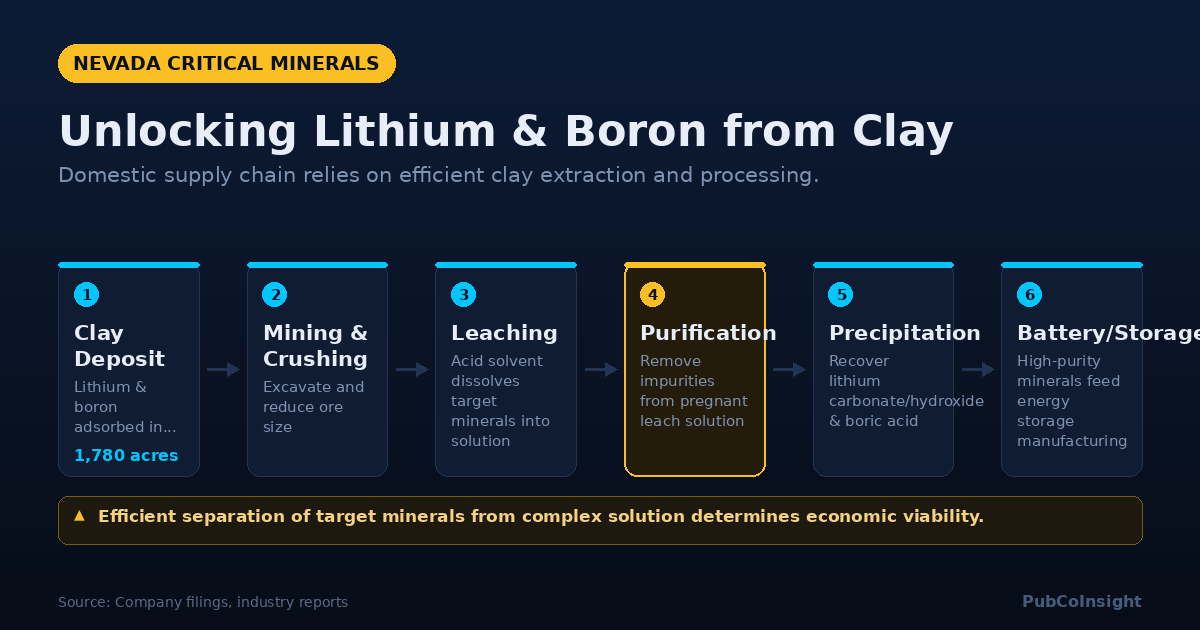
The Brine-to-Battery Pipeline
Extracting lithium and boron from brines is fundamentally different from hard rock mining. Brines are saline solutions, often found in underground aquifers or salt lakes. The process begins with pumping the brine to the surface. Next, sunlight and wind concentrate the lithium and boron through evaporation in large ponds. This solar evaporation is low-cost but slow, taking months or even years. Direct Lithium Extraction, or DLE, technologies aim to speed this up, using selective adsorbents or ion-exchange resins to pull lithium directly from the brine. DLE reduces the evaporation footprint and processing time. However, DLE systems are still evolving, and their commercial scalability and long-term operating costs are not fully proven for every brine chemistry. Once concentrated, the brine undergoes further chemical processing to precipitate lithium carbonate or lithium hydroxide. Boron, often co-present, requires its own separation and purification steps, typically involving solvent extraction or crystallization. The purity requirements for battery-grade materials are stringent. Contaminants like magnesium, calcium, and sulfates must be removed to parts-per-million levels. This refining stage is where much of the technical expertise and capital is consumed. A misstep here means a lower-grade product, or worse, material unsuitable for battery cathodes. The cost and complexity of this purification, especially for DLE systems which add another layer of chemical engineering, ultimately determine the economic viability of a brine project.Operators in the Brine Space
Several companies are navigating this complex brine-to-battery pathway. ioneer Ltd (IONR), for example, is developing its Rhyolite Ridge project in Nevada. This project is unique, targeting both lithium carbonate and boric acid from a single ore body. The co-production of boron is a key differentiator, as boron is essential for certain battery chemistries and other industrial applications. IONR aims to leverage this dual revenue stream, but faces the challenge of optimizing two distinct extraction and purification processes simultaneously. Standard Lithium Ltd. (SLI) is focused on DLE technology in Arkansas, specifically targeting lithium from brine co-produced with existing bromine operations. SLI aims to use DLE to extract lithium from the Smackover Formation brine, a strategy that could reduce upfront capital by utilizing existing infrastructure. The company continues to advance its pilot plant operations and engineering studies. Atlas Lithium Corporation (ATLX), with its Neves project in Brazil, is primarily a hard rock lithium developer, but the broader market for new lithium supply influences all players. ATLX recently advanced pre-assembly steps for its processing plant, indicating progress towards production. While not a brine player, its movement toward production adds to the global supply picture, which in turn impacts the pressure on brine projects to deliver. American Battery Technology Company (ABAT) is pursuing a multi-pronged approach, including lithium-ion battery recycling and primary lithium extraction from Nevada claystone resources. While not strictly a brine play, ABAT's focus on domestic lithium supply and advanced extraction methods highlights the broader industry push for innovative processing solutions. Critical Metals Corp. (CRML) and NioCorp Developments Ltd. (NB) are focused on other critical minerals. CRML targets minerals like antimony and tungsten, while NB is developing a niobium, scandium, and titanium project in Nebraska. These companies contribute to the broader critical minerals supply chain, but their operations do not directly address the brine lithium and boron extraction challenges. USA Rare Earth, Inc. (USAR) is focused on rare earth elements, another distinct segment of the critical minerals market.American Lithium Minerals, Inc.
American Lithium Minerals, Inc. (AMLM) is an exploration-stage company, trading over the counter. It focuses on lithium and boron properties in Nevada. The company’s current project is the Sarcobatus Lithium property, comprising 1,780 acres of mining claims in Central Nevada. AMLM’s stated business plan involves exploring these Nevada properties and expanding its exploration and acquisition for mineral properties worldwide. The company has also stated an intention to develop the use of Real World Asset Tokens to provide capital for mining. AMLM was incorporated in Nevada on March 10, 2005. Its activities since 2009 have focused on lithium exploration in Central Nevada. The company has also acquired and divested cobalt, nickel, and graphite prospects in Central Nevada, and rare earth elements projects in Kingman, Arizona and Southeast Illinois. The company has not generated significant revenues to date. Its ability to generate revenue depends on its ability to execute its business plan and expand its client base and business model. The public record does not yet establish a definitive resource estimate or preliminary economic assessment for the Sarcobatus project. AMLM qualified a Regulation A offering on Form 1-A on February 4, 2026. This offering covers up to 80,000,000 units, with up to 120,000,000 shares issuable if attached warrants are fully exercised. The minimum purchase requirement for investors in this offering is $1,000, though the company can waive this minimum. AMLM intends to trademark future product or service names and its company logo.What to watch
Several concrete developments will shape the brine and critical minerals sector. Watch for permitting decisions on major projects, particularly in Nevada, which could unlock significant domestic supply. Environmental impact assessments and water rights are often key hurdles. Offtake agreements and strategic partnerships with battery manufacturers or automotive OEMs will signal market validation and de-risk projects. These deals often include financing components. Updated resource estimates and preliminary economic assessments, especially for exploration-stage companies, will provide critical data points on project viability. For DLE technologies, look for sustained, commercial-scale operating data that demonstrates consistent recovery rates and purity. Finally, government funding announcements and policy shifts, such as those related to the Inflation Reduction Act, will continue to influence project timelines and economics., { "label": "Extraction", "note": "Pumping brine, then solar evaporation or Direct Lithium Extraction (DLE).", "metric": "DLE Pilot Plants" }, { "label": "Concentration", "note": "Increasing lithium/boron content in the brine.", "metric": "Months to Years" }, { "label": "Purification", "note": "Removing contaminants to achieve battery-grade purity.", "metric": "PPM Purity" }, { "label": "Material Output", "note": "Lithium carbonate/hydroxide, boric acid for batteries." } ], "highlight": 3, "highlight_note": "Achieving battery-grade purity is capital-intensive and technically challenging. This stage determines viability.", "footnote": "PubCo Insight Analysis, Company Filings" }Companies mentioned
| Ticker | Company | Price |
|---|---|---|
| ABAT | American Battery Technology Company | $1.48 |
| AMLM client | American Lithium Minerals, Inc. | $0.0599 |
| ATLX | Atlas Lithium Corporation | $2.26 |
| CRML | Critical Metals Corp. | $6.97 |
| IONR | ioneer Ltd | $2.76 |
| NB | NioCorp Developments Ltd. | $3.125 |
| SLI | Standard Lithium Ltd. | $1.45 |
| USAR | USA Rare Earth, Inc. | $10.54 |
Listed alphabetically, not ranked. Prices as of 2026-10-19 and they move. Check a live quote before relying on any of this.
How we chose the companies in this article
We cover a fixed universe of companies working in lithium, boron and the critical minerals that feed battery and energy-storage supply chains. Every one of them that had usable market data on 2026-10-19 appears in this article. We do not pick which ones to mention based on what we think of them, and we do not order them by size, price or trading volume, because an ordered list is a verdict and that is not ours to hand down. Companies left out, and why: none. American Lithium Minerals and Artificial Intelligence Technology Solutions pay us, which is disclosed in full at the foot of every article they appear in.
See the dilution and promotion flags before you see the pitch.
Each week: the micro and small-caps now showing dilution or paid-promotion signals, with the SEC filing behind every flag. No recommendations, no price targets.
Sources used in this article
- Albemarle has surprising new reason to rally TheStreet · 2026-10-19
- Top 3 Canadian Lithium Stocks To Watch In October 2026 Simply Wall St. · 2026-10-17
- MP Materials vs. USA Rare Earth: Which Rare Earth Stock Is the Better Buy? Motley Fool · 2026-10-17
- Albemarle (ALB) Sees a More Significant Dip Than Broader Market: Some Facts to Know Zacks · 2026-10-16
- Rocket Thrusters on a Road Car Arrive as EV Makers Split Into Winners and Laggards CNW Group · 2026-10-16
- What US Small Cap Value Portfolio ETF (DFSV) Bought: Dick's Leads on Wednesday GuruFocus.com · 2026-10-16
- 2 Best Tire Stocks to Own as Premium Makers Navigate Inflation Risks Investing.com · 2026-10-16
- U.S. Targeted Value Portfolio ETF (DFAT) Adds GameStop and Dick's on Oct. 13 GuruFocus.com · 2026-10-15
- RBC Cuts Price Target on Albemarle to $129 From $157, Keeps Outperform Rating MT Newswires · 2026-10-15
- Lithium Americas Shares Rise After Canaccord Genuity Upgrade MT Newswires · 2026-10-15
- Canaccord Genuity Upgrades Lithium Americas to Speculative Buy From Hold MT Newswires · 2026-10-15
- Why Pirelli & C (BIT:PIRC) Is Getting Attention Today Simply Wall St. · 2026-10-15
Disclosure required by Section 17(b) of the Securities Act of 1933
American Lithium Minerals, Inc.. American Lithium Minerals, Inc. (issuer) paid Strategic Innovations First, Inc., an affiliate of PubCo Insight and Pulse IR. Compensation received: USD 11,550.00 total, three equal monthly installments of USD 3,850.00. Form of payment: cash only; no stock, options or warrants. Services: investor relations, marketing and content creation under Master Services Agreement dated June 22, 2026. Period: three month initial term, June 2026 through August 2026. No position, options or warrants held by PubCo Insight, Pulse IR, Strategic Innovations First, Inc., or Brad Listermann.
This is information, not investment, financial, legal or tax advice. It is not a recommendation or solicitation to buy, sell or hold any security and it contains no price target. Nothing here is independently verified by us. Confirm every figure against primary filings on SEC EDGAR before you act. Micro-cap and over-the-counter securities are speculative and illiquid and can lose all of their value. The companies named without a disclosure above pay us nothing and have no relationship with us; they are named because a published, mechanical screen selected them. Full disclosure policy.