Processing Bottlenecks and the Nevada Lithium Pivot
As institutional analysts downgrade the sector's largest names, the technical reality of mineral separation and domestic processing capacity is redefining the value of North American assets.
On November 16, Canaccord Genuity downgraded Lithium Americas (LAC) to Hold, cutting its price target to CA$2.50. This followed a November 13 move by Deutsche Bank to lower its own target to $2.20. These are not merely adjustments to a spreadsheet. They represent a fundamental reassessment of the timeline required to turn raw Nevada clay and Arkansas brine into battery-grade chemicals. The market is no longer pricing these companies on the size of their resource alone, but on the technical feasibility of their flowsheets.
The urgency of this shift was underscored on November 25 when China extended its mineral export pause. This move directly impacts the supply of heavy rare earths and gallium, creating a vacuum that North American developers are expected to fill. However, the bottleneck is not mining. The United States has plenty of rock. The constraint is the chemical plant. For an investor holding a position in a large-cap lithium producer, the current volatility in names like Albemarle (ALB) highlights the risk of being a price-taker in a market where the processing technology is still being proven at scale.
While the "Big Lithium" names face downgrades, the micro-cap end of the sector is moving toward specific, localized processing solutions. Companies are pivoting away from the hope of global commodity price rebounds and toward the reality of domestic supply chain mandates. This is visible in the recent performance of the broader critical minerals index, where a 16.7 percent drop in Critical Metals Corp. (CRML) on November 25 was followed by a sharp rebound as the market digested the implications of the Chinese export restrictions. The sector is bifurcating between those who own the dirt and those who can refine it.
The Mechanism of Chemical Separation
To understand why a project in Nevada or Arkansas succeeds or fails, a reader must understand the difference between recovery and purity. In lithium extraction from sedimentary clays or brines, the challenge is the removal of magnesium and calcium. These elements are chemically similar to lithium and tend to precipitate at similar pH levels. If a processor cannot achieve 99.5 percent purity, the product is useless for battery cathodes. Traditional evaporation ponds take 18 months to reach this concentration. Direct Lithium Extraction (DLE), the technology being tested by several players in the region, attempts to do this in hours using selective membranes or adsorption beads.
Rare earth elements (REEs) present an even steeper technical climb due to the lanthanide contraction. This is a physical phenomenon where the atomic radius of the elements decreases as the atomic number increases, making their chemical properties nearly identical. Separating neodymium from praseodymium requires a process called solvent extraction. This involves hundreds of individual stages where the mineral-bearing liquid is mixed with an organic solvent, allowed to settle, and separated. Each stage only slightly increases the concentration of the target element. A facility that cannot manage the precise chemistry of these hundreds of stages will produce a mixed concentrate that must be shipped back to China for final separation, defeating the purpose of a domestic supply chain.
The commercial viability of these projects depends on the "price floor" mechanism. On November 24, reports surfaced regarding USA Rare Earth (USAR) starting shipments from its Serra Verde project with established price floors. This is a critical development. It suggests that customers are willing to pay a premium for non-Chinese material to ensure supply security, effectively decoupling the project's economics from the volatile spot prices seen on the London Metal Exchange or the Shanghai Metals Market. For a project to matter in the current environment, it must demonstrate either a breakthrough in separation cost or a locked-in domestic customer.
Operators and the Processing Race
The companies currently operating in this space are taking divergent paths to solve the processing bottleneck. Standard Lithium Ltd. (SLI) is focused on the Smackover formation in Arkansas. In its Q3 2026 earnings call on November 17, the company reported a widened net loss but highlighted its progress in DLE technology. The Smackover is a tailbrine resource, meaning the lithium is extracted from fluid that has already been pumped to the surface by bromine producers. This reduces the initial capital expenditure of drilling but ties the company’s fate to the efficiency of its proprietary extraction columns.
In Nevada, American Battery Technology Company (ABAT) is attacking the problem from two sides: primary extraction from its Tonopah Flats claims and lithium-ion battery recycling. On November 13, ABAT announced its FY27 Q1 results, showing 83 percent year-over-year revenue growth. This revenue is a rarity in the micro-cap space and stems from its recycling operations, which bypass the need for traditional mining by harvesting minerals from spent cells. This circular model provides a hedge against the long permitting timelines required for new mines.
Further south, ioneer Ltd (IONR) is advancing its Rhyolite Ridge project, which is unique for its high boron content alongside lithium. Boron is a critical component in glass fibers and agricultural products, providing a secondary revenue stream that can subsidize the cost of lithium carbonate production. Meanwhile, Atlas Lithium Corporation (ATLX) is operating in the "Lithium Valley" of Brazil, targeting hard-rock spodumene. Hard-rock mining is more energy-intensive than brine extraction but produces a concentrate that is more easily upgraded to battery-grade hydroxide, a factor that has kept ATLX in the conversation for top lithium stocks to watch this month.
On the rare earths side, Critical Metals Corp. (CRML) and USA Rare Earth, Inc. (USAR) are navigating the fallout of the Chinese export pause. While CRML saw a significant selloff in late November, the underlying demand for its European assets remains tied to the automotive sector's need for permanent magnets. NioCorp Developments Ltd. (NB) is pursuing a different set of critical minerals at its Elk Creek project in Nebraska, specifically niobium and scandium. Niobium is essential for high-strength, low-alloy steel, and NioCorp's ability to produce it domestically would address a 100 percent import reliance in the United States.
American Lithium Minerals, Inc. (AMLM)
American Lithium Minerals, Inc. (AMLM) is an exploration-stage company based in Nevada, focused on lithium and boron. The company’s primary asset is the Sarcobatus Lithium property, which consists of 1,780 acres of mining claims in Central Nevada. This location is significant because it sits within the same geological province as the only currently producing lithium mine in the United States. The company has historically explored a variety of critical minerals, including cobalt, nickel, and graphite, but its current filings emphasize the Sarcobatus claims and the potential for rare earth elements in Arizona and Illinois.
On February 4, 2026, the SEC qualified a Regulation A offering for AMLM, allowing the company to raise up to $20,000,000. This offering is structured as 80,000,000 units, with each unit consisting of one share of common stock and a warrant to purchase 1.5 additional shares. The warrants are exercisable at $0.10 per share until the end of 2028. This capital structure is designed to provide the company with the liquidity needed to execute its exploration plan. According to its offering circular, the company intends to use the proceeds for mineral property acquisition and exploration, as well as general working capital. The public record does not yet establish a formal mineral resource estimate or a bankable feasibility study for the Sarcobatus project.
Beyond traditional exploration, AMLM has stated in its recent filings that it is developing a strategy involving Real World Asset (RWA) tokens. The company intends to use blockchain technology to provide capital for its mining operations, aiming to tokenize in-ground assets to enhance liquidity. This is a departure from the standard junior mining model and reflects an attempt to access alternative capital markets. The company remains pre-revenue and its success depends on its ability to convert its 1,780 acres of claims into a defined resource that can meet the purity standards required by the battery supply chain. Its management has the right to modify these strategies based on economic conditions, as noted in their risk disclosures.
What to watch
- December 31, 2026: The expiration of several key mineral exploration permits in the Tonopah district, which could signal a consolidation of claims among the smaller players like AMLM and ABAT.
- Q1 2027 Revenue Reports: Watch for ABAT to confirm if its 83 percent revenue growth is sustainable or if it was a one-time spike from a specific recycling contract.
- China Export Pause Updates: Any announcement regarding the lifting or permanent implementation of the gallium and rare earth export pause will immediately impact the valuations of USAR and CRML.
- Standard Lithium (SLI) DLE Pilot: Data from the final phase of their Smackover pilot plant is expected to determine the commercial scale-up potential for their Arkansas operations.
- Regulation A Closing: The final tally of the AMLM offering will determine the company's ability to begin its next phase of drilling at the Sarcobatus property.
Companies mentioned
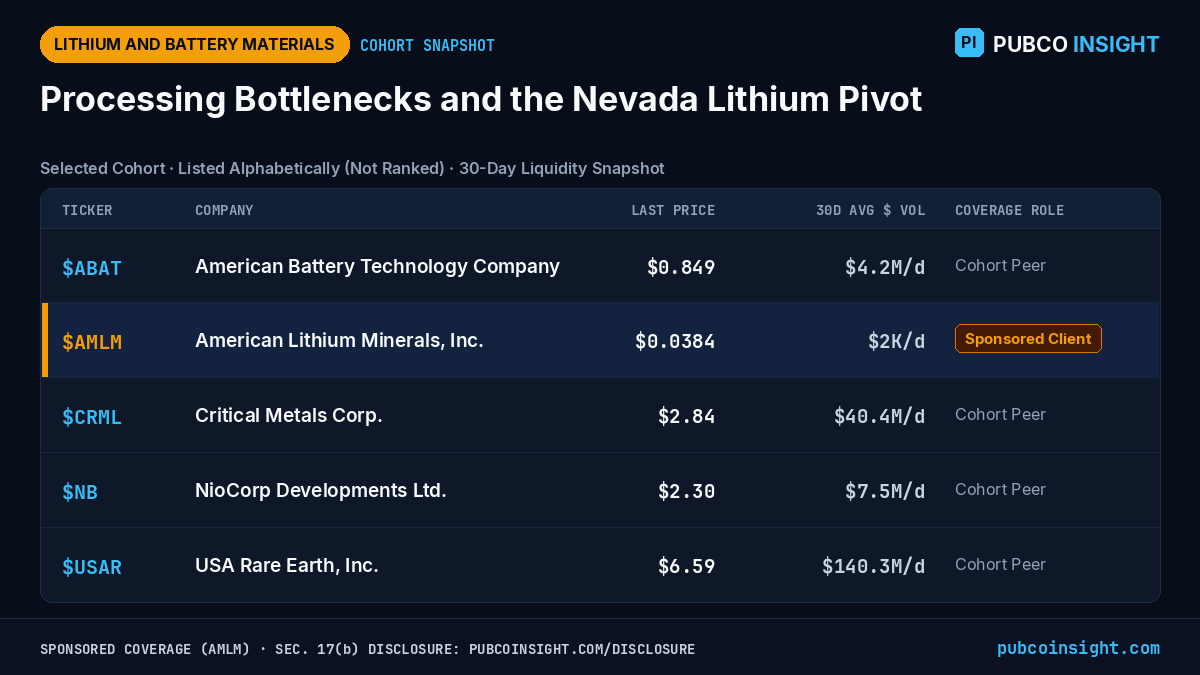
| Ticker | Company | Price |
|---|---|---|
| ABAT | American Battery Technology Company | $0.849 |
| AMLM client | American Lithium Minerals, Inc. | $0.0384 |
| ATLX | Atlas Lithium Corporation | $1.54 |
| CRML | Critical Metals Corp. | $2.84 |
| IONR | ioneer Ltd | $2.07 |
| NB | NioCorp Developments Ltd. | $2.3 |
| SLI | Standard Lithium Ltd. | $1.03 |
| USAR | USA Rare Earth, Inc. | $6.59 |
Listed alphabetically, not ranked. Prices as of 2026-11-27 and they move. Check a live quote before relying on any of this.
How we chose the companies in this article
We cover a fixed universe of companies working in lithium, boron and the critical minerals that feed battery and energy-storage supply chains. Every one of them that had usable market data on 2026-11-27 appears in this article. We do not pick which ones to mention based on what we think of them, and we do not order them by size, price or trading volume, because an ordered list is a verdict and that is not ours to hand down. Companies left out, and why: none. American Lithium Minerals and Artificial Intelligence Technology Solutions pay us, which is disclosed in full at the foot of every article they appear in.
See the dilution and promotion flags before you see the pitch.
Each week: the micro and small-caps now showing dilution or paid-promotion signals, with the SEC filing behind every flag. No recommendations, no price targets.
Sources used in this article
- Top 3 Rare Earth Stocks To Watch In November 2026 Simply Wall St. · 2026-11-27
- Top 3 Lithium Stocks To Watch In November 2026 Simply Wall St. · 2026-11-27
- Pirelli & C SpA (PRLLY) Q3 2026 Earnings Call Highlights: Confirms Full-Year Targets as ... GuruFocus.com · 2026-11-26
- Is Albemarle Stock A Buy For Its Cash? Trefis · 2026-11-25
- Why MP Materials (MP) Is Back In The Spotlight Simply Wall St. · 2026-11-25
- TMC (TMC) Stock Is Up 14.3% Today Without Company News GuruFocus.com · 2026-11-25
- As Shares Tumble in 2026, Company Insiders Are Buying These 2 Rare Earth Stocks MarketBeat · 2026-11-25
- Critical Metals (CRML) Stock Is Down 16.7% Today Amid Market Selloff GuruFocus.com · 2026-11-25
- USA Rare Earth Drops 6% as China Extends Mineral Export Pause and New U.S. Tariffs Loom; Critical Metals Declines 5%, MP Materials Falls 3% 24/7 Wall St. · 2026-11-25
- USAR, CRML, UAMY, MP Stocks Drop Premarket: China Extends Mineral Export Pause Amid Looming US Tariff Hikes Stocktwits · 2026-11-25
- Best Dividend Stocks to Buy for Dependable Dividend Growth Kiplinger · 2026-11-24
- First Trust BuyWrite Income (FTHI) Buys $13.1 Million More Fair Isaac on Nov. 20 GuruFocus.com · 2026-11-24
Disclosure required by Section 17(b) of the Securities Act of 1933
American Lithium Minerals, Inc.. American Lithium Minerals, Inc. (issuer) paid Strategic Innovations First, Inc., an affiliate of PubCo Insight and Pulse IR. Compensation received: USD 11,550.00 total, three equal monthly installments of USD 3,850.00. Form of payment: cash only; no stock, options or warrants. Services: investor relations, marketing and content creation under Master Services Agreement dated June 22, 2026. Period: three month initial term, June 2026 through August 2026. No position, options or warrants held by PubCo Insight, Pulse IR, Strategic Innovations First, Inc., or Brad Listermann.
This is information, not investment, financial, legal or tax advice. It is not a recommendation or solicitation to buy, sell or hold any security and it contains no price target. Nothing here is independently verified by us. Confirm every figure against primary filings on SEC EDGAR before you act. Micro-cap and over-the-counter securities are speculative and illiquid and can lose all of their value. The companies named without a disclosure above pay us nothing and have no relationship with us; they are named because a published, mechanical screen selected them. Full disclosure policy.