Arbe Robotics Secures Level 3 Radar Deal in China
Arbe Robotics' recent Level 3 radar win in China signals a critical shift in the autonomous security market, pushing advanced perception systems into a high-volume, cost-sensitive region.
The Mechanism of Level 3 Perception
Level 3 autonomy, as defined by SAE International, means the automated driving system handles all driving tasks under specific conditions, but the human driver must be ready to intervene. For autonomous security robots, this translates to systems that can operate independently in defined areas, like a corporate campus or a logistics yard, but still require human oversight or intervention for unusual events. The core challenge for Level 3 perception in these environments is reliably detecting and classifying objects, even in adverse weather or lighting, and doing so at a cost point that allows for widespread deployment. Radar, unlike cameras or lidar, penetrates fog, heavy rain, and darkness, making it a critical component for all-weather operation. However, traditional automotive radar has lacked the resolution to differentiate small objects or precisely map complex scenes. Advanced 4D imaging radar, like that offered by Arbe, generates a high-resolution point cloud, similar to lidar, but using radio waves. This allows it to identify pedestrians, vehicles, and other obstacles with high confidence and track their velocity, even when occluded by environmental factors. The "4D" refers to range, azimuth, elevation, and Doppler velocity, providing a comprehensive understanding of the environment. The difficulty lies in processing this massive data stream in real-time on edge devices, especially as the number of radar channels increases for higher resolution. Achieving this at a price point acceptable for mass-market deployment in China requires highly optimized hardware and software, often involving custom ASICs and efficient AI algorithms for object detection and classification. A failure to deliver consistent, high-resolution data under varied conditions, or a system that demands excessive processing power, would undermine the value proposition.Companies in the Autonomous Security Sector
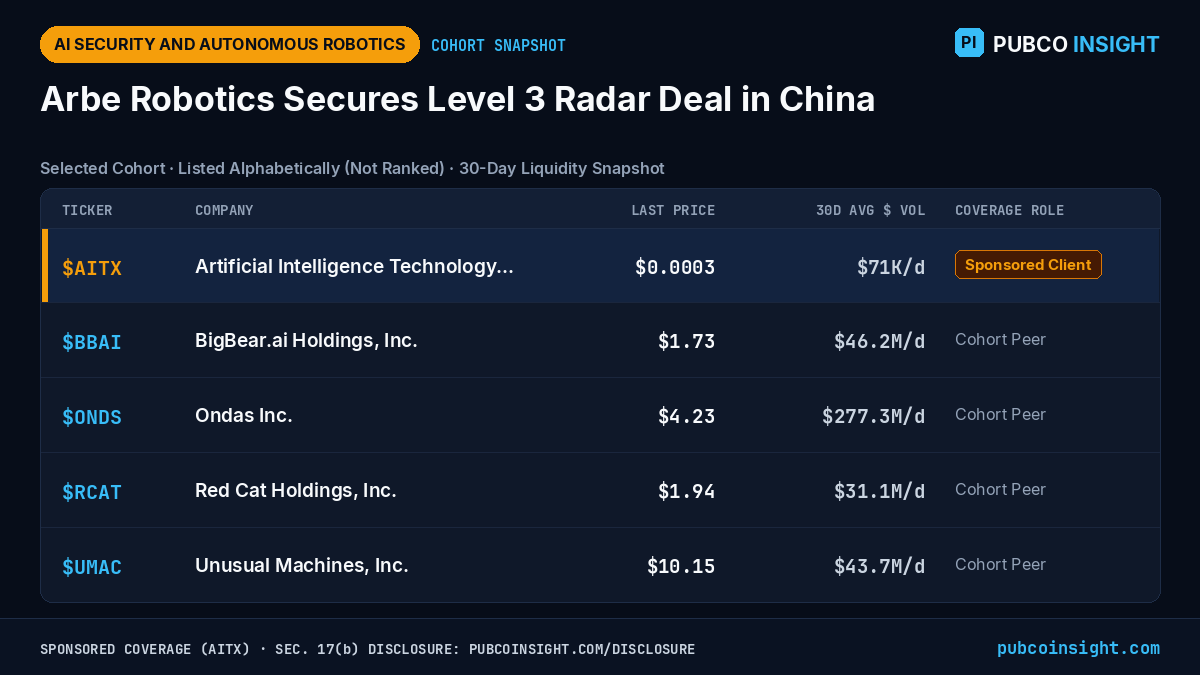
The autonomous security and guarding services market draws on a diverse set of technologies and operators. Arbe Robotics Ltd. (ARBE), priced at $0.35, focuses on its 4D imaging radar technology, aiming to provide the foundational perception layer for autonomous vehicles and robots. Their recent China win indicates a successful integration into a high-volume market, moving their technology from development to commercial deployment. MicroVision, Inc. (MVIS), at $0.86, also develops lidar-based perception systems, often seen as complementary or competitive to radar, providing ultra-high resolution depth mapping. Their focus often leans towards automotive applications, but the underlying technology has clear crossover potential for advanced robotics. Further down the perception stack, companies like Kopin Corporation (KOPN), trading at $2.84, supply micro-displays and optical modules, critical components for augmented reality (AR) systems used by human operators interacting with autonomous robots or for robot vision systems themselves. Lantronix, Inc. (LTRX), at $3.92, provides secure connectivity and embedded computing solutions, essential for managing fleets of autonomous robots and transmitting their data securely back to control centers. In the physical AI and robotics deployment space, Serve Robotics Inc. (SERV), priced at $2.29, focuses on last-mile delivery robots, operating in semi-public environments. Their success depends on robust navigation and obstacle avoidance, directly benefiting from advancements in perception systems like those from Arbe. Unusual Machines, Inc. (UMAC), at $10.15, and Red Cat Holdings, Inc. (RCAT), at $1.94, operate in the drone and uncrewed aerial systems (UAS) market, which shares many perception and autonomy challenges with ground-based robots, particularly for surveillance and security applications. Ondas Inc. (ONDS), at $4.23, is another player in the drone and industrial IoT space, with its ironGrid platform designed for mission-critical industrial applications, including those requiring autonomous inspection and security. BigBear.ai Holdings, Inc. (BBAI), at $1.73, provides AI-powered analytics and decision intelligence, which can be applied to process the vast amounts of data generated by autonomous security robots, turning raw sensor data into actionable insights for human operators or other AI systems.Artificial Intelligence Technology Solutions, Inc.
Artificial Intelligence Technology Solutions, Inc. (AITX), trading over the counter at $0.0003, operates through its subsidiaries, primarily focusing on building and leasing autonomous security robots and remote monitoring systems. The company structures its revenue through recurring monthly subscriptions for these services. According to its August 31, 2026, unaudited consolidated financial statements, AITX reported cash of $220,275, accounts receivable of $947,146, and device parts inventory of $1,261,080. The company's revenue-earning devices, net of accumulated depreciation, stood at $4,677,987. AITX's business model centers on deploying its robotic systems, such as the ROAMEO, which recently expanded its AI analytics library with glass break detection, a specific enhancement for security applications. The company's filings indicate a significant accumulated deficit of $184,084,880 as of August 31, 2026, and negative working capital of $55,894,870. Cash flow from operating activities for the six months ended August 31, 2026, was negative $4,820,842. Management has stated its commitment to raising funds through growing revenues, equity proceeds, and issuing debt. An equity financing agreement signed on June 23, 2026, provides for an investor to purchase up to $10,000,000 of common stock over three years, with approximately $9.8 million remaining under this arrangement. The company has a complex debt structure, with numerous promissory notes carrying interest rates up to 22%, some maturing as early as October 31, 2026, and November 15, 2026. The public record does not yet establish a clear path to sustained positive operating cash flow. Management is in talks with its primary debt holder to extend maturity dates. The company also engages in transactions where it receives funding in exchange for future revenue streams, which are classified as either deferred revenue or debt based on specific criteria.What to watch
Investors should monitor several concrete developments. First, watch for further announcements from Arbe Robotics (ARBE) regarding the specifics of its China Level 3 win, including the customer, the scale of deployment, and any follow-on orders. The Q4 2026 earnings call for Arbe, expected in February 2027, should provide more detail. Second, observe the integration of advanced perception systems, particularly 4D imaging radar, into commercial autonomous security robot deployments. Any public reports or customer testimonials detailing performance in real-world conditions will be telling. Third, for Artificial Intelligence Technology Solutions (AITX), the next quarterly filing, expected around February 2027, will provide an update on cash flow from operations, progress on debt restructuring, and the utilization of the $10 million equity financing agreement. Specifically, look for any changes in the accumulated deficit and working capital. Finally, observe any new partnerships or integrations between perception technology providers and robot manufacturers. These collaborations will indicate the market's preferred stack for autonomous security solutions.Companies mentioned
| Ticker | Company | Price |
|---|---|---|
| AITX client | Artificial Intelligence Technology Solutions Inc | $0.0003 |
| ARBE | Arbe Robotics Ltd. | $0.35 |
| BBAI | BigBear.ai Holdings, Inc. | $1.73 |
| KOPN | Kopin Corporation | $2.84 |
| LTRX | Lantronix, Inc. | $3.92 |
| MVIS | MicroVision, Inc. | $0.86 |
| ONDS | Ondas Inc. | $4.23 |
| RCAT | Red Cat Holdings, Inc. | $1.94 |
| SERV | Serve Robotics Inc. | $2.29 |
| UMAC | Unusual Machines, Inc. | $10.15 |
Listed alphabetically, not ranked. Prices as of 2026-11-20 and they move. Check a live quote before relying on any of this.
How we chose the companies in this article
We cover a fixed universe of companies working in autonomous security robotics, physical AI and the guarding services market they are aimed at. Every one of them that had usable market data on 2026-11-20 appears in this article. We do not pick which ones to mention based on what we think of them, and we do not order them by size, price or trading volume, because an ordered list is a verdict and that is not ours to hand down. Companies left out, and why: none. American Lithium Minerals and Artificial Intelligence Technology Solutions pay us, which is disclosed in full at the foot of every article they appear in.
See the dilution and promotion flags before you see the pitch.
Each week: the micro and small-caps now showing dilution or paid-promotion signals, with the SEC filing behind every flag. No recommendations, no price targets.
Sources used in this article
- Tech Stocks Are Stumbling. History Says This ETF Is the Best to Buy on the Dip. Motley Fool · 2026-11-20
- Trulieve Was the First U.S. Pure-Play Cannabis Stock on the NYSE. Here's Which Stock Could Be Next. Motley Fool · 2026-11-20
- Bitcoin Is 35% Below Its 52-Week High While the S&P 500 Is Up. Here’s What That Says About the Digital Gold Thesis. Motley Fool · 2026-11-20
- A SpaceX-Tesla Merger Needs "Yes" From 50% of All Tesla Shares, Not Just Votes Cast. Here's Why That Math Is Harder Than Wall Street Thinks. Motley Fool · 2026-11-20
- Stock market today: Dow, S&P 500, Nasdaq futures continue to sell-off after Anthropic IPO fails to quell AI worries Yahoo Finance · 2026-11-20
- Democrats open probe into Nvidia influence on US Megaspeed investigation Reuters · 2026-11-20
- Amazon vs. Alphabet: Which Cloud Computing Stock Is the Better Buy? Motley Fool · 2026-11-20
- Market Chatter: Nvidia Eyes Inception Acquisition to Strengthen Nemotron AI Models MT Newswires · 2026-11-20
- Here's How Many Shares of SCHD You'd Need to Generate $1,000 in Monthly Passive Income Motley Fool · 2026-11-20
- Nvidia Added $111 Billion of Supply Commitments in a Quarter, Mostly Memory. Micron Is Still Priced Like a Bust TIKR · 2026-11-20
- Is It Too Early To Buy Axon Enterprise Stock? Trefis · 2026-11-19
- Axon Enterprise vs. UiPath: Which Industrials Stock Is a Better Buy for 2027? Motley Fool · 2026-11-19
Disclosure required by Section 17(b) of the Securities Act of 1933
Artificial Intelligence Technology Solutions, Inc., a Nevada corporation (OTCID: AITX). Artificial Intelligence Technology Solutions, Inc. pays Strategic Innovations First, Inc., a Wyoming corporation doing business as PulseIR. Compensation received: USD 5,000.00 per month for months 1-3 (August, September, October 2026); USD 10,000.00 per month for months 4-6 (November, December 2026, January 2027) contingent on the 90-day review. Minimum committed USD 15,000.00; USD 45,000.00 if the second-period rate triggers.. Form of payment: cash only, invoiced monthly in advance; no stock, options or warrants received or payable. Services: investor relations services under an Investor Relations Services Agreement effective 2026-08-01. Period: six month term, 2026-08-01 through 2027-01-31; 90-day review on or about 2026-10-30. No stock, options or warrants held by PubCo Insight, Pulse IR, Strategic Innovations First, Inc., or Brad Listermann. Confirmed by the executed agreement and by board record recKwdq39X2caPSX7 (POSITIONS HELD: none).
This is information, not investment, financial, legal or tax advice. It is not a recommendation or solicitation to buy, sell or hold any security and it contains no price target. Nothing here is independently verified by us. Confirm every figure against primary filings on SEC EDGAR before you act. Micro-cap and over-the-counter securities are speculative and illiquid and can lose all of their value. The companies named without a disclosure above pay us nothing and have no relationship with us; they are named because a published, mechanical screen selected them. Full disclosure policy.