Autonomous Security Robotics Shift to Mobile Platforms: AITX Rebrands RAD-M as PURSUON
The autonomous security robotics sector is prioritizing mobile platforms, exemplified by AITX's strategic rebranding of RAD-M to PURSUON and its stated goal of 50 units by August 2027, signaling a push for broader deployment of roaming AI security.
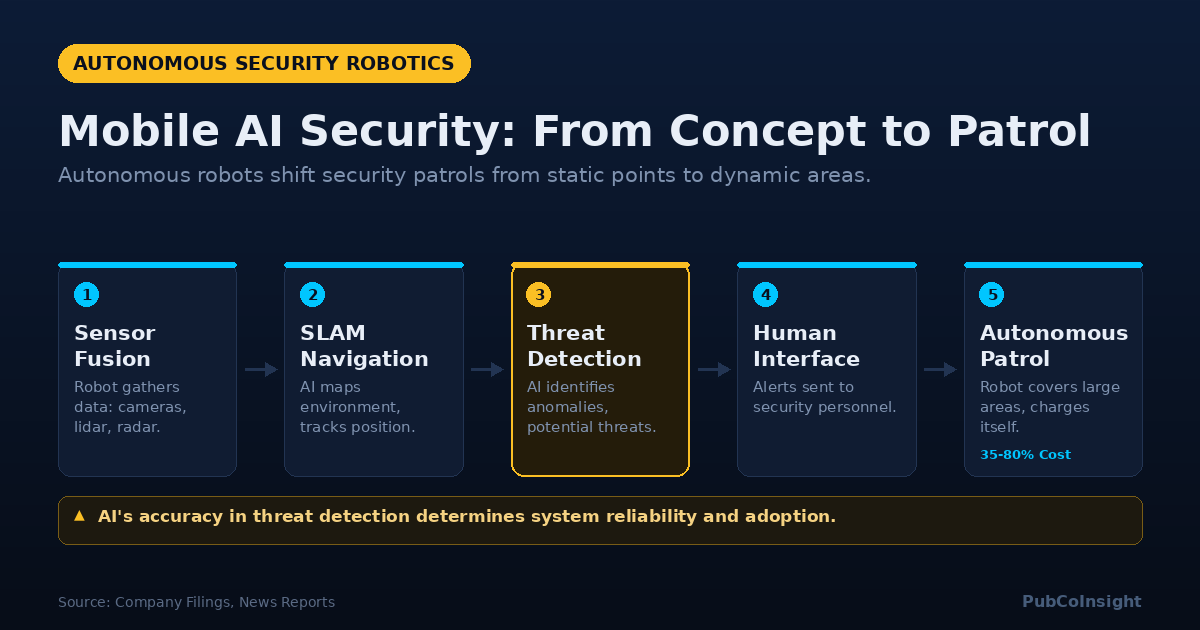
The Mechanism of Mobile Autonomous Security
Mobile autonomous security systems operate by deploying robots equipped with a suite of sensors, cameras, and AI-driven analytics to patrol designated areas. These robots, like AITX’s PURSUON, navigate autonomously, detecting anomalies, identifying intruders, and often communicating with human security personnel or a central monitoring station. The core mechanism relies on sophisticated simultaneous localization and mapping (SLAM) algorithms, which allow the robot to build a map of its environment while simultaneously tracking its own position within that map. This is crucial for navigating complex, outdoor environments where GPS signals can be intermittent or imprecise. For these systems to be effective, several conditions must hold true. First, the AI must accurately differentiate between routine activity and genuine threats, minimizing false positives that can burden human operators. This requires robust machine learning models trained on diverse datasets. Second, the robot's physical design needs to withstand various environmental conditions, from weather to potential tampering. Third, battery life and autonomous charging capabilities are critical for continuous operation without human intervention. Finally, seamless integration with existing security infrastructure, such as access control systems and alarm networks, determines the system’s overall utility. Failure in any of these areas, particularly high false alarm rates or unreliable navigation, can quickly undermine the cost-saving benefits and lead to user dissatisfaction, proving the technology unsuitable for real-world deployment. The bottleneck often sits in the AI's ability to interpret complex, unstructured data streams in real-time, making accurate threat assessment the true differentiator.Companies Operating in Autonomous Security Robotics
The small and micro-cap space for autonomous security robotics and physical AI is populated by companies pursuing various niches within the larger security market. Some focus on the hardware itself, others on the AI and software, and some integrate both into a "solutions-as-a-service" model. Arbe Robotics Ltd. (ARBE) focuses on high-resolution 4D imaging radar technology, primarily for automotive applications, but its sensor capabilities are relevant for autonomous navigation in security robots. Their radar systems offer perception in adverse weather conditions, a critical component for outdoor mobile platforms. Kopin Corporation (KOPN) develops micro-displays and optical components, which are essential for advanced sensor arrays and augmented reality interfaces that could be integrated into sophisticated security robots for enhanced situational awareness. Lantronix, Inc. (LTRX) provides secure data access and management solutions, which are vital for the remote operation and data collection of autonomous security devices. Their focus on IoT connectivity and edge computing supports the infrastructure needed for these robots to communicate and process information efficiently. MicroVision, Inc. (MVIS) develops lidar technology, another key sensor type for autonomous navigation and object detection, offering precision mapping and obstacle avoidance capabilities for mobile platforms. In the drone sector, which shares many technological underpinnings with ground-based autonomous robotics, Ondas Inc. (ONDS) and Red Cat Holdings, Inc. (RCAT) are active. Ondas focuses on critical infrastructure networks and drone solutions, while Red Cat develops drone hardware and software, including systems for defense and public safety. Unusual Machines, Inc. (UMAC) also operates in the drone space, recently making headlines for its NDAA-compliant expansion and focus on U.S. drone component output, signaling a push for domestic manufacturing. Serve Robotics Inc. (SERV) is primarily focused on sidewalk delivery robots, but its expertise in autonomous navigation, fleet management, and urban deployment is transferable to the security sector, particularly for patrolling urban campuses or large commercial properties. BigBear.ai Holdings, Inc. (BBAI) provides AI-powered analytics and decision intelligence, which can be applied to process the vast amounts of data collected by autonomous security robots, turning raw sensor input into actionable intelligence for security personnel. Axon Enterprise (AXON), a larger player not strictly micro-cap, is known for its body cameras and Taser devices, but has been expanding into drone technology and AI-powered evidence management, showing the convergence of various security technologies. ADT (ADT), another larger entity, provides traditional security monitoring services, representing the established market that autonomous solutions aim to disrupt or augment.Artificial Intelligence Technology Solutions, Inc.
Artificial Intelligence Technology Solutions, Inc. (AITX), trading as AITX on the OTCID, is a developer and operator of AI-driven security and productivity solutions. The company operates through several subsidiaries, including Robotic Assistance Devices, Inc. (RAD-I), focused on stationary security devices, and Robotic Assistance Devices Mobile (RAD-M), now rebranded as PURSUON, which handles mobile autonomous platforms like the ROAMEO unit. The company also includes Robotic Assistance Devices Group (RAD-G) for its SARA agentic artificial intelligence platform and Robotic Assistance Devices Lanka (Private) Limited (RAD Lanka) for software development and AI initiatives. AITX employs a "Solutions-as-a-Service" model, offering its AI-driven security robots and remote monitoring systems on a recurring monthly subscription basis. This contrasts with a one-off hardware sale model. The company's solutions are designed to deliver cost savings, estimated between 35% and 80%, compared to traditional manned security and monitoring. Its recent S-1 filing, dated July 17, 2026, outlines its strategy across these three principal pillars: stationary security devices, mobile autonomous platforms, and the SARA AI platform. The filing reported revenue of $7,745,336 for the fiscal year ended February 28, 2026, a 26% increase over the prior year, with gross profit rising 48% to $5,533,700 and gross margin expanding to approximately 71%. Operating expenses remained flat at around $17,477,097, leading to an improved loss from operations of $(11,943,397). The company reported a net loss of approximately $14.5 million for the fiscal year ended February 28, 2026, with an accumulated deficit of approximately $171 million and negative working capital of $17,017,745 as of that date. The public record does not yet establish a clear path to sustained positive cash flow from operations for AITX. The company states its RAD-I segment's recurring revenue and gross margin could, on a standalone basis, support positive cash flow operations, and that RAD-M (PURSUON) is expected to surpass RAD-I's monthly recurring revenue contribution at some future point. Early commercial deployment of the ROAMEO mobile security unit began in May 2026. The company’s stated goal is to produce 50 PURSUON units by August 2027, supported by a growing deployment pipeline for ROAMEO.What to watch
Investors in this sector should monitor several concrete developments. For AITX, the key will be the actual deployment numbers for PURSUON and ROAMEO units. The stated goal of 50 units by August 2027 provides a clear metric. Look for subsequent 8-K filings detailing new deployments or progress towards this production target. Specifically, watch for announcements of new customer contracts and the locations of these deployments. Beyond AITX, observe the broader market's acceptance of autonomous mobile security solutions. This includes contract awards from large enterprises or government entities to any of the companies mentioned, as well as pilot program outcomes. For companies like Ondas (ONDS) and Unusual Machines (UMAC), watch for specific defense contracts or expansions in their manufacturing capabilities, especially regarding NDAA compliance. For Serve Robotics (SERV), monitor their expansion into new urban areas or partnerships that could leverage their autonomous navigation technology beyond delivery. Finally, track any public reports on the operational efficiency and cost savings achieved by deployed autonomous security robots, as these metrics will ultimately drive broader adoption., { "label": "SLAM Navigation", "note": "AI maps environment, tracks position." }, { "label": "Threat Detection", "note": "AI identifies anomalies, potential threats." }, { "label": "Human Interface", "note": "Alerts sent to security personnel." }, { "label": "Autonomous Patrol", "note": "Robot covers large areas, charges itself.", "metric": "35-80% Cost Savings" } ], "highlight": 2, "highlight_note": "AI's accuracy in threat detection determines system reliability and adoption.", "footnote": "Source: Company Filings, News Reports" }Companies mentioned
| Ticker | Company | Price |
|---|---|---|
| AITX client | Artificial Intelligence Technology Solutions Inc | $0.0063 |
| ARBE | Arbe Robotics Ltd. | $0.6997 |
| BBAI | BigBear.ai Holdings, Inc. | $3.09 |
| KOPN | Kopin Corporation | $4.83 |
| LTRX | Lantronix, Inc. | $5.86 |
| MVIS | MicroVision, Inc. | $1.81 |
| ONDS | Ondas Inc. | $8.24 |
| RCAT | Red Cat Holdings, Inc. | $9.1 |
| SERV | Serve Robotics Inc. | $4.88 |
| UMAC | Unusual Machines, Inc. | $24.35 |
Listed alphabetically, not ranked. Prices as of 2026-08-26 and they move. Check a live quote before relying on any of this.
How we chose the companies in this article
We cover a fixed universe of companies working in autonomous security robotics, physical AI and the guarding services market they are aimed at. Every one of them that had usable market data on 2026-08-26 appears in this article. We do not pick which ones to mention based on what we think of them, and we do not order them by size, price or trading volume, because an ordered list is a verdict and that is not ours to hand down. Companies left out, and why: none. American Lithium Minerals and Artificial Intelligence Technology Solutions pay us, which is disclosed in full at the foot of every article they appear in.
See the dilution and promotion flags before you see the pitch.
Each week: the micro and small-caps now showing dilution or paid-promotion signals, with the SEC filing behind every flag. No recommendations, no price targets.
Sources used in this article
- Whatever Happens on Wednesday, Nvidia Stock Will Almost Certainly Be Cheaper After Earnings Motley Fool · 2026-08-26
- AMD's Next AI Accelerator Carries 432 Gigabytes of Memory -- 50% More Than the Last One. Here's the Bill That Comes With It. Motley Fool · 2026-08-26
- Why Are S&P 500, Nasdaq Futures Slipping While Dow Futures Are Climbing? Stocktwits · 2026-08-26
- TSLA Stock Races Past NVDA, GOOG In August Rally: Elon Musk’s TeraFab And Semi Bets Shift Into High Gear Stocktwits · 2026-08-26
- Dow Jones Futures: Inflation Data, Nvidia Earnings Due; Robinhood In Buy Area Investor's Business Daily · 2026-08-26
- Stocks edge higher as oil drops on fresh Mideast hopes AFP · 2026-08-26
- Peter Thiel Has Steadily Sold Down His Palantir Stake for Years Yet Remains Its Largest Individual Shareholder. Here's What His Selling Pattern Signals for Investors. Motley Fool · 2026-08-26
- Alphabet Spends About 60 Cents of Every Technical Infrastructure Dollar on Servers. Nvidia's Biggest Customers Were Just Told Prices Are Going Up More Than 15%. Motley Fool · 2026-08-26
- How Nvidia Is Secretly Funding the Next Wave of AI 24/7 Wall St. · 2026-08-26
- Asian stocks hesitant before Nvidia, oil slips on Hormuz hopes Reuters · 2026-08-26
- Dow Jones AI Giant Nvidia Tests Key Support Level As Pivotal Earnings Report Looms Investor's Business Daily · 2026-08-25
- Axon vs. Teledyne: Which Defense & Security Stock Should You Bet On? Zacks · 2026-08-25
Disclosure required by Section 17(b) of the Securities Act of 1933
Artificial Intelligence Technology Solutions, Inc., a Nevada corporation (OTCID: AITX). Artificial Intelligence Technology Solutions, Inc. pays Strategic Innovations First, Inc., a Wyoming corporation doing business as PulseIR. Compensation received: USD 5,000.00 per month for months 1-3 (August, September, October 2026); USD 10,000.00 per month for months 4-6 (November, December 2026, January 2027) contingent on the 90-day review. Minimum committed USD 15,000.00; USD 45,000.00 if the second-period rate triggers.. Form of payment: cash only, invoiced monthly in advance; no stock, options or warrants received or payable. Services: investor relations services under an Investor Relations Services Agreement effective 2026-08-01. Period: six month term, 2026-08-01 through 2027-01-31; 90-day review on or about 2026-10-30. No stock, options or warrants held by PubCo Insight, Pulse IR, Strategic Innovations First, Inc., or Brad Listermann. Confirmed by the executed agreement and by board record recKwdq39X2caPSX7 (POSITIONS HELD: none).
This is information, not investment, financial, legal or tax advice. It is not a recommendation or solicitation to buy, sell or hold any security and it contains no price target. Nothing here is independently verified by us. Confirm every figure against primary filings on SEC EDGAR before you act. Micro-cap and over-the-counter securities are speculative and illiquid and can lose all of their value. The companies named without a disclosure above pay us nothing and have no relationship with us; they are named because a published, mechanical screen selected them. Full disclosure policy.