Autonomous Security Robotics Shifts Focus to Mobile Platforms
The rebranding of AITX's RAD-M to PURSUON signals a clear industry trend: the future of physical AI security hinges on adaptable, self-navigating units, moving beyond fixed installations.
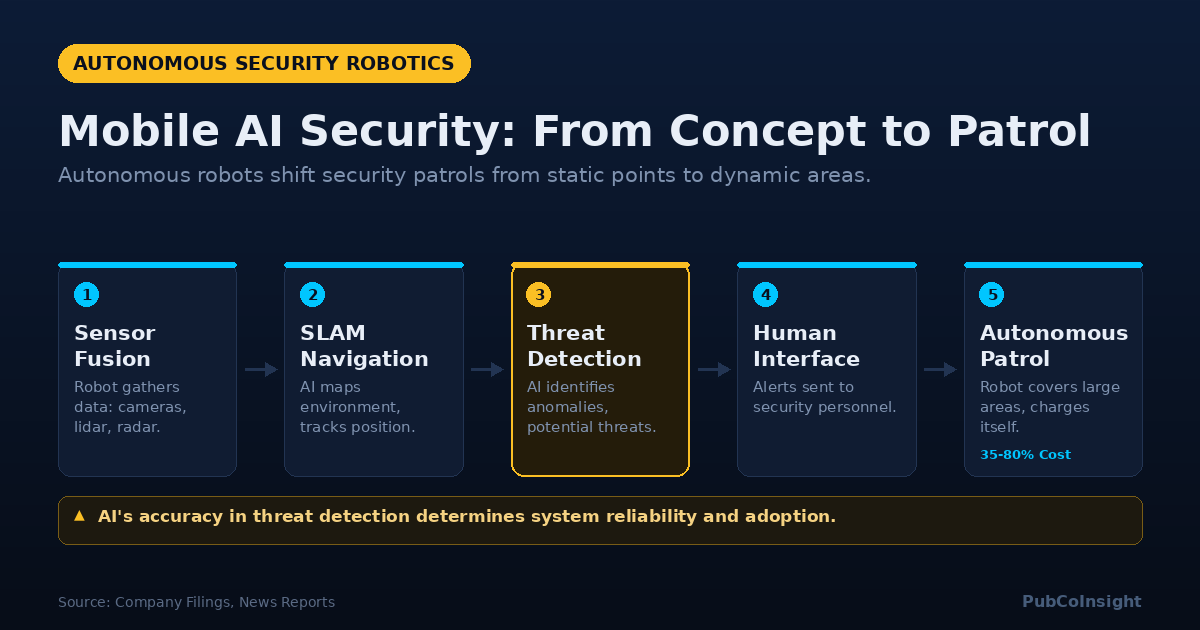
The Mechanism of Mobile Autonomy
True autonomous mobile security relies on a confluence of sensor fusion, real-time path planning, and robust power management. A robot like PURSUON, for example, must integrate data from multiple sources: LiDAR for precise distance mapping, high-resolution cameras for visual identification, and thermal sensors for low-light or obscured detection. This raw sensor data, often gigabytes per minute, feeds into an onboard AI processing unit. The unit's task is to build a dynamic, three-dimensional map of its environment, identify objects, classify threats, and plot an optimal, collision-free path. The challenge here is not just processing speed, but power efficiency. Running sophisticated AI algorithms and multiple sensors continuously drains batteries. The physics of locomotion, especially over varied terrain, also demands significant energy. A robot patrolling a large industrial complex for twelve hours needs a battery system capable of sustained output, or an efficient charging mechanism it can autonomously access. This is where the engineering becomes critical: balancing sensor density, processing power, battery capacity, and the weight and maneuverability of the robot itself. Any weakness in this chain, particularly in the ability to maintain continuous operation or navigate unforeseen obstacles, compromises the entire system's effectiveness and its value proposition against human patrols. The ability of the robot to self-diagnose and report potential failures is also a key component, ensuring uptime and reliability.Companies Driving Mobile Security Robotics
Several companies are navigating this evolving landscape, each with distinct approaches to the underlying technology and market application. In the broader drone and robotics space, Ondas Inc. (ONDS) and Unusual Machines, Inc. (UMAC) operate in areas that inform mobile autonomy, though their direct focus may differ. Ondas, for instance, develops mission-critical wireless networks and drone solutions, which provide the communication backbone and aerial perspective often complementary to ground-based robotics. Unusual Machines, while newer to public markets, focuses on drone technology, which shares many of the same challenges in autonomous navigation and sensor integration as ground robots. Red Cat Holdings, Inc. (RCAT) also develops drone software and hardware, including for defense applications, pushing the boundaries of autonomous flight and control systems. On the sensor and AI processing side, critical for any mobile platform, companies like MicroVision, Inc. (MVIS) and Arbe Robotics Ltd. (ARBE) are significant. MicroVision develops LiDAR technology, a cornerstone for precise environmental mapping in autonomous systems. Arbe Robotics specializes in 4D imaging radar solutions, offering high-resolution perception in adverse weather conditions, a crucial capability for outdoor mobile security robots. Kopin Corporation (KOPN) provides micro-displays and optical modules, which could be integrated into heads-up displays for human operators overseeing robot fleets, or directly into the robots for advanced visual processing. Beyond pure hardware, the intelligence layer is handled by companies like BigBear.ai Holdings, Inc. (BBAI), which delivers AI-powered analytics and decision intelligence. Their capabilities in processing vast datasets and deriving actionable insights are directly applicable to the complex decision-making required by autonomous security platforms, from identifying suspicious activity to optimizing patrol routes. Lantronix, Inc. (LTRX) focuses on secure data access and management for IoT and edge computing devices, essential for the secure communication and remote management of distributed robot fleets. Serve Robotics Inc. (SERV), while primarily focused on sidewalk delivery robots, shares core technological challenges with security robotics, particularly in urban navigation, obstacle avoidance, and human-robot interaction in public spaces. The insights gained from their deployment models and operational data directly inform the development of robust, publicly-deployable autonomous systems.Artificial Intelligence Technology Solutions, Inc.
Artificial Intelligence Technology Solutions, Inc. (AITX) trades over the counter under AITX on the OTCID tier. The company, through its subsidiaries, focuses on building and leasing autonomous security robots and remote monitoring systems. Their business model centers on recurring monthly subscriptions for these services, rather than one-off hardware sales. This shifts the financial emphasis from capital expenditure to operational expenditure for customers, a common trend in the "as-a-service" economy. The recent rebranding of RAD-M to PURSUON, announced August 24, 2026, highlights the company's commitment to mobile platforms. PURSUON is designed as a fully autonomous mobile security robot, intended to patrol large areas, detect threats, and provide real-time alerts. AITX has stated its goal to deploy 50 PURSUON units by August 2027, and recent reports from August 25, 2026, indicate a growing deployment pipeline and expanded production readiness to support this target. The company’s August 31, 2026, 8-K filing noted a 32-unit order intake across five solutions in August, with a diverse 14-unit intake across five customer relationships recorded on August 27, 2026. These orders include units across their product lines, demonstrating ongoing market engagement. What the public record does not yet establish is the specific revenue contribution from these new PURSUON units or the average subscription length for these new deployments. AITX has also announced its participation in GSX 2026, leveraging three points on the show floor to reach attendees, signaling a continued focus on direct customer engagement and market visibility. Their filings, available on EDGAR, provide detailed information on revenue, subscription counts, share count, and cash position, which are the primary sources for understanding the company's financial state.What to watch
Investors should monitor AITX's progress against its stated goal of deploying 50 PURSUON units by August 2027. Specific updates on the number of units deployed, customer acquisition, and subscription revenue attributable to PURSUON will be key. The company's 8-K filings, which are frequent, will likely contain updates on order intake and operational milestones. Further, watch for developments in sensor technology from companies like MicroVision (MVIS) and Arbe Robotics (ARBE). Advancements in LiDAR and radar performance, particularly in terms of cost reduction and environmental robustness, directly impact the capabilities and economic viability of mobile autonomous platforms like PURSUON. Any new strategic partnerships or integration agreements between sensor providers and robotics companies will be significant. Finally, observe the broader market's adoption of autonomous guarding services. Large security integrators and guarding service providers, such as ADT, may signal their increased investment or partnership activity in mobile robotics, validating the market shift. The competitive landscape, including new entrants or significant expansions from existing players, will also shape the trajectory of this specialized sector., { "label": "AI Processing", "note": "Onboard AI identifies objects, classifies threats, plans paths." }, { "label": "Power Management", "note": "Efficient batteries and autonomous charging ensure uptime." }, { "label": "Autonomous Patrol", "note": "Robot navigates complex environments, responds to incidents.", "metric": "50 units by Aug 2027" }, { "label": "Real-time Alerts", "note": "Notifications sent to human operators for intervention." } ], "highlight": 2, "highlight_note": "Sustained operation requires balancing power demand with battery capacity and efficient charging.", "footnote": "AITX 8-K Filings, August 2026" }Companies mentioned
| Ticker | Company | Price |
|---|---|---|
| AITX client | Artificial Intelligence Technology Solutions Inc | $0.004 |
| ARBE | Arbe Robotics Ltd. | $0.644 |
| BBAI | BigBear.ai Holdings, Inc. | $2.95 |
| KOPN | Kopin Corporation | $4.21 |
| LTRX | Lantronix, Inc. | $5.15 |
| MVIS | MicroVision, Inc. | $1.72 |
| ONDS | Ondas Inc. | $7.04 |
| RCAT | Red Cat Holdings, Inc. | $8.25 |
| SERV | Serve Robotics Inc. | $4.69 |
| UMAC | Unusual Machines, Inc. | $22.65 |
Listed alphabetically, not ranked. Prices as of 2026-09-02 and they move. Check a live quote before relying on any of this.
How we chose the companies in this article
We cover a fixed universe of companies working in autonomous security robotics, physical AI and the guarding services market they are aimed at. Every one of them that had usable market data on 2026-09-02 appears in this article. We do not pick which ones to mention based on what we think of them, and we do not order them by size, price or trading volume, because an ordered list is a verdict and that is not ours to hand down. Companies left out, and why: none. American Lithium Minerals and Artificial Intelligence Technology Solutions pay us, which is disclosed in full at the foot of every article they appear in.
See the dilution and promotion flags before you see the pitch.
Each week: the micro and small-caps now showing dilution or paid-promotion signals, with the SEC filing behind every flag. No recommendations, no price targets.
Sources used in this article
- US Stock Market Today: S&P 500 Futures Slip As Rising Yields Pressure Equities Simply Wall St. · 2026-09-02
- Here's What $1,000 Invested in Berkshire Hathaway the Day Greg Abel Became CEO Is Worth Now Motley Fool · 2026-09-02
- If the Stock Market Crashes Tomorrow, History Says Investors Should Make This 1 Specific Move Motley Fool · 2026-09-02
- Forget Nebius. CoreWeave Has a New Competitor. And It's Not Another AI Cloud Company. Motley Fool · 2026-09-02
- Should Investors Be Worried About Tesla's Slowing Growth? Motley Fool · 2026-09-02
- This Is the 1 Move Every Long-Term Investor Should Make Right Now, According to History Motley Fool · 2026-09-02
- Nvidia's next act is bigger than selling AI chips: Chart of the Day Yahoo Finance · 2026-09-02
- Big Oil vs. Midstream: Which Side of the Barrel Pays Better Right Now? Motley Fool · 2026-09-02
- AI Adoption in Crypto Crime Soared by 40% Over the Past Year. Here Are 4 Practical Solutions to Keep Your Crypto Safe. Motley Fool · 2026-09-02
- SpaceX vs. Anthropic: Which Is the Better IPO to Own? Motley Fool · 2026-09-02
- Ranking the "Magnificent Seven" From Most to Least Attractive, Based on Future Cash Flow Motley Fool · 2026-09-02
- Ondas Drops 6% as Risk-Off Selling Cascades Through Drone Names, Red Cat Slides 3% 24/7 Wall St. · 2026-09-01
Disclosure required by Section 17(b) of the Securities Act of 1933
Artificial Intelligence Technology Solutions, Inc., a Nevada corporation (OTCID: AITX). Artificial Intelligence Technology Solutions, Inc. pays Strategic Innovations First, Inc., a Wyoming corporation doing business as PulseIR. Compensation received: USD 5,000.00 per month for months 1-3 (August, September, October 2026); USD 10,000.00 per month for months 4-6 (November, December 2026, January 2027) contingent on the 90-day review. Minimum committed USD 15,000.00; USD 45,000.00 if the second-period rate triggers.. Form of payment: cash only, invoiced monthly in advance; no stock, options or warrants received or payable. Services: investor relations services under an Investor Relations Services Agreement effective 2026-08-01. Period: six month term, 2026-08-01 through 2027-01-31; 90-day review on or about 2026-10-30. No stock, options or warrants held by PubCo Insight, Pulse IR, Strategic Innovations First, Inc., or Brad Listermann. Confirmed by the executed agreement and by board record recKwdq39X2caPSX7 (POSITIONS HELD: none).
This is information, not investment, financial, legal or tax advice. It is not a recommendation or solicitation to buy, sell or hold any security and it contains no price target. Nothing here is independently verified by us. Confirm every figure against primary filings on SEC EDGAR before you act. Micro-cap and over-the-counter securities are speculative and illiquid and can lose all of their value. The companies named without a disclosure above pay us nothing and have no relationship with us; they are named because a published, mechanical screen selected them. Full disclosure policy.