Autonomous Security Firms Diverge on Capital Strategy: Equity vs. Debt
Recent financing moves by Arbe Robotics and Axon Enterprise reveal a split in how autonomous security and robotics companies are funding growth, reflecting different stages of maturity and market access.
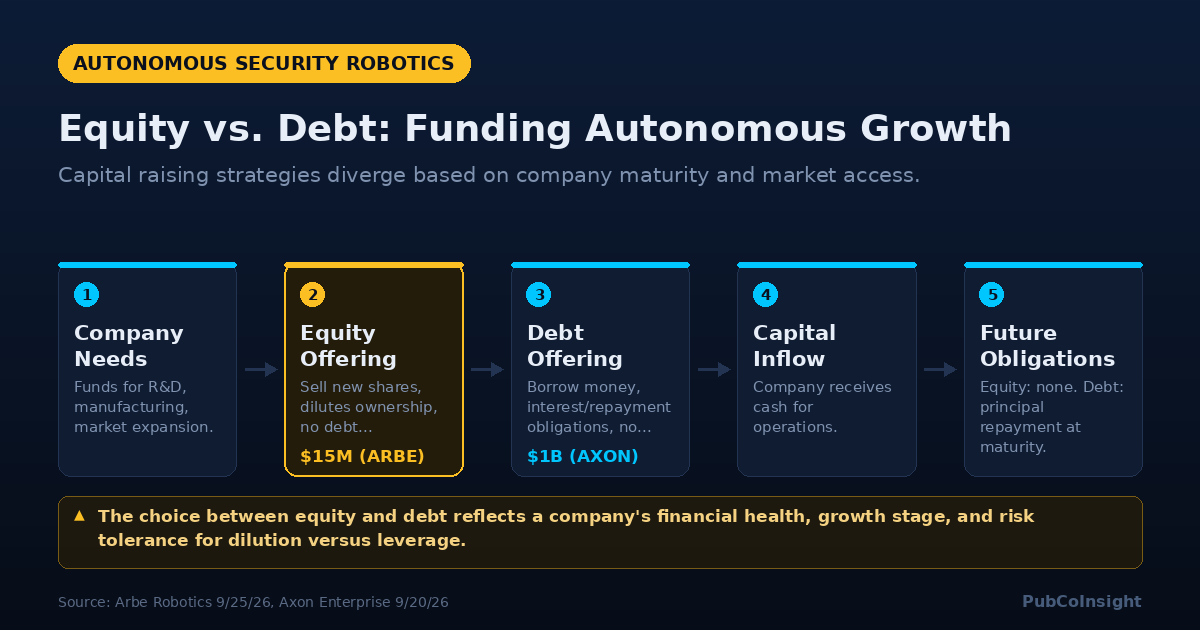
The Mechanism of Capital Raising
Capital raising in the public markets involves a company securing funds from investors. The two primary methods are equity financing and debt financing. Equity financing means selling ownership stakes, or shares, in the company. A direct offering, like Arbe's, involves issuing new shares directly to investors, often institutions, at a negotiated price. This dilutes existing shareholders by increasing the total number of shares outstanding. The company receives cash in exchange for this ownership. The benefit is no repayment obligation or interest expense. The cost is dilution and a potential downward pressure on share price if the offering is priced below the market. Debt financing, conversely, involves borrowing money that must be repaid, typically with interest. Zero-coupon notes, as issued by Axon, are a specific type of debt. These notes do not pay regular interest payments. Instead, they are sold at a discount to their face value and mature at their face value, with the difference representing the investor's return. This structure can be attractive to companies seeking to defer cash interest payments, effectively pushing the cost of capital into the future. The issuer benefits from no immediate cash outflow for interest. The risk is the large lump-sum repayment at maturity and the potential for increased leverage on the balance sheet. For a company with strong growth prospects, the deferred payment can be a significant advantage, assuming future cash flows will cover the maturity obligation. For investors, zero-coupon notes can offer predictable returns without re-investment risk from coupon payments. The choice between equity and debt often hinges on a company's current cash flow, growth trajectory, and its ability to service debt or absorb dilution.Companies in the Autonomous Security Sector
The autonomous security and robotics sector is broad, encompassing hardware, software, and integrated solutions. Companies here address diverse applications from physical guarding to drone-based surveillance and AI-driven analytics. In the radar technology space, Arbe Robotics Ltd. (ARBE), priced at $0.635, focuses on high-resolution 4D imaging radar solutions. These systems are critical for advanced driver-assistance systems (ADAS) and autonomous vehicles, but also find application in security robotics for enhanced perception. Their recent $15 million direct offering signals a need for capital to continue development and scale, likely targeting specific operational milestones. Drone technology developers include Red Cat Holdings, Inc. (RCAT), trading at $6.66, which builds and markets drone platforms and software for defense, enterprise, and consumer markets. Ondas Inc. (ONDS), at $7.64, has expanded its integrated autonomous defense systems platform through recent acquisitions. Ondas acquired three defense technology firms for $56 million in September 2026, a move that broadens its component ownership and defense offerings. The company's focus on defense applications suggests a different market dynamic than pure commercial security. Unusual Machines, Inc. (UMAC), priced at $24.05, also operates in the drone sector, with Brightline Interactive securing a strategic investment led by drone executive Allan Evans in September 2026, indicating continued investor interest in the space. For component-level innovation, Kopin Corporation (KOPN), at $4.99, is developing micro-display technologies. Fabric.AI, in collaboration with Kopin, filed two patent applications in September 2026 for fiber-coupled and connector-free MicroLED optical interconnects, which could be foundational for next-generation augmented reality and display systems in robotics. MicroVision, Inc. (MVIS), trading at $1.60, is another player in lidar technology, essential for spatial awareness in autonomous systems. Software and AI analytics are central to many offerings. BigBear.ai Holdings, Inc. (BBAI), at $2.80, provides AI-powered analytics and data solutions, primarily for government and defense clients. These platforms are crucial for processing the vast amounts of data generated by autonomous security systems. Lantronix, Inc. (LTRX), priced at $7.02, offers secure data access and management solutions for the Internet of Things (IoT) and IT infrastructure, which are vital for connecting and managing distributed autonomous devices. In the realm of robotic delivery, Serve Robotics Inc. (SERV), at $4.45, is targeting the last-mile delivery market with its autonomous sidewalk robots. Serve Robotics aims at a $450 billion market, highlighting the potential for automation beyond traditional security.Artificial Intelligence Technology Solutions, Inc.
Artificial Intelligence Technology Solutions, Inc. (AITX) trades over the counter at $0.003. The company, through its subsidiaries, develops and leases autonomous security robots and remote monitoring systems. AITX operates on a "Solutions-as-a-Service" model, providing recurring monthly subscriptions rather than one-off hardware sales. This model targets the security and guarding services industry, which the company estimates as a $50 billion market in the United States. AITX states its solutions are designed to deliver cost savings between 35% and 80% compared with traditional manned security. The company's operations are structured across three main pillars. Robotic Assistance Devices, Inc. (RAD-I) focuses on stationary security devices. Robotic Assistance Devices Mobile (RAD-M) develops mobile autonomous platforms, including the ROAMEO mobile security unit, which began early commercial deployment in May 2026. The third pillar, Robotic Assistance Devices Group (RAD-G), encompasses the SARA agentic artificial intelligence platform. AITX also operates Robotic Assistance Devices Lanka (Private) Limited (RAD Lanka) in Sri Lanka, which supports software development, AI initiatives, and technical operations. The company envisions an integrated autonomous security deployment across campuses or communities, a concept it refers to as "RAD Town." For the fiscal year ended February 28, 2026, AITX reported revenue of $7,745,336, a 26% increase from the prior year. Gross profit rose 48% to $5,533,700, with gross margin expanding to approximately 71%. Operating expenses remained flat at around $17,477,097, leading to an improved loss from operations of $(11,943,397). The net loss for the fiscal year was approximately $14.5 million, with an accumulated deficit of approximately $171 million as of that date. The company had negative cash flow from operating activities of $9,344,534 for the same period. While the company outlines ambitious plans for revenue growth and market penetration, the public record does not yet establish a clear path to sustained positive cash flow from operations. AITX announced updated hardware pricing on September 24, 2026, to reflect rising materials, compute, and transportation costs. The company also expanded a national dealer relationship with a third order on September 23, 2026, and increased its presence in higher education on September 18, 2026.What to watch
Investors should monitor several concrete developments. For Arbe Robotics, the deployment of the $15 million from its direct offering will be key. Look for specific announcements regarding expanded production capacity, new customer contracts, or accelerated product development timelines. These will indicate how the capital is being utilized to drive growth. For Axon Enterprise, the terms and maturity of its $1 billion zero-coupon notes bear watching. The company's ability to generate sufficient future cash flow to repay this obligation at maturity, without further dilutive financing, will be a critical indicator. Any changes in its debt ratings or future financing activities could signal shifts. Across the broader sector, keep an eye on hardware pricing adjustments. AITX's September 24, 2026, announcement of increased hardware pricing due to rising input costs suggests broader inflationary pressures impacting the bill of materials for autonomous systems. Other companies may follow suit, affecting gross margins and competitive positioning. Further acquisitions by companies like Ondas Inc., following its $56 million defense technology firm purchases in September 2026, could signal consolidation or strategic expansion in niche areas. Look for details on how these acquired technologies integrate and contribute to revenue. Finally, watch for new patent filings from innovators like Kopin Corporation, as these can foreshadow future product capabilities and market differentiation in core components., { "label": "Equity Offering", "note": "Sell new shares, dilutes ownership, no debt repayment.", "metric": "$15M (ARBE)" }, { "label": "Debt Offering", "note": "Borrow money, interest/repayment obligations, no dilution.", "metric": "$1B (AXON)" }, { "label": "Capital Inflow", "note": "Company receives cash for operations." }, { "label": "Future Obligations", "note": "Equity: none. Debt: principal repayment at maturity." } ], "highlight": 1, "highlight_note": "The choice between equity and debt reflects a company's financial health, growth stage, and risk tolerance for dilution versus leverage.", "footnote": "Source: Arbe Robotics 9/25/26, Axon Enterprise 9/20/26" }Companies mentioned
| Ticker | Company | Price |
|---|---|---|
| AITX client | Artificial Intelligence Technology Solutions Inc | $0.003 |
| ARBE | Arbe Robotics Ltd. | $0.635 |
| BBAI | BigBear.ai Holdings, Inc. | $2.8 |
| KOPN | Kopin Corporation | $4.99 |
| LTRX | Lantronix, Inc. | $7.02 |
| MVIS | MicroVision, Inc. | $1.6 |
| ONDS | Ondas Inc. | $7.64 |
| RCAT | Red Cat Holdings, Inc. | $6.66 |
| SERV | Serve Robotics Inc. | $4.45 |
| UMAC | Unusual Machines, Inc. | $24.05 |
Listed alphabetically, not ranked. Prices as of 2026-09-28 and they move. Check a live quote before relying on any of this.
How we chose the companies in this article
We cover a fixed universe of companies working in autonomous security robotics, physical AI and the guarding services market they are aimed at. Every one of them that had usable market data on 2026-09-28 appears in this article. We do not pick which ones to mention based on what we think of them, and we do not order them by size, price or trading volume, because an ordered list is a verdict and that is not ours to hand down. Companies left out, and why: none. American Lithium Minerals and Artificial Intelligence Technology Solutions pay us, which is disclosed in full at the foot of every article they appear in.
See the dilution and promotion flags before you see the pitch.
Each week: the micro and small-caps now showing dilution or paid-promotion signals, with the SEC filing behind every flag. No recommendations, no price targets.
Sources used in this article
- This Space Stock Could Make You Rich (Hint: It's Not SpaceX) Motley Fool · 2026-09-28
- Elon Musk Just Gave Nvidia Investors More Good News. Is the Stock a Buy? Motley Fool · 2026-09-28
- Nebius Is Raising the Price of Its AI Compute on Oct. 1. Here's What That Says About the Shortage. Motley Fool · 2026-09-27
- Here's How Many Shares of Coca-Cola You'd Need for $10,000 in Yearly Dividends Motley Fool · 2026-09-27
- 1 Top Warren Buffett Stock Trading 21% Below Its All-Time High That Can Double a $1,000 Investment in 5 Years Motley Fool · 2026-09-27
- I'd Buy Amazon Stock While It Sits 12% Below Its Record Motley Fool · 2026-09-27
- 3 Simple Reasons I'd Rather Own Nvidia Than SpaceX Motley Fool · 2026-09-27
- SpaceX vs. Tesla: Which Will Be the Largest Company at the End of 2027? Motley Fool · 2026-09-27
- GE Aerospace Is Spending $12 Billion on an Acquisition. Is It Still the Best Aerospace Stock to Own? Motley Fool · 2026-09-27
- Why Meta Platforms Stock Jumped 13% This Week Motley Fool · 2026-09-27
- Axon Enterprise (AXON) Stock Sinks As Market Gains: What You Should Know Zacks · 2026-09-25
- Sterling, Axon, Herc, Nextpower, and FTAI Aviation Shares Plummet, What You Need To Know StockStory · 2026-09-25
Disclosure required by Section 17(b) of the Securities Act of 1933
Artificial Intelligence Technology Solutions, Inc., a Nevada corporation (OTCID: AITX). Artificial Intelligence Technology Solutions, Inc. pays Strategic Innovations First, Inc., a Wyoming corporation doing business as PulseIR. Compensation received: USD 5,000.00 per month for months 1-3 (August, September, October 2026); USD 10,000.00 per month for months 4-6 (November, December 2026, January 2027) contingent on the 90-day review. Minimum committed USD 15,000.00; USD 45,000.00 if the second-period rate triggers.. Form of payment: cash only, invoiced monthly in advance; no stock, options or warrants received or payable. Services: investor relations services under an Investor Relations Services Agreement effective 2026-08-01. Period: six month term, 2026-08-01 through 2027-01-31; 90-day review on or about 2026-10-30. No stock, options or warrants held by PubCo Insight, Pulse IR, Strategic Innovations First, Inc., or Brad Listermann. Confirmed by the executed agreement and by board record recKwdq39X2caPSX7 (POSITIONS HELD: none).
This is information, not investment, financial, legal or tax advice. It is not a recommendation or solicitation to buy, sell or hold any security and it contains no price target. Nothing here is independently verified by us. Confirm every figure against primary filings on SEC EDGAR before you act. Micro-cap and over-the-counter securities are speculative and illiquid and can lose all of their value. The companies named without a disclosure above pay us nothing and have no relationship with us; they are named because a published, mechanical screen selected them. Full disclosure policy.