Small-Cap Robotics Firms Secure Capital, Eye Drone Manufacturing and Radar Tech
Unusual Machines made a $10 million strategic investment in Draganfly to scale drone production, while Arbe Robotics closed a $15 million direct offering, signaling capital deployment into specific hardware and sensor capabilities.
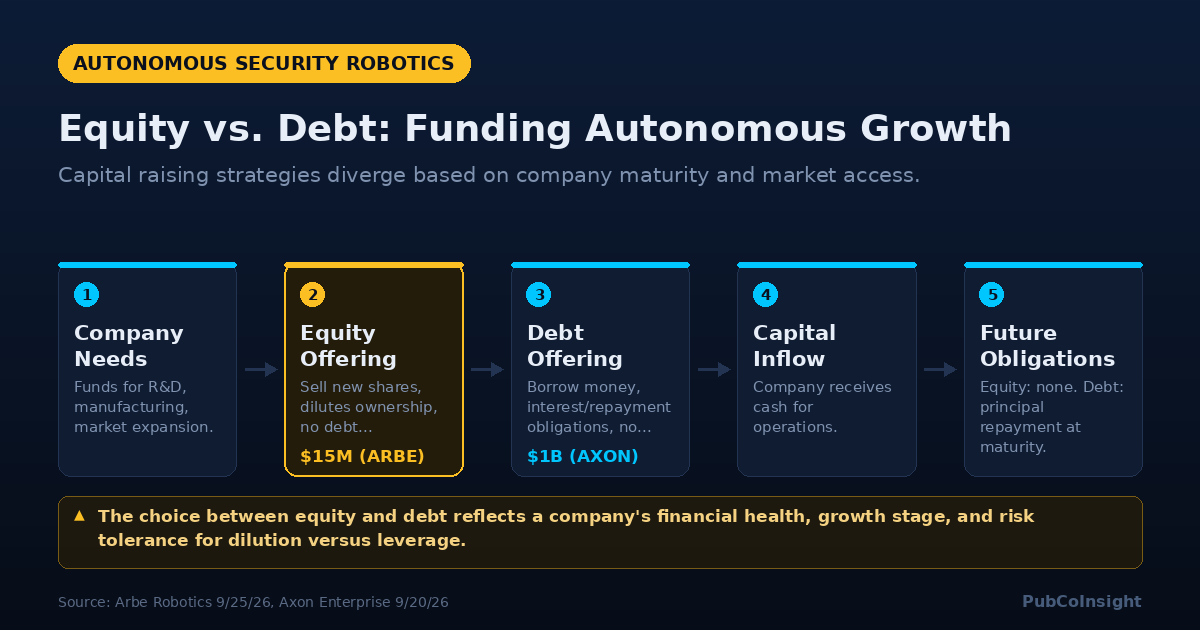
The Mechanism of Capital Deployment in Robotics
Scaling drone manufacturing involves more than just assembly lines. It demands a robust supply chain for specialized components: flight controllers, high-end cameras, advanced battery systems, and durable airframe materials. Each of these components can present a bottleneck. For instance, high-performance, lightweight composite materials require specific fabrication processes, often with long lead times. Expanding production means pre-ordering these components in volume, which ties up capital. The investment in Draganfly directly addresses this by providing the liquidity needed to commit to larger orders and potentially automate parts of the assembly process, reducing per-unit costs and increasing throughput. This is a direct bet on future demand for their drone platforms. Conversely, the capital raise by Arbe Robotics points to a different kind of scaling: the refinement and deployment of a critical sensor technology, 4D imaging radar. Unlike traditional radar, 4D imaging radar provides real-time, high-resolution data on an object's range, azimuth, elevation, and velocity. This additional dimension, elevation, is crucial for autonomous systems to differentiate between, for example, a stationary sign and a pedestrian moving at ground level. Developing and integrating these systems requires significant R&D spend, specialized chip manufacturing, and extensive field testing. The $15 million offering allows Arbe to accelerate this development, move from pilot programs to broader commercialization, and potentially secure larger design wins with automotive and robotics partners. The success of such a technology hinges on its ability to perform reliably in diverse environmental conditions and integrate seamlessly with existing AI perception stacks. Failure to achieve consistent performance or broad adoption would undermine the value of this focused investment.Companies Working in This Part of the Sector
Several companies are navigating this landscape, each with distinct approaches to physical AI and autonomous guarding. In the drone and aerial robotics space, Unusual Machines (UMAC), at $23.96, has been active. Their investment in Draganfly (UMAC) on September 28, alongside a US investment fund, specifically targets scaling drone manufacturing. Unusual Machines has also been noted for its revenue growth, with reports pointing to what drives its next leg. Ondas Inc. (ONDS), trading at $7.68, operates in a similar vein, with its Cyberhawk™ subsidiary securing a multi-year agreement for electricity network inspection and surveying with the UK's SSE plc. Ondas has also been linked to defense sector bets, with reports mentioning a $56 million defense play and the potential for three buyouts to build an autonomous warfare stack. Red Cat Holdings, Inc. (RCAT), priced at $6.5, also operates in the drone sector, with its shares recently seeing a bounce alongside other drone names. These companies are focused on the hardware and service delivery aspects of aerial autonomous solutions. On the sensor and AI processing side, Arbe Robotics Ltd. (ARBE), at $0.6, is pushing its 4D imaging radar technology. The recent $15 million direct offering, closing on September 28, provides capital to further develop and commercialize this advanced sensor, critical for precise environmental perception in autonomous systems. MicroVision, Inc. (MVIS), at $1.46, also works in advanced sensor technology, particularly LiDAR, which complements radar in many autonomous applications. Kopin Corporation (KOPN), at $4.75, focuses on micro-displays and optical solutions, essential components for augmented reality and heads-up displays in advanced robotics and defense applications, with recent patent filings for fiber-coupled and connector-free MicroLED optical interconnects. Companies like BigBear.ai Holdings, Inc. (BBAI), at $2.66, and Lantronix, Inc. (LTRX), at $7.22, provide the underlying AI and IoT infrastructure. BigBear.ai focuses on AI-powered analytics and decision intelligence, often for government and defense clients. Lantronix specializes in secure data access and management for IoT devices, providing the connectivity layer for many autonomous systems. In the ground robotics and service delivery sector, Serve Robotics Inc. (SERV), at $4.43, is deploying autonomous sidewalk delivery robots. The company is reportedly targeting a $450 billion market, indicating a focus on last-mile logistics and service automation.Artificial Intelligence Technology Solutions, Inc.
Artificial Intelligence Technology Solutions, Inc. (AITX), trading on the OTCID tier at $0.003, develops and operates AI-driven security and productivity solutions for enterprise clients. The company structures its operations through several subsidiaries: Robotic Assistance Devices, Inc. (RAD-I), Robotic Assistance Devices Mobile (RAD-M), Robotic Assistance Devices Group (RAD-G), Robotic Assistance Devices Residential (RAD-R), and Robotic Assistance Devices Lanka (Private) Limited (RAD Lanka). RAD-I, the primary subsidiary, markets an AI-driven "Solutions-as-a-Service" model to the security and guarding services industry, which AITX estimates to be an approximately $50 billion market in the United States. These solutions aim to deliver cost savings of between 35% and 80% compared with traditional manned security and monitoring. The company utilizes a suite of stationary and mobile devices, integrated with its proprietary software and monitoring platforms. The company's operations are divided into three main pillars: stationary security devices (RAD-I), mobile autonomous platforms (RAD-M), which include the ROAMEO mobile security unit with early commercial deployment beginning in May 2026, and the SARA agentic artificial intelligence platform (RAD-G). RAD Lanka, a wholly owned subsidiary located in Sri Lanka, supports software development, AI initiatives, and technical operations across the company's subsidiaries. AITX refers to the long-term outcome of this integrated strategy as "RAD Town," envisioning comprehensive autonomous-security deployments across campuses, communities, or jurisdictions. For the fiscal year ended February 28, 2026, AITX reported revenue of $7,745,336, a 26% increase over the prior fiscal year. Gross profit rose 48% to $5,533,700, and gross margin expanded to approximately 71% from 61%. Operating expenses remained flat at approximately $17,477,097, leading to an improved loss from operations of approximately $2.0 million, resulting in a $(11,943,397) loss. The net loss for the fiscal year was approximately $14.5 million, with an accumulated deficit of approximately $171 million as of that date. The company reported negative cash flow from operating activities of $9,344,534 for the year ended February 28, 2026, and had negative working capital of $17,017,745. The public record does not yet establish a clear path to sustained positive cash flow from operations. The company has stated that RAD-I's recurring revenue and gross margin could, on a standalone basis, support positive cash flow operations, and management characterizes RAD-I as having "achieved a point" where it could support positive cash flow today. AITX also states that RAD-M will surpass RAD-I's monthly recurring revenue contribution at some future point. They project subscription gross margin to exceed 75% and outright-sale gross margin to exceed 50%, based on average bill of materials costs and pricing that the market "has appeared to accept." Recent 8-K filings on September 24 and September 23 indicate updates to hardware pricing to reflect rising materials, compute, and transportation costs, and an expansion of a national dealer relationship with a third order.What to watch
Investors should watch for Draganfly's (UMAC) specific manufacturing output figures following the $10 million investment. Concrete announcements of increased production capacity or new drone models will indicate how effectively the capital is being deployed. For Arbe Robotics (ARBE), look for new design wins or expanded commercial deployments of their 4D imaging radar systems. These would validate the market's acceptance of their technology and the impact of the recent $15 million offering. Ondas (ONDS) investors should monitor progress on its multi-year agreement with SSE plc, specifically the scope and expansion of electricity network inspection and surveying contracts. Any further details regarding Ondas's $56 million defense bet and potential acquisitions will also be key. For Artificial Intelligence Technology Solutions (AITX), watch for quarterly financial filings that show trends in recurring revenue, subscription counts for RAD-I, and the commercial deployment progress of the ROAMEO mobile security unit under RAD-M. Specific announcements of new dealer relationships or significant customer deployments will also be important indicators., { "label": "Component Sourcing", "note": "Funds commit to bulk orders for specialized parts.", "metric": "$10M UMAC / $15M ARBE" }, { "label": "Manufacturing Scale", "note": "Increased production capacity for drones or sensors." }, { "label": "Sensor Integration", "note": "Advanced radar or LiDAR systems deployed." }, { "label": "Market Adoption", "note": "New products enter commercial use." } ], "highlight": 2, "highlight_note": "Scaling manufacturing capacity for complex robotics or advanced sensors is the bottleneck and value driver.", "footnote": "Sources: Unusual Machines, Draganfly, Arbe Robotics company news and filings, Sept 2026." }Companies mentioned
| Ticker | Company | Price |
|---|---|---|
| AITX client | Artificial Intelligence Technology Solutions Inc | $0.003 |
| ARBE | Arbe Robotics Ltd. | $0.6 |
| BBAI | BigBear.ai Holdings, Inc. | $2.66 |
| KOPN | Kopin Corporation | $4.75 |
| LTRX | Lantronix, Inc. | $7.22 |
| MVIS | MicroVision, Inc. | $1.46 |
| ONDS | Ondas Inc. | $7.68 |
| RCAT | Red Cat Holdings, Inc. | $6.5 |
| SERV | Serve Robotics Inc. | $4.43 |
| UMAC | Unusual Machines, Inc. | $23.96 |
Listed alphabetically, not ranked. Prices as of 2026-09-29 and they move. Check a live quote before relying on any of this.
How we chose the companies in this article
We cover a fixed universe of companies working in autonomous security robotics, physical AI and the guarding services market they are aimed at. Every one of them that had usable market data on 2026-09-29 appears in this article. We do not pick which ones to mention based on what we think of them, and we do not order them by size, price or trading volume, because an ordered list is a verdict and that is not ours to hand down. Companies left out, and why: none. American Lithium Minerals and Artificial Intelligence Technology Solutions pay us, which is disclosed in full at the foot of every article they appear in.
See the dilution and promotion flags before you see the pitch.
Each week: the micro and small-caps now showing dilution or paid-promotion signals, with the SEC filing behind every flag. No recommendations, no price targets.
Sources used in this article
- Want a $1 Million Investment Portfolio? History Says This Strategy Could Get You There. Motley Fool · 2026-09-29
- Is Arm (ARM) Quietly Becoming the Linchpin of Nvidia’s AI Security and Compute Strategy? Simply Wall St. · 2026-09-29
- Stock-Split Watch: Is Meta Platforms Next? Motley Fool · 2026-09-29
- Nvidia turns to insurers to spread risk of AI build-out - FT Investing.com · 2026-09-29
- Michael Burry Said AI Bursts in 2028. One Weekend of Research Changed That BeInCrypto · 2026-09-29
- Zacks Investment Ideas feature highlights: Nvidia, Bloom Energy and Amphenol Zacks · 2026-09-29
- Samsung Commits $1.0 Billion to AI Infrastructure Firm Backed by KKR, Nvidia The Wall Street Journal · 2026-09-29
- Move Over, SpaceX. Anthropic Will Soon Go Public. Why It Could Be Critical for AI Stocks Motley Fool · 2026-09-29
- PANW, CRWD, ZS Lead Nasdaq-100 Gains As Nvidia's AI Agent Safety Push, Security Scares Lift Cybersecurity Stocks Stocktwits · 2026-09-29
- Why Kodiak Sciences Skyrocketed Today Motley Fool · 2026-09-29
- Serve Robotics vs. Symbotic: Which Robotics Stock Has the Edge Now? Zacks · 2026-09-28
- Why Ondas (ONDS) Is Back In The Spotlight Simply Wall St. · 2026-09-28
Disclosure required by Section 17(b) of the Securities Act of 1933
Artificial Intelligence Technology Solutions, Inc., a Nevada corporation (OTCID: AITX). Artificial Intelligence Technology Solutions, Inc. pays Strategic Innovations First, Inc., a Wyoming corporation doing business as PulseIR. Compensation received: USD 5,000.00 per month for months 1-3 (August, September, October 2026); USD 10,000.00 per month for months 4-6 (November, December 2026, January 2027) contingent on the 90-day review. Minimum committed USD 15,000.00; USD 45,000.00 if the second-period rate triggers.. Form of payment: cash only, invoiced monthly in advance; no stock, options or warrants received or payable. Services: investor relations services under an Investor Relations Services Agreement effective 2026-08-01. Period: six month term, 2026-08-01 through 2027-01-31; 90-day review on or about 2026-10-30. No stock, options or warrants held by PubCo Insight, Pulse IR, Strategic Innovations First, Inc., or Brad Listermann. Confirmed by the executed agreement and by board record recKwdq39X2caPSX7 (POSITIONS HELD: none).
This is information, not investment, financial, legal or tax advice. It is not a recommendation or solicitation to buy, sell or hold any security and it contains no price target. Nothing here is independently verified by us. Confirm every figure against primary filings on SEC EDGAR before you act. Micro-cap and over-the-counter securities are speculative and illiquid and can lose all of their value. The companies named without a disclosure above pay us nothing and have no relationship with us; they are named because a published, mechanical screen selected them. Full disclosure policy.