Autonomous Security Robotics: The Push for 50 Mobile Units by August 2027
A recent announcement from PURSUON details an accelerated deployment pipeline and increased production capacity for its ROAMEO mobile security units, signaling a significant ramp-up in the autonomous security robotics sector.
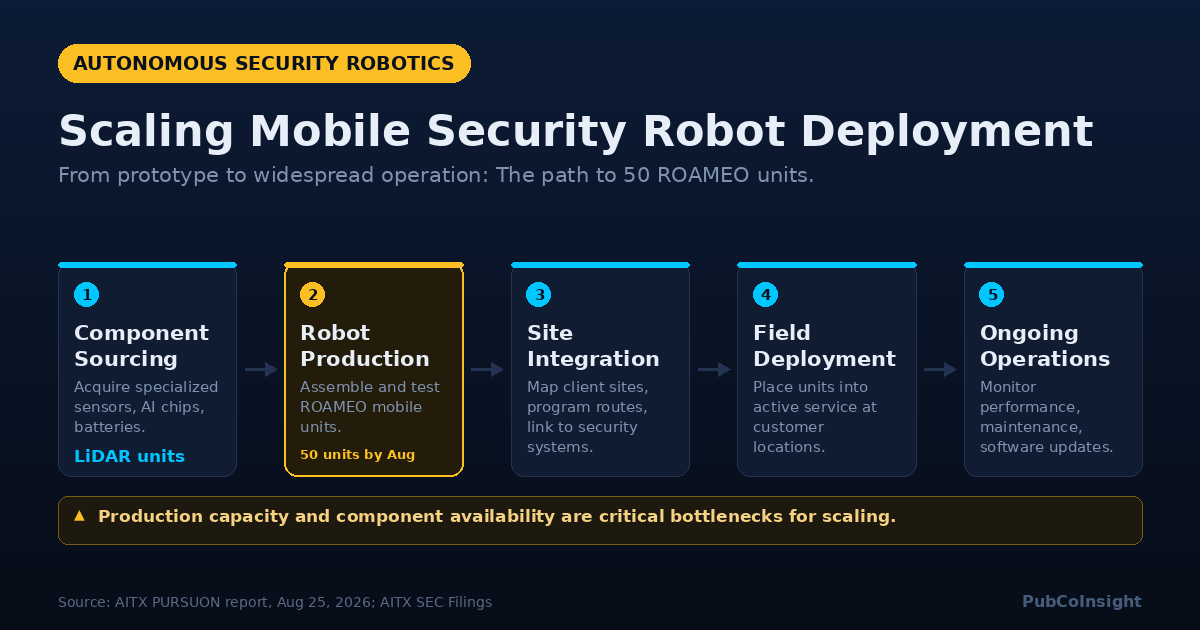
The Mechanism of Scaled Deployment
Scaling autonomous security robots, especially mobile units like ROAMEO, hinges on two primary factors: manufacturing efficiency and operational integration. Manufacturing involves not just assembly, but also sourcing specialized components, particularly sensors, high-capacity batteries, and robust computing modules designed for edge AI processing. These components, often shared with the automotive and drone industries, can face supply chain bottlenecks. For example, specific LiDAR units or high-end NVIDIA GPUs, crucial for real-time environmental mapping and threat detection, have seen fluctuating availability and pricing. A bottleneck in a single critical component can halt an entire production line, regardless of assembly capacity. Operational integration is the second, often more complex, hurdle. A robot is not a static camera. It navigates complex environments, interacts with humans, and must operate reliably for extended periods without direct supervision. This requires sophisticated software for path planning, obstacle avoidance, and anomaly detection. It also demands robust communication infrastructure, often involving dedicated cellular networks or secure Wi-Fi meshes, to transmit data back to a central monitoring station. Furthermore, each deployment site, whether a large corporate campus or a logistics hub, requires site-specific mapping, programming of patrol routes, and integration with existing security systems like access control and alarm panels. The more units deployed, the more strain this integration process places on field service teams and software engineers. Success depends on streamlining these site-specific adaptations and ensuring seamless data flow. If a robot cannot reliably navigate a new environment or integrate with a client's existing security protocols, its value proposition diminishes rapidly, regardless of its raw hardware capabilities.Companies in the Sector
The autonomous security robotics and physical AI market features a range of companies, each approaching the challenge from different angles. Some focus on the hardware itself, others on the AI, and some on the service model. In the mobile robotics space, Serve Robotics Inc. (SERV) is actively deploying its autonomous delivery robots, primarily for last-mile logistics. While not directly in security, their experience with urban navigation and managing a fleet of physical AI units offers insights into scaling mobile operations. The company reported on August 20, 2026, about turning its 2,000 robots into a revenue growth engine, focusing on the operational scalability of its fleet. Drone manufacturers also play a role, providing aerial surveillance capabilities that complement ground-based robots. Ondas Inc. (ONDS), trading at $8.24, develops and manufactures industrial drones and has been expanding its solutions for critical infrastructure. On August 21, 2026, Ondas highlighted its record backlog and Q2 results, indicating increasing demand for its drone platforms. Similarly, Red Cat Holdings, Inc. (RCAT), at $9.1, focuses on drone technology, including enterprise-grade drones and software. Unusual Machines, Inc. (UMAC), trading at $24.35, is ramping up U.S. drone component output, as reported on August 21, 2026, specifically addressing defense demand and NDAA compliance, which can be a factor in government and critical infrastructure security contracts. Companies like Arbe Robotics Ltd. (ARBE), priced at $0.7, are developing high-resolution 4D imaging radar technology. While primarily aimed at autonomous vehicles, this sensor technology is crucial for advanced perception in security robots, enabling them to operate effectively in challenging weather conditions or low light. MicroVision, Inc. (MVIS), at $1.81, also works in LiDAR and micro-display technology, which are core components for advanced robotic navigation and human-machine interaction. Further up the AI stack, BigBear.ai Holdings, Inc. (BBAI), trading at $3.09, provides AI-powered analytics and decision intelligence solutions, often for government and defense clients. Their expertise in data processing and predictive analytics could be leveraged for advanced threat assessment and pattern recognition in large-scale security deployments. Lantronix, Inc. (LTRX), at $5.86, offers intelligent edge computing and connectivity solutions, which are vital for ensuring that autonomous robots can communicate securely and efficiently with central command centers and other networked devices. Kopin Corporation (KOPN), at $4.83, develops micro-displays and optical solutions, components that could be integrated into advanced robotic interfaces or augmented reality systems for human operators overseeing robotic fleets.Artificial Intelligence Technology Solutions, Inc.
Artificial Intelligence Technology Solutions, Inc. (AITX), trading over the counter at $0.0063, operates through several subsidiaries, focusing on AI-driven security and productivity solutions. The company's business model centers on a "Solutions-as-a-Service" approach, leasing autonomous security robots and remote monitoring systems on a recurring monthly subscription. This contrasts with a one-off hardware sale model, aiming for a predictable revenue stream. AITX's operations are structured across three main pillars. The first, Robotic Assistance Devices, Inc. (RAD-I), focuses on stationary security devices. The company states these solutions target the estimated $50 billion U.S. security and guarding services market, claiming potential cost savings of 35% to 80% compared to traditional manned security. The second pillar is Robotic Assistance Devices Mobile (RAD-M), which includes the ROAMEO mobile security unit. Early commercial deployments of ROAMEO began in May 2026. The recent August 25, 2026, announcement from PURSUON, which is RAD-M, specifically highlighted an expanded production readiness and a goal of 50 ROAMEO units by August 2027. This indicates a significant ramp-up in the mobile unit segment. The third pillar is the company's SARA agentic artificial intelligence platform (RAD-G), intended for licensing. A wholly-owned subsidiary, RAD Lanka, located in Sri Lanka, supports software development and AI initiatives across the company's various segments. The long-term vision, referred to internally as "RAD Town," aims for integrated autonomous security deployments across large campuses or communities. Financially, AITX reported revenue of $7,745,336 for the fiscal year ended February 28, 2026, a 26% increase year-over-year. Gross profit increased 48% to $5,533,700, with gross margin expanding to approximately 71%. Operating expenses remained flat at around $17,477,097, leading to an improved loss from operations of approximately $(11,943,397). The net loss for the year was approximately $14.5 million, with an accumulated deficit of approximately $171 million as of February 28, 2026. The company had negative cash flow from operating activities of $9,344,534 for the same period. The public record does not yet establish how the company will fund the capital expenditures required to reach its stated goal of 50 ROAMEO units by August 2027, given its current cash flow and accumulated deficit. The company's independent registered public accounting firm has included an explanatory paragraph in its report expressing substantial doubt about its ability to continue as a going concern.What to watch
Investors should monitor several specific developments in the coming months. The most immediate is the progress towards AITX's stated goal of 50 ROAMEO units deployed by August 2027. This means watching for further announcements from PURSUON detailing specific deployment locations, customer names, and the actual number of units in operation. Any subsequent 8-K filings from AITX detailing new contracts or significant production milestones will be key. Pay attention to the company's financial filings for updates on cash flow from operations and capital expenditure plans, which will indicate how the production ramp-up is being funded. For the broader sector, watch for reports on component supply chain stability, particularly for LiDAR and AI processing units, as these can impact all manufacturers. Also, observe new permit approvals for autonomous robot operations in various jurisdictions, as regulatory environments continue to evolve., { "label": "Robot Production", "note": "Assemble and test ROAMEO mobile units.", "metric": "50 units by Aug 2027" }, { "label": "Site Integration", "note": "Map client sites, program routes, link to security systems." }, { "label": "Field Deployment", "note": "Place units into active service at customer locations." }, { "label": "Ongoing Operations", "note": "Monitor performance, maintenance, software updates." } ], "highlight": 1, "highlight_note": "Production capacity and component availability are critical bottlenecks for scaling.", "footnote": "Source: AITX PURSUON report, Aug 25, 2026; AITX SEC Filings" }Companies mentioned
| Ticker | Company | Price |
|---|---|---|
| AITX client | Artificial Intelligence Technology Solutions Inc | $0.0063 |
| ARBE | Arbe Robotics Ltd. | $0.7 |
| BBAI | BigBear.ai Holdings, Inc. | $3.09 |
| KOPN | Kopin Corporation | $4.83 |
| LTRX | Lantronix, Inc. | $5.86 |
| MVIS | MicroVision, Inc. | $1.81 |
| ONDS | Ondas Inc. | $8.24 |
| RCAT | Red Cat Holdings, Inc. | $9.1 |
| SERV | Serve Robotics Inc. | $4.88 |
| UMAC | Unusual Machines, Inc. | $24.35 |
Listed alphabetically, not ranked. Prices as of 2026-08-26 and they move. Check a live quote before relying on any of this.
How we chose the companies in this article
We cover a fixed universe of companies working in autonomous security robotics, physical AI and the guarding services market they are aimed at. Every one of them that had usable market data on 2026-08-26 appears in this article. We do not pick which ones to mention based on what we think of them, and we do not order them by size, price or trading volume, because an ordered list is a verdict and that is not ours to hand down. Companies left out, and why: none. American Lithium Minerals and Artificial Intelligence Technology Solutions pay us, which is disclosed in full at the foot of every article they appear in.
See the dilution and promotion flags before you see the pitch.
Each week: the micro and small-caps now showing dilution or paid-promotion signals, with the SEC filing behind every flag. No recommendations, no price targets.
Sources used in this article
- Hackers Just Stole $130 Million Worth of Bitcoin From Cold Storage. Here's Why That Matters for Bitcoin Investors. Motley Fool · 2026-08-26
- Can Nvidia's Stock Survive the Growing Nationwide Data Center Backlash? Motley Fool · 2026-08-26
- Nvidia earnings could reveal its fastest-growing business isn't chips: Chart of the Day Yahoo Finance · 2026-08-26
- From $0 to $100,000: Here's the Investing Strategy That Can Get You There Motley Fool · 2026-08-26
- Nvidia Stock Gains Ahead of Earnings Report Barrons.com · 2026-08-26
- 3 Overlooked Autonomous Vehicle Stocks Investors Should Jump On Motley Fool · 2026-08-26
- Disney's Experiences Generated $3 Billion in One Quarter. Here's Why the Market Is Still Pricing It as a Value Stock. Motley Fool · 2026-08-26
- 4 reasons Nvidia stock is lagging Yahoo Finance · 2026-08-26
- Bill Ackman's Pershing Square Made Microsoft Its Largest AI Holding by Selling Alphabet. Here's the Thesis Behind the Switch. Motley Fool · 2026-08-26
- Stocks to Watch: Nvidia, Intuit, Meta The Wall Street Journal · 2026-08-26
- Dow Jones AI Giant Nvidia Tests Key Support Level As Pivotal Earnings Report Looms Investor's Business Daily · 2026-08-25
- Axon vs. Teledyne: Which Defense & Security Stock Should You Bet On? Zacks · 2026-08-25
Disclosure required by Section 17(b) of the Securities Act of 1933
Artificial Intelligence Technology Solutions, Inc., a Nevada corporation (OTCID: AITX). Artificial Intelligence Technology Solutions, Inc. pays Strategic Innovations First, Inc., a Wyoming corporation doing business as PulseIR. Compensation received: USD 5,000.00 per month for months 1-3 (August, September, October 2026); USD 10,000.00 per month for months 4-6 (November, December 2026, January 2027) contingent on the 90-day review. Minimum committed USD 15,000.00; USD 45,000.00 if the second-period rate triggers.. Form of payment: cash only, invoiced monthly in advance; no stock, options or warrants received or payable. Services: investor relations services under an Investor Relations Services Agreement effective 2026-08-01. Period: six month term, 2026-08-01 through 2027-01-31; 90-day review on or about 2026-10-30. No stock, options or warrants held by PubCo Insight, Pulse IR, Strategic Innovations First, Inc., or Brad Listermann. Confirmed by the executed agreement and by board record recKwdq39X2caPSX7 (POSITIONS HELD: none).
This is information, not investment, financial, legal or tax advice. It is not a recommendation or solicitation to buy, sell or hold any security and it contains no price target. Nothing here is independently verified by us. Confirm every figure against primary filings on SEC EDGAR before you act. Micro-cap and over-the-counter securities are speculative and illiquid and can lose all of their value. The companies named without a disclosure above pay us nothing and have no relationship with us; they are named because a published, mechanical screen selected them. Full disclosure policy.