Autonomous Security Robotics See Diverse Order Flow in August
Recent order intakes for autonomous security robots show a broadening application of AI-driven solutions beyond traditional fixed installations, pointing to a shift in deployment strategy.
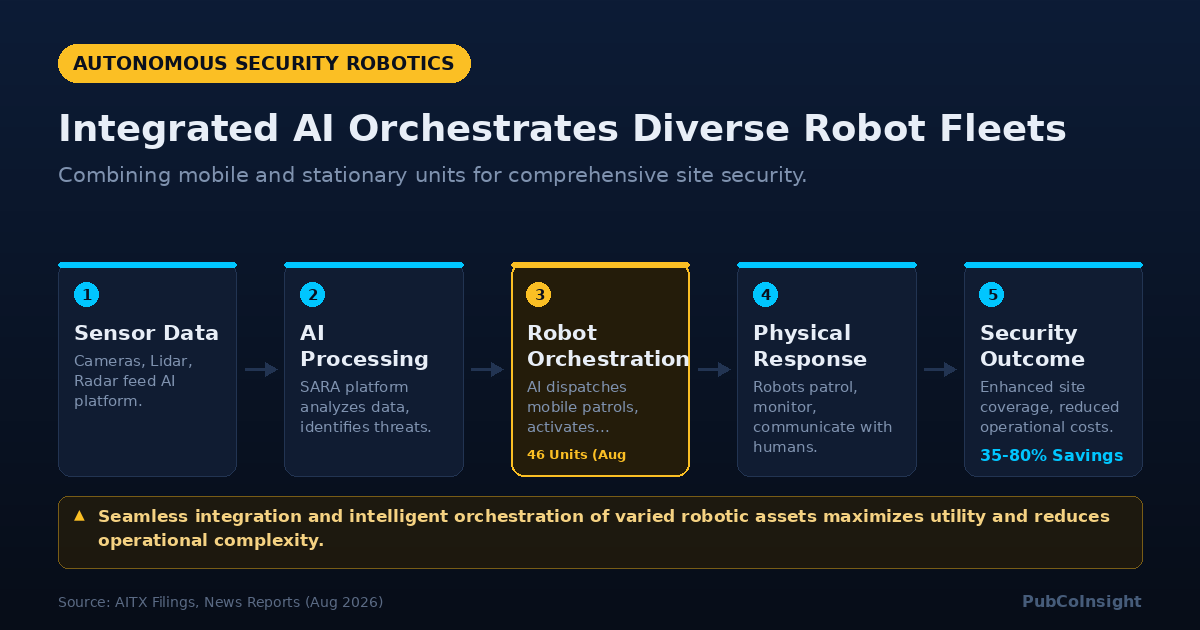
The Mechanism of Diversified Deployment
The core of this market shift lies in the evolution from specialized, fixed-function robots to adaptable, multi-solution platforms. Early autonomous security robots often focused on single tasks, like perimeter patrol or static surveillance. These units typically required extensive site-specific programming and infrastructure integration, limiting their rapid deployment and versatility. The current generation of systems, however, leverages more advanced AI and modular hardware to handle a broader array of security and operational tasks. Consider a large industrial campus. A few years ago, securing such a site might involve a series of fixed cameras, a few stationary security kiosks, and a human patrol. Today, an integrated autonomous system can combine these functions. A mobile robot, like AITX's ROAMEO, can patrol large areas, using onboard cameras and sensors for real-time threat detection. This unit can then communicate with stationary devices, such as a RAD-I security kiosk, which might handle access control or provide a direct audio/visual link to remote monitoring personnel. The key is the interoperability and the software layer, often an agentic AI platform like AITX's SARA, which orchestrates these disparate units. This software allows a single operator to manage a fleet of robots and stationary devices, responding to alerts, initiating patrols, and even engaging with individuals through two-way communication. The physical AI component is crucial. These robots are not just remote-controlled cameras. They use onboard processing to interpret sensor data, navigate complex environments, and make real-time decisions, such as identifying an unauthorized person or detecting a fire. This requires robust sensor fusion, combining data from cameras, lidar, radar, and acoustic sensors to build a comprehensive understanding of their surroundings. The value proposition for customers is not just cost reduction, often cited between 35% and 80% compared to manned security, but also enhanced consistency, tireless operation, and the ability to deploy resources rapidly to high-risk areas without human exposure. The constraint, and therefore the value, sits in the seamless integration and intelligent orchestration of these varied robotic assets, all controlled through a unified platform. A system that can deploy a mix of mobile and stationary units, each performing specialized tasks while contributing to a larger security ecosystem, offers a far more compelling solution than a collection of siloed devices. This integration reduces operational complexity for the end-user and maximizes the utility of each robot. Without this cohesive management layer, the potential of multi-unit deployments remains largely untapped.Companies Operating in This Sector
The push for diversified autonomous security solutions is evident across several companies. Serve Robotics Inc. (SERV), for example, has focused on last-mile delivery robots, demonstrating the operational capabilities of autonomous mobile platforms in urban environments. While their primary market is logistics, the underlying technology for navigation, obstacle avoidance, and human interaction shares common ground with security robotics. The ability to operate reliably in dynamic public spaces is a significant asset. In the drone space, companies like Ondas Inc. (ONDS) and Red Cat Holdings, Inc. (RCAT) are developing and deploying unmanned aerial vehicles for various applications, including infrastructure inspection and defense. While not directly in physical guarding services, their advancements in autonomous flight, sensor payloads, and data processing contribute to the broader ecosystem of AI-driven surveillance and reconnaissance, which complements ground-based security robots. Unusual Machines, Inc. (UMAC), also in the drone sector, has recently highlighted its NDAA-compliant expansion, indicating a focus on specific regulatory and defense market niches. These companies are pushing the boundaries of aerial autonomy, which can provide an overhead perspective to ground-based security systems. Other firms are building the foundational technologies that enable these autonomous systems. Arbe Robotics Ltd. (ARBE) specializes in 4D imaging radar solutions, a critical sensor technology for autonomous navigation and object detection in all weather conditions. This radar technology provides high-resolution perception that complements optical sensors, improving the reliability and safety of robots operating in complex environments. MicroVision, Inc. (MVIS) and Kopin Corporation (KOPN) are involved in lidar and micro-display technologies, respectively. Lidar is another key sensor for precise mapping and obstacle detection, essential for mobile robot navigation. Kopin's micro-displays are crucial for augmented reality interfaces, which could be integrated into remote operator stations for enhanced situational awareness. Lantronix, Inc. (LTRX) provides secure data access and management solutions, which are vital for connecting and managing distributed fleets of IoT devices and robots, ensuring reliable communication and data flow. BigBear.ai Holdings, Inc. (BBAI) focuses on AI-powered analytics and decision intelligence, which can be applied to process the vast amounts of data collected by autonomous security systems, turning raw sensor input into actionable intelligence for security personnel.Artificial Intelligence Technology Solutions, Inc.
Artificial Intelligence Technology Solutions, Inc. (AITX), trading as AITX on the OTCID tier, designs and deploys autonomous security robots and remote monitoring systems. The company operates through a Solutions-as-a-Service model, generating recurring monthly subscription revenue rather than one-off hardware sales. AITX's strategy focuses on delivering cost savings, estimated between 35% and 80%, compared to traditional manned security. The company's operations are structured around three primary pillars. Robotic Assistance Devices, Inc. (RAD-I) handles stationary security devices. Robotic Assistance Devices Mobile (RAD-M) encompasses mobile autonomous platforms, including the ROAMEO unit, which began early commercial deployment in May 2026. The third pillar is Robotic Assistance Devices Group (RAD-G), which includes the SARA agentic artificial intelligence platform. This platform is designed to orchestrate the various robotic assets and provide a unified interface for security operations. AITX also maintains Robotic Assistance Devices Lanka (Private) Limited (RAD Lanka) in Sri Lanka, which supports software development, AI initiatives, and technical operations. The company's internal vision for an integrated, large-scale autonomous security deployment is referred to as "RAD Town," envisioning a comprehensive security solution across a campus, community, or even a broader jurisdiction. For the fiscal year ended February 28, 2026, AITX reported revenue of $7,745,336, an increase of 26% from the prior fiscal year. Gross profit rose 48% to $5,533,700, with gross margin expanding to approximately 71% from 61%. Operating expenses remained largely flat at $17,477,097. The company's loss from operations improved by approximately $2.0 million, reaching $(11,943,397). AITX reported a net loss of approximately $14.5 million for the fiscal year and an accumulated deficit of approximately $171 million as of February 28, 2026. The company had negative cash flow from operating activities of $9,344,534 for the fiscal year. As of February 28, 2026, AITX had negative working capital of $17,017,745. The public record does not yet establish a clear path to positive cash flow from operations, which management does not anticipate in the near term. Despite this, the company's filings indicate a plan to expand the ROAMEO deployment pipeline and scale production readiness, targeting 50 units by August 2027. The August 2026 order intakes, totaling 46 units, suggest progress toward these deployment goals across its diverse solution set.What to watch
The immediate focus for the autonomous security robotics sector will be on continued order flow and deployment figures, particularly from companies like AITX. Look for further updates on the expansion of the ROAMEO mobile security unit deployments, as the company has stated a goal of 50 units by August 2027. Specific customer wins and the types of environments where these multi-solution packages are deployed will indicate market acceptance and operational scalability. Beyond AITX, watch for quarterly earnings reports from companies like Serve Robotics (SERV) for insights into their operational metrics and expansion plans in last-mile delivery, which can inform the broader mobile robotics market. For drone-focused entities like Ondas (ONDS) and Red Cat Holdings (RCAT), monitor any announcements regarding new government contracts, particularly those related to NDAA compliance, and the integration of their aerial platforms with ground-based security systems. Any developments in sensor technology from Arbe Robotics (ARBE) or MicroVision (MVIS) that enhance robot perception and autonomy will also be significant. Finally, observe any shifts in the recurring revenue models across the sector, as the Solutions-as-a-Service approach gains traction over outright hardware sales., { "label": "AI Processing", "note": "SARA platform analyzes data, identifies threats." }, { "label": "Robot Orchestration", "note": "AI dispatches mobile patrols, activates stationary units.", "metric": "46 Units (Aug 2026)" }, { "label": "Physical Response", "note": "Robots patrol, monitor, communicate with humans." }, { "label": "Security Outcome", "note": "Enhanced site coverage, reduced operational costs.", "metric": "35-80% Savings" } ], "highlight": 2, "highlight_note": "Seamless integration and intelligent orchestration of varied robotic assets maximizes utility and reduces operational complexity.", "footnote": "Source: AITX Filings, News Reports (Aug 2026)" }Companies mentioned
| Ticker | Company | Price |
|---|---|---|
| AITX client | Artificial Intelligence Technology Solutions Inc | $0.0044 |
| ARBE | Arbe Robotics Ltd. | $0.653 |
| BBAI | BigBear.ai Holdings, Inc. | $3.13 |
| KOPN | Kopin Corporation | $4.44 |
| LTRX | Lantronix, Inc. | $5.3 |
| MVIS | MicroVision, Inc. | $1.81 |
| ONDS | Ondas Inc. | $7.655 |
| RCAT | Red Cat Holdings, Inc. | $8.59 |
| SERV | Serve Robotics Inc. | $4.87 |
| UMAC | Unusual Machines, Inc. | $23.67 |
Listed alphabetically, not ranked. Prices as of 2026-09-01 and they move. Check a live quote before relying on any of this.
How we chose the companies in this article
We cover a fixed universe of companies working in autonomous security robotics, physical AI and the guarding services market they are aimed at. Every one of them that had usable market data on 2026-09-01 appears in this article. We do not pick which ones to mention based on what we think of them, and we do not order them by size, price or trading volume, because an ordered list is a verdict and that is not ours to hand down. Companies left out, and why: none. American Lithium Minerals and Artificial Intelligence Technology Solutions pay us, which is disclosed in full at the foot of every article they appear in.
See the dilution and promotion flags before you see the pitch.
Each week: the micro and small-caps now showing dilution or paid-promotion signals, with the SEC filing behind every flag. No recommendations, no price targets.
Sources used in this article
- Should You Put 5% of Your Portfolio in Bitcoin? Here's What the Numbers Say. Motley Fool · 2026-09-01
- The Stock Market Is Flashing a Major Red Flag Seen Only Once Before. Here's What's Different This Time. Motley Fool · 2026-09-01
- AMD vs. Nvidia: SpaceX and Tesla CEO Elon Musk Weighs In on His Top Pick Motley Fool · 2026-09-01
- Can't Decide Between Investing in Rare-Earth Materials and Nuclear Energy? This Under-the-Radar Stock Provides Exposure to Both Industries. Motley Fool · 2026-09-01
- If You'd Invested $5,000 in the Vanguard S&P 500 ETF (VOO) a Decade Ago, Here's What You'd Have Today Motley Fool · 2026-09-01
- Nvidia's Rubin CPX Back From the Dead? Ming-Chi Kuo Says AI Chip Back With Major Redesign Benzinga · 2026-09-01
- Dell Reports Tuesday, and Its Server Margin Is Where the AI Memory Bill Finally Reaches the Stock Motley Fool · 2026-09-01
- Nvidia Just Paused Part of Its AI Financing Machine. The Timing Is Awkward Insider Monkey · 2026-09-01
- Why CrowdStrike Stock Keeps Going Up Motley Fool · 2026-09-01
- The Nasdaq Has Fallen in 48% of Septembers Since 1971. Here's What That Means for Nvidia and Micron. Motley Fool · 2026-09-01
- Reasons Why Allegion Stock Should Be in Your Portfolio Now Zacks · 2026-08-31
- Serve Robotics vs. Symbotic: Which Robotics Stock Is More Compelling? Zacks · 2026-08-31
Disclosure required by Section 17(b) of the Securities Act of 1933
Artificial Intelligence Technology Solutions, Inc., a Nevada corporation (OTCID: AITX). Artificial Intelligence Technology Solutions, Inc. pays Strategic Innovations First, Inc., a Wyoming corporation doing business as PulseIR. Compensation received: USD 5,000.00 per month for months 1-3 (August, September, October 2026); USD 10,000.00 per month for months 4-6 (November, December 2026, January 2027) contingent on the 90-day review. Minimum committed USD 15,000.00; USD 45,000.00 if the second-period rate triggers.. Form of payment: cash only, invoiced monthly in advance; no stock, options or warrants received or payable. Services: investor relations services under an Investor Relations Services Agreement effective 2026-08-01. Period: six month term, 2026-08-01 through 2027-01-31; 90-day review on or about 2026-10-30. No stock, options or warrants held by PubCo Insight, Pulse IR, Strategic Innovations First, Inc., or Brad Listermann. Confirmed by the executed agreement and by board record recKwdq39X2caPSX7 (POSITIONS HELD: none).
This is information, not investment, financial, legal or tax advice. It is not a recommendation or solicitation to buy, sell or hold any security and it contains no price target. Nothing here is independently verified by us. Confirm every figure against primary filings on SEC EDGAR before you act. Micro-cap and over-the-counter securities are speculative and illiquid and can lose all of their value. The companies named without a disclosure above pay us nothing and have no relationship with us; they are named because a published, mechanical screen selected them. Full disclosure policy.