Kazakhstan Autonomous Vehicle Push Signals New Market Entry Models
Pony AI and Nvidia’s recent collaboration for autonomous vehicle deployment in Kazakhstan highlights a shift toward new geographical partnerships and integrated technology stacks for global market entry.
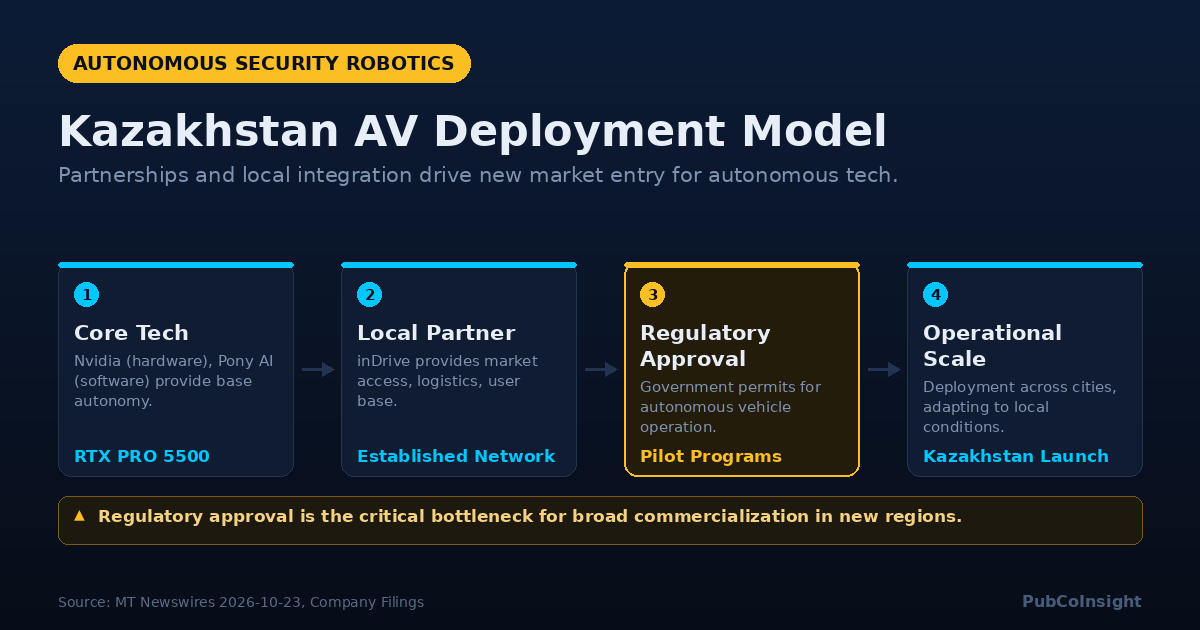
The Mechanism of Market Entry
Deploying autonomous vehicles or security robots in a new country involves several layers of integration. First, the core technology must adapt to local conditions. This includes mapping infrastructure, navigating diverse weather patterns, and recognizing regional signage. Second, regulatory approval is paramount. Governments must establish clear guidelines for autonomous operation, liability, and data privacy. This often involves pilot programs and extensive testing. Third, local partnerships are essential for logistics, maintenance, and customer support. A company cannot simply drop hardware into a new market and expect it to function effectively without local expertise. The Pony AI and Nvidia collaboration addresses these points directly. Nvidia provides the underlying AI computing platform, likely leveraging its RTX PRO 5500 GPUs, which are seeing significant investment from major tech firms like ByteDance and Alibaba. Pony AI contributes its autonomous driving software and operational experience. The key differentiator here is inDrive. This local partner brings established logistical networks, a user base, and critical insights into the Kazakhstani market. This combination accelerates the path to commercialization by distributing the technical and operational burden across multiple specialized entities. The success of this model hinges on the seamless integration of these disparate components, from hardware to local service delivery. A failure in any one of these stages, particularly regulatory approval or local operational efficiency, would significantly impede deployment.Companies Operating in Autonomous Security and Physical AI
The broader autonomous security and physical AI sector spans a range of technologies, from perception systems to mobile robotics and data analytics. Companies like Arbe Robotics Ltd. (ARBE) focus on advanced radar technology. Arbe recently introduced its Gryphon Radar System, designed for reliable perception in unmanned ground vehicles operating on rough terrain. This type of specialized sensor technology is critical for autonomous platforms navigating complex environments, whether in security or logistics. MicroVision, Inc. (MVIS) and Kopin Corporation (KOPN) are engaged in optical and display technologies. Kopin, for example, is exploring optical interconnect architectures to address data center bottlenecks, modeling significant GPU utilization increases with its Neural I/o™-Powered Data Center. While not directly in physical security robotics, advancements in high-speed data transfer and processing are foundational for robust AI systems powering autonomous devices. In the drone and unmanned systems space, Unusual Machines, Inc. (UMAC) recently secured a $16.9 million order from Powerus for American-made drone components. Unusual Machines also completed the acquisition of Upgrade Energy, expanding its U.S. drone battery manufacturing capabilities. These developments highlight the growing demand for specialized components and the importance of domestic supply chains in the autonomous sector. Red Cat Holdings, Inc. (RCAT) also operates in the drone sector, providing various drone solutions. Other companies, such as Ondas Inc. (ONDS), are developing wireless and autonomous solutions. Ondas, in collaboration with Palantir, launched Regna AI to expand sovereign AI capabilities, and is pursuing EASA certification to boost its airborne defense prospects. This indicates a focus on secure, high-performance communication and AI for critical infrastructure and defense applications. Lantronix, Inc. (LTRX) provides secure data access and management solutions, enabling the robust connectivity required for distributed autonomous systems. Serve Robotics Inc. (SERV) specializes in sidewalk delivery robots, an area that requires precise navigation and interaction with public spaces. BigBear.ai Holdings, Inc. (BBAI) offers AI-powered analytics and decision intelligence, providing the backend processing and insights for complex autonomous operations.Artificial Intelligence Technology Solutions, Inc.
Artificial Intelligence Technology Solutions, Inc. (AITX) operates through its subsidiaries, developing and leasing AI-driven security robots and remote monitoring systems. The company sells its solutions on a recurring monthly subscription basis. AITX’s primary subsidiary, Robotic Assistance Devices, Inc. (RAD-I), targets the security and guarding services industry, which it estimates as a $50 billion market in the United States. The company states its solutions can deliver cost savings between 35% and 80% compared to traditional manned security. AITX’s operations are structured around three main pillars. First, stationary security devices are managed by RAD-I. Second, mobile autonomous platforms fall under Robotic Assistance Devices Mobile (RAD-M), including the ROAMEO mobile security unit, which began early commercial deployment in May 2026. Third, the company’s SARA agentic artificial intelligence platform is handled by Robotic Assistance Devices Group (RAD-G). A wholly-owned subsidiary, RAD Lanka, located in Sri Lanka and operating under Port City Colombo status, supports software development, AI initiatives, and technical operations across the company’s subsidiaries. Internally, AITX refers to the long-term goal of this integrated strategy as "RAD Town," envisioning comprehensive autonomous-security deployments across campuses, communities, or larger jurisdictions. For the fiscal year ended February 28, 2026, AITX reported revenue of $7,745,336, a 26% increase over the prior fiscal year. Gross profit rose 48% to $5,533,700, with gross margin expanding to approximately 71% from 61%. Operating expenses remained flat at about $17,477,097, leading to an improved loss from operations of $(11,943,397). The company reported a net loss of approximately $14.5 million for the fiscal year and had an accumulated deficit of approximately $171 million as of that date. AITX has stated its intention to achieve monthly operating cash breakeven in January 2027, ahead of projected revenue ramps for its RAIA, SARA, and ROAMEO platforms. The public record does not yet establish consistent positive cash flow from operations for AITX. The company recently engaged security industry veteran Tom Reilly to drive strategy for new integrator and distribution channels, aiming to expand its market reach. On October 22, 2026, AITX’s RAD secured orders across three product lines, indicating continued product adoption.What to watch
Several concrete developments will indicate the direction of this market. Keep an eye on regulatory announcements from the Kazakhstani government regarding autonomous vehicle permits, specifically those naming Pony AI or Nvidia. Any public statements from inDrive about the operational rollout or early pilot results will be key. For Unusual Machines, watch for further updates on the Powerus order and the integration of Upgrade Energy’s battery manufacturing. Serve Robotics will report its third-quarter 2026 financial results on November 5, providing insight into its delivery robot deployments. Axon Enterprise (AXON) will release its third-quarter 2026 earnings on November 5. ADT (ADT) is scheduled to release its third-quarter 2026 results on November 3. For AITX, monitor the company’s filings for updates on its stated goal of achieving monthly operating cash breakeven in January 2027, particularly regarding revenue growth from its RAIA, SARA, and ROAMEO platforms, and any further announcements related to new distribution channels., { "label": "Local Partner", "note": "inDrive provides market access, logistics, user base.", "metric": "Established Network" }, { "label": "Regulatory Approval", "note": "Government permits for autonomous vehicle operation.", "metric": "Pilot Programs" }, { "label": "Operational Scale", "note": "Deployment across cities, adapting to local conditions.", "metric": "Kazakhstan Launch" } ], "highlight": 2, "highlight_note": "Regulatory approval is the critical bottleneck for broad commercialization in new regions.", "footnote": "Source: MT Newswires 2026-10-23, Company Filings" }Companies mentioned
| Ticker | Company | Price |
|---|---|---|
| AITX client | Artificial Intelligence Technology Solutions Inc | $0.0015 |
| ARBE | Arbe Robotics Ltd. | $0.439 |
| BBAI | BigBear.ai Holdings, Inc. | $2.13 |
| KOPN | Kopin Corporation | $3.35 |
| LTRX | Lantronix, Inc. | $5.61 |
| MVIS | MicroVision, Inc. | $1.14 |
| ONDS | Ondas Inc. | $6.02 |
| RCAT | Red Cat Holdings, Inc. | $4.37 |
| SERV | Serve Robotics Inc. | $2.88 |
| UMAC | Unusual Machines, Inc. | $16.27 |
Listed alphabetically, not ranked. Prices as of 2026-10-23 and they move. Check a live quote before relying on any of this.
How we chose the companies in this article
We cover a fixed universe of companies working in autonomous security robotics, physical AI and the guarding services market they are aimed at. Every one of them that had usable market data on 2026-10-23 appears in this article. We do not pick which ones to mention based on what we think of them, and we do not order them by size, price or trading volume, because an ordered list is a verdict and that is not ours to hand down. Companies left out, and why: none. American Lithium Minerals and Artificial Intelligence Technology Solutions pay us, which is disclosed in full at the foot of every article they appear in.
See the dilution and promotion flags before you see the pitch.
Each week: the micro and small-caps now showing dilution or paid-promotion signals, with the SEC filing behind every flag. No recommendations, no price targets.
Sources used in this article
- Stock market today: Dow, S&P 500, Nasdaq wobble after sharp tech sell-off Yahoo Finance · 2026-10-23
- The Hardware Ceiling: ByteDance, Alibaba, and Tencent Bet $35B on the RTX PRO 5500 Forkast News · 2026-10-23
- Nasdaq, Dow, S&P 500 Futures Drop Premarket: NVDA, AMD, META, CRWV, MRNA, WDC, BE In Focus Stocktwits · 2026-10-23
- This All-Star Stock Just Plunged. It Could Be a Massive Buying Opportunity Motley Fool · 2026-10-23
- Better Dividend Stock to Buy and Hold: Pfizer or Bristol Myers Squibb? Motley Fool · 2026-10-23
- Is 2027 the Turnaround Year for These 4 EV and Air Taxi Stocks? Motley Fool · 2026-10-23
- Warren Buffett's Successor, Greg Abel, Has 32% of Berkshire Hathaway's $364 Billion Portfolio Invested in 3 Unstoppable AI Stocks Motley Fool · 2026-10-23
- Pony AI Unveils Collaboration With Nvidia, inDrive to Explore Launch of Autonomous Vehicles in Kazakhstan MT Newswires · 2026-10-23
- Stock-Split Watch: Is ASML Next? Motley Fool · 2026-10-23
- Better Memory Stock: Micron vs. Sandisk Motley Fool · 2026-10-23
- Axon to Release Third Quarter 2026 Earnings on November 5, 2026 PR Newswire · 2026-10-22
- Serve Robotics to Report Third Quarter 2026 Financial Results, Host Conference Call and Webcast on November 5 GlobeNewswire · 2026-10-22
Disclosure required by Section 17(b) of the Securities Act of 1933
Artificial Intelligence Technology Solutions, Inc., a Nevada corporation (OTCID: AITX). Artificial Intelligence Technology Solutions, Inc. pays Strategic Innovations First, Inc., a Wyoming corporation doing business as PulseIR. Compensation received: USD 5,000.00 per month for months 1-3 (August, September, October 2026); USD 10,000.00 per month for months 4-6 (November, December 2026, January 2027) contingent on the 90-day review. Minimum committed USD 15,000.00; USD 45,000.00 if the second-period rate triggers.. Form of payment: cash only, invoiced monthly in advance; no stock, options or warrants received or payable. Services: investor relations services under an Investor Relations Services Agreement effective 2026-08-01. Period: six month term, 2026-08-01 through 2027-01-31; 90-day review on or about 2026-10-30. No stock, options or warrants held by PubCo Insight, Pulse IR, Strategic Innovations First, Inc., or Brad Listermann. Confirmed by the executed agreement and by board record recKwdq39X2caPSX7 (POSITIONS HELD: none).
This is information, not investment, financial, legal or tax advice. It is not a recommendation or solicitation to buy, sell or hold any security and it contains no price target. Nothing here is independently verified by us. Confirm every figure against primary filings on SEC EDGAR before you act. Micro-cap and over-the-counter securities are speculative and illiquid and can lose all of their value. The companies named without a disclosure above pay us nothing and have no relationship with us; they are named because a published, mechanical screen selected them. Full disclosure policy.