Nvidia Leadership Instability Rattles AI Robotics Supply Chain
The reported board preparations to oust Nvidia CEO Jensen Huang on November 12, 2026, introduce significant uncertainty for autonomous security robotics firms relying on advanced AI hardware.
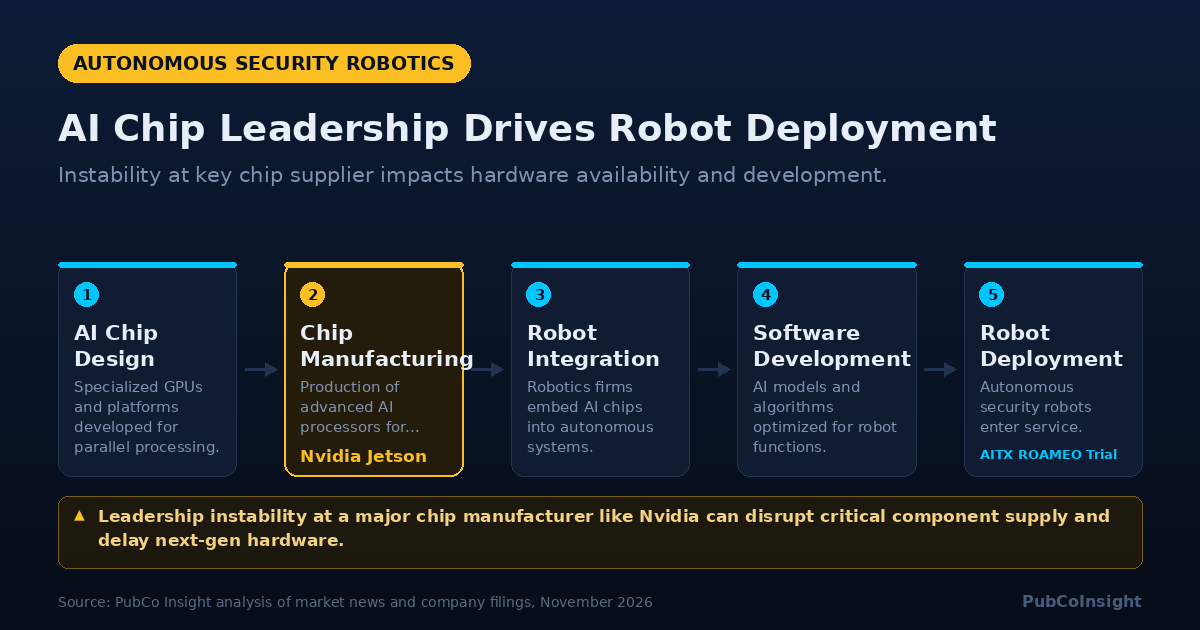
The Mechanism of Disruption
Autonomous security robots, from patrol units to delivery bots, rely on specialized AI processing units for real-time perception, navigation, and decision-making. Nvidia's GPUs and AI platforms, like Jetson, are foundational components across the industry. These chips are not interchangeable with standard processors. They are designed for parallel processing, crucial for the complex neural network computations that power computer vision, sensor fusion, and predictive analytics in a robot. The underlying architecture involves thousands of small, efficient cores working simultaneously, a stark contrast to the fewer, more powerful cores in a traditional CPU. This parallel design allows robots to process vast streams of data from cameras, lidar, and radar in milliseconds, enabling immediate responses to dynamic environments. A leadership change at Nvidia could impact this supply chain in several ways. Strategic shifts in product development, changes in manufacturing priorities, or even a temporary slowdown in decision-making can ripple through the ecosystem. Any delay in next-generation chip releases or alterations to existing product lines could force robotics companies to re-engineer their hardware, delaying product launches and increasing costs. Furthermore, Nvidia's extensive developer ecosystem and software tools are deeply integrated into many robotics platforms. A shift in corporate direction could affect support for these tools, creating compatibility challenges and development bottlenecks. The value sits squarely at the chip design and manufacturing stage, where specialized AI hardware is produced. Without these advanced processors, the sophisticated AI capabilities of autonomous robots cannot function effectively.Operators in the Sector
Several companies operate within this specialized market, each with a distinct approach to autonomous security and physical AI. Axon Enterprise (AXON), though larger and more diversified, touches this space through its public safety technology, including body cameras and TASER devices. Its focus remains on law enforcement and security personnel, but the underlying AI and sensor technologies it develops for its human-centric tools often overlap with those used in autonomous systems. Axon's recent performance saw its stock sink 27% in a week to a new 52-week low on November 10, following Q3 results, with Argus Research adjusting its price target from $600 to $380. In the drone and unmanned systems segment, Ondas Inc. (ONDS) is making moves in tactical applications. On November 10, Ondas received a purchase order for next-generation tactical attack drones and aims to leverage a planned ARAN Defense acquisition to manufacture thousands of systems. This indicates a focus on specialized, high-performance autonomous systems for defense. The company’s stock rose overnight on November 11 on news of new 'Digital Bat' drones orders ahead of earnings. Red Cat Holdings, Inc. (RCAT) also operates in the drone space, often focusing on commercial and defense applications. Their strategy involves developing and integrating drone hardware and software solutions, including those for reconnaissance and security. For micro-display and optical solutions, Kopin Corporation (KOPN) plays a role in the visual interfaces for various robotic and augmented reality applications. Their Q3 2026 earnings call highlighted a 52% revenue surge on funded programs, with Fabric.AI filing a U.S. patent application to utilize surplus MicroLED channels for fault tolerance and faster GPU synchronization on November 11. This suggests their technology could enhance the visual perception and processing capabilities of advanced robotic systems. Kopin reported a Q3 loss but beat revenue estimates. Companies like Arbe Robotics Ltd. (ARBE) and MicroVision, Inc. (MVIS) are critical for advanced sensing. Arbe focuses on 4D imaging radar solutions, providing high-resolution perception for autonomous vehicles and robots, crucial for navigating complex environments safely. MicroVision develops lidar technology, another key sensor for spatial mapping and object detection, essential for autonomous navigation. Lantronix, Inc. (LTRX) provides secure data access and management solutions for the Internet of Things (IoT) and embedded computing. Their technology enables the connectivity and remote management of autonomous devices, ensuring data integrity and operational continuity for robotic fleets. Serve Robotics Inc. (SERV) is a direct player in autonomous delivery, deploying sidewalk robots for last-mile logistics. On November 11, Serve Robotics opened its autonomous delivery fleet to developers through a new API, allowing external parties to build on their robot delivery network. This move aims to expand the utility and reach of their physical AI platforms. Despite this, analysts lowered targets, cutting Serve Robotics' fair value. BigBear.ai Holdings, Inc. (BBAI) provides AI-powered analytics and decision intelligence, often for defense and government clients. While not directly building robots, their software can feed into the operational intelligence of autonomous security systems, enhancing their strategic capabilities and threat assessment. Finally, Unusual Machines, Inc. (UMAC), though less frequently in the news, represents the innovative edge of the sector, often exploring novel applications or hardware designs for autonomous systems.Artificial Intelligence Technology Solutions, Inc.
Artificial Intelligence Technology Solutions, Inc. (AITX) trades over the counter under the ticker AITX. The company, through its subsidiaries, focuses on building and leasing autonomous security robots and remote monitoring systems. AITX generates revenue through recurring monthly subscriptions for its services, rather than one-off hardware sales. This model aims to provide predictable revenue streams from its deployed robot fleet. The company's recent filings, including an 8-K on November 10, 2026, indicate a focus on its fifteen-initiative product roadmap, concentrating engineering efforts behind its RAIA, ROAMEO, and SARA platforms. On November 11, AITX's RAD subsidiary announced plans for a 30-day ROAMEO security robot trial at a corrections facility, aiming to address the high costs of corrections patrols. AITX's most recent substantive filing, the 10-Q for the six months ended August 31, 2026, details its financial position. The company reported negative cash flow from operating activities of $4,820,842 for the six months ended August 31, 2026. As of that date, AITX had an accumulated deficit of $184,084,880 and negative working capital of $55,894,870. Management does not anticipate positive cash flow from operations in the near future. These factors, as stated in the filing, raise substantial doubt about the company's ability to continue as a going concern for the twelve months following the issuance of the financial statements. Management has a stated plan to address this financial situation by raising funds through growing revenues, equity proceeds, and issuing debt. On June 23, 2026, the company entered an equity financing agreement to purchase up to $10,000,000 of common stock at a discount over three years, with approximately $9.8 million remaining under this arrangement. The filing also lists various loans payable, with several promissory notes maturing on October 31, 2026, and November 15, 2026, carrying interest rates of 15%. The public record does not yet establish a clear path to sustained positive operating cash flow for AITX. Despite this, the company continues to deploy revenue-earning devices, which totaled $4,677,987 net of accumulated depreciation as of August 31, 2026. Accounts receivable stood at $947,146, and device parts inventory was $1,261,080. The company's strategy involves continued product development and market penetration, as evidenced by the ROAMEO trial.What to watch
Investors should monitor Nvidia's board decisions regarding Jensen Huang's leadership. Any formal announcement or resolution from the board will offer clarity on the stability of a key supply chain component. Watch for further details on Ondas Inc.'s planned ARAN Defense acquisition and the scaling of its ULTRA aircraft output. The company's ability to manufacture thousands of tactical attack drones will indicate its operational ramp-up. For Serve Robotics Inc., track the adoption and integration of its new developer API. The number of external developers building on its network will demonstrate the platform's ecosystem growth. Review AITX's upcoming filings for updates on its financial position, specifically its progress in raising funds and managing debt obligations. The outcome of the 30-day ROAMEO security robot trial at the corrections facility will provide concrete data on the robot's performance and potential for broader adoption in that market segment., { "label": "Chip Manufacturing", "note": "Production of advanced AI processors for robotics.", "metric": "Nvidia Jetson" }, { "label": "Robot Integration", "note": "Robotics firms embed AI chips into autonomous systems." }, { "label": "Software Development", "note": "AI models and algorithms optimized for robot functions." }, { "label": "Robot Deployment", "note": "Autonomous security robots enter service.", "metric": "AITX ROAMEO Trial" } ], "highlight": 1, "highlight_note": "Leadership instability at a major chip manufacturer like Nvidia can disrupt critical component supply and delay next-gen hardware.", "footnote": "Source: PubCo Insight analysis of market news and company filings, November 2026" }Companies mentioned
| Ticker | Company | Price |
|---|---|---|
| AITX client | Artificial Intelligence Technology Solutions Inc | $0.0004 |
| ARBE | Arbe Robotics Ltd. | $0.507 |
| BBAI | BigBear.ai Holdings, Inc. | $2.3 |
| KOPN | Kopin Corporation | $3.72 |
| LTRX | Lantronix, Inc. | $4.73 |
| MVIS | MicroVision, Inc. | $1.14 |
| ONDS | Ondas Inc. | $5.73 |
| RCAT | Red Cat Holdings, Inc. | $4.29 |
| SERV | Serve Robotics Inc. | $3.165 |
| UMAC | Unusual Machines, Inc. | $12.65 |
Listed alphabetically, not ranked. Prices as of 2026-11-12 and they move. Check a live quote before relying on any of this.
How we chose the companies in this article
We cover a fixed universe of companies working in autonomous security robotics, physical AI and the guarding services market they are aimed at. Every one of them that had usable market data on 2026-11-12 appears in this article. We do not pick which ones to mention based on what we think of them, and we do not order them by size, price or trading volume, because an ordered list is a verdict and that is not ours to hand down. Companies left out, and why: none. American Lithium Minerals and Artificial Intelligence Technology Solutions pay us, which is disclosed in full at the foot of every article they appear in.
See the dilution and promotion flags before you see the pitch.
Each week: the micro and small-caps now showing dilution or paid-promotion signals, with the SEC filing behind every flag. No recommendations, no price targets.
Sources used in this article
- China chip stocks rally as U.S. weighs curbs on remote AI access Investing.com · 2026-11-12
- This 1 Important Signal Is Now Flashing Red for Ethereum. That's Why I'm Selling ETH Right Now. Motley Fool · 2026-11-12
- What Happens to Nvidia Stock if Jensen Huang Is Fired? History Has a Warning BeInCrypto · 2026-11-12
- Nvidia faces governance risks; watch these 2 chip stocks for buy opportunities Investing.com · 2026-11-12
- 3 Stocks For Investors Seeking Shelter From Nvidia Leadership Risk Simply Wall St. · 2026-11-12
- Stock Market: Will S&P 500 Open Up or Down Today? Benzinga Prediction Markets · 2026-11-12
- Nvidia live updates: Stock tanks after new affair allegations, board reportedly preparing to oust Jensen Huang Yahoo Finance · 2026-11-12
- Where Will Robinhood Be in 3 Years? Motley Fool · 2026-11-12
- Alibaba, Tencent shares fall on report U.S. weighs curbs on remote AI chip access Investing.com · 2026-11-12
- Morning Bid: Jensen hangs on as Nvidia tumbles Reuters · 2026-11-12
- ONDS Stock Eyes Green Week: Retail Awaits Ondas’ Defense Powerhouse Validation As Crucial Earnings Loom Stocktwits · 2026-11-12
- What Is The True Hidden Price Of Axon Stock? Trefis · 2026-11-11
Disclosure required by Section 17(b) of the Securities Act of 1933
Artificial Intelligence Technology Solutions, Inc., a Nevada corporation (OTCID: AITX). Artificial Intelligence Technology Solutions, Inc. pays Strategic Innovations First, Inc., a Wyoming corporation doing business as PulseIR. Compensation received: USD 5,000.00 per month for months 1-3 (August, September, October 2026); USD 10,000.00 per month for months 4-6 (November, December 2026, January 2027) contingent on the 90-day review. Minimum committed USD 15,000.00; USD 45,000.00 if the second-period rate triggers.. Form of payment: cash only, invoiced monthly in advance; no stock, options or warrants received or payable. Services: investor relations services under an Investor Relations Services Agreement effective 2026-08-01. Period: six month term, 2026-08-01 through 2027-01-31; 90-day review on or about 2026-10-30. No stock, options or warrants held by PubCo Insight, Pulse IR, Strategic Innovations First, Inc., or Brad Listermann. Confirmed by the executed agreement and by board record recKwdq39X2caPSX7 (POSITIONS HELD: none).
This is information, not investment, financial, legal or tax advice. It is not a recommendation or solicitation to buy, sell or hold any security and it contains no price target. Nothing here is independently verified by us. Confirm every figure against primary filings on SEC EDGAR before you act. Micro-cap and over-the-counter securities are speculative and illiquid and can lose all of their value. The companies named without a disclosure above pay us nothing and have no relationship with us; they are named because a published, mechanical screen selected them. Full disclosure policy.