Nvidia Board Probe Adds Pressure to AI Robotics Supply Chain
An internal investigation into Nvidia CEO Jensen Huang's conduct, reported November 8th and 9th, creates new uncertainty for the high-end AI chips that power advanced autonomous security robots.
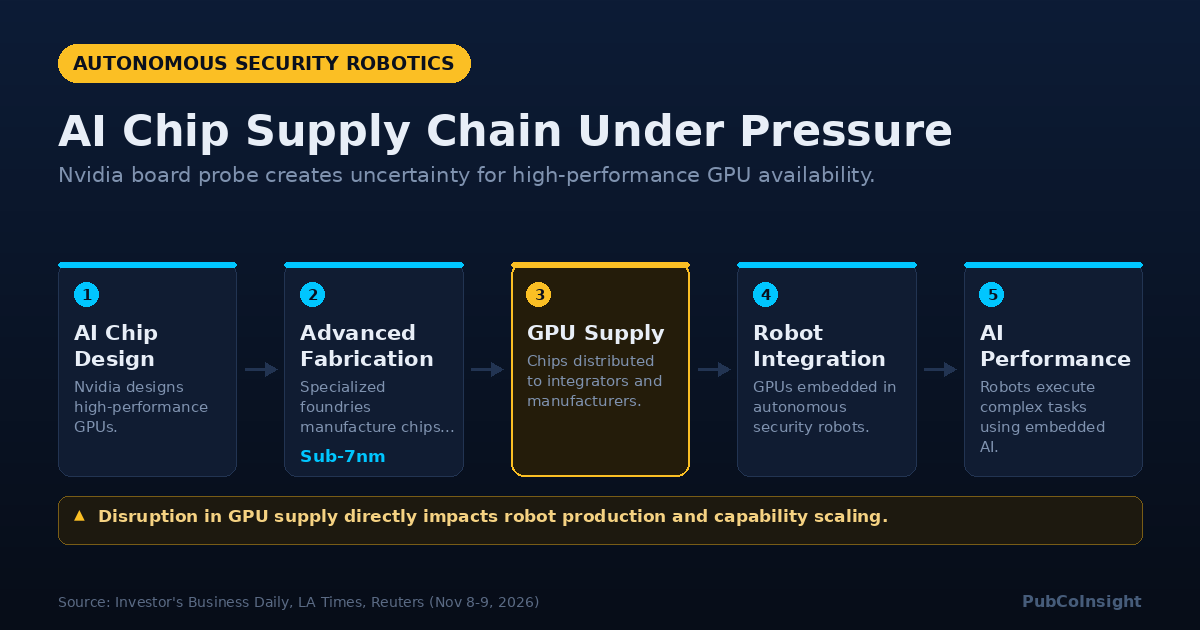
The Mechanism of AI Robotics Performance
Autonomous security robots, from stationary sentinels to mobile patrols, depend on sophisticated AI to perceive their environment, make decisions, and execute complex tasks. This AI capability is not abstract; it is directly tied to the processing power of the embedded chips. These robots use neural networks for object detection, facial recognition, anomaly detection, and predictive analytics. A robot patrolling a logistics yard, for instance, must process live video feeds, identify vehicles, distinguish authorized personnel from intruders, and flag unusual behavior, all in real-time. This requires immense parallel processing, a domain where specialized Graphics Processing Units, or GPUs, excel. The bottleneck sits in the fabrication of these high-end GPUs. Designing them is one challenge, but manufacturing them at scale, with the necessary precision and yield, is another entirely. This involves advanced lithography, using extreme ultraviolet (EUV) light to etch circuits at nanometer scales. Only a handful of foundries globally possess this capability, making the supply chain highly concentrated. Any disruption, whether from geopolitical tensions, natural disasters, or, as we see now, internal corporate instability at a key design firm, can slow the flow of these critical components. Without these chips, the computational backbone of advanced physical AI systems weakens, impacting not just new deployments but also the development of next-generation capabilities. The ability to process more data faster allows for more sophisticated AI models, leading to better threat detection, fewer false positives, and more reliable autonomous operation in dynamic environments.Operators in the Autonomous Security Robotics Sector
The companies operating in this space are diverse, ranging from those building the robots themselves to those developing the underlying AI and sensing technologies. Their success often hinges on securing access to advanced computing power. Unusual Machines, Inc. (UMAC), trading at $11.9, recently highlighted its Q3 earnings, with revenue soaring 551% as its defense sector engagements expanded. This suggests a reliance on robust processing for specialized applications, likely involving advanced sensor fusion and real-time decision-making in complex operational environments. Ondas Inc. (ONDS), priced at $5.335, saw its shares climb 18% recently, with drone stocks rebounding ahead of its earnings report. Ondas focuses on critical infrastructure and government markets, where secure and reliable drone operations are paramount. Their systems likely require edge AI processing for navigation, payload control, and data analysis in remote or contested areas. Red Cat Holdings, Inc. (RCAT), at $4.04, also saw a jump, indicating broader market interest in drone capabilities. Red Cat’s focus on drone software and hardware for enterprise and government suggests a need for reliable, high-performance computing to manage drone fleets and process collected data. Serve Robotics Inc. (SERV), trading at $3.22, announced Q3 revenue surging over 300% and launched physical AI services, opening its robot fleet technology to other companies. Serve’s delivery robots operate in urban environments, requiring real-time navigation, obstacle avoidance, and interaction capabilities, all powered by embedded AI. The expansion into offering their underlying physical AI services means more companies will depend on their robust computational infrastructure. Axon Enterprise (AXON), despite a recent downgrade and drop to a two-year low, committed $1.2 billion to a public safety drone deal. Priced at $1.2 billion, this investment underscores a significant belief in the future of autonomous systems for first responders. Axon’s strategy involves integrating drones into existing public safety frameworks, which will demand reliable, high-speed AI processing for live video analysis, situational awareness, and coordinated response. Further up the component stack, companies like Arbe Robotics Ltd. (ARBE), at $0.434, develop 4D imaging radar solutions, a critical sensor for autonomous systems. The data generated by such advanced radar requires substantial processing to create a coherent environmental model. MicroVision, Inc. (MVIS), at $1.16, focuses on lidar technology for automotive and industrial applications, another data-intensive sensor that feeds into AI decision-making. Kopin Corporation (KOPN), priced at $3.04, provides micro-displays and optical modules, essential for human-machine interfaces in robotics and augmented reality systems. Lantronix, Inc. (LTRX), at $5.17, offers embedded computing and networking solutions, crucial for connecting and managing distributed robotic systems and their data. BigBear.ai Holdings, Inc. (BBAI), at $2.22, provides AI-powered analytics and decision intelligence, often leveraging data from autonomous platforms.Artificial Intelligence Technology Solutions, Inc.
Artificial Intelligence Technology Solutions, Inc. (AITX), trading over the counter at $0.0005, operates through its subsidiaries to build and lease autonomous security robots and remote monitoring systems. The company structures its revenue generation on a recurring monthly subscription model rather than one-off hardware sales. This approach emphasizes long-term client relationships and continuous service delivery. AITX's most recent substantive filing, a 10-Q filed on October 20, 2026, details its financial position as of August 31, 2026. The company reported negative cash flow from operating activities of $4,820,842 for the six months ending August 31, 2026, an accumulated deficit of $184,084,880, and negative working capital of $55,894,870. The filing acknowledges substantial doubt about the company's ability to continue as a going concern for the next twelve months without additional capital. Management's plan to address this involves growing revenues, securing equity proceeds, and issuing debt. An equity financing agreement signed June 23, 2026, allows an investor to purchase up to $10,000,000 of common stock at a discount over three years, with approximately $9.8 million remaining under this arrangement. On November 6, 2026, AITX's subsidiary, RAD, secured its fourth ROAMEO security robot order from a global logistics customer. This repeat business indicates customer satisfaction with the ROAMEO platform. The ROAMEO is a large, mobile autonomous security robot designed for outdoor applications, such as patrolling large facilities and campuses. Its operation requires sophisticated AI for navigation, obstacle avoidance, and surveillance tasks, processing data from multiple sensors. The public record does not yet establish the specific type or volume of AI processing hardware used in the ROAMEO or other RAD devices. However, the functionality described implies a reliance on robust embedded AI capabilities. The company's balance sheet shows revenue-earning devices, net of depreciation, at $4,677,987 as of August 31, 2026, down from $5,097,627 on February 28, 2026. This reflects the deployment and ongoing depreciation of its robot fleet.What to watch
Investors should track specific, verifiable events that will clarify the impact of the Nvidia situation and the broader supply chain. First, watch for any official statements from Nvidia regarding the CEO investigation, particularly around its scope, duration, and potential outcomes. Any executive changes or shifts in product roadmap announcements could signal deeper issues. Second, monitor quarterly earnings calls from key AI chip manufacturers and their foundry partners for guidance on production capacity, lead times, and any mention of supply chain disruptions related to high-end GPUs. Specifically, look for any revisions to previously stated production targets. Third, observe the order books and deployment announcements from autonomous security robot developers. A slowdown in new robot deployments or extended delivery timelines could indicate a tightening of the AI chip supply. Finally, watch for any shifts in government policy or funding related to domestic chip manufacturing initiatives, as these could offer long-term solutions to supply chain concentration, though their impact would not be immediate., { "label": "Advanced Fabrication", "note": "Specialized foundries manufacture chips at scale.", "metric": "Sub-7nm" }, { "label": "GPU Supply", "note": "Chips distributed to integrators and manufacturers." }, { "label": "Robot Integration", "note": "GPUs embedded in autonomous security robots." }, { "label": "AI Performance", "note": "Robots execute complex tasks using embedded AI." } ], "highlight": 2, "highlight_note": "Disruption in GPU supply directly impacts robot production and capability scaling.", "footnote": "Source: Investor's Business Daily, LA Times, Reuters (Nov 8-9, 2026)" }Companies mentioned
| Ticker | Company | Price |
|---|---|---|
| AITX client | Artificial Intelligence Technology Solutions Inc | $0.0005 |
| ARBE | Arbe Robotics Ltd. | $0.434 |
| BBAI | BigBear.ai Holdings, Inc. | $2.22 |
| KOPN | Kopin Corporation | $3.04 |
| LTRX | Lantronix, Inc. | $5.17 |
| MVIS | MicroVision, Inc. | $1.16 |
| ONDS | Ondas Inc. | $5.335 |
| RCAT | Red Cat Holdings, Inc. | $4.04 |
| SERV | Serve Robotics Inc. | $3.22 |
| UMAC | Unusual Machines, Inc. | $11.9 |
Listed alphabetically, not ranked. Prices as of 2026-11-09 and they move. Check a live quote before relying on any of this.
How we chose the companies in this article
We cover a fixed universe of companies working in autonomous security robotics, physical AI and the guarding services market they are aimed at. Every one of them that had usable market data on 2026-11-09 appears in this article. We do not pick which ones to mention based on what we think of them, and we do not order them by size, price or trading volume, because an ordered list is a verdict and that is not ours to hand down. Companies left out, and why: none. American Lithium Minerals and Artificial Intelligence Technology Solutions pay us, which is disclosed in full at the foot of every article they appear in.
See the dilution and promotion flags before you see the pitch.
Each week: the micro and small-caps now showing dilution or paid-promotion signals, with the SEC filing behind every flag. No recommendations, no price targets.
Sources used in this article
- Dow Jones Futures Rise, Techs Slide A Nvidia Probes CEO Jensen Huang Spying Case Investor's Business Daily · 2026-11-09
- Bloom Energy Stock Fell 16% on the Same Day 2 Giant Data Center Deals Named It. Is It a Buy? Motley Fool · 2026-11-09
- Could Buying Palantir Stock Today Set You Up for Life? Motley Fool · 2026-11-09
- David Sacks Warns the AI Data Center Pipeline Could Dry Up. Here’s What’s at Stake 24/7 Wall St. · 2026-11-09
- Nvidia CEO Jensen Huang's image tarnished by board investigation and affair, analysts say LA Times · 2026-11-09
- Trump calls Nvidia's Huang 'honorable,' says he has not discussed allegations with him Reuters · 2026-11-08
- Procter & Gamble's Dividend Has Survived 26 Recessions. Here's What $10,000 Now Earns in Yearly Dividend Income. Motley Fool · 2026-11-08
- Nvidia Board Launches Probe In CEO Jensen Huang Spying Case Investor's Business Daily · 2026-11-08
- Nvidia Stock Faces New Pressure as Board Investigates Huang’s Links to Alleged Spy Barrons.com · 2026-11-08
- Here's What a $1,000 Investment in Tesla Stock Could Be Worth in 5 Years Motley Fool · 2026-11-08
- Unusual Machines Q3 Earnings Call Highlights MarketBeat · 2026-11-08
- Here’s Why Craig Hallum Downgraded Axon (AXON) Insider Monkey · 2026-11-07
Disclosure required by Section 17(b) of the Securities Act of 1933
Artificial Intelligence Technology Solutions, Inc., a Nevada corporation (OTCID: AITX). Artificial Intelligence Technology Solutions, Inc. pays Strategic Innovations First, Inc., a Wyoming corporation doing business as PulseIR. Compensation received: USD 5,000.00 per month for months 1-3 (August, September, October 2026); USD 10,000.00 per month for months 4-6 (November, December 2026, January 2027) contingent on the 90-day review. Minimum committed USD 15,000.00; USD 45,000.00 if the second-period rate triggers.. Form of payment: cash only, invoiced monthly in advance; no stock, options or warrants received or payable. Services: investor relations services under an Investor Relations Services Agreement effective 2026-08-01. Period: six month term, 2026-08-01 through 2027-01-31; 90-day review on or about 2026-10-30. No stock, options or warrants held by PubCo Insight, Pulse IR, Strategic Innovations First, Inc., or Brad Listermann. Confirmed by the executed agreement and by board record recKwdq39X2caPSX7 (POSITIONS HELD: none).
This is information, not investment, financial, legal or tax advice. It is not a recommendation or solicitation to buy, sell or hold any security and it contains no price target. Nothing here is independently verified by us. Confirm every figure against primary filings on SEC EDGAR before you act. Micro-cap and over-the-counter securities are speculative and illiquid and can lose all of their value. The companies named without a disclosure above pay us nothing and have no relationship with us; they are named because a published, mechanical screen selected them. Full disclosure policy.