Axon's Dedrone Acquisition: Integrating Counter-UAS into Guarding Services
Axon's recent acquisition of Dedrone signals a strategic consolidation in the guarding services market, pushing autonomous security toward integrated counter-drone capabilities.
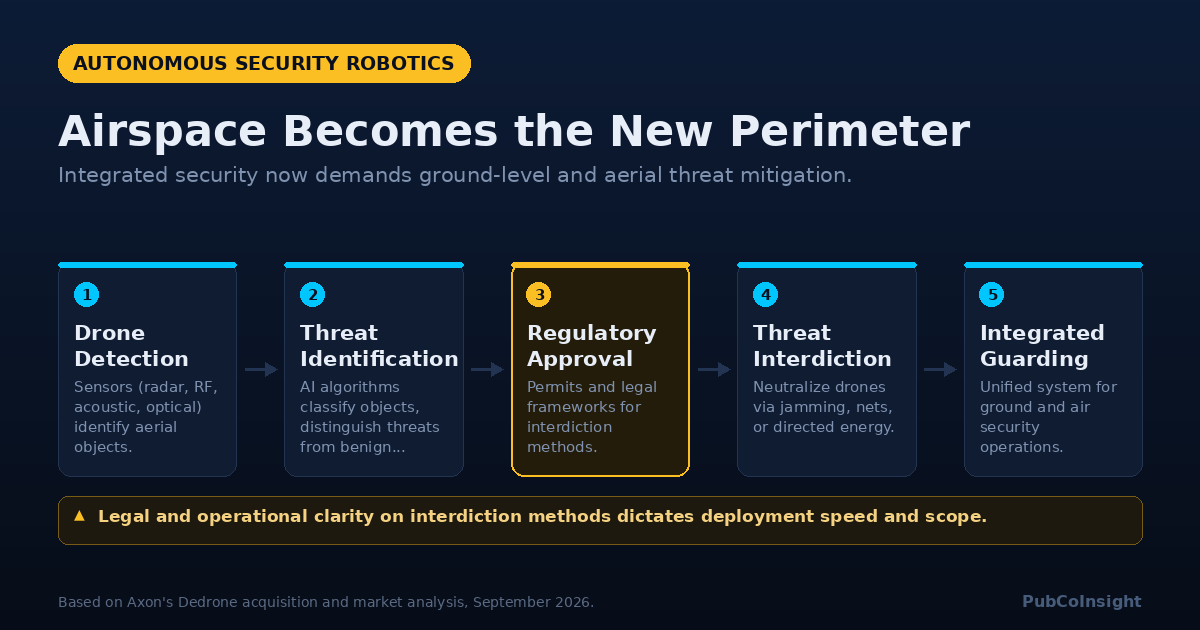
The Mechanism of Aerial Threat Mitigation
Counter-UAS technology works by detecting, classifying, and mitigating unauthorized drones. The process typically involves three main stages: detection, identification, and interdiction. Detection relies on a combination of sensors. Radar systems pick up the physical presence of a drone. Radio frequency (RF) scanners identify the control signals between a drone and its operator. Acoustic sensors listen for the distinct sounds of propellers, and optical sensors use cameras to visually confirm a drone's presence. Each sensor type has strengths and weaknesses; radar struggles with small, slow drones, while RF detection can be jammed. Combining them creates a robust detection net. Once a drone is detected, the system identifies it. This involves analyzing its flight path, size, and signal characteristics. Machine learning algorithms compare these data points against known drone profiles, distinguishing between authorized and unauthorized aerial vehicles. This classification is crucial. False positives, like identifying a bird or a legitimate delivery drone as a threat, waste resources and create operational disruptions. Accurate identification prevents unnecessary interventions. Interdiction, the final stage, aims to neutralize the threat. Passive methods include jamming the drone's control signals or GPS, forcing it to land or return to its operator. Active methods, like deploying a net-firing drone or using directed energy weapons, are more aggressive and often subject to stricter regulatory oversight. The choice of interdiction method depends on the specific threat, the environment, and local regulations. For example, jamming a drone over a populated area could cause it to fall uncontrollably, posing a public safety risk. The effectiveness of a C-UAS system hinges on its ability to execute all three stages seamlessly, with minimal latency and high accuracy, adapting to evolving drone technology and tactics.Companies in the Sector Adapting to New Threats
The shift towards integrated security, including C-UAS, affects a range of players in the autonomous security and physical AI space. Companies like Ondas Inc. (ONDS, price $7.23), through its American Robotics subsidiary, already focus on autonomous drone operations for data collection and inspection. Their existing expertise in drone navigation and data processing could position them to integrate C-UAS capabilities, either by developing their own interdiction methods or by partnering with C-UAS specialists. Ondas raised its 2026 revenue view, citing surging backlog, which suggests a strong demand for their existing drone solutions. Red Cat Holdings, Inc. (RCAT, price $7.96) operates in the drone and drone services market. Their Skypersonic subsidiary provides software for remote drone inspection and training. As the market demands broader security solutions, Red Cat could leverage its drone expertise to develop or integrate C-UAS functionalities, potentially offering drone-based interdiction or surveillance. Unusual Machines, Inc. (UMAC, price $22.95) recently made a $20 million investment in XTEND AI Robotics, bringing its total investment to $27.5 million. This focus on AI robotics suggests a commitment to advanced autonomous systems. While XTEND AI Robotics primarily focuses on human-guided drones for various applications, the underlying AI and robotics platforms could be adapted for C-UAS roles, particularly in identification and potentially active interdiction. In the broader AI and robotics landscape, BigBear.ai Holdings, Inc. (BBAI, price $2.87) provides AI-powered analytics and decision intelligence. Their capabilities in processing vast datasets and identifying patterns could be crucial for developing sophisticated C-UAS detection and classification algorithms, especially for identifying novel drone threats. Arbe Robotics Ltd. (ARBE, price $0.784) specializes in 4D imaging radar for autonomous vehicles. This high-resolution radar technology, designed for complex environments, could be adapted for drone detection, offering superior range and object discrimination compared to traditional radar systems. Other companies, while not directly in the C-UAS space, contribute to the ecosystem of autonomous security. Serve Robotics Inc. (SERV, price $4.48) focuses on sidewalk delivery robots. While their immediate market is different, the underlying autonomous navigation and obstacle avoidance technologies are foundational to many mobile robotic security platforms. Kopin Corporation (KOPN, price $4.56) manufactures microdisplays for augmented and virtual reality, including applications in defense and thermal imaging. Their display technology could enhance situational awareness for human operators monitoring C-UAS systems. Lantronix, Inc. (LTRX, price $5.24) provides IoT solutions, including connectivity and edge computing. These are critical components for deploying and managing distributed C-UAS sensor networks and processing data at the edge. MicroVision, Inc. (MVIS, price $1.64) develops lidar technology for automotive safety and other applications. Lidar's precise 3D mapping capabilities could be valuable for drone detection and tracking, particularly in complex urban environments where other sensors might struggle with clutter.Artificial Intelligence Technology Solutions, Inc.
Artificial Intelligence Technology Solutions, Inc. (AITX, price $0.0036), trading on the OTCID tier, develops and leases autonomous security robots and remote monitoring systems. The company structures its offerings as a "Solutions-as-a-Service" model, generating recurring monthly subscription revenue rather than one-time hardware sales. This model aims to deliver cost savings, estimated between 35% and 80%, compared to traditional manned security. AITX operates through several subsidiaries. Robotic Assistance Devices, Inc. (RAD-I) focuses on stationary security devices. Robotic Assistance Devices Mobile (RAD-M) develops mobile autonomous platforms, including the ROAMEO mobile security unit, which began early commercial deployment in May 2026. Robotic Assistance Devices Group (RAD-G) manages the SARA agentic artificial intelligence platform, which the company intends to license for substantial revenue. Robotic Assistance Devices Residential (RAD-R) targets residential applications. A wholly-owned subsidiary, RAD Lanka, located in Sri Lanka, handles software development, AI initiatives, and technical operations. The company envisions an integrated autonomous-security deployment across campuses or communities, which it refers to as "RAD Town." For the fiscal year ended February 28, 2026, AITX reported revenue of $7,745,336, a 26% increase over the prior year. Gross profit rose 48% to $5,533,700, with gross margin expanding to approximately 71% from 61%. Operating expenses remained flat at around $17,477,097, leading to an improved loss from operations of $(11,943,397). The net loss for the year was approximately $14.5 million, with an accumulated deficit of about $171 million as of that date. The company had negative cash flow from operating activities of $9,344,534 for the same period. While AITX has stated its goal to accelerate its path to positive monthly cash flow through spending reductions, the public record does not yet establish consistent positive cash flow from operations. Recent 8-K filings, including those on September 14, September 10, and September 9, 2026, indicate ongoing operational developments. The September 10 filing specifically mentioned AITX's RAD and Circadian Risk bringing "continuous intelligence and action to physical risk assessment." The September 9 filing noted AITX's RAD opening Q3 with expanding orders across RIO, ROSA, and SARA platforms. These filings suggest continued deployment and expansion of their core product lines, focusing on stationary and mobile autonomous security units integrated with their AI platform. The company's strategy hinges on scaling these deployments and achieving the projected cost savings for clients to drive recurring revenue growth.What to watch
Investors should monitor the integration timeline for Axon's Dedrone acquisition. Specific product rollouts or service bundles incorporating C-UAS capabilities will demonstrate the practical impact. Watch for any announcements regarding new C-UAS contracts or pilot programs won by Axon or its competitors. For Ondas Inc. (ONDS), the key will be their ability to deliver on the increased 2026 revenue guidance. Any specific details on how their drone solutions might integrate with C-UAS offerings, either through internal development or partnerships, would be significant. The second half of 2026 will be crucial for their required revenue ramp. Observe the progress of Unusual Machines, Inc.'s (UMAC) investment in XTEND AI Robotics. Any public demonstrations of XTEND AI's technology adapted for security or counter-drone applications would be a tangible development. For Artificial Intelligence Technology Solutions, Inc. (AITX), focus on the quarterly filings for evidence of sustained revenue growth and progress towards positive cash flow from operations. Specific announcements regarding new large-scale deployments of their ROAMEO units or licensing agreements for the SARA platform will be important. The company's ability to convert its stated cost savings for clients into increased subscription numbers will be a critical metric., { "label": "Threat Identification", "note": "AI algorithms classify objects, distinguish threats from benign activity." }, { "label": "Regulatory Approval", "note": "Permits and legal frameworks for interdiction methods." }, { "label": "Threat Interdiction", "note": "Neutralize drones via jamming, nets, or directed energy." }, { "label": "Integrated Guarding", "note": "Unified system for ground and air security operations." } ], "highlight": 2, "highlight_note": "Legal and operational clarity on interdiction methods dictates deployment speed and scope.", "footnote": "Based on Axon's Dedrone acquisition and market analysis, September 2026." }Companies mentioned
| Ticker | Company | Price |
|---|---|---|
| AITX client | Artificial Intelligence Technology Solutions Inc | $0.0036 |
| ARBE | Arbe Robotics Ltd. | $0.784 |
| BBAI | BigBear.ai Holdings, Inc. | $2.87 |
| KOPN | Kopin Corporation | $4.56 |
| LTRX | Lantronix, Inc. | $5.24 |
| MVIS | MicroVision, Inc. | $1.64 |
| ONDS | Ondas Inc. | $7.23 |
| RCAT | Red Cat Holdings, Inc. | $7.96 |
| SERV | Serve Robotics Inc. | $4.48 |
| UMAC | Unusual Machines, Inc. | $22.95 |
Listed alphabetically, not ranked. Prices as of 2026-09-14 and they move. Check a live quote before relying on any of this.
How we chose the companies in this article
We cover a fixed universe of companies working in autonomous security robotics, physical AI and the guarding services market they are aimed at. Every one of them that had usable market data on 2026-09-14 appears in this article. We do not pick which ones to mention based on what we think of them, and we do not order them by size, price or trading volume, because an ordered list is a verdict and that is not ours to hand down. Companies left out, and why: none. American Lithium Minerals and Artificial Intelligence Technology Solutions pay us, which is disclosed in full at the foot of every article they appear in.
See the dilution and promotion flags before you see the pitch.
Each week: the micro and small-caps now showing dilution or paid-promotion signals, with the SEC filing behind every flag. No recommendations, no price targets.
Sources used in this article
- Berkshire Hathaway (BRKB) Stock Is the Financial Stock I'd Still Want to Own in 2036, and Not Because of Warren Buffett Motley Fool · 2026-09-14
- Broadcom vs. Nvidia: 3 Key Metrics Point to the Stronger AI Chipmaker to Buy After Earnings Motley Fool · 2026-09-14
- Anthropic CEO Urges AI Industry to Slow Development Pace; Chip Stocks Slide MT Newswires · 2026-09-14
- How to Earn $500 a Month From Chevron Stock Motley Fool · 2026-09-14
- The Zacks Analyst Blog Highlights Amkor Technology, Ultra Clean, FormFactor, Taiwan Semiconducto and NVIDIA Zacks · 2026-09-14
- Jim Cramer Tries To Predict NVIDIA Corporation (NASDAQ:NVDA) Share Price Movement Following Anthropic CEO’s Remarks Insider Monkey · 2026-09-14
- Robinhood's New Blockchain Is Now Making More Money Than Ethereum. Does That Make Robinhood Stock a Buy? Motley Fool · 2026-09-14
- The Zacks Analyst Blog Highlights Alphabet, Microsoft, NVIDIA, Arista Networks and Vertiv Zacks · 2026-09-14
- SpaceX's Musk 'Highly Confident' of Launching Nvidia AI Computers in Space in 2027 MT Newswires · 2026-09-14
- Billionaire David Einhorn Says SpaceX Is Making History, but Not in a Good Way Motley Fool · 2026-09-14
- Wonder Deal, $240M Cash, and 31% Short Interest. A Short Squeeze Could Be Brewing in Serve Robotics Stock. Barchart · 2026-09-13
- Can SERV's Revenue Diversification Offset Weaker Uber Deliveries? Zacks · 2026-09-11
Disclosure required by Section 17(b) of the Securities Act of 1933
Artificial Intelligence Technology Solutions, Inc., a Nevada corporation (OTCID: AITX). Artificial Intelligence Technology Solutions, Inc. pays Strategic Innovations First, Inc., a Wyoming corporation doing business as PulseIR. Compensation received: USD 5,000.00 per month for months 1-3 (August, September, October 2026); USD 10,000.00 per month for months 4-6 (November, December 2026, January 2027) contingent on the 90-day review. Minimum committed USD 15,000.00; USD 45,000.00 if the second-period rate triggers.. Form of payment: cash only, invoiced monthly in advance; no stock, options or warrants received or payable. Services: investor relations services under an Investor Relations Services Agreement effective 2026-08-01. Period: six month term, 2026-08-01 through 2027-01-31; 90-day review on or about 2026-10-30. No stock, options or warrants held by PubCo Insight, Pulse IR, Strategic Innovations First, Inc., or Brad Listermann. Confirmed by the executed agreement and by board record recKwdq39X2caPSX7 (POSITIONS HELD: none).
This is information, not investment, financial, legal or tax advice. It is not a recommendation or solicitation to buy, sell or hold any security and it contains no price target. Nothing here is independently verified by us. Confirm every figure against primary filings on SEC EDGAR before you act. Micro-cap and over-the-counter securities are speculative and illiquid and can lose all of their value. The companies named without a disclosure above pay us nothing and have no relationship with us; they are named because a published, mechanical screen selected them. Full disclosure policy.