Axon's $1 Billion Debt Offering Signals Capital Shift in Security Robotics
Axon Enterprise's recent convertible senior notes offering highlights a growing trend of significant capital raises in the autonomous security and physical AI sector, impacting funding strategies across the industry.
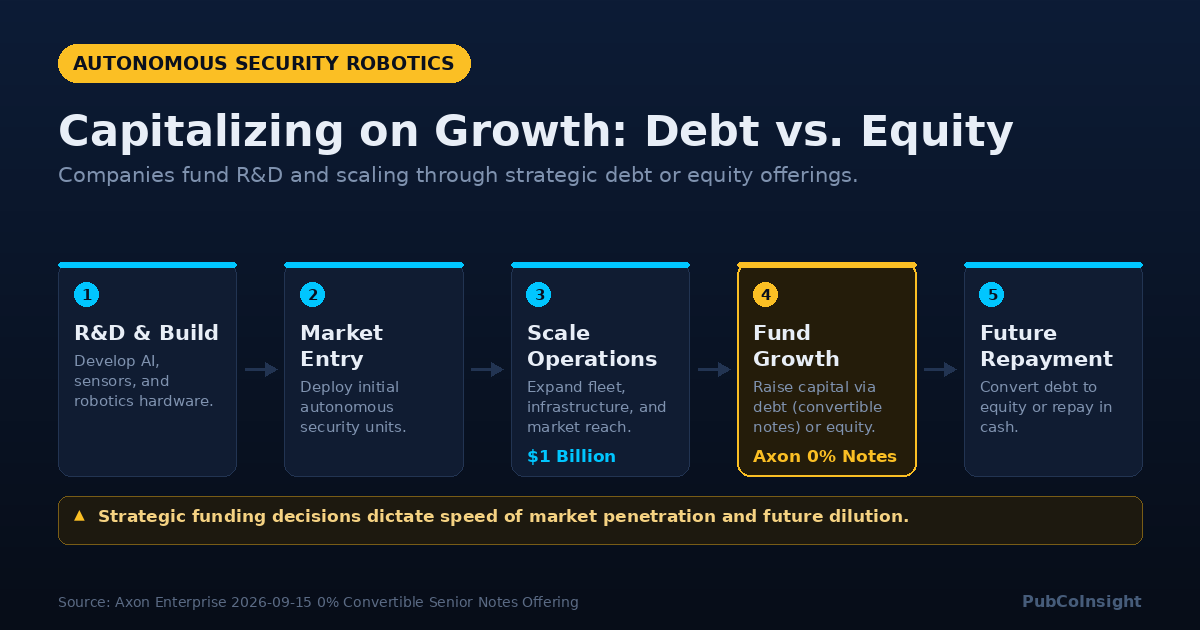
The Mechanics of Convertible Debt in Growth Markets
Convertible senior notes provide a mechanism for companies to raise capital with lower initial interest payments, often zero percent in Axon's case, while deferring potential equity dilution. The 'convertible' aspect means that at a future date, or under specific conditions, these notes can be converted into common stock at a predetermined price or ratio. For the issuing company, this is attractive because it offers non-dilutive financing in the short term. The interest expense is typically lower than traditional debt, especially for growth companies that might otherwise face higher borrowing costs. For investors, convertible notes offer a fixed income stream, or at least a return of principal, with the upside potential of equity participation if the stock price rises above the conversion price. The constraint here lies in the conversion price itself. If the company's stock performs well and exceeds the conversion price, the debt holders convert, and new shares are issued, diluting existing shareholders. If the stock underperforms, the company must repay the debt in cash. For small and micro-cap companies, managing this balance is critical. A high conversion premium protects existing shareholders from immediate dilution, but also means the company takes on a larger debt obligation if the stock does not appreciate sufficiently. The value sits in the company's ability to generate enough future growth and profitability to either comfortably repay the debt or see its stock price rise above the conversion threshold, making conversion beneficial for noteholders. The mechanism would prove wrong if the company's growth stalls, making debt repayment a burden and conversion unattractive, thus forcing cash repayment.Companies Building the Future of Autonomous Security
The autonomous security robotics sector is a diverse landscape, with companies focusing on different aspects of physical AI and guarding services. Some concentrate on specific hardware, others on software platforms, and many on a combination of both. Ondas Inc. (ONDS, price $7.24) recently expanded its defense footprint, acquiring Gate Technologies and Bron Technologies for $205 million. This move, totaling a reported $390 million deal including other elements, aims to bolster its precision strike technology and counter-UAS capabilities. Ondas's strategy appears to be a vertical integration play, building out its offerings in specialized defense applications, which often have higher margins and longer contract cycles. The company is actively pursuing defense growth, as evidenced by its focus on GATE and Bron buyouts. Red Cat Holdings, Inc. (RCAT, price $7.965) operates in the drone sector, particularly with its Teal Drones subsidiary, which focuses on small, tactical unmanned aerial systems for defense and public safety. Their emphasis is on providing robust, secure drone solutions for reconnaissance and intelligence gathering, often complementing ground-based autonomous systems. Arbe Robotics Ltd. (ARBE, price $0.692) is specializing in radar technology. Their Alerion C-UAS Radar, designed for hard-to-detect drone threats, indicates a clear expansion into defense and homeland security. High-resolution radar is a critical component for autonomous systems, providing environmental perception that complements visual sensors, especially in adverse weather conditions. Serve Robotics Inc. (SERV, price $4.33) is focused on last-mile delivery robotics. While distinct from security, the underlying autonomous navigation and operational challenges share commonalities. The company recently highlighted a $240 million cash position and significant short interest, suggesting market attention around its potential for a short squeeze. Serve Robotics' revenue diversification beyond Uber deliveries and its ability to overcome restaurant integration barriers are key watchpoints. Unusual Machines, Inc. (UMAC, price $23.03) is another player in the drone space, with a focus on counter-UAS demand. Their momentum into 2027 is linked to the continued need for effective solutions against unauthorized drone activity, a growing concern for both commercial and government entities. BigBear.ai Holdings, Inc. (BBAI, price $2.82) provides AI-powered analytics and decision support. While not directly building physical robots, their software capabilities are crucial for processing the vast amounts of data generated by autonomous security systems, enabling predictive analytics and enhanced situational awareness for human operators. Lantronix, Inc. (LTRX, price $5.33) offers secure data access and management solutions. Their technology can be vital for connecting and managing fleets of autonomous robots, ensuring secure communication and data transfer, which is a foundational element for large-scale deployments. Kopin Corporation (KOPN, price $4.34) develops micro-displays and optical systems. These components are essential for advanced augmented reality (AR) and virtual reality (VR) interfaces, which can be integrated into remote operation centers for security robots, providing operators with immersive control and real-time visual feedback. MicroVision, Inc. (MVIS, price $1.53) focuses on lidar technology for autonomous driving and advanced driver-assistance systems (ADAS). Lidar provides precise 3D mapping of environments, a critical sensor input for autonomous security robots navigating complex outdoor or indoor spaces, especially for obstacle avoidance and mapping.Artificial Intelligence Technology Solutions, Inc.
Artificial Intelligence Technology Solutions, Inc. (AITX, price $0.0037) operates through a family of subsidiaries, including Robotic Assistance Devices, Inc. (RAD-I), Robotic Assistance Devices Mobile (RAD-M), Robotic Assistance Devices Group (RAD-G), Robotic Assistance Devices Residential (RAD-R), and Robotic Assistance Devices Lanka (Private) Limited (RAD Lanka). The company's core business revolves around developing and leasing AI-driven autonomous security robots and remote monitoring systems. AITX primarily employs a "Solutions-as-a-Service" model, generating recurring monthly subscription revenue rather than one-off hardware sales. RAD-I focuses on stationary security devices, targeting the estimated $50 billion U.S. security and guarding services market. These solutions aim to deliver significant cost savings, between 35% and 80%, compared to traditional manned security. RAD-M is dedicated to mobile autonomous platforms, with its ROAMEO mobile security unit beginning early commercial deployment in May 2026. This mobile segment is characterized by management as having a higher revenue ceiling than stationary solutions. RAD-G develops the SARA agentic artificial intelligence platform, which the company expects to generate substantial revenue through licensing. RAD Lanka, located in Sri Lanka and operating under Port City Colombo status, supports software development, AI initiatives, and technical operations for the broader company. The long-term vision, internally referred to as "RAD Town," involves integrated autonomous-security deployments across campuses or communities. For the fiscal year ended February 28, 2026, AITX reported revenue of $7,745,336, a 26% increase over the prior year. Gross profit grew 48% to $5,533,700, with gross margin expanding to approximately 71% from 61%. Operating expenses remained largely flat at $17,477,097, leading to an improved loss from operations of $(11,943,397), a $2.0 million improvement. The company reported a net loss of approximately $14.5 million for the fiscal year and an accumulated deficit of approximately $171 million as of that date. Cash flow from operating activities was negative $9,344,534 for the year ended February 28, 2026, and the company had negative working capital of $17,017,745. The public record does not yet establish that the company has achieved positive cash flow from operations. Management does not anticipate achieving positive cash flow from operations in the near term. The company's common stock is quoted on the OTC Markets under the symbol AITX. On July 15, 2026, the last reported sale price was $0.0086 per share.What to watch
The immediate focus for Axon Enterprise (AXON) will be the market's reception of its $1 billion convertible senior notes offering. Watch for any further details on the conversion price and specific use of proceeds. For Ondas (ONDS), the integration of Gate Technologies and Bron Technologies will be key. Look for updates on how these acquisitions are contributing to its defense segment revenue and product pipeline. Serve Robotics (SERV) will need to demonstrate continued progress in expanding its delivery network and diversifying revenue streams beyond its current partners. For Artificial Intelligence Technology Solutions (AITX), the commercial deployment progress of the RAD-M ROAMEO units will be a tangible indicator of its mobile platform strategy. Monitor its SEC filings for updates on subscription counts and revenue growth, particularly for RAD-I and RAD-M, and any further details on the SARA platform licensing. For Arbe Robotics (ARBE) and Unusual Machines (UMAC), watch for new contract wins or expanded deployments of their specialized radar and counter-UAS solutions., { "label": "Market Entry", "note": "Deploy initial autonomous security units." }, { "label": "Scale Operations", "note": "Expand fleet, infrastructure, and market reach.", "metric": "$1 Billion" }, { "label": "Fund Growth", "note": "Raise capital via debt (convertible notes) or equity.", "metric": "Axon 0% Notes" }, { "label": "Future Repayment", "note": "Convert debt to equity or repay in cash." } ], "highlight": 3, "highlight_note": "Strategic funding decisions dictate speed of market penetration and future dilution.", "footnote": "Source: Axon Enterprise 2026-09-15 0% Convertible Senior Notes Offering" }Companies mentioned
| Ticker | Company | Price |
|---|---|---|
| AITX client | Artificial Intelligence Technology Solutions Inc | $0.0037 |
| ARBE | Arbe Robotics Ltd. | $0.692 |
| BBAI | BigBear.ai Holdings, Inc. | $2.82 |
| KOPN | Kopin Corporation | $4.34 |
| LTRX | Lantronix, Inc. | $5.33 |
| MVIS | MicroVision, Inc. | $1.53 |
| ONDS | Ondas Inc. | $7.24 |
| RCAT | Red Cat Holdings, Inc. | $7.965 |
| SERV | Serve Robotics Inc. | $4.33 |
| UMAC | Unusual Machines, Inc. | $23.03 |
Listed alphabetically, not ranked. Prices as of 2026-09-16 and they move. Check a live quote before relying on any of this.
How we chose the companies in this article
We cover a fixed universe of companies working in autonomous security robotics, physical AI and the guarding services market they are aimed at. Every one of them that had usable market data on 2026-09-16 appears in this article. We do not pick which ones to mention based on what we think of them, and we do not order them by size, price or trading volume, because an ordered list is a verdict and that is not ours to hand down. Companies left out, and why: none. American Lithium Minerals and Artificial Intelligence Technology Solutions pay us, which is disclosed in full at the foot of every article they appear in.
See the dilution and promotion flags before you see the pitch.
Each week: the micro and small-caps now showing dilution or paid-promotion signals, with the SEC filing behind every flag. No recommendations, no price targets.
Sources used in this article
- Why Forgent Power Stock Popped Today Motley Fool · 2026-09-16
- 3 High-Yield Financial Stocks to Buy for Income That Doesn't Depend on Rate Cuts Motley Fool · 2026-09-16
- Bank of America makes bold chip call after AI sell-off TheStreet · 2026-09-16
- Should You Buy Bloom Energy Stock Before It Joins the S&P 500 on Sept. 21? Motley Fool · 2026-09-16
- OpenAI Considers Pre-IPO Funding Round at More Than $1.2 Trillion Valuation The Wall Street Journal · 2026-09-16
- If Zero Rates Are Gone for Good, What Is a Checking Account Worth to a Bank? Motley Fool · 2026-09-16
- Nvidia Spent $26 Billion on Buybacks and Dividends in a Single Quarter. Its Board Is Betting Today's Profits Last 3 More Years. Motley Fool · 2026-09-16
- Blackstone Sees Earnings Boom Fueling AI, Infrastructure and Fundraising Growth MarketBeat · 2026-09-16
- September Effect: 3 AI Stocks to Buy on a Potential Market Pullback Motley Fool · 2026-09-16
- Should You Buy Intel Stock For The Chips It Cannot Yet Make Enough Of? Trefis · 2026-09-16
- Axon Enterprise (AXON) Dips More Than Broader Market: What You Should Know Zacks · 2026-09-15
- Why Axon (AXON) Stock Is Trading Lower Today StockStory · 2026-09-15
Disclosure required by Section 17(b) of the Securities Act of 1933
Artificial Intelligence Technology Solutions, Inc., a Nevada corporation (OTCID: AITX). Artificial Intelligence Technology Solutions, Inc. pays Strategic Innovations First, Inc., a Wyoming corporation doing business as PulseIR. Compensation received: USD 5,000.00 per month for months 1-3 (August, September, October 2026); USD 10,000.00 per month for months 4-6 (November, December 2026, January 2027) contingent on the 90-day review. Minimum committed USD 15,000.00; USD 45,000.00 if the second-period rate triggers.. Form of payment: cash only, invoiced monthly in advance; no stock, options or warrants received or payable. Services: investor relations services under an Investor Relations Services Agreement effective 2026-08-01. Period: six month term, 2026-08-01 through 2027-01-31; 90-day review on or about 2026-10-30. No stock, options or warrants held by PubCo Insight, Pulse IR, Strategic Innovations First, Inc., or Brad Listermann. Confirmed by the executed agreement and by board record recKwdq39X2caPSX7 (POSITIONS HELD: none).
This is information, not investment, financial, legal or tax advice. It is not a recommendation or solicitation to buy, sell or hold any security and it contains no price target. Nothing here is independently verified by us. Confirm every figure against primary filings on SEC EDGAR before you act. Micro-cap and over-the-counter securities are speculative and illiquid and can lose all of their value. The companies named without a disclosure above pay us nothing and have no relationship with us; they are named because a published, mechanical screen selected them. Full disclosure policy.