Axon Acquires Dedrone, Expanding Physical AI to Counter-UAS
Axon Enterprise's recent acquisition of Dedrone integrates drone detection and neutralization into the broader physical AI security landscape, shifting the focus for guarding services.
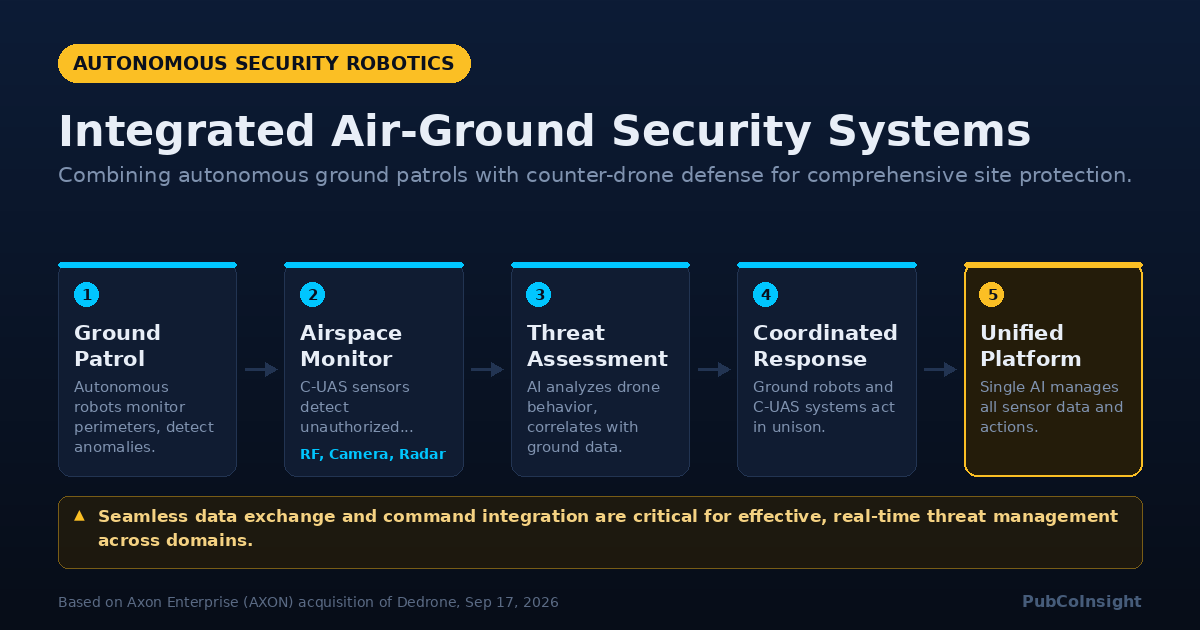
The Mechanism of Integrated Airspace and Ground Security
The core mechanism at play here is the fusion of ground-level autonomous security with aerial threat detection and neutralization. Historically, physical AI robots, like those used for patrolling campuses or warehouses, have focused on terrestrial surveillance, access control, and incident response. Counter-UAS systems, conversely, are designed to detect, track, identify, and potentially mitigate unauthorized drones. Dedrone's technology, for example, uses a combination of radio frequency sensors, cameras, and radar to identify drone activity. Once a drone is detected, the system analyzes its flight path and characteristics. If deemed a threat, it can trigger various countermeasures, ranging from passive alerts to active jamming or kinetic interception. Integrating these two capabilities means a single security platform can now manage threats from both the ground and the air. Imagine an autonomous ground robot patrolling a perimeter. If a drone breaches the airspace above, the C-UAS system detects it. This detection can then trigger the ground robot to investigate, alert human operators, or even coordinate with other defensive measures. The critical factor for success lies in the seamless data exchange and command integration between these disparate systems. A unified AI platform must process sensor data from both domains, correlate events, and execute coordinated responses without human intervention. This requires robust, low-latency communication protocols and sophisticated AI algorithms capable of real-time threat assessment across multiple vectors. Without a truly unified operational picture and automated response capability, the integration remains a collection of siloed technologies, rather than a force multiplier.Companies Operating in This Part of the Sector
The small and micro-cap landscape for autonomous security robotics and physical AI is diverse, with companies focusing on various niches within the broader guarding services market. Some, like Serve Robotics Inc. (SERV), concentrate on last-mile delivery and hospitality applications, deploying autonomous robots for tasks such as food delivery within defined areas. Their focus is on operational efficiency and customer service, rather than direct security patrols. Other companies are building the foundational components that enable these autonomous systems. Kopin Corporation (KOPN), for example, develops micro-displays and optical modules crucial for augmented and virtual reality systems, which can be integrated into robot vision and human-robot interaction interfaces. MicroVision, Inc. (MVIS) focuses on lidar technology, providing the advanced sensing capabilities essential for autonomous navigation and object detection in complex environments. Lantronix, Inc. (LTRX) offers secure data access and management solutions, enabling the robust connectivity and data integrity required for remote operation and monitoring of physical AI deployments. Arbe Robotics Ltd. (ARBE) specializes in 4D imaging radar, offering high-resolution perception for autonomous vehicles and robotics, which is vital for safe and effective navigation in dynamic security scenarios. In the drone and aerial robotics space, Ondas Inc. (ONDS) is active, recently acquiring GATE and Bron to enhance its component ownership for defense returns. Ondas focuses on industrial drone solutions and has seen its stock fluctuate alongside other drone names. Red Cat Holdings, Inc. (RCAT) and Unusual Machines, Inc. (UMAC) also operate in the drone sector, with RCAT focusing on drone services and UMAC on drone manufacturing. These companies are navigating a market where speculative interest can lead to significant price movements. BigBear.ai Holdings, Inc. (BBAI) provides AI-powered analytics and decision intelligence, which can be applied to security data analysis, though their focus is broader than just physical AI.Artificial Intelligence Technology Solutions, Inc.
Artificial Intelligence Technology Solutions, Inc. (AITX) operates through several subsidiaries, including Robotic Assistance Devices, Inc. (RAD-I), Robotic Assistance Devices Mobile (RAD-M), and Robotic Assistance Devices Group (RAD-G). The company develops and leases autonomous security robots and remote monitoring systems, primarily through a "Solutions-as-a-Service" model. This means customers pay a recurring monthly subscription rather than purchasing hardware outright. AITX estimates the U.S. security and guarding services market to be approximately $50 billion, and states its solutions aim to deliver significant cost savings, between 35% and 80%, compared to traditional manned security. RAD-I, the primary subsidiary, markets stationary security devices. These include units like ROSA, which the company describes as the foundation of its stationary security platform. Recent 8-K filings from September 18 and September 16 highlight RAD's expansion into higher education and the reinforcement of ROSA's role. RAD-M develops mobile autonomous platforms, such as the ROAMEO mobile security unit, which began early commercial deployment in May 2026. The company views RAD-M as having a higher revenue ceiling than its stationary solutions. RAD-G focuses on the SARA agentic artificial intelligence platform, which AITX anticipates will generate substantial revenue through licensing. A wholly-owned subsidiary, RAD Lanka, located in Sri Lanka, supports software development, AI initiatives, and technical operations across the company’s subsidiaries. The company refers to its long-term strategy as "RAD Town," envisioning integrated autonomous security deployments across large campuses or jurisdictions. For the fiscal year ended February 28, 2026, AITX reported revenue of $7,745,336, a 26% increase over the prior fiscal year. Gross profit rose 48% to $5,533,700, with gross margin expanding to approximately 71%. Operating expenses remained largely flat at $17,477,097. The company reported a net loss of approximately $14.5 million for the fiscal year and had an accumulated deficit of approximately $171 million as of February 28, 2026. Cash flow from operating activities was negative $9,344,534 for the same period. The public record does not yet establish a clear path to sustained positive cash flow from operations. The company's filings also discuss its equity purchase agreement with Trillium, where AITX will receive proceeds from the sale of Put Shares.What to watch
Investors should monitor several specific developments. Axon Enterprise's integration timeline for Dedrone's C-UAS technology into its existing security offerings will be key. Look for announcements detailing specific product bundles or service rollouts, especially those targeting large commercial or government contracts. Pay attention to any new permit applications or regulatory approvals for expanded autonomous drone operations in commercial airspace. For Ondas Inc., the operational impact and revenue contributions from its recent GATE and Bron acquisitions should be watched in upcoming financial reports. For Artificial Intelligence Technology Solutions, Inc., the continued deployment of its ROAMEO mobile security units and any new licensing agreements for its SARA platform will be important indicators. The company's next substantive financial filing will provide updated figures on revenue, subscription counts, and cash position. Any new large-scale deployments of "RAD Town" concepts would signal progress in its integrated security strategy., { "label": "Airspace Monitor", "note": "C-UAS sensors detect unauthorized drones.", "metric": "RF, Camera, Radar" }, { "label": "Threat Assessment", "note": "AI analyzes drone behavior, correlates with ground data." }, { "label": "Coordinated Response", "note": "Ground robots and C-UAS systems act in unison." }, { "label": "Unified Platform", "note": "Single AI manages all sensor data and actions." } ], "highlight": 4, "highlight_note": "Seamless data exchange and command integration are critical for effective, real-time threat management across domains.", "footnote": "Based on Axon Enterprise (AXON) acquisition of Dedrone, Sep 17, 2026" }Companies mentioned
| Ticker | Company | Price |
|---|---|---|
| AITX client | Artificial Intelligence Technology Solutions Inc | $0.0039 |
| ARBE | Arbe Robotics Ltd. | $0.687 |
| BBAI | BigBear.ai Holdings, Inc. | $2.9 |
| KOPN | Kopin Corporation | $4.85 |
| LTRX | Lantronix, Inc. | $6.18 |
| MVIS | MicroVision, Inc. | $1.67 |
| ONDS | Ondas Inc. | $7.38 |
| RCAT | Red Cat Holdings, Inc. | $6.95 |
| SERV | Serve Robotics Inc. | $4.44 |
| UMAC | Unusual Machines, Inc. | $24.25 |
Listed alphabetically, not ranked. Prices as of 2026-09-22 and they move. Check a live quote before relying on any of this.
How we chose the companies in this article
We cover a fixed universe of companies working in autonomous security robotics, physical AI and the guarding services market they are aimed at. Every one of them that had usable market data on 2026-09-22 appears in this article. We do not pick which ones to mention based on what we think of them, and we do not order them by size, price or trading volume, because an ordered list is a verdict and that is not ours to hand down. Companies left out, and why: none. American Lithium Minerals and Artificial Intelligence Technology Solutions pay us, which is disclosed in full at the foot of every article they appear in.
See the dilution and promotion flags before you see the pitch.
Each week: the micro and small-caps now showing dilution or paid-promotion signals, with the SEC filing behind every flag. No recommendations, no price targets.
Sources used in this article
- Not Micron. Not Alphabet. Here's My Top Artificial Intelligence (AI) Stock Pick for the Next 3 Years. Motley Fool · 2026-09-22
- History Says a $1,000 Investment in Broadcom Will Be Worth This Much by 2028 Motley Fool · 2026-09-22
- Astera Labs Stock Jumped 12% Yesterday. The Street Sees 14% More Upside, Here’s Why. TIKR · 2026-09-22
- AMD joins trillion-dollar chipmaker club as AI demand surges Euronews · 2026-09-22
- Meta Stock Is Still Too Cheap Motley Fool · 2026-09-22
- BABA Stock Spikes Overnight: Alibaba Takes On Nvidia With China's Most Powerful AI Chip Yet Stocktwits · 2026-09-22
- Is STMicroelectronics (ENXTPA:STMPA) Doubling Down On Automotive Imaging To Sharpen Its Competitive Edge? Simply Wall St. · 2026-09-22
- CoreWeave (CRWV) Rolls Out Rubin Clusters And AI Storage For Agentic AI Simply Wall St. · 2026-09-22
- Nvidia's Forecast Assumes No Data Center Chip Sales to China. The Sept. 24 U.S.-China Summit Could Change That. Motley Fool · 2026-09-22
- Apple Launches New Products in Time for New CEO Motley Fool · 2026-09-22
- Goldman Sachs Adjusts PT on Axon Enterprise to $675 From $715, Maintains Buy Rating MT Newswires · 2026-09-21
- 3 Small-Cap Stocks We Keep Off Our Radar StockStory · 2026-09-21
Disclosure required by Section 17(b) of the Securities Act of 1933
Artificial Intelligence Technology Solutions, Inc., a Nevada corporation (OTCID: AITX). Artificial Intelligence Technology Solutions, Inc. pays Strategic Innovations First, Inc., a Wyoming corporation doing business as PulseIR. Compensation received: USD 5,000.00 per month for months 1-3 (August, September, October 2026); USD 10,000.00 per month for months 4-6 (November, December 2026, January 2027) contingent on the 90-day review. Minimum committed USD 15,000.00; USD 45,000.00 if the second-period rate triggers.. Form of payment: cash only, invoiced monthly in advance; no stock, options or warrants received or payable. Services: investor relations services under an Investor Relations Services Agreement effective 2026-08-01. Period: six month term, 2026-08-01 through 2027-01-31; 90-day review on or about 2026-10-30. No stock, options or warrants held by PubCo Insight, Pulse IR, Strategic Innovations First, Inc., or Brad Listermann. Confirmed by the executed agreement and by board record recKwdq39X2caPSX7 (POSITIONS HELD: none).
This is information, not investment, financial, legal or tax advice. It is not a recommendation or solicitation to buy, sell or hold any security and it contains no price target. Nothing here is independently verified by us. Confirm every figure against primary filings on SEC EDGAR before you act. Micro-cap and over-the-counter securities are speculative and illiquid and can lose all of their value. The companies named without a disclosure above pay us nothing and have no relationship with us; they are named because a published, mechanical screen selected them. Full disclosure policy.