Axon's Dedrone Push Signals Broader Shift in Guarding Services
Axon's accelerating focus on drone integration through its Dedrone platform highlights a critical inflection point for autonomous security, moving beyond fixed installations to dynamic aerial surveillance.
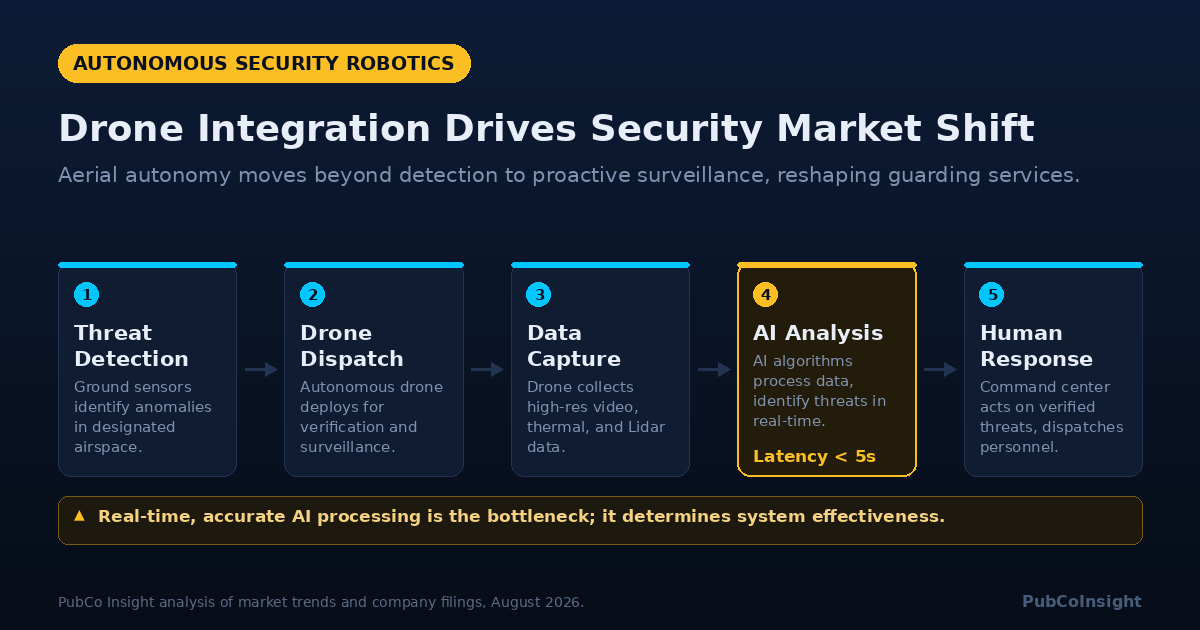
The Mechanism of Aerial Autonomy in Security
The core mechanism for drone-based security involves a layered approach, blending persistent aerial surveillance with on-demand rapid response. First, a network of ground-based sensors, often radar or acoustic arrays, detects anomalies in a designated airspace. This initial detection triggers a verification process, usually involving an autonomous drone dispatched from a nearby charging station. The drone, equipped with high-resolution cameras, thermal imaging, and potentially Lidar, flies a pre-programmed or dynamically generated patrol path to the area of interest. The critical bottleneck sits in the real-time data processing and decision-making loop. Raw drone footage generates immense data. This data must be ingested, analyzed by AI algorithms for threat detection - identifying intruders, suspicious vehicles, or unusual activity - and then communicated to a central command center, all within seconds. Low-latency, edge computing capabilities on the drone itself or at nearby ground stations are essential here. If the AI cannot accurately distinguish a squirrel from a human intruder in varied lighting and weather conditions, or if the data transfer is too slow, the system fails. The value lies in the speed and accuracy of this analysis, enabling human operators to respond to verified threats, not false alarms. This process reduces the need for constant human patrol, allowing security personnel to focus on intervention rather than observation.Companies Shaping Autonomous Security
Several companies are navigating this evolving landscape, each with distinct approaches to physical AI and autonomous security. Ondas Inc. (ONDS, price $7.9) focuses on critical infrastructure and industrial markets through its American Robotics subsidiary, which developed the Scout System, an autonomous drone solution. Ondas also operates Ondas Networks, providing wireless communication platforms that are crucial for reliable drone operation in remote or challenging environments. Their strategy emphasizes end-to-end solutions for specific industrial applications, where regulatory hurdles for autonomous flight are often less stringent than in public spaces. Red Cat Holdings, Inc. (RCAT, price $8.49) operates across several drone segments, including consumer FPV drones and enterprise solutions. Their Fat Shark brand is well-known in the FPV racing community, but their Teal Drones subsidiary is more relevant to security, producing NDAA-compliant drones for government and defense applications. This focus on secure, American-made hardware positions them for contracts where supply chain integrity is paramount. Unusual Machines, Inc. (UMAC, price $23.98) has recently made moves to expand its manufacturing capabilities and secure battery deals, as reported by Simply Wall St. on August 22, 2026. Their NDAA-compliant expansion suggests a direct play for defense and government contracts, mirroring Red Cat's strategic direction. The focus on manufacturing and supply chain control points to an emphasis on scaling hardware production for specific, high-security applications. Serve Robotics Inc. (SERV, price $5.03) operates in a different segment of physical AI, focusing on sidewalk delivery robots. While not directly in the security guarding market, their expertise in autonomous navigation, obstacle avoidance, and last-mile logistics for urban environments provides a foundation that could be adapted for mobile ground-based security patrols. The underlying AI and sensor fusion technologies share common ground with security robotics. Beyond direct drone and robotics manufacturers, companies like Arbe Robotics Ltd. (ARBE, price $0.656) and MicroVision, Inc. (MVIS, price $1.84) provide critical sensor technology. Arbe specializes in high-resolution 4D imaging radar, essential for autonomous systems to perceive their environment in all weather conditions. MicroVision develops Lidar solutions, offering precise depth perception that complements camera and radar systems. These sensor providers are foundational to the accuracy and reliability of any autonomous security platform, whether aerial or ground-based. Lantronix, Inc. (LTRX, price $5.37) offers intelligent edge computing and connectivity solutions. Their hardware and software enable remote management and data processing for IoT devices, including autonomous robots. This infrastructure layer is crucial for deploying and maintaining distributed networks of security robots and drones, ensuring seamless communication and data flow back to command centers. Kopin Corporation (KOPN, price $4.48) develops micro-displays and optical modules. While often associated with augmented reality and defense applications, their displays are critical for remote operators of security drones and robots, providing clear, high-fidelity visual feedback for monitoring and control. BigBear.ai Holdings, Inc. (BBAI, price $3.05) provides AI-powered analytics and data warehousing solutions, primarily for government and defense clients. Their expertise in processing vast datasets and generating actionable intelligence is directly applicable to the security sector, where autonomous systems generate continuous streams of surveillance data requiring sophisticated analysis to identify patterns and predict threats.Artificial Intelligence Technology Solutions, Inc.
Artificial Intelligence Technology Solutions, Inc. (AITX, price $0.0044) operates through a "Solutions-as-a-Service" model, focusing on the security and guarding services industry. The company develops and leases AI-driven stationary and mobile security devices. Its primary subsidiary, Robotic Assistance Devices, Inc. (RAD-I), markets stationary security devices. The company estimates this market to be approximately $50 billion in the United States. AITX states its solutions aim to deliver cost savings between 35% and 80% compared to traditional manned security. AITX's strategy extends to mobile autonomous platforms under Robotic Assistance Devices Mobile (RAD-M), including the ROAMEO mobile security unit. Early commercial deployments of ROAMEO began in May 2026. The company also develops the SARA agentic artificial intelligence platform through Robotic Assistance Devices Group (RAD-G). This platform is intended for licensing, with the company stating it believes RAD-G will generate substantial revenue from such licensing. AITX's wholly-owned subsidiary, RAD Lanka, located in Sri Lanka, supports software development, AI initiatives, and technical operations. The company's internal long-term vision is "RAD Town," an integrated autonomous-security deployment across a campus, community, or jurisdiction. For the fiscal year ended February 28, 2026, AITX reported revenue of $7,745,336, a 26% increase over the prior fiscal year. Gross profit increased 48% to $5,533,700, with gross margin expanding to approximately 71% from 61%. Operating expenses remained flat at around $17,477,097, and the loss from operations improved by approximately $2.0 million to $(11,943,397). The company reported a net loss of approximately $14.5 million for the fiscal year ended February 28, 2026, and had an accumulated deficit of approximately $171 million as of that date. Cash flow from operating activities was negative $9,344,534 for the same period. The public record does not yet establish a clear pathway to sustained positive cash flow from operations for AITX. The company's recent 8-K filings on August 27 and August 25, 2026, detail a 14-unit order intake across five customer relationships and the rebranding of RAD-M to PURSUON, advancing its autonomous mobile security strategy. AITX also reported a growing ROAMEO deployment pipeline, aiming for 50 units by August 2027.What to watch
The immediate focus for investors should be on the deployment numbers for mobile autonomous platforms. Axon's deepening commitment to drone technology validates the market, but the specific execution by smaller players will dictate their success. Watch for any public announcements from Ondas (ONDS) regarding new deployments or expanded contracts for its American Robotics Scout System, particularly in critical infrastructure. For Red Cat Holdings (RCAT) and Unusual Machines (UMAC), contract awards for NDAA-compliant drones will be key indicators of their penetration into government and defense. For Artificial Intelligence Technology Solutions (AITX), the progress of the PURSUON strategy and ROAMEO deployment pipeline will be critical. The stated goal of 50 ROAMEO units by August 2027 provides a clear metric. Any updates on the SARA platform licensing through RAD-G will also be important, as this represents a distinct revenue stream. Finally, observe the broader regulatory landscape for autonomous drone operations. Changes in FAA regulations regarding beyond visual line of sight (BVLOS) flights will directly impact the scalability and economic viability of large-scale drone security deployments., { "label": "Drone Dispatch", "note": "Autonomous drone deploys for verification and surveillance." }, { "label": "Data Capture", "note": "Drone collects high-res video, thermal, and Lidar data." }, { "label": "AI Analysis", "note": "AI algorithms process data, identify threats in real-time.", "metric": "Latency < 5s" }, { "label": "Human Response", "note": "Command center acts on verified threats, dispatches personnel." } ], "highlight": 3, "highlight_note": "Real-time, accurate AI processing is the bottleneck; it determines system effectiveness.", "footnote": "PubCo Insight analysis of market trends and company filings, August 2026." }Companies mentioned
| Ticker | Company | Price |
|---|---|---|
| AITX client | Artificial Intelligence Technology Solutions Inc | $0.0044 |
| ARBE | Arbe Robotics Ltd. | $0.656 |
| BBAI | BigBear.ai Holdings, Inc. | $3.05 |
| KOPN | Kopin Corporation | $4.48 |
| LTRX | Lantronix, Inc. | $5.37 |
| MVIS | MicroVision, Inc. | $1.84 |
| ONDS | Ondas Inc. | $7.9 |
| RCAT | Red Cat Holdings, Inc. | $8.49 |
| SERV | Serve Robotics Inc. | $5.03 |
| UMAC | Unusual Machines, Inc. | $23.98 |
Listed alphabetically, not ranked. Prices as of 2026-08-30 and they move. Check a live quote before relying on any of this.
How we chose the companies in this article
We cover a fixed universe of companies working in autonomous security robotics, physical AI and the guarding services market they are aimed at. Every one of them that had usable market data on 2026-08-30 appears in this article. We do not pick which ones to mention based on what we think of them, and we do not order them by size, price or trading volume, because an ordered list is a verdict and that is not ours to hand down. Companies left out, and why: none. American Lithium Minerals and Artificial Intelligence Technology Solutions pay us, which is disclosed in full at the foot of every article they appear in.
See the dilution and promotion flags before you see the pitch.
Each week: the micro and small-caps now showing dilution or paid-promotion signals, with the SEC filing behind every flag. No recommendations, no price targets.
Sources used in this article
- Wall Street Isn't Giving Up on CVS Health -- and Its Valuation Looks Stronger Than Investors Think Motley Fool · 2026-08-30
- Robinhood and Interactive Brokers Both Ride Retail Volume. Only One Earns on Idle Cash. Motley Fool · 2026-08-30
- President Trump Says the CFTC Is Working to Bring Hyperliquid to the United States. Does That Make It a Screaming Buy? Motley Fool · 2026-08-30
- SK Hynix CEO Warns Memory Shortage Will Persist Through 2030 as Chipmaker Builds $4 Billion Indiana Fab Benzinga · 2026-08-30
- If You'd Invested $1,000 in QQQ 20 Years Ago, Here's What You'd Have Today Motley Fool · 2026-08-30
- Peter Thiel's Fund Reported Zero Stocks for 2 Straight Quarters. Its $419 Million Comeback Put 72% Into Energy and Power. Motley Fool · 2026-08-30
- Bitcoin Could Hit $300,000 by 2030, Says Coinbase CEO Brian Armstrong. Here's Why He's Right. Motley Fool · 2026-08-30
- John Ternus Becomes Apple's CEO on Sept. 1. Here's What History Says the First Year Does to the Stock. Motley Fool · 2026-08-30
- AI’s memory stack: What investors need to know Investing.com · 2026-08-29
- Has Novo Nordisk Finally Found the Catalyst That Could Flip the Script on Eli Lilly? Motley Fool · 2026-08-29
- Will Strength in Dedrone Platform Continue to Drive AXON's Growth? Zacks · 2026-08-28
- Drone Stocks Drop While Broad Market Rises: Unusual Machines Sinks 9%, Ondas Falls 6%, Red Cat Slides 5% 24/7 Wall St. · 2026-08-28
Disclosure required by Section 17(b) of the Securities Act of 1933
Artificial Intelligence Technology Solutions, Inc., a Nevada corporation (OTCID: AITX). Artificial Intelligence Technology Solutions, Inc. pays Strategic Innovations First, Inc., a Wyoming corporation doing business as PulseIR. Compensation received: USD 5,000.00 per month for months 1-3 (August, September, October 2026); USD 10,000.00 per month for months 4-6 (November, December 2026, January 2027) contingent on the 90-day review. Minimum committed USD 15,000.00; USD 45,000.00 if the second-period rate triggers.. Form of payment: cash only, invoiced monthly in advance; no stock, options or warrants received or payable. Services: investor relations services under an Investor Relations Services Agreement effective 2026-08-01. Period: six month term, 2026-08-01 through 2027-01-31; 90-day review on or about 2026-10-30. No stock, options or warrants held by PubCo Insight, Pulse IR, Strategic Innovations First, Inc., or Brad Listermann. Confirmed by the executed agreement and by board record recKwdq39X2caPSX7 (POSITIONS HELD: none).
This is information, not investment, financial, legal or tax advice. It is not a recommendation or solicitation to buy, sell or hold any security and it contains no price target. Nothing here is independently verified by us. Confirm every figure against primary filings on SEC EDGAR before you act. Micro-cap and over-the-counter securities are speculative and illiquid and can lose all of their value. The companies named without a disclosure above pay us nothing and have no relationship with us; they are named because a published, mechanical screen selected them. Full disclosure policy.