The $1.2 Billion Bet on Unmanned First Response
Axon’s expansion into Howard County marks a shift from reactive body cams to proactive aerial telepresence, forcing a realignment across the autonomous security and sensor ecosystem.
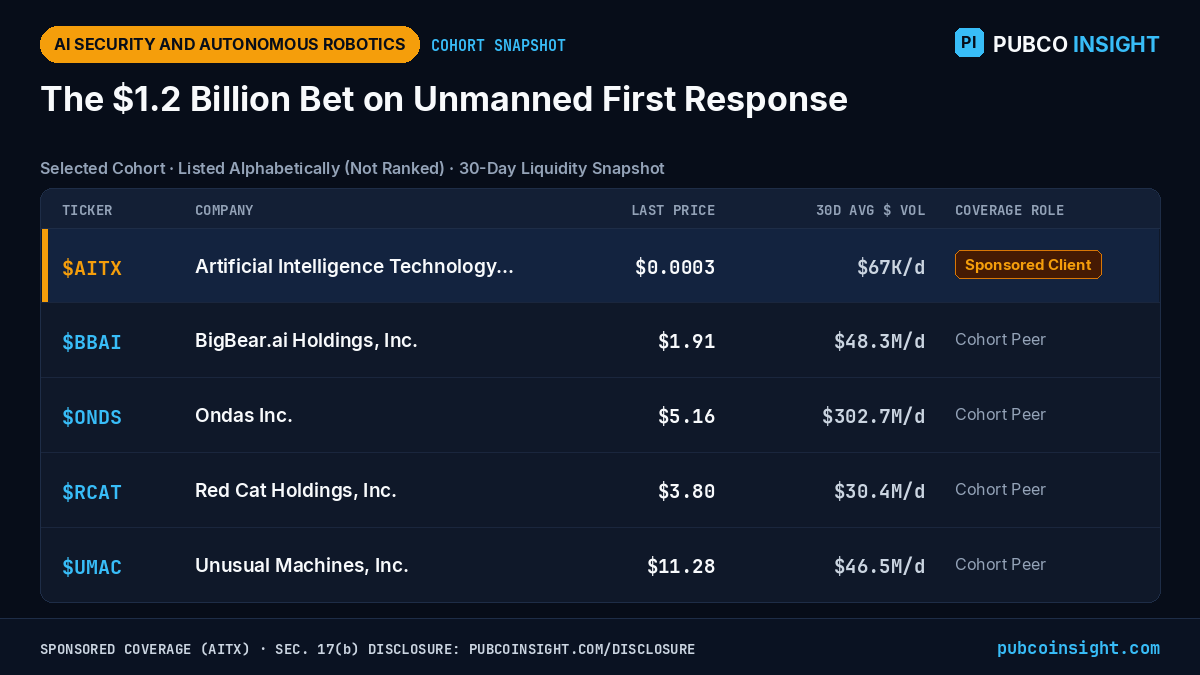
On November 12, 2026, Howard County, Maryland, officially integrated the Axon Air Drone as First Responder (DFR) program into its public safety matrix. This move is a single piece of a broader $1.2 billion strategic push into autonomous flight by the sector’s largest incumbent. It signals a move away from the "record and review" era of body-worn cameras toward a "detect and intercept" model that relies on hardware autonomy rather than human patrol density.
The market for physical AI and guarding robotics is currently bifurcated. On one side, large-cap integrators are attempting to own the sky through DFR. On the other, micro-cap operators are fighting to secure the ground-level "perimeter" through stationary and mobile robotic units. The Howard County deployment is significant because it validates the commercial viability of Beyond Visual Line of Sight (BVLOS) operations in a suburban environment, a regulatory hurdle that has historically kept these technologies in the pilot phase.
This shift is not just about flying cameras. It is about the transition of the security guard from a physical presence to a remote "tele-operator" who manages a fleet of sensors. When a 911 call or a perimeter alarm triggers, the system does not wait for a human to drive to the scene. It launches an autonomous asset to provide live telemetry before the first responder even leaves the station. This changes the fundamental unit of value in the guarding market from man-hours to data-latency.
The Mechanism of Drone as First Responder
The DFR mechanism functions through a three-part integration of Computer Aided Dispatch (CAD), automated docking stations, and low-latency streaming. When a call enters the CAD system, it triggers a geofence alert. If the incident falls within the drone's radius, the docking station roof opens, and the aircraft launches without a pilot on-site. The drone arrives at the scene in an average of 60 to 90 seconds, significantly faster than the five to ten minutes required for a patrol car.
The technical bottleneck is not the flight itself, but the data ingestion. For DFR to be useful, the video feed must be integrated into the existing evidence management system in real-time. This requires a high-bandwidth, low-latency link that can handle 4K video while the aircraft is moving at 35 miles per hour. This is where the "Physical AI" component becomes critical. The drone must be able to identify a suspect vehicle or a person with a weapon autonomously, as the remote operator may be managing multiple feeds simultaneously.
The commercial logic rests on "officer safety" and "resource allocation." If a drone confirms a call is a false alarm or a non-violent civil dispute, the department can cancel the high-priority police response. This saves fuel, reduces the risk of high-speed transit accidents, and keeps officers available for high-value tasks. The success of this model depends entirely on the reliability of the autonomous flight software and the ability to maintain a constant "eye in the sky" through staggered battery swaps and automated charging.
The Operators and the Hardware Ecosystem
The expansion of DFR and autonomous guarding is pulling a variety of specialized hardware and software players into the orbit of public safety. Ondas Inc. (ONDS) is currently managing a massive $835 million backlog, according to its November 13 filings. While the company reported wider losses in Q3, its 1,550% revenue jump highlights the demand for the "drone-in-a-box" infrastructure required for permanent aerial installations. Red Cat Holdings, Inc. (RCAT) and Unusual Machines, Inc. (UMAC) are providing the tactical hardware that fills the gap between large-scale DFR systems and individual officer-deployed units.
On the sensor side, the move toward autonomy is a tailwind for companies providing the "eyes" of the machines. Arbe Robotics Ltd. (ARBE) and MicroVision, Inc. (MVIS) are focused on the radar and LiDAR systems that allow these robots to navigate complex environments without human intervention. Kopin Corporation (KOPN) provides the specialized displays used by remote operators, while Lantronix, Inc. (LTRX) handles the underlying connectivity and edge computing modules that keep the data flowing. BigBear.ai Holdings, Inc. (BBAI) sits at the analytics layer, processing the massive amounts of visual data generated by these fleets to find patterns that a human dispatcher might miss.
Ground-level autonomy is also seeing a shift toward open ecosystems. Serve Robotics Inc. (SERV) recently opened its autonomous delivery fleet to third-party developers through a new API. While Serve focuses on sidewalk delivery, the underlying logic of shared autonomous networks is beginning to bleed into the security space. If a delivery robot can navigate a sidewalk, it can also act as a mobile sensor for a municipal "smart city" security grid, effectively turning every autonomous vehicle into a potential first-responder asset.
Artificial Intelligence Technology Solutions, Inc.
Artificial Intelligence Technology Solutions, Inc. (AITX) operates in the stationary and mobile ground-based security robot market through its subsidiary, Robotic Assistance Devices (RAD). The company’s business model is built on converting traditional guarding expenses into recurring monthly revenue (RMR) through long-term leases of its hardware. On November 12, 2026, the company reported a preliminary 12.4% two-month increase in billed RMR, a growth trend driven primarily by its stationary devices like the ROSA (Responsive Observation Security Agent).
The company is currently expanding its footprint into the corrections sector. RAD has planned a 30-day trial of its ROAMEO (Ruggedized Observation Agile Mobile Entity) robot at a corrections facility to test autonomous patrolling in high-security environments. This trial is intended to prove that mobile ground units can replace human perimeter checks, which are often high-risk and repetitive. Unlike the aerial DFR models used by Axon, AITX’s ground units are designed for persistent 24/7 presence, using AI to detect loitering, trespassing, and "man-down" scenarios at the edge.
Financially, AITX remains in a high-risk development phase. According to its 10-Q filing for the period ending August 31, 2026, the company had an accumulated deficit of $184,084,880 and negative working capital of $55,894,870. The public record does not yet establish a clear timeline for when the company will achieve positive cash flow from operations, and management has stated they do not anticipate this in the near future. To sustain operations, the company relies on equity financing and debt. Specifically, it has an agreement to sell up to $10 million of common stock to an investor, with approximately $9.8 million remaining available under that facility as of the last filing. The company’s survival is currently tethered to its ability to continue raising capital while scaling its RMR base.
What to watch
- Nvidia (NVDA) Earnings: The November 17 report and subsequent guidance will be the primary indicator for the cost of edge-AI compute. Any commentary on H100 rental rates or chip restrictions will directly impact the margins of companies building physical AI units.
- AITX ROAMEO Trial Results: The conclusion of the 30-day corrections facility trial will be a milestone for ground-based mobile security. Watch for announcements regarding a permanent contract or "follow-on" orders from the facility.
- Ondas Backlog Conversion: With an $835 million backlog, the key metric for ONDS is the rate of conversion into recognized revenue. Investors should watch the next quarterly filing for a reduction in this backlog paired with a corresponding revenue spike.
- FAA BVLOS Decisions: Any new waivers granted for "Beyond Visual Line of Sight" operations in residential areas will act as a catalyst for the DFR market. The Howard County expansion is a template; watch for similar filings in adjacent counties.
- Axon’s $1.2 Billion Capital Allocation: Watch for specific acquisition announcements or hardware launches that clarify how this capital is being deployed to support the DFR push.
Companies mentioned
| Ticker | Company | Price |
|---|---|---|
| AITX client | Artificial Intelligence Technology Solutions Inc | $0.0003 |
| ARBE | Arbe Robotics Ltd. | $0.439 |
| BBAI | BigBear.ai Holdings, Inc. | $1.91 |
| KOPN | Kopin Corporation | $3.24 |
| LTRX | Lantronix, Inc. | $4.33 |
| MVIS | MicroVision, Inc. | $1.05 |
| ONDS | Ondas Inc. | $5.16 |
| RCAT | Red Cat Holdings, Inc. | $3.8 |
| SERV | Serve Robotics Inc. | $2.62 |
| UMAC | Unusual Machines, Inc. | $11.28 |
Listed alphabetically, not ranked. Prices as of 2026-11-16 and they move. Check a live quote before relying on any of this.
How we chose the companies in this article
We cover a fixed universe of companies working in autonomous security robotics, physical AI and the guarding services market they are aimed at. Every one of them that had usable market data on 2026-11-16 appears in this article. We do not pick which ones to mention based on what we think of them, and we do not order them by size, price or trading volume, because an ordered list is a verdict and that is not ours to hand down. Companies left out, and why: none. American Lithium Minerals and Artificial Intelligence Technology Solutions pay us, which is disclosed in full at the foot of every article they appear in.
See the dilution and promotion flags before you see the pitch.
Each week: the micro and small-caps now showing dilution or paid-promotion signals, with the SEC filing behind every flag. No recommendations, no price targets.
Sources used in this article
- Axon Enterprise (AXON) Could Be 44% Undervalued On Howard County Public Safety Win Simply Wall St. · 2026-11-16
- Axon Enterprise (AXON) Stock Trades Below Fair Value As Cash Flow Hopes Build Simply Wall St. · 2026-11-16
- What Is Axon Enterprise (AXON) Asking With Its $1.2 Billion Drone Push? Simply Wall St. · 2026-11-16
- Jensen Huang Resigns: 3 Things to Watch From Nvidia on Nov. 17 Motley Fool · 2026-11-16
- The Ultimate Dividend Stock to Buy With $5,000 Right Now Motley Fool · 2026-11-16
- Bessent: Trump Made It “Very Clear” China Gets No Nvidia Chips “Above H100s” TIKR · 2026-11-16
- Markets mixed as traders await Nvidia earnings and Anthropic IPO Euronews · 2026-11-16
- If the Stock Market Crashes, Warren Buffett Says This is the Best Move Investors Can Make Motley Fool · 2026-11-16
- Bombardier And 2 Canadian Insider Stocks To Watch Simply Wall St. · 2026-11-16
- ECB warns of market risks if AI boom stalls AFP · 2026-11-16
- Not SpaceX. Not Blue Origin. The Space Stock That Just Raised Its Launch Price to $70 Million -- and Still Sold Out. Motley Fool · 2026-11-16
- European stocks buoyed by defence, consumer sectors; tech lags Reuters · 2026-11-16
Disclosure required by Section 17(b) of the Securities Act of 1933
Artificial Intelligence Technology Solutions, Inc., a Nevada corporation (OTCID: AITX). Artificial Intelligence Technology Solutions, Inc. pays Strategic Innovations First, Inc., a Wyoming corporation doing business as PulseIR. Compensation received: USD 5,000.00 per month for months 1-3 (August, September, October 2026); USD 10,000.00 per month for months 4-6 (November, December 2026, January 2027) contingent on the 90-day review. Minimum committed USD 15,000.00; USD 45,000.00 if the second-period rate triggers.. Form of payment: cash only, invoiced monthly in advance; no stock, options or warrants received or payable. Services: investor relations services under an Investor Relations Services Agreement effective 2026-08-01. Period: six month term, 2026-08-01 through 2027-01-31; 90-day review on or about 2026-10-30. No stock, options or warrants held by PubCo Insight, Pulse IR, Strategic Innovations First, Inc., or Brad Listermann. Confirmed by the executed agreement and by board record recKwdq39X2caPSX7 (POSITIONS HELD: none).
This is information, not investment, financial, legal or tax advice. It is not a recommendation or solicitation to buy, sell or hold any security and it contains no price target. Nothing here is independently verified by us. Confirm every figure against primary filings on SEC EDGAR before you act. Micro-cap and over-the-counter securities are speculative and illiquid and can lose all of their value. The companies named without a disclosure above pay us nothing and have no relationship with us; they are named because a published, mechanical screen selected them. Full disclosure policy.