Federal Agencies Expand Autonomous Security Deployments as Fiscal Year Closes
Axon’s recent federal contract wins highlight a growing trend in government adoption of autonomous security solutions, signaling a shift in how large organizations approach physical guarding and monitoring.
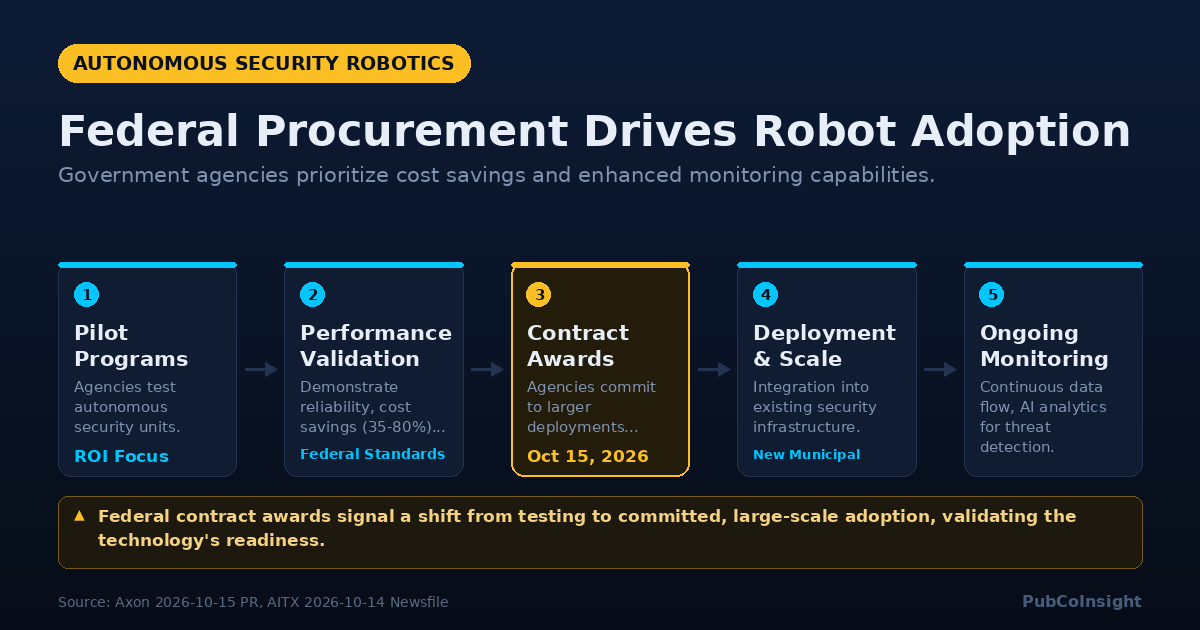
The Mechanics of Federal Adoption
Federal procurement for security technology operates through a complex, multi-stage process. Initial stages often involve proof-of-concept deployments or small-scale pilot programs. Success in these early stages, demonstrating clear cost savings, enhanced capabilities, or improved efficiency, is crucial for securing larger, more enduring contracts. The U.S. government fiscal year, ending September 30, often sees a surge in contract awards as agencies expend remaining budgets. This creates a predictable window of opportunity for vendors. For autonomous security robotics, federal agencies typically evaluate systems on several key metrics: reliability in diverse environmental conditions, integration capabilities with existing security infrastructure, data security protocols, and demonstrable return on investment compared to human guards. The "return on investment" is the critical element. A robot that reduces the need for multiple human patrols, or provides continuous monitoring in hazardous environments, offers a tangible fiscal advantage. The technology must also meet stringent federal compliance and cybersecurity standards, often requiring specific certifications. Failure to meet these technical and regulatory hurdles means no contract, regardless of the technology’s promise.Companies Operating in Autonomous Security Robotics
Several companies are actively pursuing opportunities in the autonomous security and physical AI sector, each with distinct approaches to technology and market penetration. Ondas Inc. (ONDS), for example, focuses on autonomous systems, particularly drones. The company recently partnered with Palantir to launch Regna AI on October 16, aiming to expand sovereign AI capabilities, particularly for defense applications. Ondas also announced EASA certification of an advanced missile protection system on a Bombardier Global 7500 on October 13, pointing to its work in airborne defense. Unusual Machines, Inc. (UMAC), at a price of $16.31, is exploring the scalability of AI robotics. MarketBeat reported on October 15 about "Swarm Economics" and whether XTEND AI Robotics can deliver at scale. This indicates a focus on coordinated, multi-unit deployments, potentially for larger areas or complex environments. Unusual Machines also appointed its CEO, Dr. Allan Evans, to serve as Chairman of XTI Aerospace’s board on October 14, suggesting strategic leadership alignment across related sectors. Serve Robotics Inc. (SERV), priced at $3.23, operates in the last-mile delivery segment, deploying autonomous robots for food and grocery delivery. While not directly in security, their operational experience with autonomous ground vehicles in public spaces contributes to the broader understanding of physical AI deployment and navigation challenges. The company saw a stock plunge on October 17, following news of Uber autonomous head Maredia's departure on October 13, highlighting the sensitivity of this sector to key personnel and partnerships. Arbe Robotics Ltd. (ARBE), trading at $0.46, develops high-resolution radar technology, a critical component for autonomous navigation and object detection in robotics. Their radar systems are designed to provide detailed environmental sensing, enhancing the safety and effectiveness of autonomous platforms, whether for security or other applications. MicroVision, Inc. (MVIS), at $1.13, is another player in sensing technology, focusing on lidar solutions for autonomous systems. Lidar provides precise 3D mapping capabilities, essential for robots navigating complex outdoor or indoor environments, and avoiding obstacles in real-time. Kopin Corporation (KOPN), priced at $3.29, develops microdisplays and optical systems, which are crucial for advanced robotics, particularly for augmented and virtual reality interfaces that might be used by human operators interacting with autonomous security units. Kopin hosted a live YouTube "Ask Me Anything" panel on October 16 on the future of AI infrastructure, indicating their engagement with the broader AI ecosystem. Lantronix, Inc. (LTRX), at $5.61, provides secure data access and management solutions for the Internet of Things (IoT). Their technology enables remote monitoring and control of connected devices, which is fundamental for managing fleets of autonomous security robots and ensuring secure data transmission from these units. Red Cat Holdings, Inc. (RCAT), trading at $4.72, specializes in drone technology, including hardware and software for various applications, some of which intersect with security and surveillance. Their expertise in unmanned aerial systems offers capabilities for aerial monitoring, complementing ground-based autonomous security solutions. BigBear.ai Holdings, Inc. (BBAI), at $2.16, provides AI-powered analytics and data solutions, often for government and defense clients. While not directly building robots, their platforms can process the vast amounts of data generated by autonomous security systems, turning raw sensor input into actionable intelligence for security personnel.Artificial Intelligence Technology Solutions, Inc.
Artificial Intelligence Technology Solutions, Inc. (AITX) trades on the OTCID tier under the symbol AITX at $0.0016. The company operates through several subsidiaries, including Robotic Assistance Devices, Inc. (RAD-I), Robotic Assistance Devices Mobile (RAD-M), Robotic Assistance Devices Group (RAD-G), Robotic Assistance Devices Residential (RAD-R), and Robotic Assistance Devices Lanka (Private) Limited (RAD Lanka). AITX focuses on building and leasing autonomous security robots and remote monitoring systems. Their business model emphasizes a recurring monthly subscription service rather than one-time hardware sales. RAD-I, the primary subsidiary, targets the security and guarding services industry, which AITX estimates as a $50 billion market in the United States. AITX states its solutions aim to deliver cost savings between 35% and 80% compared to traditional manned security. These solutions integrate stationary and mobile devices with proprietary software and monitoring platforms. The company reported revenue of $7,745,336 for the fiscal year ended February 28, 2026, a 26% increase over the prior year. Gross profit increased 48% to $5,533,700, with gross margin expanding to approximately 71% from 61%. Operating expenses remained largely flat at about $17,477,097, leading to an improved loss from operations of $(11,943,397). The company reported a net loss of approximately $14.5 million for the fiscal year ended February 28, 2026, with an accumulated deficit of approximately $171 million as of that date. The public record does not yet establish consistent positive cash flow from operations for the company. AITX’s independent registered public accounting firm has included an explanatory paragraph in its report on consolidated financial statements, expressing substantial doubt about the company’s ability to continue as a going concern. AITX’s operations are structured around three main pillars. The first, RAD-I, focuses on stationary security devices. The second, RAD-M, develops mobile autonomous platforms, with early commercial deployment of its ROAMEO mobile security unit beginning in May 2026. The third pillar is RAD-G, which encompasses the company’s SARA agentic artificial intelligence platform. RAD Lanka, a wholly owned subsidiary in Sri Lanka, supports software development, AI initiatives, and technical operations. The company refers to its long-term strategy as "RAD Town," an integrated autonomous-security deployment across a campus, community, or jurisdiction. On October 14, AITX's RAD division added another municipal customer with a seven-unit ROSA order, demonstrating ongoing customer acquisition in the public sector.What to watch
Investors should monitor the cadence of federal contract announcements from companies like Axon, particularly as the next U.S. government fiscal year approaches its close in September 2027. Specifics to track include the number of units deployed, the contract durations, and the agencies involved. For Ondas, watch for further details on the Regna AI partnership with Palantir and any new defense-related certifications or deployments. For Unusual Machines, observe any announcements regarding large-scale, multi-robot deployments that could validate its "swarm economics" approach. Serve Robotics’ operational metrics, such as delivery volume and expansion into new markets, will indicate its progress in autonomous last-mile logistics. For AITX, the NT 10-Q filing due around January 15, 2027, will provide updated financial performance and operational details. Look for reports on new municipal or enterprise customer acquisitions, and any further updates on the commercial deployment of the RAD-M ROAMEO units., { "label": "Performance Validation", "note": "Demonstrate reliability, cost savings (35-80%), compliance.", "metric": "Federal Standards" }, { "label": "Contract Awards", "note": "Agencies commit to larger deployments. Fiscal year end surge.", "metric": "Oct 15, 2026" }, { "label": "Deployment & Scale", "note": "Integration into existing security infrastructure.", "metric": "New Municipal Orders" }, { "label": "Ongoing Monitoring", "note": "Continuous data flow, AI analytics for threat detection." } ], "highlight": 2, "highlight_note": "Federal contract awards signal a shift from testing to committed, large-scale adoption, validating the technology's readiness.", "footnote": "Source: Axon 2026-10-15 PR, AITX 2026-10-14 Newsfile" }Companies mentioned
| Ticker | Company | Price |
|---|---|---|
| AITX client | Artificial Intelligence Technology Solutions Inc | $0.0016 |
| ARBE | Arbe Robotics Ltd. | $0.46 |
| BBAI | BigBear.ai Holdings, Inc. | $2.16 |
| KOPN | Kopin Corporation | $3.29 |
| LTRX | Lantronix, Inc. | $5.61 |
| MVIS | MicroVision, Inc. | $1.13 |
| ONDS | Ondas Inc. | $6.04 |
| RCAT | Red Cat Holdings, Inc. | $4.72 |
| SERV | Serve Robotics Inc. | $3.23 |
| UMAC | Unusual Machines, Inc. | $16.31 |
Listed alphabetically, not ranked. Prices as of 2026-10-19 and they move. Check a live quote before relying on any of this.
How we chose the companies in this article
We cover a fixed universe of companies working in autonomous security robotics, physical AI and the guarding services market they are aimed at. Every one of them that had usable market data on 2026-10-19 appears in this article. We do not pick which ones to mention based on what we think of them, and we do not order them by size, price or trading volume, because an ordered list is a verdict and that is not ours to hand down. Companies left out, and why: none. American Lithium Minerals and Artificial Intelligence Technology Solutions pay us, which is disclosed in full at the foot of every article they appear in.
See the dilution and promotion flags before you see the pitch.
Each week: the micro and small-caps now showing dilution or paid-promotion signals, with the SEC filing behind every flag. No recommendations, no price targets.
Sources used in this article
- If I Could Only Own 1 Artificial Intelligence (AI) Memory Stock for the Next 5 Years, It Wouldn't Be Micron. Motley Fool · 2026-10-19
- Here Is What a $5,000 Investment in Micron Could Be Worth by 2028 Motley Fool · 2026-10-18
- The Bond Market Is Sending a Warning to Nvidia Shareholders Motley Fool · 2026-10-18
- NVIDIA And 2 Other Fast Growing Stocks To Own Simply Wall St. · 2026-10-18
- Here's What a $5,000 Investment in CrowdStrike Will Be Worth by 2028 Motley Fool · 2026-10-18
- Where Will CRISPR Therapeutics Stock Be in 2030? Motley Fool · 2026-10-18
- Some Investors Are Questioning the AI Trade. Microsoft Is Bucking the Trend Motley Fool · 2026-10-18
- The next AI race will be won at the credit desk Fortune · 2026-10-18
- Is Citigroup Stock a Buy 13% Below Its 52-Week High? Motley Fool · 2026-10-18
- The $5 Trillion Club: Which Is the Better Stock to Own, Apple or Nvidia? Motley Fool · 2026-10-18
- Axon Stock Fell 6% in a Day and Is Down 31% in 2026. Time to Sell or Load Up? TIKR · 2026-10-17
- Axon Stock In Focus After Federal Contract Wins Simply Wall St. · 2026-10-17
Disclosure required by Section 17(b) of the Securities Act of 1933
Artificial Intelligence Technology Solutions, Inc., a Nevada corporation (OTCID: AITX). Artificial Intelligence Technology Solutions, Inc. pays Strategic Innovations First, Inc., a Wyoming corporation doing business as PulseIR. Compensation received: USD 5,000.00 per month for months 1-3 (August, September, October 2026); USD 10,000.00 per month for months 4-6 (November, December 2026, January 2027) contingent on the 90-day review. Minimum committed USD 15,000.00; USD 45,000.00 if the second-period rate triggers.. Form of payment: cash only, invoiced monthly in advance; no stock, options or warrants received or payable. Services: investor relations services under an Investor Relations Services Agreement effective 2026-08-01. Period: six month term, 2026-08-01 through 2027-01-31; 90-day review on or about 2026-10-30. No stock, options or warrants held by PubCo Insight, Pulse IR, Strategic Innovations First, Inc., or Brad Listermann. Confirmed by the executed agreement and by board record recKwdq39X2caPSX7 (POSITIONS HELD: none).
This is information, not investment, financial, legal or tax advice. It is not a recommendation or solicitation to buy, sell or hold any security and it contains no price target. Nothing here is independently verified by us. Confirm every figure against primary filings on SEC EDGAR before you act. Micro-cap and over-the-counter securities are speculative and illiquid and can lose all of their value. The companies named without a disclosure above pay us nothing and have no relationship with us; they are named because a published, mechanical screen selected them. Full disclosure policy.