Federal Drone Contracts Slow, Prompting Sector Re-evaluation
Axon's recent 21% stock drop, attributed to delayed government drone deals, highlights a broader shift in the autonomous security robotics market, pushing companies to diversify revenue streams.
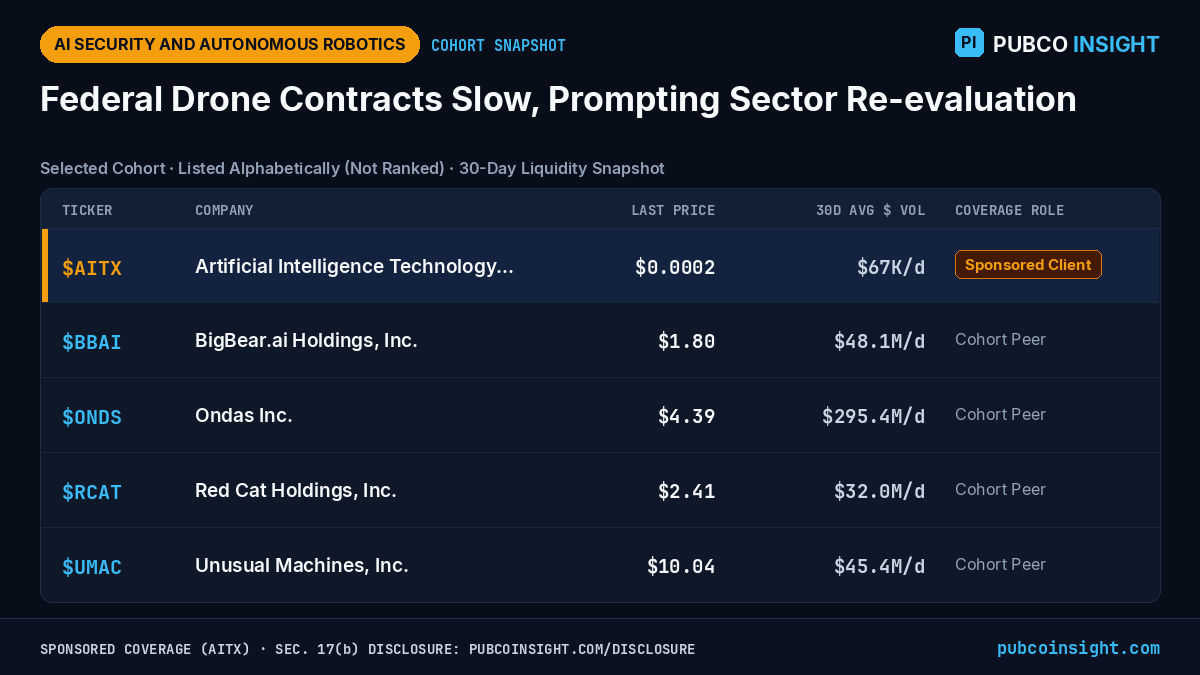
Axon (AXON) shares dropped 21% over the past month, a direct consequence of delayed federal drone contracts. The company, as of November 17, 2026, characterized this as "just a timing piece." This explanation, however, does not alter the immediate impact: a significant slowdown in anticipated government drone technology deals. This pause forces a closer look at how autonomous security robotics firms, particularly those with a heavy reliance on large government or enterprise contracts, are navigating market shifts.
The core issue here is the procurement cycle for advanced robotics in federal applications. These are not off-the-shelf purchases. They involve extensive testing, regulatory approvals, and often, bespoke integration into existing security infrastructure. When a company like Axon, a significant player in the broader public safety technology space, sees delays, it signals a systemic friction point. It is not necessarily a rejection of the technology, but rather an indication of bureaucratic hurdles, budget reallocations, or prolonged evaluation periods inherent in large-scale government adoption. The ripple effect can impact smaller players hoping to feed into larger systems or secure their own direct federal deals.
On the Mechanism of Federal Procurement
Federal procurement for autonomous security robotics follows a multi-stage process, often beginning with research and development grants or pilot programs, moving through competitive tenders, and culminating in multi-year contracts. The initial stages involve proving out a robot's capabilities in controlled environments, demonstrating compliance with specific security protocols, and ensuring interoperability with existing systems like surveillance networks or human guard forces. This phase can take years. Once a technology passes initial evaluations, it enters the Request for Proposal, or RFP, stage. Here, vendors submit detailed proposals outlining technical specifications, deployment strategies, and cost structures. The evaluation of these proposals is exhaustive, involving technical review boards, legal assessments, and budget approvals from various agencies. Delays often occur in the evaluation phase, where a single change in requirements, a new security concern, or a shift in departmental priorities can push back contract awards by months, or even quarters. The final stage is contract award and deployment, which itself can be phased, with initial deployments in limited areas followed by broader rollouts. A bottleneck at any point, particularly in the mid-to-late stages, can leave a company with significant R&D investment and production capacity awaiting revenue.
Companies Operating in Autonomous Security Robotics
The autonomous security robotics sector includes a range of companies, from those focusing on advanced sensor arrays to firms deploying full-scale mobile robots. Red Cat Holdings, Inc. (RCAT), for example, operates in the drone space, often targeting defense and public safety applications. Their recent revenue miss and pulled guidance, as reported on November 17, 2026, suggest that the federal procurement slowdown is not isolated to a single company. Unusual Machines, Inc. (UMAC) also saw dips in its stock price around the same time, indicating broader market sensitivity to these contract delays. Ondas Inc. (ONDS), despite raising its 2026 outlook due to backlog and defense demand on November 17, 2026, also saw a 22.3% drop in the past month, with Zacks noting execution risks. This highlights the tension between strong demand signals and the challenges of converting that demand into predictable revenue, especially when dealing with large, complex clients.
Beyond drones, companies like Serve Robotics Inc. (SERV) focus on ground-based autonomous delivery robots, primarily for commercial applications. Their Q3 earnings beat on strong pricing and a 168% year-over-year revenue climb, reported November 12, 2026, demonstrates a different market dynamic, less exposed to federal procurement cycles. Kopin Corporation (KOPN) develops microdisplays and optical solutions, components crucial for many advanced robotics and AI systems. Their recent corporate update, reporting over $20 million in cash on November 16, 2026, speaks to a different stage of development, focusing on foundational technology rather than direct deployment. MicroVision, Inc. (MVIS) and Arbe Robotics Ltd. (ARBE) are both engaged in LiDAR technology, essential for autonomous navigation. Lantronix, Inc. (LTRX) provides embedded computing and networking solutions, critical for connecting and managing robotic fleets. BigBear.ai Holdings, Inc. (BBAI) focuses on AI-powered analytics and data processing, which underpins the intelligence of autonomous systems, often working with government clients.
Artificial Intelligence Technology Solutions, Inc.
Artificial Intelligence Technology Solutions, Inc. (AITX) operates through its subsidiaries, focusing on building and leasing autonomous security robots and remote monitoring systems. The company's revenue model is based on recurring monthly subscriptions for these services, not one-off hardware sales. This approach aims to provide a more predictable revenue stream compared to large, lumpy hardware contracts. AITX's most recent substantive filing, an 8-K from November 16, 2026, and an earlier one from November 12, 2026, detail several operational and financial aspects. The company reported a preliminary 12.4% two-month increase in billed recurring monthly revenue, driven by stationary devices, as of November 12, 2026. This indicates growth in their subscription base for deployed units. On November 16, 2026, AITX's RAD subsidiary announced an expansion of its AI analytics library to include glass break detection for ROAMEO, one of its mobile autonomous security robots. This specific enhancement adds a new detection capability, improving the robot's utility in certain security environments.
Financially, AITX's August 31, 2026, condensed consolidated balance sheet shows current assets of $3,012,097, including cash of $220,275, accounts receivable of $947,146, and device parts inventory of $1,261,080. The company reported revenue-earning devices, net of depreciation, at $4,677,987. Total current liabilities stood at $58,906,967, including significant current portions of loans payable and accrued interest. The company had an accumulated deficit of $184,084,880 and negative working capital of $55,894,870 as of August 31, 2026. Management does not anticipate positive cash flow from operations in the near future and acknowledges substantial doubt about its ability to continue as a going concern for the next twelve months without additional capital. The company has plans to address its financial situation by raising funds, including an equity financing agreement from June 23, 2026, for up to $10,000,000, with approximately $9.8 million remaining to be issued under this arrangement. They also plan to continue funding through growing revenues, equity proceeds, and issuing debt. The public record does not yet establish a clear timeline for achieving consistent positive operating cash flow. However, the company continues to develop and deploy its technology, as evidenced by the recent AI analytics library expansion and reported growth in recurring revenue from stationary devices.
What to watch
The immediate focus for the autonomous security robotics sector will be on the resolution of federal drone contracts. Watch for any official statements from Axon or government agencies regarding the status of these deals. Specific contract awards, even smaller pilot programs, would signal a thawing of the current slowdown. For Ondas, their ability to convert backlog into revenue without further execution risks will be key, particularly as they have an announced $1.1 billion 2027 revenue target from November 16, 2026. Keep an eye on the timing and terms of any new equity raises or debt restructuring announcements from companies like AITX, as these will directly impact their operational runway. Look for further product development announcements, such as new AI capabilities or expanded robot models, which indicate ongoing investment in technology despite market headwinds. Finally, monitor quarterly earnings reports from all players for shifts in revenue mix, particularly any increased emphasis on commercial or international contracts to offset federal delays.
Companies mentioned
| Ticker | Company | Price |
|---|---|---|
| AITX client | Artificial Intelligence Technology Solutions Inc | $0.0002 |
| ARBE | Arbe Robotics Ltd. | $0.397 |
| BBAI | BigBear.ai Holdings, Inc. | $1.8 |
| KOPN | Kopin Corporation | $3.03 |
| LTRX | Lantronix, Inc. | $3.93 |
| MVIS | MicroVision, Inc. | $0.97 |
| ONDS | Ondas Inc. | $4.39 |
| RCAT | Red Cat Holdings, Inc. | $2.41 |
| SERV | Serve Robotics Inc. | $2.44 |
| UMAC | Unusual Machines, Inc. | $10.04 |
Listed alphabetically, not ranked. Prices as of 2026-11-18 and they move. Check a live quote before relying on any of this.
How we chose the companies in this article
We cover a fixed universe of companies working in autonomous security robotics, physical AI and the guarding services market they are aimed at. Every one of them that had usable market data on 2026-11-18 appears in this article. We do not pick which ones to mention based on what we think of them, and we do not order them by size, price or trading volume, because an ordered list is a verdict and that is not ours to hand down. Companies left out, and why: none. American Lithium Minerals and Artificial Intelligence Technology Solutions pay us, which is disclosed in full at the foot of every article they appear in.
See the dilution and promotion flags before you see the pitch.
Each week: the micro and small-caps now showing dilution or paid-promotion signals, with the SEC filing behind every flag. No recommendations, no price targets.
Sources used in this article
- 3 Unstoppable AI Stocks to Buy Hand Over Fist Now That the Midterms Are Over Motley Fool · 2026-11-18
- Down Over 60% From Its High, Is Intel's Stock a Good Buy Right Now? Motley Fool · 2026-11-18
- Not Micron. Not Broadcom. This Artificial Intelligence (AI) Stock Will Skyrocket in December After the Latest Sell-Off Motley Fool · 2026-11-18
- Stock Market Correction: 2 AI Stocks With 130% and 160% Upside, According to Wall Street. Motley Fool · 2026-11-18
- European stocks subdued as tech offsets mining declines Reuters · 2026-11-18
- Nvidia Stops Selling AI Chips to China Despite US Approval Bloomberg · 2026-11-18
- If You Only Make 1 Investing Move Before 2027, History Says It Should Be This Motley Fool · 2026-11-18
- Stock market today: Dow, S&P 500, Nasdaq futures rise after Nvidia clears hurdle, Anthropic prepares to price its IPO Yahoo Finance · 2026-11-18
- Should You Really Buy Anthropic Stock At the IPO? History Has a Clear Answer for Investors. Motley Fool · 2026-11-18
- Crypto Stocks Rebound As Nvidia’s Earnings Beat Lifts Risk Appetite — Why COIN, CRCL, NXXT Are Moving Today Stocktwits · 2026-11-18
- Axon Sinks 21% in a Month on Delayed Federal Drone Deals: “Just a Timing Piece” TIKR · 2026-11-17
- Are Rising Memory Costs A Threat To Axon Stock? Trefis · 2026-11-17
Disclosure required by Section 17(b) of the Securities Act of 1933
Artificial Intelligence Technology Solutions, Inc., a Nevada corporation (OTCID: AITX). Artificial Intelligence Technology Solutions, Inc. pays Strategic Innovations First, Inc., a Wyoming corporation doing business as PulseIR. Compensation received: USD 5,000.00 per month for months 1-3 (August, September, October 2026); USD 10,000.00 per month for months 4-6 (November, December 2026, January 2027) contingent on the 90-day review. Minimum committed USD 15,000.00; USD 45,000.00 if the second-period rate triggers.. Form of payment: cash only, invoiced monthly in advance; no stock, options or warrants received or payable. Services: investor relations services under an Investor Relations Services Agreement effective 2026-08-01. Period: six month term, 2026-08-01 through 2027-01-31; 90-day review on or about 2026-10-30. No stock, options or warrants held by PubCo Insight, Pulse IR, Strategic Innovations First, Inc., or Brad Listermann. Confirmed by the executed agreement and by board record recKwdq39X2caPSX7 (POSITIONS HELD: none).
This is information, not investment, financial, legal or tax advice. It is not a recommendation or solicitation to buy, sell or hold any security and it contains no price target. Nothing here is independently verified by us. Confirm every figure against primary filings on SEC EDGAR before you act. Micro-cap and over-the-counter securities are speculative and illiquid and can lose all of their value. The companies named without a disclosure above pay us nothing and have no relationship with us; they are named because a published, mechanical screen selected them. Full disclosure policy.