Axon Insider Sale Raises Questions on Security Robotics Sector Momentum
Axon's President sold $9.6 million in company stock on September 4, 2026, a move that prompts a closer look at the broader autonomous security robotics market and its underlying dynamics.
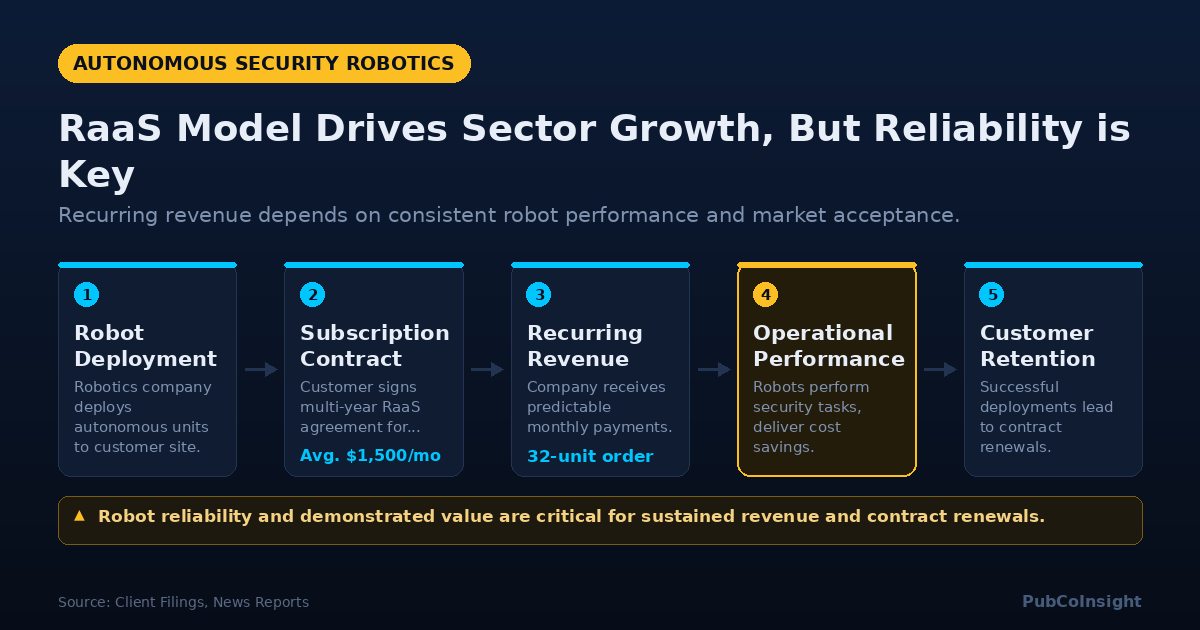
The Recurring Revenue Mechanism
The core of the RaaS model is the subscription contract. A customer signs a multi-year agreement for robotic units, maintenance, software updates, and often, remote monitoring services. This contract guarantees a fixed monthly payment for the duration. The robotics company, in turn, finances the production and deployment of the robots. This financing can come from internal cash flow, debt facilities, or equity raises. The critical element for the robotics company is the lifetime value of the customer (LTV) relative to the customer acquisition cost (CAC) and the hardware cost. A high LTV-to-CAC ratio signals a healthy business model. For the RaaS model to thrive, several conditions must hold true. First, the robots must deliver demonstrable cost savings or efficiency gains over traditional guarding services. If a single autonomous unit can replace two human guards, the value proposition is clear. Second, the technology must be robust and reliable. Downtime directly impacts the customer's security posture and the provider's reputation, leading to churn. Third, the market must accept the transition from human-centric security to hybrid or fully autonomous solutions. This involves overcoming regulatory hurdles, public perception issues, and integration challenges with existing security infrastructure. If robot reliability falters, or if the cost savings do not materialize as promised, the recurring revenue model becomes unsustainable, leading to contract cancellations and a collapse in LTV.Companies Building the Autonomous Security Future
The autonomous security robotics sector is populated by companies developing a range of solutions, from ground-based patrol units to aerial surveillance drones and advanced AI platforms. These operators are pushing the boundaries of what physical AI can achieve in real-world security applications. In the drone space, Unusual Machines, Inc. (UMAC) trades at $23.76 and recently strengthened its supply chain intelligence through a partnership with Altana. This move aims to improve drone component manufacturing, a critical step given the recent imposition of 100% tariffs on drone imports. The focus on supply chain resilience is paramount for drone manufacturers facing geopolitical trade pressures. Red Cat Holdings, Inc. (RCAT), trading at $8.37, also operates in the drone sector, providing various drone solutions. Both companies face the challenge of scaling production while navigating complex global supply chains and evolving regulatory landscapes for unmanned aerial systems. For ground-based robotics and associated AI, companies like Serve Robotics Inc. (SERV), at $4.945, are focused on last-mile delivery robots, which share many underlying AI and navigation technologies with security platforms. Serve Robotics' $240 million liquidity cushion, as reported by Zacks, suggests a strong position to fund its robot ambitions, a key factor for capital-intensive hardware deployments. Specialized components and AI software are also crucial. Arbe Robotics Ltd. (ARBE), trading at $0.636, develops high-resolution 4D imaging radar solutions, essential for autonomous navigation and object detection in complex environments. MicroVision, Inc. (MVIS), at $1.65, focuses on lidar technology, another critical sensor for precise environmental mapping. Kopin Corporation (KOPN), priced at $4.28, provides micro-displays and optical solutions, which are vital for augmented reality applications often integrated into advanced security systems or remote operator interfaces. Lantronix, Inc. (LTRX), at $5.22, offers secure data access and management solutions, enabling the robust connectivity required for remote robot operation and data transfer. On the AI and analytics front, BigBear.ai Holdings, Inc. (BBAI), trading at $2.92, provides decision intelligence solutions, leveraging AI to process vast amounts of data from various sensors and provide actionable insights for security operations. Ondas Inc. (ONDS), at $7.62, is involved in critical infrastructure networks and industrial drones, with its Ondas Networks subsidiary providing wireless solutions for mission-critical applications. The company has recently faced heavy short bets, as reported by GuruFocus.com, indicating market skepticism regarding its near-term prospects despite its technological focus.Artificial Intelligence Technology Solutions, Inc.
Artificial Intelligence Technology Solutions, Inc. (AITX), trading over the counter at $0.0044, operates through its subsidiaries to build and lease autonomous security robots and remote monitoring systems. The company's business model centers on recurring monthly subscriptions for its robotic solutions, rather than one-time hardware sales. This RaaS approach aims to provide predictable revenue streams and lower upfront costs for customers seeking to deploy autonomous security. AITX's public filings, accessible through SEC EDGAR, provide details on its operational activities. Recent 8-K filings from September 3, 2026, September 1, 2026, and August 31, 2026, indicate ongoing business developments and order intakes. For instance, the company announced on August 31, 2026, that its RAD subsidiary recorded a 32-unit order intake across five solutions during August. This was followed by a report on August 27, 2026, of a 14-unit order intake across five customer relationships, described as the most diverse 24-hour order intake in company history. These announcements suggest a focus on diversifying its customer base and product offerings. AITX's strategy, as discussed by its CEO in an investor "Ask Me Anything" session on September 3, 2026, involves the PURSUON initiative, which aims to drive further market penetration. The company also announced its RAD subsidiary would engage attendees from three points on the GSX 2026 show floor, indicating a direct marketing and sales effort. While the company consistently reports unit deployments and order intakes, the public record does not yet establish the average contract value or the churn rate for these subscriptions, which are key metrics for assessing the long-term viability of a RaaS model. AITX continues to emphasize its recurring revenue model and expanding deployments as central to its growth plan.What to watch
Several concrete developments bear watching in the coming months. For Unusual Machines (UMAC), the impact of the 100% tariff on drone imports, effective September 3, 2026, will be critical. Watch for filings or news releases detailing how their Altana partnership mitigates supply chain costs and whether it allows them to maintain competitive pricing. For Ondas (ONDS), the ongoing short interest, highlighted by GuruFocus.com on September 2, 2026, suggests a need for clear operational wins. Look for specific contract awards for their critical infrastructure networks or industrial drone solutions that could validate their technology and potentially squeeze short positions. Artificial Intelligence Technology Solutions (AITX) investors should monitor future 8-K filings for details on average contract lengths and values, as well as any disclosures related to customer retention rates. These metrics will provide a clearer picture of the financial health and scalability of their RaaS model. The GSX 2026 event will also be a key indicator of their ability to convert show floor presence into new orders. More broadly, watch for further insider activity from major players like Axon (AXON). A single sale does not define a trend, but sustained insider selling or buying across the sector could indicate shifts in executive sentiment regarding market conditions or company prospects., { "label": "Subscription Contract", "note": "Customer signs multi-year RaaS agreement for services.", "metric": "Avg. $1,500/mo" }, { "label": "Recurring Revenue", "note": "Company receives predictable monthly payments.", "metric": "32-unit order" }, { "label": "Operational Performance", "note": "Robots perform security tasks, deliver cost savings." }, { "label": "Customer Retention", "note": "Successful deployments lead to contract renewals." } ], "highlight": 3, "highlight_note": "Robot reliability and demonstrated value are critical for sustained revenue and contract renewals.", "footnote": "Source: Client Filings, News Reports" }Companies mentioned
| Ticker | Company | Price |
|---|---|---|
| AITX client | Artificial Intelligence Technology Solutions Inc | $0.0044 |
| ARBE | Arbe Robotics Ltd. | $0.636 |
| BBAI | BigBear.ai Holdings, Inc. | $2.92 |
| KOPN | Kopin Corporation | $4.28 |
| LTRX | Lantronix, Inc. | $5.22 |
| MVIS | MicroVision, Inc. | $1.65 |
| ONDS | Ondas Inc. | $7.62 |
| RCAT | Red Cat Holdings, Inc. | $8.37 |
| SERV | Serve Robotics Inc. | $4.945 |
| UMAC | Unusual Machines, Inc. | $23.76 |
Listed alphabetically, not ranked. Prices as of 2026-09-05 and they move. Check a live quote before relying on any of this.
How we chose the companies in this article
We cover a fixed universe of companies working in autonomous security robotics, physical AI and the guarding services market they are aimed at. Every one of them that had usable market data on 2026-09-05 appears in this article. We do not pick which ones to mention based on what we think of them, and we do not order them by size, price or trading volume, because an ordered list is a verdict and that is not ours to hand down. Companies left out, and why: none. American Lithium Minerals and Artificial Intelligence Technology Solutions pay us, which is disclosed in full at the foot of every article they appear in.
See the dilution and promotion flags before you see the pitch.
Each week: the micro and small-caps now showing dilution or paid-promotion signals, with the SEC filing behind every flag. No recommendations, no price targets.
Sources used in this article
- Here's How Many Shares of Coca-Cola You'd Need for $40,000 in Yearly Dividends Motley Fool · 2026-09-05
- Berkshire Hathaway Outperformed the S&P 500 Over a 60-Year Period Under Warren Buffett. Here's the Stock That Could Help Continue the Streak Under Greg Abel. Motley Fool · 2026-09-05
- Here's the 1 Crypto I'd Buy If I Could Pick Only One Motley Fool · 2026-09-05
- Japan, U.S. advance $550 billion investment pact with AI, chips in focus Investing.com · 2026-09-05
- Honeywell Is Now Three Companies. Here's Which Piece I'd Actually Own. Motley Fool · 2026-09-05
- Why UiPath Stock Plunged Today Motley Fool · 2026-09-05
- Thinking Machines Lab Seeks $40B Valuation as Nvidia Extends Its Capital Allocator Role Into Model-Space Forkast News · 2026-09-05
- Spot Memory Prices Are Running 4 Times Contract Prices. That Is Not What a Cycle Peak Looks Like. Motley Fool · 2026-09-05
- Where Will Solana Be in 5 Years? Motley Fool · 2026-09-05
- Why Is Axon (AXON) Up 3% Since Last Earnings Report? Zacks · 2026-09-04
- Axon's Connected Devices Unit Fuels Growth: Can It Sustain the Momentum? Zacks · 2026-09-04
- Insider Alert: Axon President Sells $9.6 Million in Stock Motley Fool · 2026-09-04
Disclosure required by Section 17(b) of the Securities Act of 1933
Artificial Intelligence Technology Solutions, Inc., a Nevada corporation (OTCID: AITX). Artificial Intelligence Technology Solutions, Inc. pays Strategic Innovations First, Inc., a Wyoming corporation doing business as PulseIR. Compensation received: USD 5,000.00 per month for months 1-3 (August, September, October 2026); USD 10,000.00 per month for months 4-6 (November, December 2026, January 2027) contingent on the 90-day review. Minimum committed USD 15,000.00; USD 45,000.00 if the second-period rate triggers.. Form of payment: cash only, invoiced monthly in advance; no stock, options or warrants received or payable. Services: investor relations services under an Investor Relations Services Agreement effective 2026-08-01. Period: six month term, 2026-08-01 through 2027-01-31; 90-day review on or about 2026-10-30. No stock, options or warrants held by PubCo Insight, Pulse IR, Strategic Innovations First, Inc., or Brad Listermann. Confirmed by the executed agreement and by board record recKwdq39X2caPSX7 (POSITIONS HELD: none).
This is information, not investment, financial, legal or tax advice. It is not a recommendation or solicitation to buy, sell or hold any security and it contains no price target. Nothing here is independently verified by us. Confirm every figure against primary filings on SEC EDGAR before you act. Micro-cap and over-the-counter securities are speculative and illiquid and can lose all of their value. The companies named without a disclosure above pay us nothing and have no relationship with us; they are named because a published, mechanical screen selected them. Full disclosure policy.